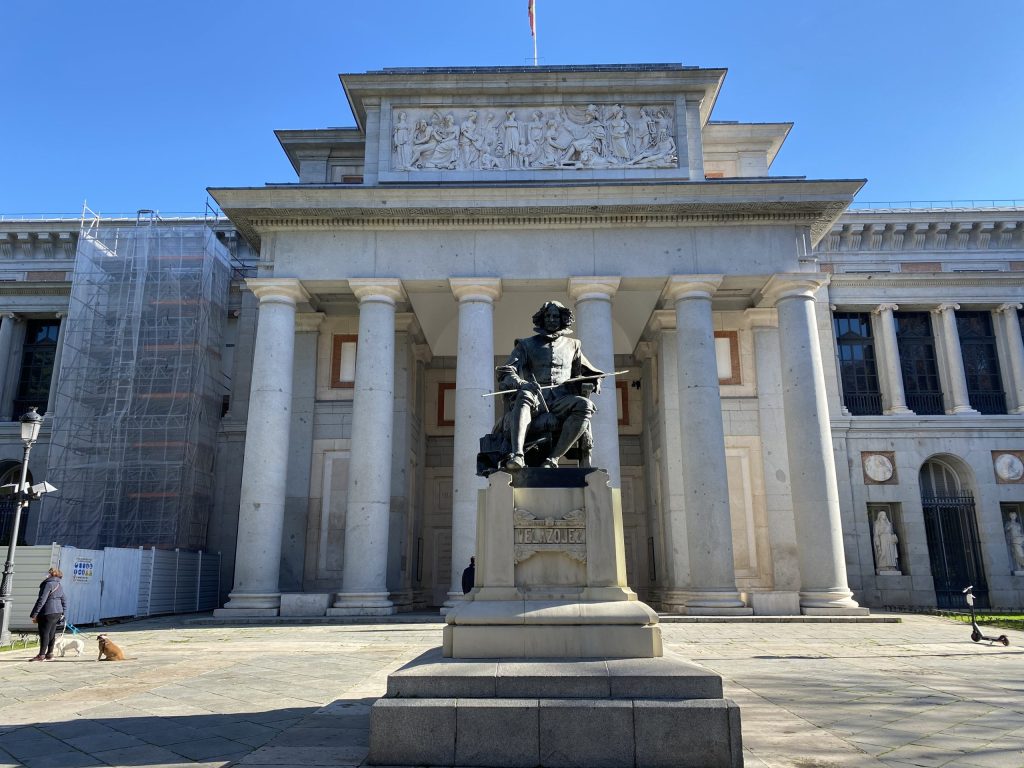
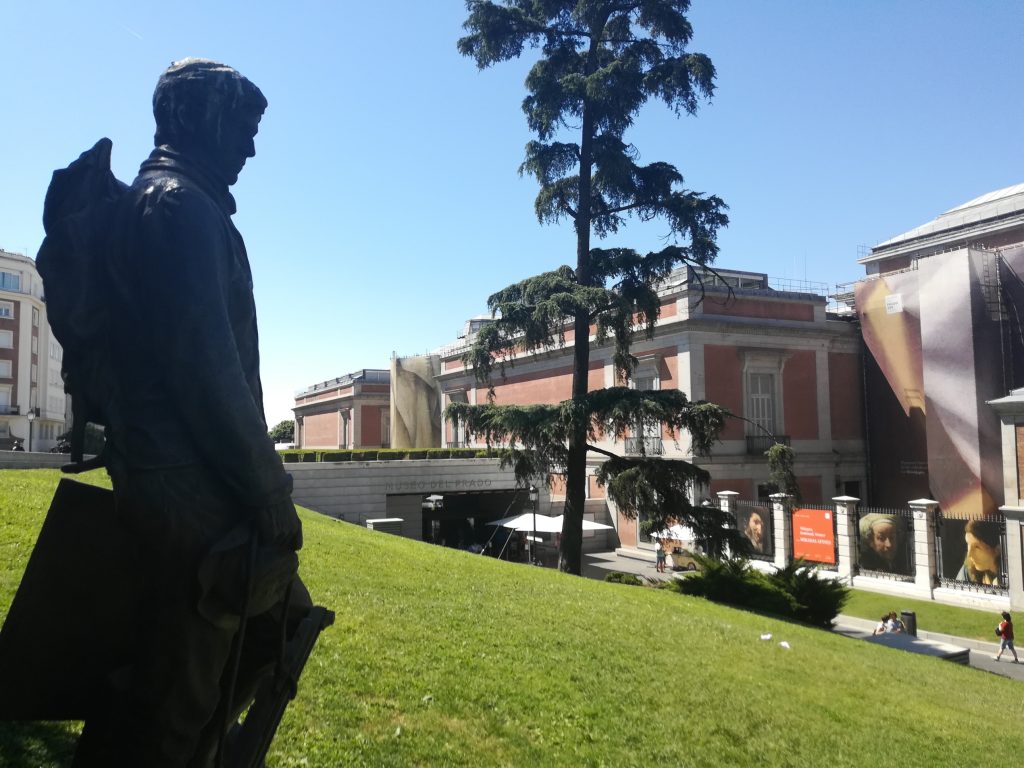
Around the Prado Museum there are three statues dedicated to Spanish painters, yet most visitors have no idea who they represent. One stands opposite the museum ticket office, another faces the Puerta de los Jerónimos (also known as the Kings’ Entrance), and the third can be found on the museum’s southern side, next to the Royal Botanical Garden. In this article, we’ll introduce these artists and explain why these statues deserve far more attention than they usually receive.
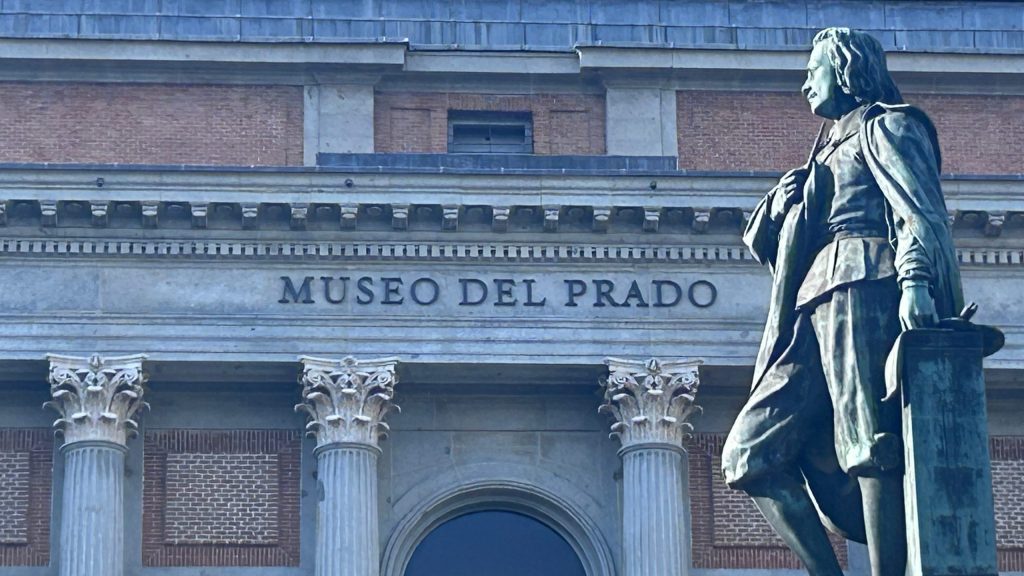
The First of the Statues: Bartolomé Esteban Murillo
Next to the Royal Botanical Garden stands one of the statues that brought us here: Bartolomé Esteban Murillo. Born in Seville in 1617, Murillo enjoyed enormous international fame during his lifetime. Today, however, Spanish audiences tend to associate him almost exclusively with religious painting, and there is a good reason for that. Much of his secular work was taken to France during Napoleon’s invasion of Spain, leaving his religious paintings as the best-known part of his legacy in his home country.
Here’s an interesting detail: this monument closely resembles the one you’ll find in Seville, Murillo’s birthplace. There, the statue stands beside the Museum of Fine Arts, where the painter is naturally celebrated as one of the city’s greatest sons.
Among his finest works are The Holy Family with the Little Bird and The Immaculate Conception of Los Venerables. Both paintings perfectly illustrate his warm, naturalistic style, created to bring ordinary people closer to the Catholic faith—something entirely understandable in the middle of the Counter-Reformation.
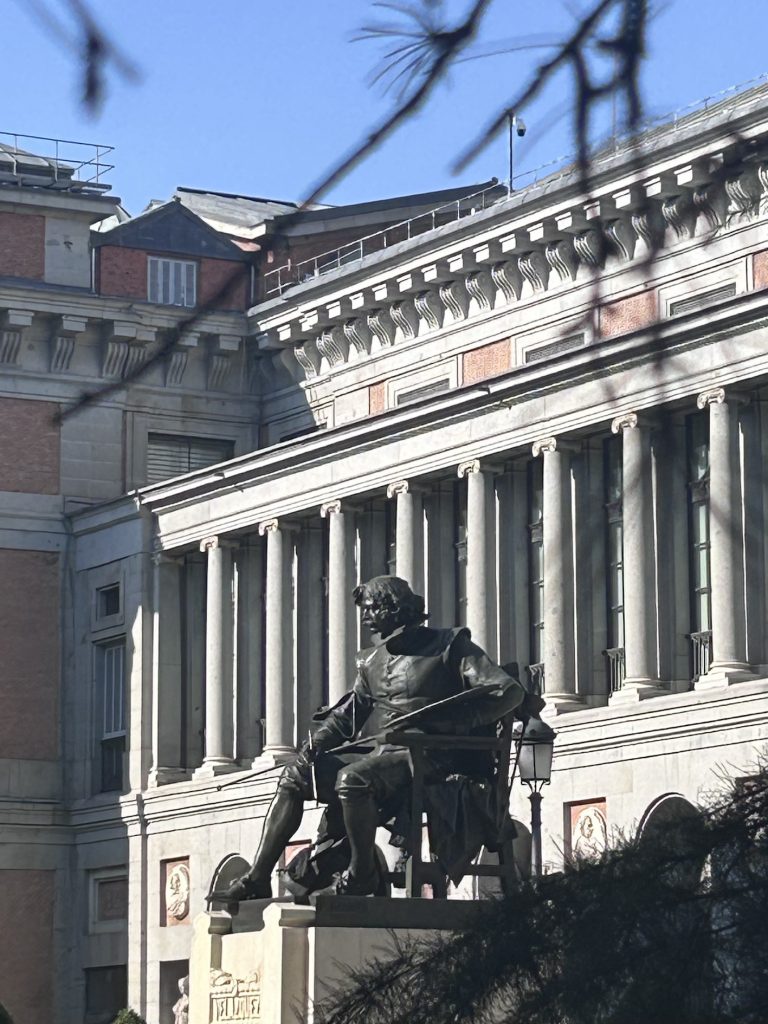
Velázquez: The Most Impressive Statue
It is difficult to do justice to Diego Rodríguez de Silva y Velázquez in just a few paragraphs. As we’ve mentioned before, he happens to be our boss’s favourite painter, so we’d better say he is unquestionably the greatest painter in history. Like Murillo (and, incidentally, our boss), Velázquez was born in Seville, in 1599. During the 1620s he moved to Madrid, and the rest, as they say, is history.
You’ll usually find a street named after Velázquez in every major Spanish city. He also has a statue in Seville, located in Plaza del Duque, which bears a remarkable resemblance to the one outside the Prado. But here’s another curious fact: Velázquez actually has two statues in Madrid. Besides the one at the Prado Museum, there is another on Calle Velázquez, at the corner with Calle Juan Bravo.
His masterpieces include Las Meninas and The Spinners (The Fable of Arachne). Both paintings reveal exactly why he deserves such monumental tributes: astonishingly free brushwork, extraordinary visual complexity and figures that almost seem to float across the canvas. Perhaps our boss is right after all—maybe Velázquez really is number one.
Goya: The Last of the Statues
And this one happens to be our meeting point!
The statue of Francisco de Goya stands on Calle Felipe IV, directly opposite the Prado Museum ticket office. One of its most interesting features is the pedestal itself, decorated with reliefs depicting some of Goya’s greatest masterpieces, including, of course, his famous print The Sleep of Reason Produces Monsters.
Like Velázquez, Goya also has a street named after him in countless Spanish towns and cities, and he too has two statues in Madrid: the one outside the Prado Museum and another at the junction of Calle Alcalá and Calle Goya.tle behind-the-scenes story: having two Goya statues in Madrid caused enough confusion among our visitors that we eventually started sending everyone an infographic before the tour. We know it can be a little confusing!
There’s Even a Fourth Statue!
Besides the three monuments we’ve already mentioned, there is actually a fourth.
You’ll find it beside the Church of San Jerónimo, gazing towards the Prado Museum in a rather bohemian pose. Rather than depicting a famous painter, it pays tribute to all the artists and art lovers who come to the museum every day to find inspiration—or even to copy the masterpieces displayed inside.
Would You Like to Learn More About These Painters?
Join us at the Prado Museum with The Guides You Need.
Simply click here to book one of our Prado Museum tours and we’ll take care of the rest.
Here’s what you can expect:
- Small groups of no more than seven people (larger groups can book a private tour).
- Museum tickets included.
- Tours available in English, Spanish, French and Italian. Each language has its own schedule, so please check carefully. If you need any help, just get in touch.
- You can choose our standard two-hour visit, or arrange a longer private experience if you’d like to explore the collection in greater depth.
- We also offer skip the line tours, although we recommend reading our article (click here) explaining exactly what skip the line means in Madrid before booking.
To make sure nobody ends up at the wrong meeting point, we normally send an email the day before your tour with an infographic and your guide’s contact details.
We’ll see you in Madrid!