Tabla de contenidos
Introduction: The importance of Spanish women painters was long overlooked
Spanish women painters played a much more important role in 20th-century art than was acknowledged for decades. When we think of the great figures of Spanish painting from this period, Picasso, Dalí, Miró and Juan Gris usually come immediately to mind. However, alongside them were several women artists who actively participated in the avant-garde, exhibited in some of Europe’s leading cultural centres and developed artistic languages entirely of their own.
The Reina Sofía Museum is one of the best places to discover some of these Spanish women painters. Its collection allows us to follow the evolution of Spanish art from the early avant-garde movements through much of the 20th century and, along the way, encounter works by women who played an important role in the artistic renewal of their time. Their careers were very different, and not all of them received the same recognition during their lifetimes, but today it is difficult to explain some of the fundamental movements in Spanish painting without taking them into account.
In this article, we are going to focus on three names: María Blanchard, Maruja Mallo and Ángeles Santos. What were Spanish women painters like? What did Spanish women painters paint? Where did Spanish women painters come from? What shaped the careers of these Spanish women painters? What are the key works of these Spanish women painters? In this article, we will try to answer these questions with the Reina Sofía as our backdrop. Is Spanish women painters the keyword of this article? What do you think? Are you one of the Spanish women painters? Oh, SEO, dear to our hearts and to the hearts of Spanish women painters everywhere!
1. María Blanchard
María Blanchard was born in Santander in 1881, the same year as Pablo Picasso, and today she is considered one of the most important figures of the early avant-garde movements. Therefore, she is one of the most universally recognised Spanish women painters. Her name is particularly associated with Cubism, a movement in which she participated directly during her years in Paris and in which she produced some of the most interesting works of her career.
Her path to Paris, however, had begun in Spain. Blanchard moved to Madrid in 1903 to train as a painter, studying under artists such as Emilio Sala and Manuel Benedito. In 1909, she received a grant from the Provincial Council of Santander that allowed her to continue her training in Paris. The journey would prove decisive.
Contact with other artists
During her different stays in Paris, Blanchard came into contact with some of the artists who were transforming European painting. She met Diego Rivera and later became associated with major figures of Cubism such as Juan Gris, Jean Metzinger and Jacques Lipchitz. Her friendship with Juan Gris was particularly close, and the two shared artistic concerns during some of the crucial years in the development of the movement.
This context is important if we want to understand her true significance. María Blanchard was not a painter who discovered Cubism once the movement had already become established; she worked in Paris alongside some of its leading figures. Among the Spanish women painters of her generation, her direct involvement in the international avant-garde makes her a particularly interesting case.
Her career, however, was marked by difficulties that went far beyond painting. As we explain in the article we have dedicated to her, Blanchard had a physical disability from birth that profoundly affected her life and the way she was treated by those around her. To this we must add the difficulties faced by any woman attempting to pursue a professional artistic career during the first decades of the 20th century.
The permanent move to Paris
In 1916, she settled permanently in Paris. There, she developed the most important phase of her Cubist production and established herself within the city’s artistic circles. Over time, however, her painting evolved towards a more figurative style. Therefore, although she is now one of the key names when we talk about Cubism and Spanish women painters, reducing her entire career to this movement means overlooking an important part of her work.
María Blanchard died in Paris in 1932, at the age of fifty-one. Her subsequent recognition has been uneven, but in recent decades she has occupied an increasingly prominent place in the study of the avant-garde. The Reina Sofía Museum has played an important role in this process, both through the works it preserves and through the place it now gives Blanchard within the history of 20th-century Spanish art.
Blanchard’s work at the Reina Sofía
The Reina Sofía Museum currently holds fifteen works by María Blanchard, a collection that allows us to explore different stages of her career. Among them are paintings such as Woman with Guitar, The Convalescent Woman, Praying Girl, Peasant Woman and The Breton Woman. Her presence in the collection is crucial to understanding the context of Spanish women painters within the avant-garde movements of the early 20th century.
If we want to discover the Blanchard most closely associated with these movements, three works are particularly interesting: The Communicant, Woman with a Fan and Cubist Composition. Together, they reveal the remarkable transformation her painting underwent in just a few years and help us understand why she occupies such a prominent place among the Spanish women painters of her generation.
Girl at Her First Communion
The first of these is Girl at Her First Communion, painted in 1914. It is a large oil painting, 180 centimetres high, depicting a young woman dressed to receive her First Communion. The work still belongs to a period before Blanchard’s fully developed Cubist phase and is particularly interesting when compared with her later paintings. Within just a few years, the way she constructed figures and space would change radically.
The history of the painting also takes us back to Spain for a moment. Blanchard exhibited this work in Madrid in 1915 as part of Los pintores íntegros, an exhibition that introduced new avant-garde trends to the capital. Its reception was accompanied by considerable controversy, which helps us understand the artistic context faced by Spanish women painters interested in the new movements developing elsewhere in Europe.
Cubist Composition
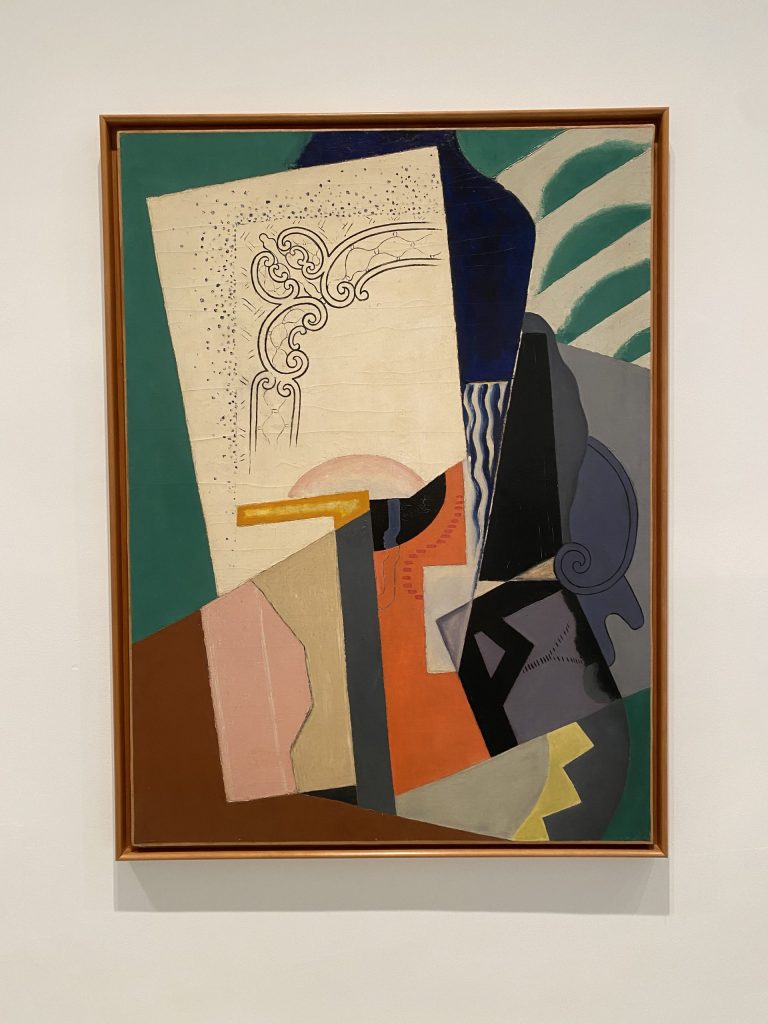
Once permanently settled in Paris, Blanchard produced Cubist Composition, dated between 1916 and 1919. Here, the transformation is evident. Objects almost disappear among geometric planes of different colours, and the viewer has to stop and try to reconstruct what they are seeing. Blanchard comes remarkably close to abstraction, although she retains recognisable elements that preserve a connection with reality.
The three paintings allow us to follow, almost step by step, an extraordinary artistic transformation. We move from the monumental figure of Girl at Her First Communion to the fragmentation of Woman with a Fan and, finally, to the complexity of Cubist Composition. This progression demonstrates that Blanchard was not simply a Spanish artist who encountered the Parisian avant-garde: she was part of it. That is precisely why she is such an essential figure when we talk about Spanish women painters and Cubism.
These works also introduce an idea that will reappear when we discuss Maruja Mallo and Ángeles Santos. There is no single story of Spanish women painters in the 20th century. Their styles, circumstances and relationships with the avant-garde were very different. In María Blanchard’s case, the Reina Sofía allows us to see first-hand how an artist initially trained within the academic tradition eventually became part of one of the movements that changed European painting forever.
2. Maruja Mallo
If María Blanchard took us to the Paris of the avant-garde, with Maruja Mallo we return to Madrid in the 1920s and 1930s. Born in Viveiro, Lugo, in 1902, Mallo was one of the Spanish women painters most closely associated with the cultural renewal that took place in Spain before the Civil War. Painting, literature and poetry constantly intersect in her biography, to the point that it is difficult to talk about her without encountering some of the great names of Spanish culture from those years.
In 1922, she moved to Madrid and began studying at the Royal Academy of Fine Arts of San Fernando. There she met Salvador Dalí and gradually became involved with the circles surrounding the Residencia de Estudiantes and the Generation of ’27. Federico García Lorca, Rafael Alberti, Luis Buñuel and Concha Méndez were all, at different times, part of that milieu. Mallo was not simply a companion to these artists and writers: she developed a career of her own and actively participated in the transformation of Spanish culture.
Besides being one of the Spanish women painters of her generation, her name is also inevitably associated with Las Sinsombrero, the name now given to a group of women connected with the Generation of ’27 whose importance was overshadowed for decades by that of their male contemporaries. Among them were creators such as Margarita Manso, Concha Méndez, María Teresa León and Maruja Mallo herself. The name comes from the famous gesture of removing their hats in public, something that, in Madrid at the time, could become a small act of defiance against social conventions.
Mallo’s personality fitted perfectly into this environment. But it would be a mistake to reduce her to anecdotes, her rebellious character or the famous people she knew. Among the Spanish women painters of her generation, Mallo developed one of the most distinctive artistic languages, moving through very different periods and showing an enormous interest in the new forms of representation emerging in Europe.
The exhibition at the Revista de Occidente
A crucial moment in her career came in 1928, when José Ortega y Gasset organised an exhibition of her paintings at the offices of the Revista de Occidente. Mallo was only twenty-five years old, and the exhibition played a decisive role in establishing her reputation within Madrid’s avant-garde. Her early works are full of movement, popular festivities, street fairs and characters that seem to capture the energy of Madrid during those years.
Her painting, however, soon underwent a considerable transformation. In contrast to the colour and dynamism of her early compositions, by the end of the 1920s she had become interested in darker landscapes and elements such as skeletons, waste, stones and organic matter. The series Sewers and Bell Towers dates from this period, one of the most distinctive stages of her career and one that brings her work close to some of the concerns of Surrealism.
In 1932, she received a grant from the Junta para Ampliación de Estudios that allowed her to travel to Paris. There she came into contact with Surrealist circles and met figures such as André Breton. Her time in France confirmed something that was already apparent during her years in Madrid: Mallo belonged to a generation of Spanish women painters who were fully connected with the transformations taking place in European art.
The Spanish Civil War completely altered the course of her career. In 1937, she travelled to Buenos Aires and began a long exile that would last for more than two decades. Argentina became one of the main centres of her artistic career, although she also travelled and exhibited in other countries across the Americas. During those years, her painting underwent another transformation, as new interests related to nature, geometry and the human figure began to emerge.
Maruja Mallo’s return to Spain
Maruja Mallo returned permanently to Spain in 1962. The country she returned to was very different from the one she had left, and her name had lost much of the prominence it had enjoyed before the war. Over time, however, her work began to be rediscovered, and her place among the Spanish women painters of the 20th century was increasingly reassessed. In 1982, she received the Gold Medal of Merit in the Fine Arts and continued to receive recognition during the final years of her life. She died in Madrid in 1995, at the age of ninety-three.
Her extraordinarily long career means that we should not think of her simply as “one of the young Spanish women painters” of the Generation of ’27, nor merely as a woman who challenged the conventions of 1920s Madrid. Mallo worked for decades and experienced very different political contexts, countries and artistic languages. Among the Spanish women painters represented at the Reina Sofía Museum, few allow us to observe so clearly the ruptures that shaped Spain’s cultural history in the 20th century.
Her work at the Reina Sofía Museum
The Reina Sofía Museum currently holds 22 works by Maruja Mallo, a substantial collection that allows us to follow different stages of a career spanning more than half a century. However, to understand Mallo’s importance among the Spanish women painters of the 20th century, three paintings are particularly interesting: La verbena, Antro de fósiles and Tierra y excrementos. All three date from the years before the Spanish Civil War and reveal just how dramatically her painting changed within a remarkably short period.<<
La verbena
La verbena, painted in 1927, belongs to a series devoted to Madrid’s popular festivities. A year later, it was included in the solo exhibition that José Ortega y Gasset organised for Mallo at the offices of the Revista de Occidente. At first glance, the scene appears to be a celebration full of movement and colour, but a few seconds of closer observation are enough to reveal something considerably stranger. Characters, fairground attractions and objects are crowded together in a space where it is difficult to find a single point of rest.
The painting includes several recognisable elements from Madrid’s traditional street fairs, such as a shooting-gallery game and a strength-testing machine. Alongside them, however, we find far less conventional characters: a one-eyed giant, a friar riding a fairground attraction, and a figure begging for money with a guitar on his back. The result is a deliberately exaggerated and satirical vision of a popular celebration.
Earth and Excrement
This evolution continues in Tierra y excrementos, painted in 1932. The title itself already tells us that we have left the festive world of Madrid’s street fairs far behind. Here, matter and earth become the protagonists of a composition dominated by muted tones. The work is associated with so-called telluric Surrealism and with Mallo’s proximity to the Vallecas School, particularly Alberto Sánchez and Benjamín Palencia.
Seeing these works together also helps us move beyond an overly simplistic image of Maruja Mallo. She was not merely the cheerful, eccentric and transgressive painter so often portrayed when discussing Las Sinsombrero. Within just a few years, her painting could move from the almost overwhelming energy of a Madrid street festival to a landscape constructed from bones, waste and decaying matter. This capacity for transformation is precisely one of the reasons why she occupies such an important place among the Spanish women painters associated with the avant-garde.
Moreover, all three paintings can currently be seen in the permanent collection: La verbena is displayed in Room 205.06, Tierra y excrementos in Room 205.07 and Antro de fósiles in Room 205.14. For anyone visiting the Reina Sofía, they offer a particularly interesting journey: three works produced between 1927 and 1932 are enough to reveal just how rapidly one of the most original Spanish women painters of her generation evolved.
3. Ángeles Santos
Ángeles Santos was born in Portbou, Girona, in 1911. Of the three Spanish women painters we have chosen for this article, she probably made the most astonishing entrance onto the art scene. Some of the works that would eventually define her career were painted before she was even twenty, while she was living in Valladolid, far from the main centres of the European avant-garde.
Her family moved frequently because of her father’s work as a customs officer, before eventually settling in Valladolid in 1927. There, Ángeles began taking painting lessons and developing a vocation that had emerged several years earlier. Her artistic training was still very limited when she began producing the works that attracted the attention of artists, writers and critics. Unlike María Blanchard or Maruja Mallo, she did not initially need Paris or Madrid’s avant-garde circles to produce radically modern paintings.
A World, her brilliant debut
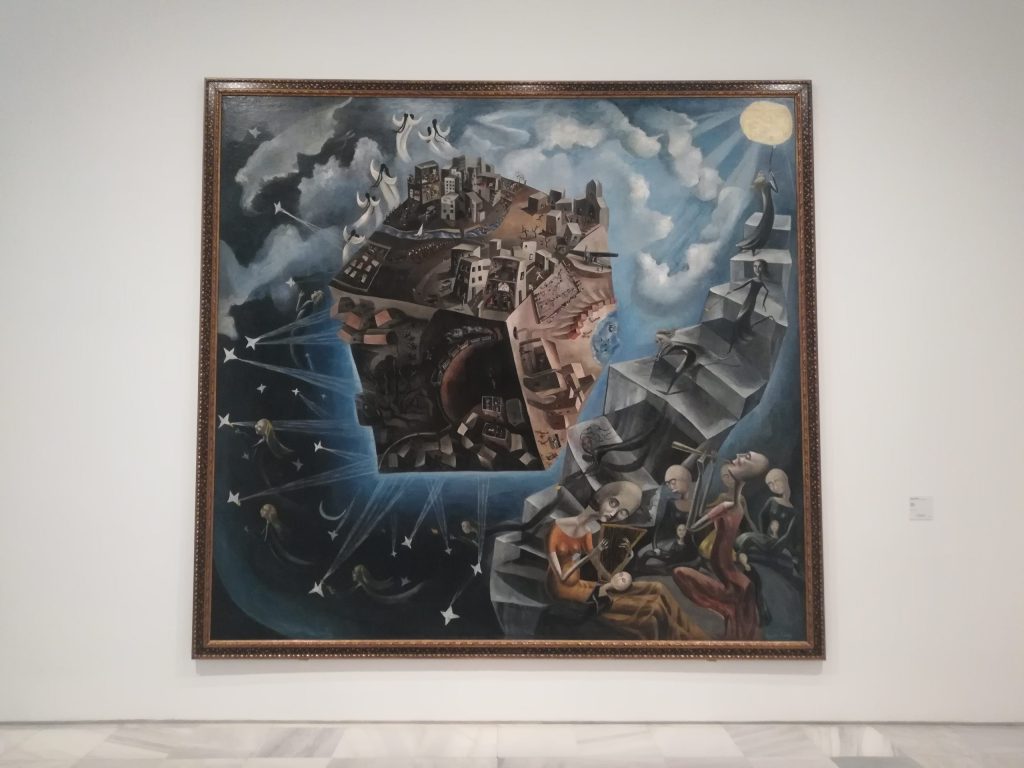
The crucial year was 1929. Ángeles Santos was only seventeen when she painted A World, an enormous canvas measuring approximately three by three metres, which she presented that same year at the 9th Autumn Salon in Madrid. The work made an enormous impression and suddenly turned a virtually unknown teenager into one of the names being discussed in Madrid’s cultural circles. Ramón Gómez de la Serna, Jorge Guillén and Federico García Lorca were among those who took an interest in the extraordinarily young artist.
This episode makes Santos an exceptional case among the Spanish women painters of the 20th century. Her success did not come after decades of work or after becoming established within one of the major European movements. It came almost at the very beginning of her career. The sheer scale of A World is remarkable in itself: to produce a painting of those dimensions, several canvases had to be joined together, as the artist did not have a studio equipped to work on such a large format.
Despite her youth, Santos became one of the most highly regarded Spanish women painters thanks in part to her knowledge of new artistic trends through books, magazines and reproductions. Images associated with the German New Objectivity were particularly important among her references, as was Franz Roh, whose book Magic Realism: Post-Expressionism had been translated into Spanish by the Revista de Occidente in 1927. This indirect contact with European art helps explain some of the characteristics of her early paintings, although the universe she created in them was profoundly personal.
That is precisely why we should avoid placing her youthful work under a single label. In her paintings from these years, we find elements associated with Surrealism, Expressionism and the New Objectivity, but also an imagination that is difficult to reduce to any of these movements. Santos created unsettling scenes, almost motionless figures and spaces in which the everyday could suddenly become something strange.
From the 1930s onwards
After the enormous impact of her first exhibitions, her career underwent significant changes during the 1930s. In 1933, she moved to Barcelona, where she met the painter and illustrator Emili Grau Sala, whom she married in 1936. Her painting gradually moved away from the enigmatic character of her early works and evolved towards a more conventional figurative style, with portraits, landscapes and interiors becoming particularly prominent.
This change partly explains a paradox that accompanies Ángeles Santos. She lived for more than a century — she died in Madrid in 2013, at the age of 101 — and had an extraordinarily long artistic career, yet much of her current reputation rests on paintings she produced when she was very young. Among the Spanish women painters of the 20th century, it is difficult to find another example in which just a few youthful works have acquired such importance in the history of Spanish art.
During the final decades of her life, her work underwent a major critical reassessment. Exhibitions and studies once again focused attention on that extraordinary early period and helped reconsider her position within the Spanish avant-garde. The Reina Sofía Museum has played a fundamental role in this rediscovery, particularly because it holds the two paintings that best allow us to understand that moment: A World and The Gathering. With them, we will conclude our journey through these three Spanish women painters and, above all, discover just how far the imagination of an artist who was still a teenager when she painted them could reach.
Her work at the Reina Sofía Museum
The Reina Sofía Museum holds several works by Ángeles Santos, but two clearly stand out: A World and The Gathering. Both were painted in Valladolid in 1929, when the artist was only seventeen years old, and they are currently displayed in the same room at the museum. Among the Spanish women painters of the 20th century, it is difficult to find another case in which two works created at such an early age have come to occupy such an important place in the history of Spanish art, and in the history of Spanish women painters in particular.
A World, the painting that changed her life
Let us begin with A World. Here, the title should be taken literally: Ángeles Santos does not depict a particular landscape but imagines an entire planet. The Earth is transformed into a kind of enormous irregular cube suspended in space, surrounded by female figures, stars and other celestial bodies. Across its different faces, we find cities, buildings, roads, cemeteries, trains, fields and tiny human figures. Everything seems to be viewed simultaneously from an impossible perspective.
Its size is equally striking. A World measures 290 by 310 centimetres, extraordinary dimensions for a painting created by an artist working in Valladolid who had not yet experienced the European avant-garde first-hand. Santos constructed this universe from what she had available to her: her immediate surroundings, books and publications about the new European art. Among these references, Franz Roh’s Magic Realism: Post-Expressionism was particularly important, as its illustrations introduced her to works by Joan Miró and artists associated with the German New Objectivity.
The painting was presented at the 1929 Autumn Salon in Madrid and made an enormous impression. Suddenly, a virtually unknown young woman was exhibiting a monumental work before some of the leading intellectuals of the period. This context explains much of the fascination that A World still inspires: we are not looking at the culmination of a career, but at a work produced almost at its very beginning. Today, the Reina Sofía itself considers it one of the key works in its collection.
The Gathering
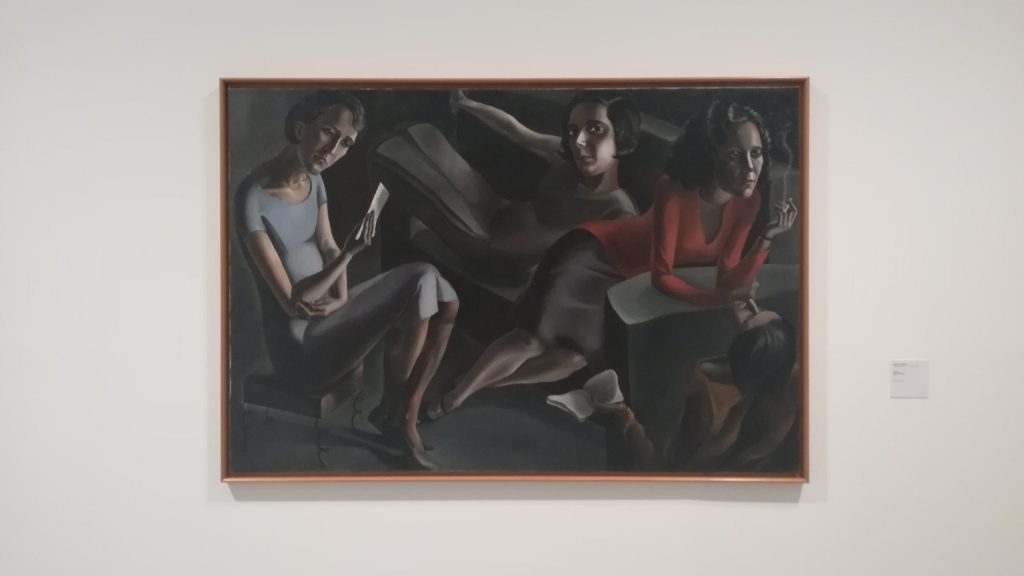
That same year, however, Santos produced a completely different painting. The Gathering measures 130 by 193 centimetres and depicts four women gathered in an interior. The title seems almost ironic. At a gathering, we might expect conversation, an exchange of ideas and glances crossing the room; here, precisely the opposite occurs. The four women appear isolated from one another, they do not look at each other, and the space feels enclosed and even claustrophobic. Santos herself would later associate these figures with loneliness and isolation.
There is another particularly interesting element. The protagonists display characteristics associated with the new woman of the 1920s and 1930s: their appearance, hairstyles and clothing convey a modernity that contrasted with traditional models of femininity. The Reina Sofía even suggests comparing this scene with The Gathering at the Café de Pombo by José Gutiérrez Solana. While intellectual gatherings dominated by men occupied cafés and other public spaces, Santos’s women are gathered inside a domestic setting.
This comparison also helps us understand the context in which many Spanish women painters of her generation had to work. Ángeles Santos could literally imagine an entire universe in A World, but in The Gathering she depicted four modern women enclosed within a room.
The Reina Sofía currently holds eight catalogued works by Ángeles Santos, including paintings and other pieces such as Two Siblings, Lilacs and Skull, Family Dinner, The Marchioness of Alquibla, Self-Portrait and Children and Plants. However, A World and The Gathering are the two currently on display, both in Room 205.06.
And perhaps this is the best place to end our journey through these three Spanish women painters. María Blanchard took us to Parisian Cubism; Maruja Mallo, to the Madrid of the Generation of ’27 and later into exile; Ángeles Santos leaves us with something completely different: a seventeen-year-old girl living in Valladolid who, in the same year, was capable of painting a room occupied by four women and an entire universe.
Would you like to learn more about 20th-century Spanish women painters? Come to the Reina Sofía Museum with The Guides You Need!
Would you like to discover María Blanchard, Maruja Mallo, Ángeles Santos and many other Spanish women painters of the 20th century? You can do so with us on a guided tour of the Reina Sofía Museum.
👥 Groups of no more than 6 people. We want you to be able to see the works, listen to your guide and ask as many questions as you like. If you’re more than 6, you’ll have a private tour for the same price.
🎓 Professional guides. No memorised scripts: our guides know the museum and adapt each visit to the group.
🎟️ Reina Sofía Museum admission included. We take care of the tickets, so all you have to do is enjoy discovering these brilliant Spanish women painters. Do we skip the line? Yes, but here’s an article about what that means.
🇪🇸🇬🇧 Tours in Spanish and English. For Italian and French, let us know in advance.
❓ Any questions before your visit? We have an article dedicated to FAQ about the Reina Sofía Museum, with practical information to help you prepare for your visit. Click here!
👉 Would you like to join us? You can book your guided tour of the Reina Sofía Museum by clicking here.