To talk about María Blanchard is to talk about how difficult it was to be both a woman and an artist in the 20th century. Even when you were born into a well-off family and surrounded by people who encouraged you to pursue an artistic career. Blanchard was a woman of enormous talent and prodigious intelligence who also lived with a disability that restricted her growth and caused her both physical and emotional pain throughout her life. Nevertheless, she always tried to transcend the limits imposed upon her, both practical and social.
And yet, even today, how difficult it is to write about Blanchard without reducing her to her gender or her physical appearance; without filtering or subordinating an artist and her work to standards still associated with masculinity, such as physical beauty or doubts about her artistic worth based on the supposed influence of her male friends and fellow artists. Perhaps it is easier simply to say this: María Blanchard was Spain’s first female Cubist painter.
Tabla de contenidos
Goodbye, Spain; Hello, Paris
María Gutiérrez-Cueto Blanchard (María Blanchard) was born in Santander into a bourgeois, freethinking family. She trained in Madrid under Emilio Sala and Fernando Álvarez de Sotomayor, and twice received a scholarship that allowed her to study in Paris, at the Académie Vitti and at Maria Vassilieff’s academy. These stays took place in 1909 and 1912, and it was in the French capital that she met artists such as Anglada Camarasa and Kees van Dongen.
Gómez de la Serna, who was both her friend and an admirer of her work, wrote of her move to France: “Paris—perhaps because it has always been the tolerant centre of everything great and everything monstrous—would not look down on her and would allow her to live without concern for her physical appearance.”
Paris offered María Blanchard a dazzling sense of freedom that finally seemed “possible” outside her native country. There she began a close friendship lasting more than ten years with Angelina Beloff and Diego Rivera. The three shared a home and studio, experimented with Cubism and took part in the artistic and intellectual gatherings of the period. Blanchard also developed close artistic relationships and collaborations with Juan Gris and Jacques Lipchitz. Together, they became part of an experimental circle associated with the second phase of Cubism during the years of the First World War.
Saying Goodbye to Spain
In 1916, despite having secured a teaching position in drawing in Salamanca, María Blanchard left Spain for good and settled permanently in France. She lived and developed her career there until 1932, when she died at the age of 51. Blanchard described Spain as a “homeland that had denied her the right to be happy.” Another quotation attributed to her expresses her feelings even more forcefully: “If you go to Spain, spit on Spanish soil and, when you return, do not forget to wipe the dust from your shoes.”
María Blanchard, the Great Artist
María Blanchard exhibited in galleries across France, Belgium, Spain and Italy. She built a life for herself as a professional painter, earning both her “room of her own” and her “three guineas”. In fact, she was able to support herself and her family entirely through her profession. It is therefore difficult to understand how an artist who was deeply respected by her contemporaries and fellow painters could have been described for decades by art historians as little more than an imitator of her male colleagues or as “a painter of children”.
For years, art history seemed more interested in judging her than understanding her. One particularly paternalistic critic wrote: “Miss Gutiérrez, when she wants to draw, draws admirably, as can be seen in her repulsive painting entitled Madrid. […] Mrs Gutiérrez would do better to continue painting mermaids.” Because of her physical appearance, María Blanchard was also frequently treated almost as if she were a child. The word repeatedly used to describe her was “deformed”.
The Success of María Blanchard
María Blanchard produced around 300 works of extraordinary technical quality. Among her contemporaries, hers was no secondary success: she achieved genuine recognition in the avant-garde circles of Paris. Her work reveals a distinctive and individual identity within Cubism, far removed from the art-historical narrative that so often rendered her invisible. Studying her work requires us to reconsider that history. Beyond her remarkable technical ability, it means recognising a sincerity and an almost painfully violent emotional intensity which, as Jacques Lipchitz once observed in her defence, is rarely found among the artists who surrounded her.
Paradoxically, her artistic importance—so genuine and so distinctive—is still partly defined today by the echoes of the scandal she caused alongside Diego Rivera at the controversial Los Pintores Íntegros exhibition, organised by Ramón Gómez de la Serna in Madrid in 1915. The exhibition represented the first direct impact of Cubism in Spain and provoked fierce rejection at the time. Yet Gómez de la Serna left us a description of its artists that still rings true today: “They are self-assured, measured, incorruptible.”
Not Even Lorca Escaped the Stereotype
Not even the brilliant Federico García Lorca escaped the stereotype. In 1932, the poet delivered a speech in honour of María Blanchard at the Ateneo de Madrid. He had never met her personally and, although his intention was to praise her, once again he spoke about the same thing:
“When I took out my sheet of paper to write down María’s name and the name of her horse, they told me: ‘she is a hunchback’ […] her opera-buffoon
body. The struggle between angel and demon was expressed mathematically in your body. If children saw you from behind, they would cry: ‘The witch! There goes the witch!’”
Ramón Gómez de la Serna, who genuinely loved María as a true friend and admired her as an artist, nevertheless wrote: “from her very first steps, María revealed herself as deformed”; “the human and spiritual spider, with the mannerisms of a little girl […]”; and “the little hunchbacked woman with glasses, seeing that her artistic future was slow to materialise, decided to apply for a teaching position in drawing in the provinces. […] We would see her in the city of steep hills, climbing them like a little black spider […]. María, who had a striking appearance.”
Picasso understood how to navigate this world through self-promotion and negotiation, but María wanted to be an authentic, courageous, sensitive and uncompromising artist. She sought refuge in her art which, regardless of opinions or changing trends, has made her one of the most significant women artists associated with European Cubism in the 20th century.
And Yet…
As Pilar V. de Foronda points out, it is remarkably difficult to find a biography of María Blanchard that does not begin by mentioning her disability in condescending terms. Blanchard had kyphoscoliosis, involving a double curvature of the spine. The condition restricted her growth, and she never grew taller than 131 cm.
It is equally difficult to find an account that does not repeat almost as a mantra that her condition “was caused by her mother falling during pregnancy”. As in so many other biographical stories, mothers somehow always seem to be blamed for something. In reality, María Blanchard’s condition was genetic and caused by a chromosomal abnormality. The first discrimination she faced was not because of her disability, but because she was a woman.
Her work was devalued to such an extent that, on several occasions, art dealers reportedly erased her authorship in order to sell her paintings more easily. Despite the firm and documented opposition of some of her fellow artists and friends, works by Blanchard were even sold bearing the signature of Juan Gris, taking advantage of the greater commercial success enjoyed by her contemporary.
Incorruptible. Our María Blanchard always was. Her life and artistic career can almost be read as a retrospective answer to Pablo Picasso’s famous remark to her: “Poor María, you think a career can be built on talent alone.” Picasso, evidently, understood far better the realities of adapting to and playing along with the art market.
Final Years
María Blanchard never married and had no children. The final years of her life were marked by increasing social and professional isolation following the loss of several close friends. Diego Rivera left for Mexico in 1922, while Angelina Beloff gradually became more distant. Then came the death of Juan Gris in 1927, which left Blanchard in a prolonged state of grief and depression. Her physical condition also progressively deteriorated, affecting her ability to work and, consequently, her financial situation. Since she was also supporting one of her sisters, Carmen, and her nieces, these difficulties placed an even greater burden on her.
Eventually, María Blanchard sought refuge in Catholicism and mysticism. Her final words are said to have been: “If I live, I am going to paint many flowers.” And that was María: an artist determined, until the very end, to pursue what she wanted, to seek beauty and fulfil her artistic vision despite physical and financial difficulties, ill health and pain.
“The important gentlemen and those in charge say that we women have neither the intelligence nor the capacity for artistic creation because we are in this world to reproduce and raise children, and that this is why our intelligence is too limited to undertake higher and more important pursuits. Clearly, that is not my case. I believe I was made for nothing other than putting brushstrokes on canvas, although I have never tried my hand at anything else; who knows where I might have ended up if I had crossed paths with a generous and handsome man. Perhaps I would have abandoned this profession because my limited intelligence would have been consumed by motherhood.”
María Blanchard’s Work at the Reina Sofía
Now that we know her story, it is time to come face to face with her paintings. The Reina Sofía Museum holds several works by María Blanchard that reveal just how successfully she developed a distinctive artistic language of her own within the avant-garde movements of the early 20th century.
We are going to focus on three of them. They have not been chosen at random: Cubist Composition, The Communicant and Woman with a Fan allow us to explore different moments in María Blanchard’s artistic career and, above all, to understand why her importance extends far beyond her biography.
Cubist Composition
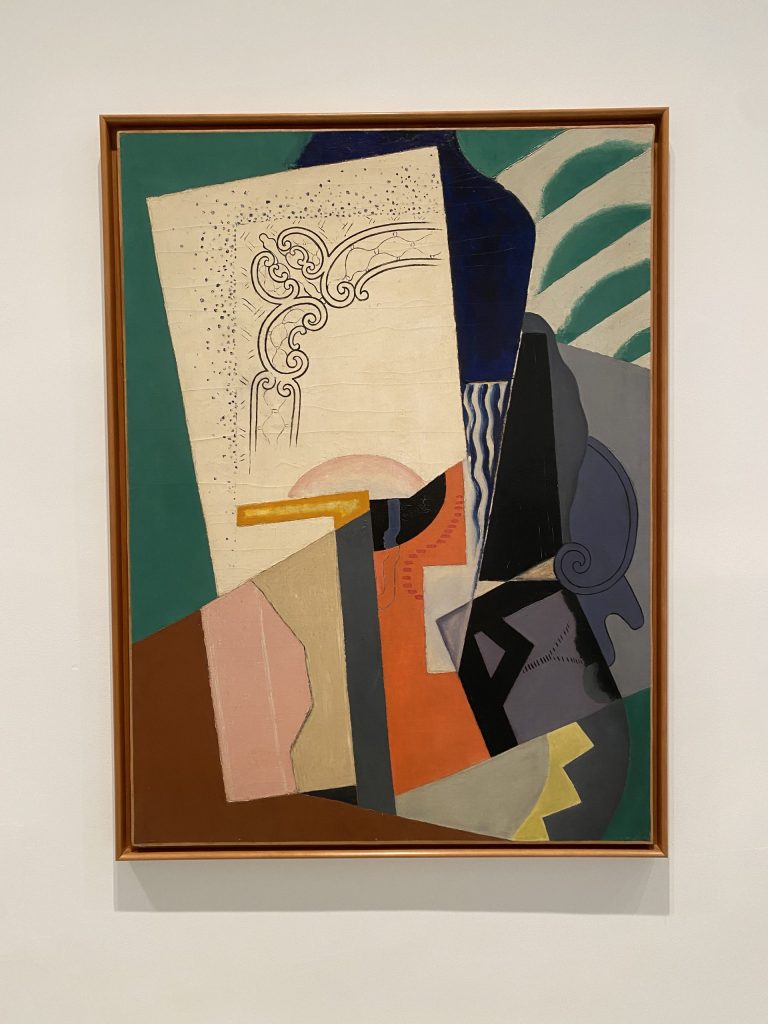
If you want to understand why María Blanchard occupies a distinctive place within Cubism, start with Cubist Composition. Created between 1916 and 1919, this large-scale oil and collage on canvas measures 154 x 114 cm and is one of the most complex works from her Cubist period.
The first thing you notice is how difficult it is to recognise exactly what you are looking at. This is no accident. Blanchard constructs the painting through geometric planes of different colours that overlap and conceal the objects represented. The forms are there, but we have to search for them among yellows, greens, pinks and oranges that fragment both the objects and the space surrounding them.
Taking Reality Apart to Rebuild It
This is precisely one of the fundamental ideas behind Cubism. The aim is no longer to reproduce reality as it might appear to a viewer standing in front of it, but to take it apart and reconstruct it on a flat surface. In Cubist Composition, María Blanchard pushes this process so far that the painting sometimes comes close to abstraction.
There is, however, one detail worth looking for when you stand in front of the painting. Amid all this geometry, a Baroque moulding appears in a much more recognisable form than the other elements. This small fragment acts almost like an anchor: however far Blanchard takes the decomposition of reality, she never abandons it completely.
Look at the Colour
The use of colour is also worth examining closely. While early Cubism is commonly associated with ochres, greys and muted tones, here we find a much bolder combination. Colour does not simply fill the forms; it helps separate and overlap them, making it even more difficult to distinguish where one object ends and another begins.
It is precisely here that we begin to encounter a María Blanchard who does not need to be explained solely through her male contemporaries. She had mastered the language of Cubism, of course, but she used it with a freedom of colour and composition that reveals an artistic personality entirely her own.
Girl at Her First Communion
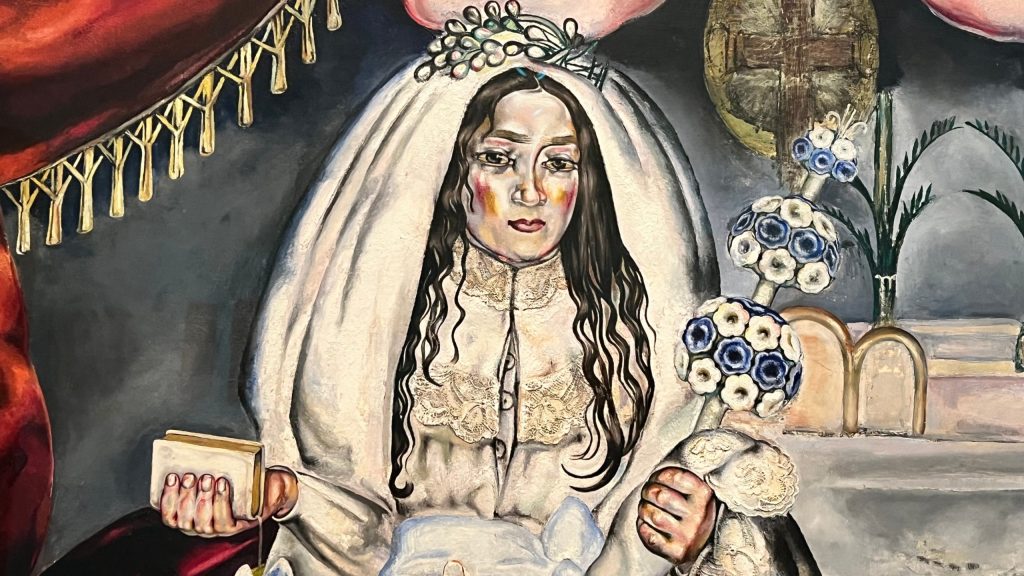
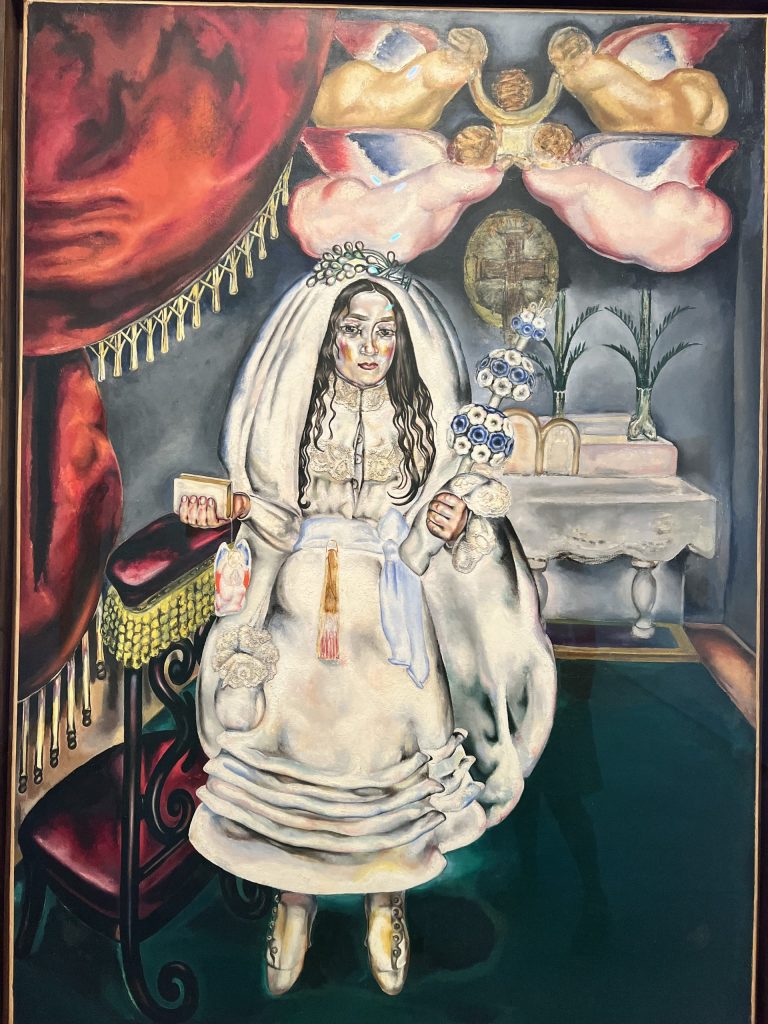
Girl at Her First Communion takes us back a few years. María Blanchard painted it in 1914, before settling permanently in Paris, and it introduces us to an artist who had not yet fully developed the Cubist language we have just seen.
The painting depicts a young girl dressed for her First Communion. The subject may seem traditional, but the way Blanchard approaches it already points towards a much more modern form of painting. The figure has a monumental presence: the canvas measures 180 x 124 cm, and the girl occupies much of a composition dominated by her white dress.
A Monumental Figure
Here, we can still immediately recognise what we are looking at. There is a figure, a body, a face and a comprehensible space, but we can already see a clear desire to move away from strictly naturalistic representation. Blanchard is not simply interested in portraying a girl on the day of her First Communion; she is constructing an image that holds its own through form, colour and the sheer presence of the figure.
The scale plays an important role in achieving this effect. We are not looking at a small genre scene or an intimate portrait, but at a canvas almost two metres high. The girl therefore acquires a powerful physical presence that compels the viewer to confront her directly.
Before María Blanchard’s Cubist Period
There is something else that becomes particularly interesting if we have just looked at Cubist Composition: Girl at Her First Communion demonstrates that María Blanchard’s artistic career cannot be reduced to a single label. There is an enormous transformation between this painting and the major Cubist compositions she would produce in the following years.
This is precisely why seeing these works together at the Reina Sofía is so valuable. They allow us to understand that Cubism did not suddenly appear in María Blanchard’s work, but emerged as part of a much broader process of learning, experimentation and the search for an artistic language of her own.
Woman with a Fan
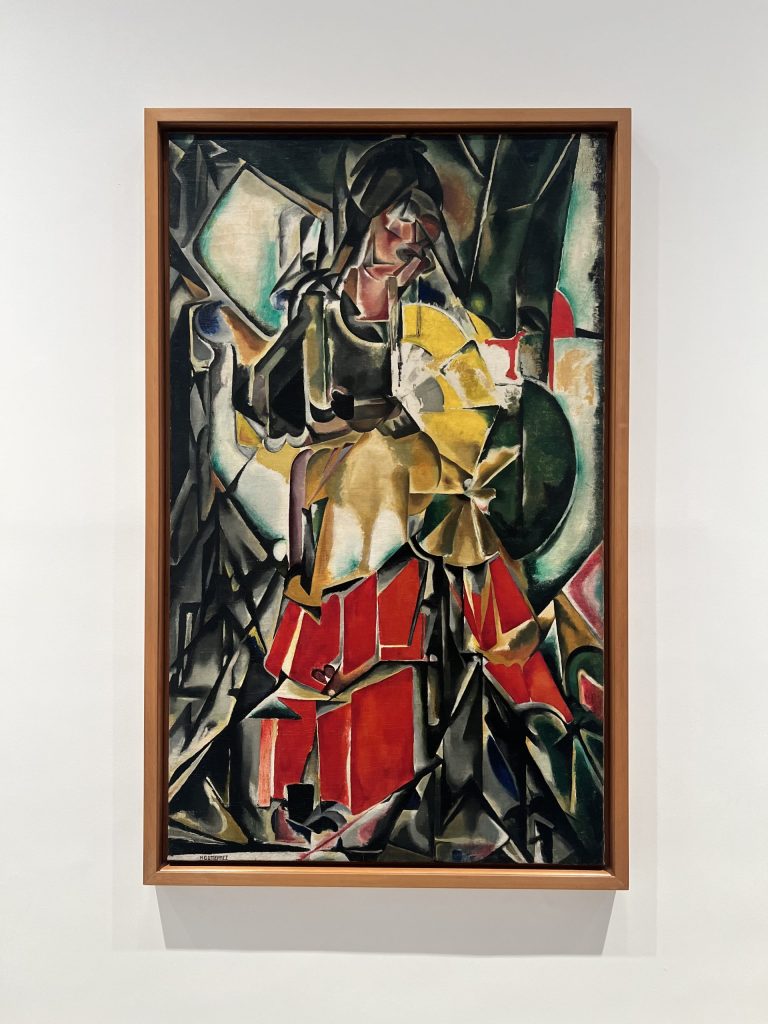
Woman with a Fan, created between 1913 and 1915, probably depicts a dancer and is one of the most ambitious works from María Blanchard’s early career. Here we once again encounter an artist eager to experiment with the new forms of representation that were transforming European art.
The painting is also connected to an episode we have already discussed. Blanchard exhibited this work at the 1915 Los Pintores Íntegros exhibition, organised by Ramón Gómez de la Serna in Madrid. We can now return to that scandal with a better understanding of the kind of images encountered by visitors to an exhibition that forcefully introduced the new avant-garde movements into an artistic environment still largely unfamiliar with them.
Where Is the Woman?
First, try to locate the woman herself. She is there, but María Blanchard has broken down her body and distributed it across different planes. There is no simple outline that our eyes can follow from head to toe. Instead, the figure seems to be constructed and dismantled simultaneously as our gaze moves across the painting.
This interplay forces the viewer to participate. It is not enough simply to look at the scene and recognise a woman: we have to reconstruct her mentally from the forms Blanchard has placed before us. Cubism thus becomes more than a matter of geometry; it also becomes a different way of looking.
The Fan and the Movement
The fan plays a particularly interesting role. It is not simply an object held by the woman, but also a perfect shape for this visual game: its ribs spread out, creating different lines and directions that contribute to the movement of the entire composition.
And perhaps that is the most surprising aspect of the painting. At first glance, Cubism can seem like a static language, constructed through rigid planes and geometries. Here, the opposite happens. The different fragments appear to shift over one another, creating a sense of dynamism that brings certain elements of the painting close to the experiments being carried out by other avant-garde movements during the same period.
Woman with a Fan thus brings us back to the María Blanchard we have been discovering throughout this article: an artist who understood the languages of the European avant-garde perfectly, but never simply reproduced them. She experimented with them, made them her own and created a body of work distinctive enough that, more than a century later, we can recognise it on its own terms.
Want to Learn More About María Blanchard? Join a Guided Tour of the Reina Sofía with The Guides You Need!
After learning about her life and taking a closer look at some of her works, the best part remains: seeing them in person. María Blanchard is one of the great Spanish artists of the 20th century, and the Reina Sofía Museum gives us the opportunity to come face to face with the work of a painter who played a fundamental role in Cubism and the European avant-garde.
At The Guides You Need, we offer guided tours of the Reina Sofía in groups of no more than 6 people. Our tours are led by professional guides and designed to give you time to look closely at the artworks, ask questions and understand not only what you are seeing, but also why it matters.
👥 Groups of no more than 6 people.
🧑🏫 Professional guides.
🎟️ Admission to the Reina Sofía Museum included. Do we skip the line in our guided tours? Yes, but here’s an article to explain that (click!)
🗣️ Tours in Spanish and English. Ask us in advance if you would prefer your tour in French or Italian.
🎨 Would you like to discover María Blanchard and many other works at the museum with us? You can book your guided tour of the Reina Sofía Museum 👉 here.
📚 Oh! We have also published an article about three brilliant women artists at the Reina Sofía. Click here to read it! 👇