In this article
Who Was Ángeles Santos?
Ángeles Santos was one of the most remarkable painters in Spanish twentieth-century. She was born in Portbou, Girona, in 1911 and spent much of her childhood moving from one city to another because of her father’s work as a customs officer. The family lived in places such as Ripoll, La Junquera, Salamanca, Seville and Valladolid, a city that would eventually play a crucial role in the beginning of her artistic career.
Her talent emerged at a very early age. During her time in Seville, the nuns at the Esclavas del Sagrado Corazón school noticed her extraordinary aptitude for drawing and recommended that her family arrange artistic training for her. What was truly exceptional, however, was not simply that she began painting at such a young age, but how quickly she developed a language of her own. Before turning twenty, she had already created the paintings that would establish her as one of the most distinctive artists of her generation.
Ángeles Santos: A World, a Prodigy
The turning point came in 1929. At just 18 years old, Ángeles Santos presented A World (Un mundo) at the 9th Autumn Salon in Madrid, an enormous painting that immediately attracted the attention of critics and intellectual circles of the time. Her success led figures such as Federico García Lorca, Jorge Guillén and Ramón Gómez de la Serna to take an interest in the extraordinarily young painter working in Valladolid. In a very short time, Santos went from being virtually unknown to establishing a place of her own within the vibrant Spanish art scene of the late 1920s.
However, her career did not follow the path that such a remarkable beginning might have suggested. After several years of intense creative activity and a serious personal crisis in 1930, her relationship with painting changed. She later married the painter Emilio Grau Sala and continued to work, but developed a style very different from the unsettling and experimental paintings of her youth. Santos herself eventually distanced herself from that earlier period and even destroyed some of the paintings and documents associated with those years.
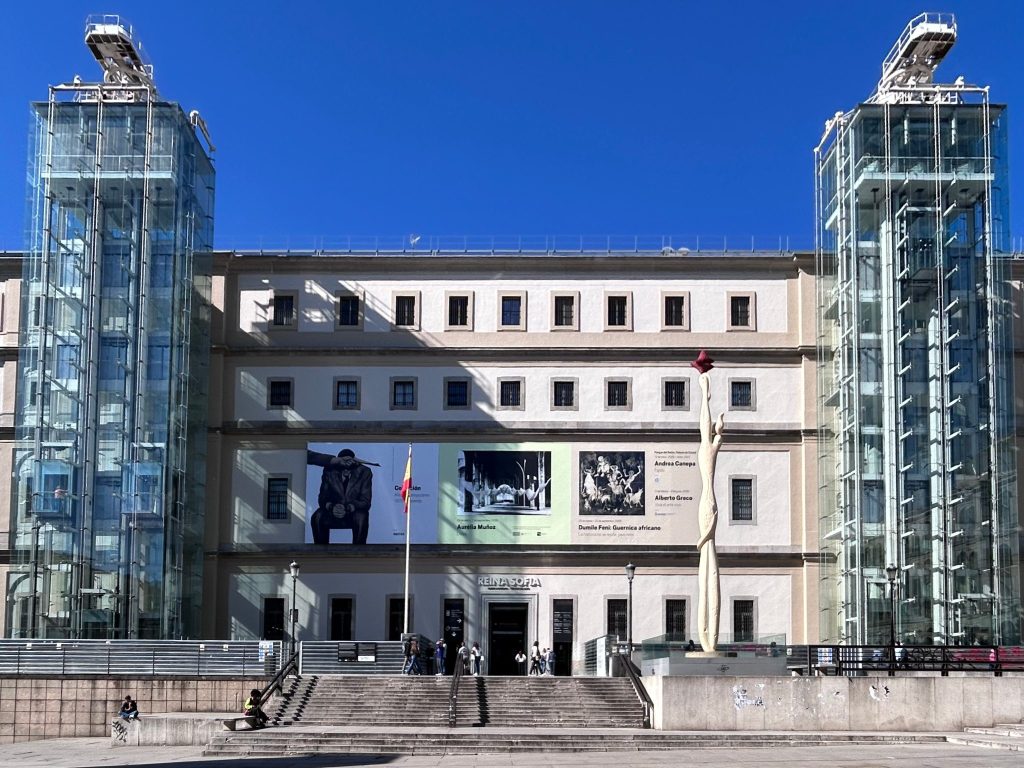
Ángeles Santos died in Madrid in 2013 at the age of 101. Her life was extraordinarily long, yet many of the works that explain her importance in art history today were created when she had barely reached adulthood. Some of the most important are now held by the Reina Sofía Museum, where they offer a glimpse into the brief but extraordinary period in which Santos created some of the most distinctive images of the Spanish avant-garde
Ángeles Santos and the Avant-Garde
Placing Ángeles Santos within the avant-garde is not straightforward. Her paintings from the late 1920s share elements with several European movements, but she never fully belonged to any of them. Nor should we imagine a young artist travelling around Paris, Berlin or the continent’s other great cultural capitals. When Santos created her most remarkable works, she was living in Valladolid, and much of her knowledge of European art came from books, magazines and reproductions.
One particularly important reference was Magic Realism: Post-Expressionism, by the German critic Franz Roh, originally published in 1925 and translated into Spanish a few years later by Revista de Occidente. Through publications such as this, Ángeles Santos was able to discover some of the new trends transforming European painting. Her works therefore contain echoes of Magic Realism, German New Objectivity and certain Surrealist experiments, although reducing her painting to any one of these labels would overlook much of what makes her work so distinctive.
Cultural Renewal in Spain
We should also place her within a period of extraordinary cultural renewal in Spain. In the late 1920s, writers of the Generation of ’27 shared the cultural scene with artists searching for new forms of representation, while Madrid was becoming an important meeting point through exhibitions, magazines and literary gatherings. Santos’s success brought her work to the attention of these circles, and figures such as Ramón Gómez de la Serna, Federico García Lorca and Jorge Guillén became interested in the young painter.
What is remarkable is that Ángeles Santos took part in this renewal while developing a highly personal universe from a relatively peripheral position. Her figures can be unsettling, her spaces seem to follow rules of their own, and everyday reality merges with images that are difficult to explain rationally. This combination reaches its fullest expression in the works from her youth now held by the Reina Sofía Museum and, above all, in a painting she created at just 18 years old: A World (Un mundo).
3 Works at the Reina Sofía Museum to Understand a Prodigy
To understand why our painter occupies such a distinctive place in twentieth-century Spanish art, there are few better ways than to look closely at her paintings. The Reina Sofía Museum holds three works that allow us to explore the most remarkable period of her career: A World (Un mundo), The Gathering (Tertulia) and Self-Portrait (Autorretrato). All three belong to her youth and reveal just how quickly Santos developed an artistic personality that was difficult to confuse with that of any other painter of her generation.
They are also three very different paintings. In A World, Ángeles Santos constructs an entire universe governed by its own rules; in The Gathering, she turns her attention to a group of women and a new way of representing them; while in Self-Portrait, the artist herself becomes the subject. Together, they reveal three dimensions of her painting—her imagination, her gaze upon others and the way she represented herself—and help us understand why works created by such an extraordinarily young artist continue to captivate visitors to the Reina Sofía Museum today.
A World: A Planet Imagined at the Age of 18
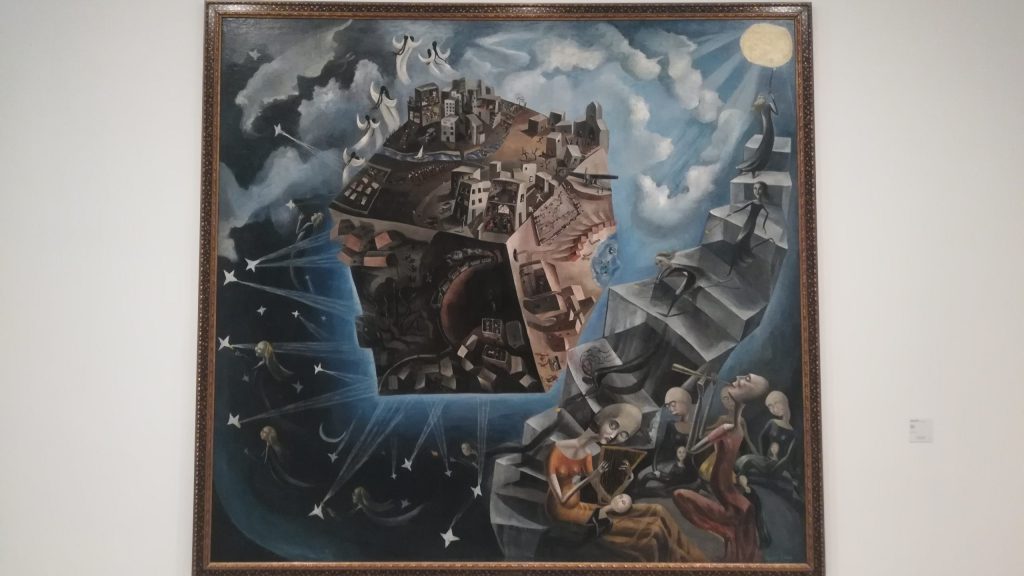
The first of these works is also the most spectacular. Our painter created A World (Un mundo) in 1929, when she was just 18 years old. Here, the title should be understood almost literally: rather than depicting a particular landscape, the artist imagines an entire planet. The Earth is transformed into a kind of enormous irregular cube suspended in space, surrounded by female figures, stars and other celestial bodies. Across its different faces, we find cities, buildings, roads, cemeteries, trains, fields and tiny human figures. Everything seems to be viewed simultaneously from an impossible perspective.
Its size is equally astonishing. A World measures approximately three metres high by three metres wide, extraordinary dimensions for a painting created by an artist working in Valladolid who had not yet encountered the European avant-garde first-hand. Santos constructed this universe from what she had available to her: her immediate surroundings, books and publications about the new European art. Among these sources, Franz Roh’s Magic Realism: Post-Expressionism was particularly important, as its illustrations introduced her to some of the artistic trends developing beyond Spain.
Her inspiration, however, did not come from painting alone. Years later, the young painter explained that, when imagining A World, she had been strongly influenced by the poetry of Juan Ramón Jiménez and, in particular, by verses beginning with the words “Vagos ángeles malvas.” Some of the female figures surrounding the planet seem to emerge from these lines: beings who light the stars, gather the light of the sun and take part in the workings of this strange universe. Santos thus transforms literary and artistic references into a cosmology entirely of her own.
The Emergence of an Extremely Young Painter
When A World was presented at the 9th Autumn Salon in Madrid in 1929, it caused an enormous impression. It was not only the monumental scale of the canvas that attracted attention, but also the age of its creator and the difficulty of fitting the painting into any familiar artistic category. Ramón Gómez de la Serna was among those fascinated by the work, and the name Ángeles Santos soon began to circulate among writers, critics and artists. At just 18 years old, that enormous planet imagined in Valladolid had placed her at the centre of Spain’s artistic conversation.
Today, A World forms part of the collection of the Reina Sofía Museum and still retains much of its original capacity to surprise. We can search for influences, symbols and references within the painting, but no single explanation seems capable of accounting for everything taking place inside it. Perhaps that is precisely where part of its power lies: almost a century later, we are still looking at the world imagined by an 18-year-old painter and trying to understand the rules by which it operates.
The Gathering: Four Women Who Broke with Their Time
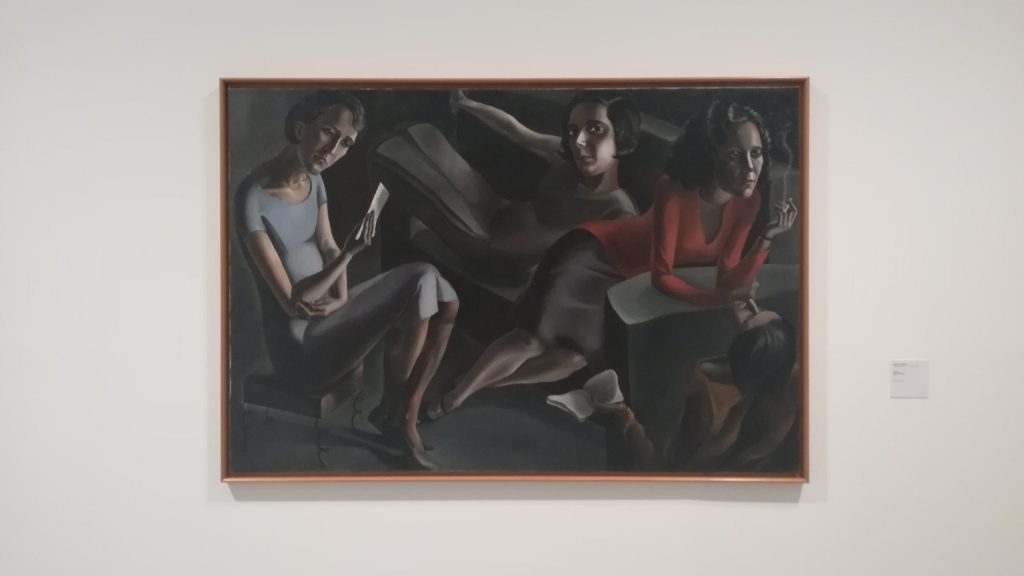
Tertulia (The Gathering), painted in 1929, takes us into a completely different setting. We are no longer looking at the fantastic universe of A World, but at four women gathered in an enclosed space. Two of them are reading, another seems lost in thought, while a fourth looks directly at the viewer. The scene lacks the monumental scale of the previous work, but retains the strange and unsettling atmosphere that characterises much of Ángeles Santos’s early painting.
The subject itself is significant. The protagonists appear alone, without any male figures, reading, talking and smoking. These are not women represented as wives, mothers or companions, but young women occupying a space of their own and engaging in intellectual activity. For this reason, The Gathering has often been associated with the emergence of new models of femininity during the first decades of the twentieth century and with the cultural circles in which female writers, artists and intellectuals were beginning to gain greater visibility.
However, Ángeles Santos is far from presenting a pleasant or conventional everyday scene. The bodies seem compressed within the room, the hands and faces take on angular forms, and the protagonists’ gazes barely meet. Even the cigarette, which could simply serve as a symbol of modernity, helps reinforce the defiant and distant attitude of some of the figures. The painter thus transforms an apparently simple gathering into an image that is much more difficult to interpret.
Once Again, the Extremely Young Painter
Tertulia (The Gathering) becomes particularly interesting when we remember that Santos was only 18 years old when she painted it. The work belongs to the same creative period as A World, but demonstrates that her imagination did not need impossible planets to create a sense of strangeness. Here, four women, a few books, several cigarettes and a room are enough for her to construct one of the most recognisable images of her early career.
Today, The Gathering forms part of the collection of the Reina Sofía Museum. Seen alongside the other works from Ángeles Santos’s youth, it reveals just how quickly this teenage painter was developing a distinctive artistic language within Spanish art of the late 1920s.
Self-Portrait: Ángeles Santos Facing Herself
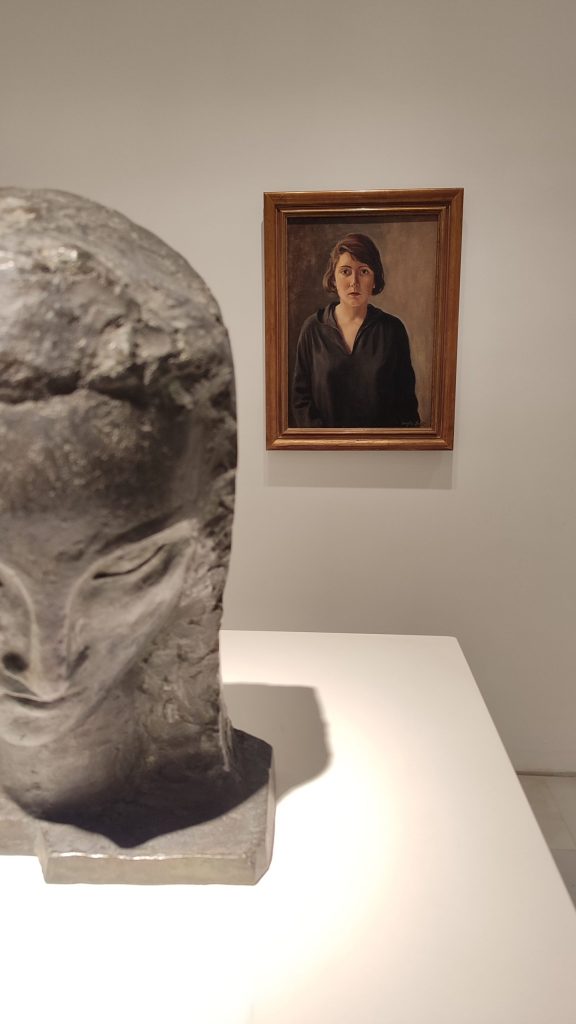
In Self-Portrait, painted in 1928, both the fantastic universe of A World and the four protagonists of The Gathering disappear. Ángeles Santos portrays herself while she was still a teenager, shortly before the period of extraordinary activity that would make her one of the most talked-about young painters on the Spanish art scene.
The composition is simple and focuses all our attention on her face. Santos appears facing forward, with short, dark hair, looking directly at the viewer with a serious expression. There are no objects to tell us who she is, nor any traditional attributes identifying her as an artist: no brushes, palette or easel. The background offers no clues as to a specific location either. Almost everything we know about the person portrayed comes from her face and the way she has chosen to present herself.
The Image the Painter Left of Herself
It is precisely this austerity that makes the painting particularly interesting when compared with the other two works we have seen. In A World, Ángeles Santos invents a universe populated by countless tiny figures; in The Gathering, she constructs a scene centred around four women. In Self-Portrait, by contrast, she strips away almost everything unnecessary and confronts her own image directly. The three paintings are very different, yet they share the same ability to create a certain sense of strangeness.
The painting takes on another dimension when we consider what happened immediately afterwards. Only a year separates this Self-Portrait from the presentation of A World at the 1929 Autumn Salon. The young woman looking back at us had not yet become the painter who would attract the attention of critics, writers and artists in Madrid, nor had she experienced the intense public attention that would accompany that success.
Discover the Reina Sofía Museum with The Guides You Need
Visitar el Museo Reina Sofía significa entrar en uno de los periodos más intensos y complejos de la historia del arte español. Picasso, Dalí, Miró o Ángeles Santos convivieron con una generación de artistas que experimentó con nuevas formas de representar el mundo durante las primeras décadas del siglo XX. Ante sus obras es fácil reconocer que estamos viendo algo diferente; lo más difícil, y también lo más interesante, es comprender por qué aquellas imágenes resultaron tan revolucionarias en su momento.
En The Guides You Need realizamos visitas guiadas al Museo Reina Sofía en grupos pequeños, con un máximo de seis personas. Este formato nos permite alejarnos de los recorridos impersonales y dedicar tiempo a observar realmente las obras, plantear preguntas y establecer relaciones entre los distintos artistas que encontramos durante la visita. Nuestros guías son profesionales que conocen la colección y adaptan las explicaciones al grupo, en lugar de limitarse a repetir un discurso memorizado delante de cada cuadro.
Además, no tendrás que preocuparte por comprar la entrada por separado. El ticket del Museo Reina Sofía está incluido en nuestras visitas, por lo que tendrás todo preparado antes de comenzar el recorrido. La visita se realiza en un único idioma y ofrecemos diferentes opciones para que puedas escoger aquella que mejor se adapte a ti.
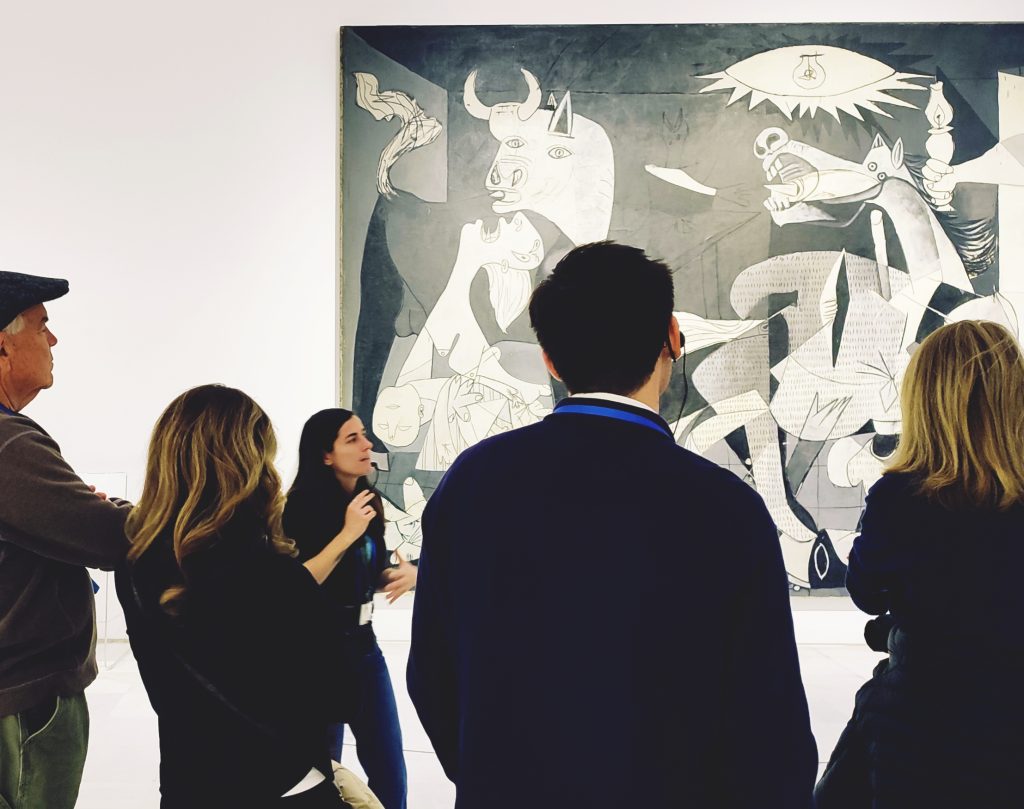
Y, por supuesto, visitar el museo acompañado permite descubrir mucho más que sus obras más famosas. El Guernica de Picasso es una razón extraordinaria para entrar en el Reina Sofía, pero sus salas esconden historias y pintoras tan fascinantes como Ángeles Santos. Si después de conocer Un mundo, Tertulia y Autorretrato quieres descubrirlas dentro del contexto de las vanguardias españolas, reserva tu visita al Museo Reina Sofía con The Guides You Need y descubre todo lo que puede contarnos su colección.
In Summary
👥 Groups of no more than 6 people.
🎓 Professional guides.
🎟️ Admission to the Reina Sofía Museum included. Skip the line? Yes, but take a look at our article (click here).
🇪🇸🇬🇧 Tours in Spanish and English. Ask us if you would prefer your tour in French or Italian.
❓ Questions about the Reina Sofía Museum? Here you can find an article answering the top 25.
👉 Would you like to join us? You can book your guided tour of the Reina Sofía Museum by clicking here.