Diego Velázquez is, according to our boss, the greatest artist in history. Everything is debatable, of course, but as far as he is concerned, Diego Velázquez is a better painter than Robert De Niro is an actor. And his favourite film is The Godfather Part II, so that’s saying something (men, honestly…).
A visit to the Prado Museum can be overwhelming, so in this post we’ll give you three key tips to help you get the most out of Velázquez without overloading yourself.
In this article
1. Understand Diego Velázquez’s Context Before Visiting the Prado Museum
Looking at an artist’s work without understanding the world in which they lived can lead to all kinds of misunderstandings. So, before looking closely at the paintings of Diego Velázquez at the Prado Museum, it is worth asking a simple question: what made him paint the way he did?
Diego Velázquez was born in Seville in 1599, and that matters enormously. At the beginning of the 17th century, Seville was one of the richest and most cosmopolitan cities in Europe, thanks largely to its privileged role in trade with the Americas. Money, merchants, travellers, artworks and ideas circulated through the city. The possibilities were… endless! Seville Cathedral was also still being “decorated”. Much of the work had already been completed, of course, but artists were still working in and around one of the most important religious buildings in Spain.
Then came Madrid. Once Velázquez entered the court of Philip IV, his job was not simply to paint portraits of the king. Over time, he took on responsibilities that made him something like the “Museum Director” of the Royal Palace. The Prado Museum did not exist yet —it would not open until 1819— but Velázquez became involved in displaying works of art, decorating royal spaces and, particularly during his second trip to Italy, acquiring works for the Royal Collection.
This is one of the keys to understanding Diego Velázquez. We tend to think of him exclusively as a great painter, but he was also an extraordinary student of Art History. In Spain, we have had at least three remarkably advanced students of the subject: Velázquez, Goya and Picasso. The first two had an additional advantage: their positions at court gave them privileged access to the Spanish Royal Collection and therefore to some of the greatest paintings available in Europe. Velázquez could study Titian at close range, meet Rubens in Madrid and later travel to Italy to see the works of the great Italian masters for himself. Not every painter had that opportunity.
The Explosion of the Baroque and the Council of Trent
To understand the paintings of Diego Velázquez —and, for that matter, a significant part of what you will see at the Prado Museum and the Royal Palace— we also need to understand the religious world into which he was born. During the 16th century, the Protestant Reformation had shattered the religious unity of Western Europe. Among other things, Martin Luther promoted more direct access to Scripture and translated the Bible into German. The Catholic Church responded to the challenges posed by the Reformation with a vast process of reform and reaffirmation, one of whose defining moments was the Council of Trent, held between 1545 and 1563.
And what does any of this have to do with Diego Velázquez? Quite a lot. The Council of Trent reaffirmed the value of religious images and insisted that sacred art should be clear, appropriate and capable of instructing the faithful. In other words, a religious painting was not there simply to look beautiful. It had a job to do. The viewer had to recognise the scene, understand what was happening and, whenever possible, be emotionally affected by it.
Catholic Europe consequently turned art into one of the greatest propaganda machines of all time. “Propaganda machine” is perhaps an almost crude way of putting it, but we think you get the idea. Art becomes spectacular and theatrical. Churches leave us speechless, saints suffer, martyrs bleed and paintings are filled with emotion. The viewer is no longer expected simply to stand outside the scene and contemplate it: you are supposed to feel that something is happening right in front of you. The Baroque triumphs.
Diego Velázquez was born right into this world. Seville was full of churches, convents, religious brotherhoods, sculptors and painters working within a profoundly Catholic society. His own teacher and future father-in-law, Francisco Pacheco, was not merely a painter: he was also an important authority on how religious subjects should be represented.
This context matters even though Velázquez would eventually move away from much religious painting and devote most of his career to the Spanish court. It helps explain his fascination with making painted figures occupy our world, with turning paint into flesh, fabric, air and light. Later, his encounters with painters such as Rubens and his study of the great European masters would take that ability much further. And when you finally stand in front of Diego Velázquez’s paintings at the Prado Museum, that combination of Seville, court culture, religion and direct contact with some of the greatest art in Europe becomes much easier to see.
2. Get to Know the Different Stages of Diego Velázquez
The Seville Years and Early Career
He was already a great painter, but this was not yet Diego Velázquez at his very best. During these early years, his painting was strongly defined by naturalism and dramatic contrasts between light and shadow. Works such as Old Woman Frying Eggs and The Water Seller of Seville belong to this period, although you will have to travel beyond the Prado Museum to see them. What matters here is that Velázquez was already showing an extraordinary ability to paint objects, faces and different materials as they actually appear to the human eye.
Once in Madrid, we come to The Triumph of Bacchus, also known as The Drunkards, a painting that still preserves much of that early naturalism. And Diego Velázquez was not perfect yet: take a look at Bacchus himself and you might agree that one of his shoulders is… well, not exactly Velázquez at his best.
Naturally, the painting is packed with extraordinary details. Here is our favourite. By the time you reach this work, there is a good chance that this will be the first time you have seen teeth in the Prado Museum. After all, everyone wants to look good in “the photo”, and modern dentistry was still a very long way off. So, generally speaking, it was probably safer not to smile.
Velázquez, however, was interested in reality rather than flattering conventions. One of the men at the centre of the composition looks straight towards us with a huge grin on his face, teeth and all. It is a small detail, but a wonderful example of the naturalism that defined the young Diego Velázquez. And no, it is definitely not a toothpaste-ad smile.
After His First Trip to Italy
It has never been proven, but we do know that Diego Velázquez met Rubens personally during the Flemish painter’s stay in Madrid, and their encounter has traditionally been linked to Velázquez’s decision to travel to Italy. Diego Velázquez set off in 1629 and visited some of the country’s great artistic centres. There, he was able to study first-hand a pictorial tradition that, until then, he had known mainly through the extraordinary collections of the Spanish monarchy.
The trip was a turning point. Diego Velázquez devoted particular attention to Venetian painting and came into direct contact with Italy’s extraordinary artistic heritage. When he returned to Spain, something had changed. All you have to do is compare his earlier works with Apollo in the Forge of Vulcan, painted during his time in Italy. The figures now occupy space differently, light is distributed much more naturally and the composition has become more complex. There is a very clear before and after in the painting of Diego Velázquez.
The following years also belong to the great court painter Diego Velázquez. He portrayed Philip IV and numerous members of the Royal Family, but he also painted jesters, dwarfs and other figures at court with extraordinary dignity. And there is something worth paying attention to here: as the years go by, Velázquez seems to need fewer and fewer brushstrokes to say more and more. Surfaces begin to lose definition when we look at them up close, yet everything falls perfectly into place when we take a few steps back.
After His Second Trip to Italy
Velázquez returned to Italy in 1649, but this time his position was completely different. He was no longer the young painter travelling abroad to complete his artistic education. Diego Velázquez was now one of the leading artists at the court of Philip IV, and his mission included acquiring paintings and sculptures for the Spanish Royal Collection, as well as hiring specialists who could work for the Spanish monarchy.
The man was in no hurry to come back, and there were reasons for that. He even had an illegitimate son in Rome. During this stay, Diego Velázquez also produced some of his most extraordinary works, including the Portrait of Juan de Pareja and the Portrait of Pope Innocent X. When he finally returned to Madrid in 1651, he entered the final stage of his career.
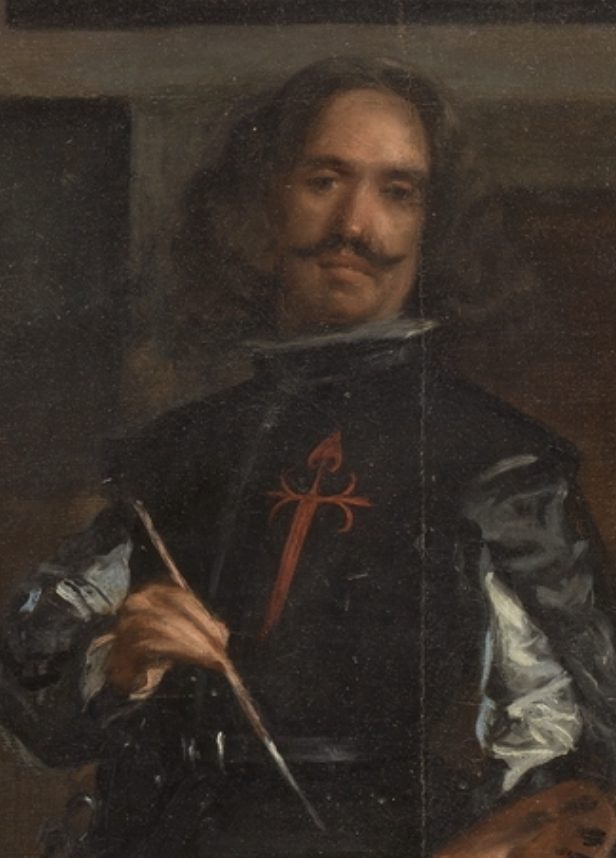
And this brings us to the Velázquez who is hardest to explain but perhaps the easiest to enjoy when you are standing in front of the paintings themselves. His brushwork becomes extraordinarily free, the space seems to be filled with air, and his figures are often created through patches of paint that barely make sense if you look at them from too close. These final years gave us Las Meninas and The Spinners. Not bad at all.
Pay Close Attention to the Brushwork
There is a before and after in Western painting when Charles V commissions Titian to paint his portrait. From this point onwards, what we traditionally understood as “drawing” begins to change. Try it yourself: get as close to a painting as you can. If you can see it better, that is drawing. If you suddenly feel as though you have developed myopia, then that is “painting”.
Naturally, we are simplifying things enormously, but the exercise works. In a painting constructed primarily through drawing, the outlines tend to be much more clearly defined: we can easily see where one figure ends and the next one begins. With Titian, something different happens. Colour, light and the brushstrokes themselves begin to construct the forms. Get too close and you may find yourself looking at what seems like a collection of patches and marks; step back a few metres and suddenly a sleeve, a face, a jewel or the shimmer of a piece of fabric appears before your eyes.
This is extremely important because one of the foundations of Diego Velázquez’s painting lies right here. Velázquez was able to study Titian’s paintings in the Spanish Royal Collection first-hand, and he also had the opportunity to immerse himself in Venetian painting during his trips to Italy. We are not talking about an artist who knew these works only through engravings or second-hand references: Diego Velázquez could stand directly in front of them and study how they had actually been painted.
Brushwork That Becomes Increasingly Fluid
With that in mind, we strongly encourage you to do exactly the same thing during your visit to the Prado Museum. Pay attention to how Velázquez’s brushwork becomes increasingly fluid as his career progresses. Get closer —as close as the museum allows you, naturally— and then step back again. Look for details that seem like little more than patches of paint from nearby and see what happens to them when you view them from several metres away.
In his final works, Diego Velázquez takes this technique to an extraordinary level. He no longer needs to describe every object meticulously for our eyes to recognise it. A handful of brushstrokes can become a reflection, a strand of hair or a piece of fabric. In Las Meninas, it is worth trying this with the dresses and faces; and when you reach The Spinners, pay particular attention to the spinning wheel and the extraordinary sense of movement. Seen from close up, much of the painting almost seems to dissolve before your eyes.
After making your way through the Prado Museum, you will eventually reach The Spinners and see something that feels almost Impressionist. Obviously, Impressionism was still two centuries away, but that is precisely what makes it so fascinating: some of the solutions that the Impressionists would later explore already have extraordinary precedents in the painting of Diego Velázquez.
3. Conoce a sus amigos
No se lo digáis a nuestro jefe, pero Diego Velázquez no hubiese sido Diego Velázquez sin sus amigos. O, siendo un poco más precisos, sin una extraordinaria red de relaciones que le permitió estar cerca de algunos de los personajes más poderosos e interesantes de su tiempo. El talento estaba ahí, naturalmente, pero también supo estar en el lugar adecuado y conocer a la gente adecuada.
Francisco Pacheco: maestro y suegro
Para empezar, su señor suegro. ¿Te acuerdas de que antes decíamos que la Catedral de Sevilla todavía estaba terminando de configurar buena parte de su decoración? Francisco Pacheco estaba muy bien relacionado con los ambientes artísticos e intelectuales de la ciudad y tuvo un papel importante como teórico y supervisor de cuestiones relacionadas con la pintura religiosa. Primero fue maestro de Diego Velázquez y después… ¡su suegro!
Velázquez se casó con Juana Pacheco en 1618. La relación con su maestro fue fundamental para su formación y también para su carrera. Cuando unos años después surgió la posibilidad de probar suerte en Madrid, Pacheco tenía contactos que podían ayudar a introducir al joven pintor sevillano en los círculos de la corte. Velázquez puso el talento; tampoco vino mal tener un suegro bien relacionado.
Felipe IV: bastante más que un cliente
Una vez en Palacio, se hace amigo de un tal Felipe… Que fuera el rey de España es una cosa que no tiene nada que ver. Diego Velázquez consiguió retratar a Felipe IV en 1623 y poco después fue nombrado pintor del rey. Aquello cambió definitivamente su vida.
La relación duró décadas. Felipe IV fue un extraordinario coleccionista de pintura y Velázquez no se limitó a realizar sus retratos: ocupó distintos cargos dentro de Palacio y terminó participando activamente en cuestiones relacionadas con la decoración y las colecciones reales. Esto es fundamental para entender al artista que hoy encontramos en el Museo del Prado. Velázquez vivía rodeado de algunas de las mejores pinturas de Europa y tenía un acceso a ellas que muy pocos artistas podían siquiera imaginar.
A eso hay que añadir otro personaje fundamental: el conde-duque de Olivares, valido de Felipe IV y uno de los hombres más poderosos de la monarquía durante buena parte de la carrera de Velázquez. El pintor realizó algunos de sus retratos más conocidos y se movió con enorme habilidad dentro de aquel mundo cortesano.
Rubens y los grandes artistas de su tiempo
Y después están los artistas. En 1628 llegó a Madrid Pedro Pablo Rubens, que ya era una auténtica celebridad europea. Rubens y Diego Velázquez coincidieron en la corte y sabemos que pudieron tratarse durante aquellos meses. Poco después, Velázquez realizó su primer viaje a Italia, aunque debemos tener cuidado con una historia que se ha repetido muchas veces: resulta tentador imaginar a Rubens diciéndole directamente que tenía que marcharse a Italia, pero no podemos afirmarlo con absoluta seguridad.
Italia amplió todavía más sus contactos y sus referencias. Durante sus viajes pudo conocer de primera mano el ambiente artístico de Roma y relacionarse con algunos de sus protagonistas. En su segunda estancia italiana su prestigio era ya enorme: retrató al papa Inocencio X y realizó allí el extraordinario Retrato de Juan de Pareja.
Por eso, cuando recorremos las salas dedicadas a Diego Velázquez en el Museo del Prado, no estamos viendo únicamente la evolución de un pintor excepcional. Estamos viendo también el resultado de una posición privilegiada: Sevilla, la corte de Felipe IV, las Colecciones Reales, Rubens, Italia y el contacto directo con algunas de las mejores obras y artistas de su época. No todos tuvieron esa suerte. Y, por supuesto, no todos habrían sabido aprovecharla como él.
Want to Know More About Diego Velázquez? Join The Guides You Need at the Prado Museum!
All you have to do is book one of our tours at the Prado Museum. You can do so by clicking here. Here is what makes our tours different:
Visiting the Prado Museum on your own is perfectly possible, but there is one problem: we are talking about an enormous collection. You can spend hours walking through its galleries, see dozens of masterpieces and still leave with the feeling that you missed an important part of what was right in front of you. That is why our tours are not simply about taking you from one famous painting to the next. We want you to understand why those works are there, how they relate to one another and what was happening when they were painted.
And, naturally, Diego Velázquez plays a fundamental role in our tours. Standing in front of his paintings gives us the chance to put many of the things we have discussed in this article into practice: watching how his brushwork evolves, discovering what he learned from other artists, understanding his relationship with Philip IV and seeing how his painting changed after his trips to Italy. Because reaching Las Meninas, taking a photo and moving on is one thing; actually understanding what you are looking at is something else entirely.
Our Prado Museum Tours
- Our groups have a maximum of 7 people (although if you are travelling with a larger group, we can arrange a private tour). We want you to be able to get close to the paintings, hear your guide comfortably and, above all, ask questions. A guided tour of the Prado Museum works much better when we can have a conversation rather than making you follow someone holding a flag above a crowd.
- Admission is included. You will not need to buy your ticket to the Prado Museum separately: we take care of it so that you can concentrate on enjoying the visit. Do we skip the line? Yes, but we recommend taking a look at this article to understand exactly how it works (click!).
- We offer tours in English, Spanish, French and Italian. Each language has its own schedule, so keep an eye on that when booking! If you need help finding the tour that best fits your plans, contact us and we will be happy to help.
- If you want a two-hour tour, that option is available. It gives us enough time to explore some of the great masterpieces in the collection and understand why artists such as Diego Velázquez, Goya, El Greco, Rubens and Titian occupy such an important place in the history of the Prado Museum. If you would like to spend longer with us, we will have to do the maths: we can also arrange a more extensive visit.
Still have questions? Here is an article that will probably answer them.
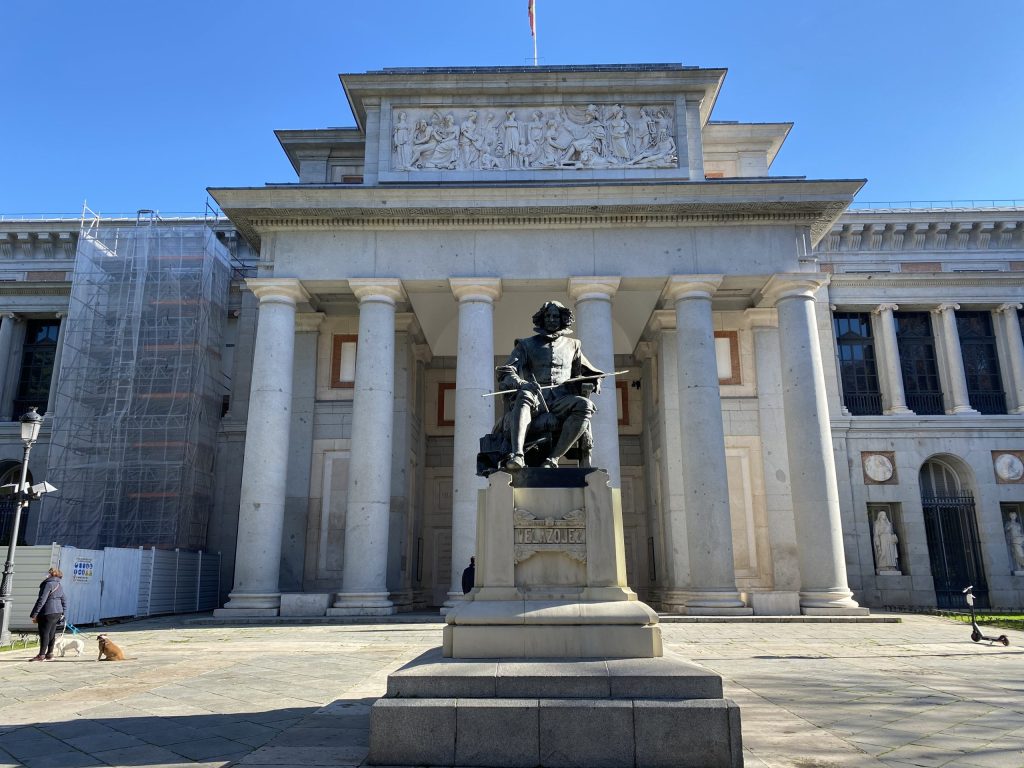
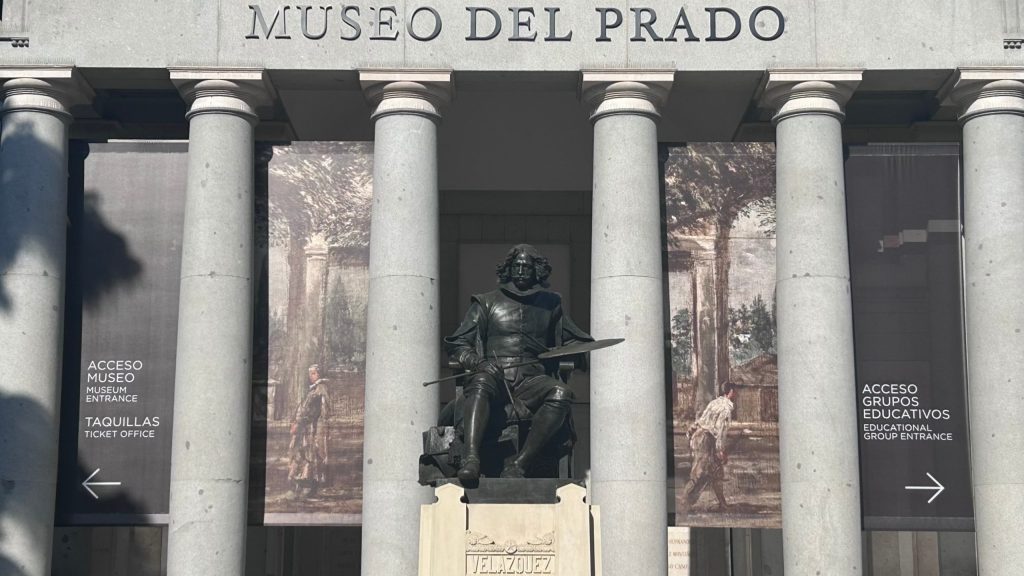
And one last curiosity before we finish. Quite a few of our guests get confused and head towards the statue of Diego Velázquez. It makes perfect sense after reading an article like this, but unfortunately that is not our meeting point. Our meeting point for the Prado Museum tour is the Statue of Goya, and we always send you an email the day before your visit with an infographic so you know exactly where to find us.
Remember: the Statue of Goya. We’ll be waiting for you there!