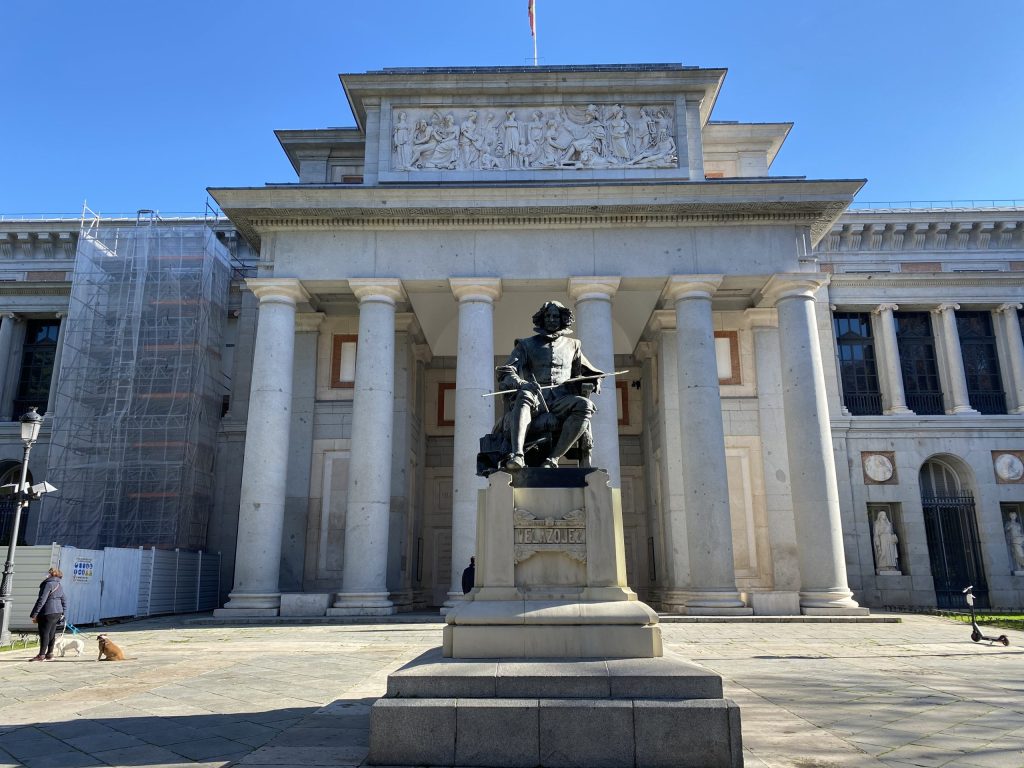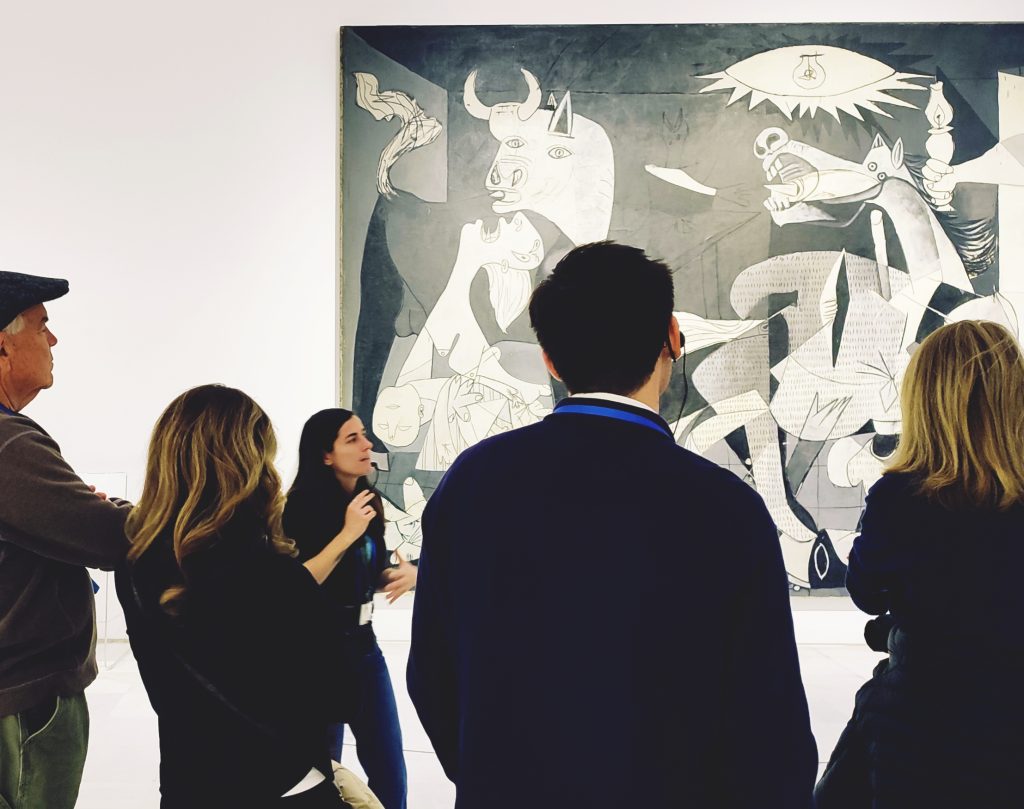
The Prado Museum is one of those places where it is easy to walk in and much harder to know exactly what to look at. With thousands of works spread across its galleries, guided tours can be an excellent way to make sense of an extraordinary collection. Velázquez, Goya, Bosch, Rubens, Titian and Fra Angelico represent only a small selection of the great artists you will encounter inside.
Exploring the collection with a professional can completely change the experience. It is not simply about walking alongside someone who knows the dates and names of the paintings. It is about understanding why certain works matter, discovering details that might otherwise go unnoticed, and connecting different paintings to better understand the stories behind them.
There is also a very practical difficulty when exploring the Prado: it is impossible to see everything in a single visit. Choosing the right works, spending enough time with them and understanding what you are looking at is usually far more rewarding than rushing through dozens of galleries without a clear plan. A good guide can turn an enormous museum into a coherent and manageable journey.
At The Guides You Need, we have spent years accompanying travellers through these galleries, and we know how different the experience can be when you explore them with someone who can help you interpret what you see. In this article, we will give you 5 reasons why exploring the Prado with a guide is worth it and explain what this kind of experience can really add to your time in the museum.
In this article
Frequently Asked Questions
Is a guided tour worth it?
Yes, especially if this is your first time at the Prado. A professional guide can help you choose which masterpieces to see, understand their historical and artistic context, and notice details that are easy to miss on your own. It can also save you time in such a large collection. Later in this article, we will look at five specific reasons why we think the experience is worthwhile.
How long is the Prado Museum guided tour?
The length depends on the company and the type of experience you book. At The Guides You Need, our regular tours last approximately two hours. We find this gives us enough time to explore a carefully selected group of masterpieces without overwhelming visitors with too much information. You can, of course, remain inside the museum afterwards and continue exploring the collection independently.
What should I not miss at the Prado Museum?
Las Meninas by Velázquez is probably the essential masterpiece for a first-time visitor, but there is much more to see. Highlights include Bosch’s The Garden of Earthly Delights, Goya’s The Third of May 1808, Rubens’ The Three Graces and Fra Angelico’s The Annunciation. What you should prioritise ultimately depends on your interests and how much time you have available.
Is there a dress code for the Prado?
There is no special dress code for a normal visit, so you do not need to dress formally. Comfortable clothing and footwear are a sensible choice, particularly if you plan to spend several hours exploring the galleries. As with any major cultural institution, visitors should simply wear appropriate clothing and follow the museum’s rules while inside the building.
Why is the Prado Museum famous?
The Prado is famous for having one of the world’s finest collections of European painting, particularly from the 16th to the 19th centuries. Its galleries contain exceptional works by Velázquez, Goya, Bosch, Rubens, Titian and El Greco. Much of this extraordinary collection is closely connected to the Spanish monarchy, whose collecting over several centuries helped bring together many of the masterpieces visitors can see today.
What is included in the price?
This depends on the company and the experience you book, so it is always worth checking before making a reservation. At The Guides You Need, the price includes both the services of a professional guide and admission to the Prado Museum. We purchase tickets in advance for our guests, which means you do not need to buy a separate museum ticket before joining us.
How do platforms such as GetYourGuide or Viator work?
Platforms such as GetYourGuide and Viator act as intermediaries between travellers and companies offering tourist activities. They allow you to search for tours, compare different options, read reviews and make a booking all in one place. However, in many cases, the activity itself is run by an independent local company, so it is worth checking who actually operates the tour, what is included in the price and the cancellation policy before booking. If you book directly through the operator’s website, you cut out the middleman. (Was that a hint? You sure? Can anybody tell me?)
What do you need to become a tour guide?
The requirements for working as a tour guide depend on the country and the regulations of the destination where you intend to work. There may also be specific requirements for guiding in certain museums or monuments. Beyond the necessary qualifications, a good guide needs historical and artistic knowledge, strong communication skills, languages and, above all, the ability to adapt their explanations to the people in front of them.
And now: Prado Museum: 5 Powerful Reasons to Take a Guided Tour
1. Guided tours help you decide what to see
One of the first problems when entering the Prado Museum is deciding where to start. Its collection is enormous, and its galleries bring together Velázquez, Goya, Bosch, Rubens, Titian, Fra Angelico and El Greco within a relatively compact space. Faced with so many masterpieces, trying to see everything is not necessarily the best strategy.
Guided tours allow visitors to follow a carefully selected route that makes sense. Instead of rushing from gallery to gallery trying to tick paintings off a list, you can spend a reasonable amount of time with each work and understand why it deserves your attention.
You don’t need to see everything to know the Prado
This is particularly important if you are visiting for the first time. Two well-planned hours can provide an excellent overview of the collection without having to walk through every gallery. The key is choosing works that introduce you to its greatest artists while also helping you understand how such an extraordinary collection came together.
And selecting carefully does not mean focusing exclusively on the most famous paintings. Las Meninas and The Garden of Earthly Delights may be essential for many visitors, but part of a good guide’s job is to introduce lesser-known works that provide context for the masterpieces or are particularly suited to the interests of the group.
A route adapted to the people in the group
Not everyone enters a museum looking for the same thing. Some people want to see the essential masterpieces, others are particularly interested in Goya, some love mythology, and others arrive convinced that painting simply isn’t their thing. Exploring the collection with a guide makes it possible to take these differences into account.
At The Guides You Need, we work with small groups precisely to encourage this interaction. We can answer questions, spend longer with a work that sparks particular interest and adapt parts of the route to the people in front of us. In the end, choosing which paintings to see becomes more than a checklist: it becomes a way to make much better use of the time you have.
2. You will understand the artworks much better
You can stand in front of a great painting, look at it for several minutes and enjoy it without knowing anything about it. But finding out who is represented, why the artist made certain decisions or who commissioned the work can completely transform the experience. One of a guide’s main roles is precisely to provide the keys that help you look more closely.
Take Las Meninas, for example. At first glance, we see a group of people gathered around the Infanta Margarita. Once we identify those figures, notice the king and queen reflected in the mirror, or start wondering what Velázquez is painting on the enormous canvas to the left, the picture begins to raise questions that would be easy to miss with a quick glance.
Context changes the way we look at art
Many paintings were created for people and places very different from those of today. Some decorated royal palaces, others were made for religious settings, while others were commissioned to project a particular image of power. Understanding that context helps explain decisions that, from a 21st-century perspective, might otherwise seem strange or go completely unnoticed.
It also helps us connect one work with another. Titian’s influence on Velázquez, Rubens’ importance at the Spanish court or Goya’s extraordinary evolution become much easier to understand when we stop looking at each painting as an isolated object.
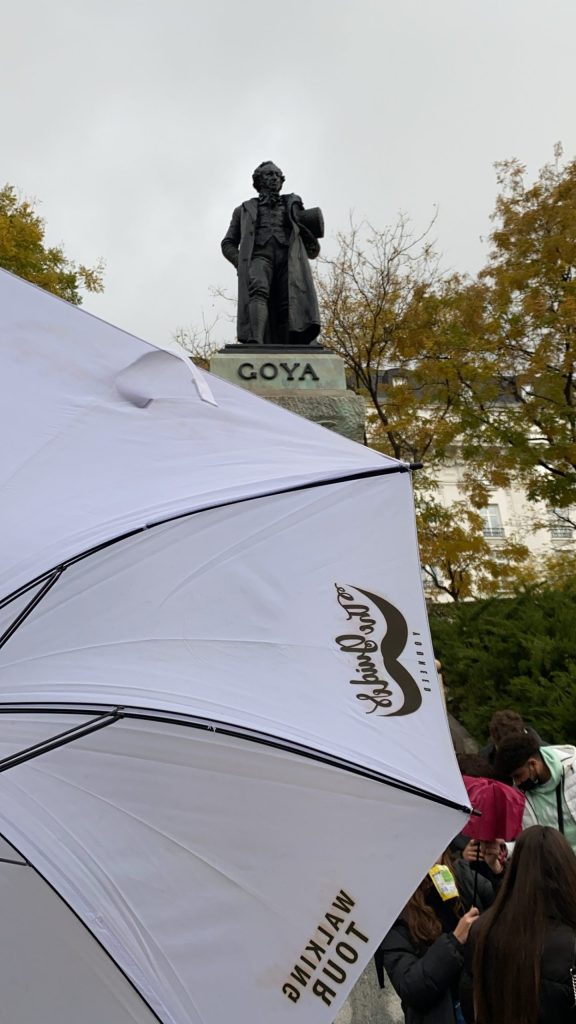
It shouldn’t feel like an art history lecture
Good guided tours should not become an endless succession of dates, names and technical terms. Information is useful when it helps you notice something in the artwork in front of you. Learning more about art does not necessarily mean accumulating facts; it means acquiring new tools that help you interpret what you see.
That is also one of the aims of our tours: to explain art in an accessible way without oversimplifying it. We want you to ask questions, participate and reach your own conclusions. After all, understanding a painting does not mean that everyone has to see it in exactly the same way.
3. You can ask as many questions as you want
One of the biggest differences between exploring a museum on your own and doing so with a guide is very simple: you can ask questions. An audio guide, a book or an app can provide plenty of information, but they follow predetermined content. A guide can listen to your question, answer it and take the conversation in a direction that might not have been planned at the beginning.
And your questions do not need to be particularly sophisticated. Why are there so many religious paintings? How do we know a painting is by Velázquez? Why did Goya’s work change so dramatically throughout his career? Where did the enormous collection of paintings by Rubens come from? Apparently simple questions can lead to much more interesting conversations about art.
Every group ends up having a different experience
This opportunity to interact means that no two tours are exactly the same. Some groups are particularly interested in Spanish history, others want to know more about artistic techniques, and sometimes a group ends up spending ten minutes discussing a painting that was not even among their priorities when they arrived.
That is why we work with a maximum of seven people. A small group makes it easier for everyone to participate, ask their own questions and talk directly to the guide. It also prevents the experience from becoming a monologue that visitors simply follow from gallery to gallery.
You can also say you don’t like something
This is something we sometimes forget when talking about art. You are under no obligation to be impressed by a painting simply because it is famous. You can stand in front of a celebrated masterpiece and admit that it does absolutely nothing for you.
In fact, those reactions can be extremely useful. Asking why a painting became so important or explaining what you find strange about it can start a conversation about artistic criteria, personal taste and changing ideas about art. Guided tours work much better when there is a genuine exchange than when visitors simply listen in silence.
4. You will make much better use of your time
The Prado is a large museum, and its layout is not always obvious to someone visiting for the first time. The works you want to see may be on different floors, some galleries may be temporarily closed, and simply following the room numbers does not necessarily give you the most interesting route.
Knowing the building well helps avoid many of these problems. A guide knows how to move between the main areas of the collection and can adjust the itinerary when circumstances require it. This means you spend more of your time looking at paintings rather than trying to figure out where to go next.
Two hours can go a long way
You do not need to spend an entire day inside the museum to get a good overview of its collection. With a well-organised route, you can discover some of its greatest artists, spend time with several essential works and understand the connections between them without constantly feeling that you need to rush.
This is particularly useful during a trip to Madrid. You may also want to visit the Royal Palace, the Reina Sofía, the Thyssen, Retiro Park or simply spend some time exploring the city. Organising those two hours efficiently allows you to enjoy the art without sacrificing a large part of your day.
Knowing when to change the route matters too
There is another factor that does not appear on museum maps: crowds. Some galleries can become extremely busy, making it difficult to get close to a painting or listen comfortably to an explanation.
In those situations, flexibility is essential. A guide can change the planned order, continue through another part of the collection and return later when conditions are better. There is little point in sticking rigidly to an itinerary when changing it can give the group a much better experience.
5. You will enjoy the experience more
So far, we have talked about choosing the right works, understanding them, asking questions and making better use of your time. But there is an even simpler reason to explore a museum with someone who knows it well: it can be much more fun.
Art does not have to be experienced in silence while you try to remember names, dates and artistic movements. Behind many paintings are surprising stories, rivalries between artists, royal commissions, journeys, financial problems, marriages, wars and all kinds of circumstances that can completely change the way we look at them.
Stories also help you remember the artworks
You are probably more likely to forget the exact date a painting was created than a good story connected to it. Learning that Rubens came to Madrid as a diplomat, discovering the unusual relationship between Philip IV and Velázquez, or understanding what was happening in Goya’s life at different stages of his career can also help you remember what you saw.
That does not mean turning art history into a collection of anecdotes. Stories work when they help us understand a painting, an artist or the period in which they lived. The main purpose remains the same: to look at the works more closely and find reasons to spend time with them.
Museums are more enjoyable when you participate
For us, this is a fundamental part of the experience. We do not want you to spend two hours following someone who talks while you simply listen. We prefer conversation: asking questions, sharing what surprises you and even telling us which paintings you do not particularly like.
At the end of guided tours, remembering every fact you have heard is not what matters most. What matters is leaving with a few artworks still in your mind, having discovered stories you did not know before and, above all, enjoying the time you spent inside. And if you leave wanting to come back one day and explore more, even better.
Why choose The Guides You Need?
👥 Groups of no more than 7 people.
🎓 Professional guides, with no memorised scripts.
🎟️ Museum admission included in the price.
⏱️ Tickets purchased in advance.
🇪🇸 🇬🇧 🇫🇷 🇮🇹 Tours in Spanish, English, French and Italian.
💬 Ask questions, participate and enjoy: we want a conversation, not a lecture.
🖼️ A carefully selected route through the masterpieces, adapted to the group and its interests.
👉 Want to explore the Prado with us? Book your guided tour here.