Taking a guided tour of the Reina Sofía Museum can completely change the way you experience contemporary art. Its galleries bring together some of the most important works of the 20th and 21st centuries, as well as artistic movements, remarkable artists and historical events that are not always easy to understand when we encounter them for the first time.
Picasso, Dalí, Miró, Juan Gris, María Blanchard and Ángeles Santos are all part of a collection that takes us through some of the greatest artistic transformations of the last century. And inevitably, at the heart of it all is Guernica: a work that attracts visitors from all over the world every year, but whose history and complexity go far beyond what we can appreciate at first glance.
However, the Reina Sofía is much more than the museum of Guernica. Exploring its galleries helps us understand why artists began to break away from traditional forms of representation, how events such as the Spanish Civil War affected artistic creation, and why our own definition of what we consider art changed so radically.
At The Guides You Need, we have spent years accompanying travellers through these galleries, and we know that you do not need to be an art history expert to enjoy them. In this article, we will answer some of the most common questions people ask before visiting the museum and give you 5 reasons to explore its collection with a professional guide.
In this article
Frequently Asked Questions About Guided Tours
Which artists can I see at the Reina Sofía Museum?
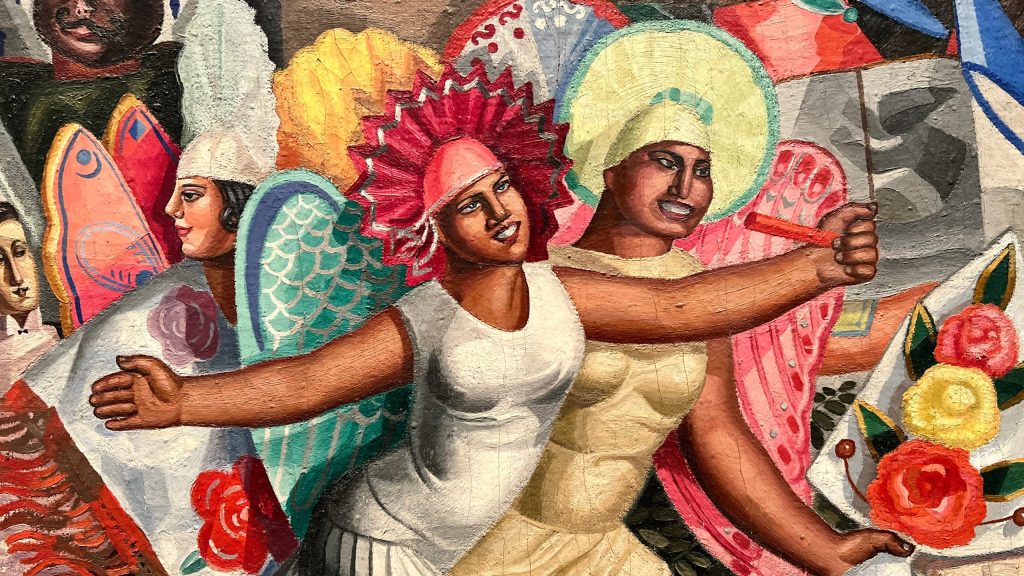
The Reina Sofía Museum is a great place to discover some of the biggest names in 20th-century Spanish art. Picasso, Salvador Dalí and Joan Miró occupy a fundamental place in the collection, alongside artists such as Juan Gris. It is also an excellent opportunity to discover great women artists who, for a long time, received less attention than they deserved, including María Blanchard, Maruja Mallo and Ángeles Santos. Their works reveal the extraordinary diversity of the avant-garde and Spanish contemporary art.
How much does it cost to enter the Reina Sofía Museum?
€12. That said, there are various discounts and opportunities for free admission. For this reason, we recommend checking the official rates before your visit. If you book with The Guides You Need, you do not need to purchase your ticket separately: museum admission is included in the price of our guided tour.
When is the Reina Sofía Museum free?
The Reina Sofía Museum offers several periods of free admission throughout the week, although opening hours may change and the museum is closed on certain days. Before planning your visit, it is worth checking the museum’s official calendar. Bear in mind that free admission periods can also attract larger crowds, particularly during the busiest times of the year.
How much time do you need at the Reina Sofía Museum?
It depends on how deeply you want to explore the collection. For a first visit, around two hours will allow you to see a good selection of essential works, including Guernica. If you are particularly interested in contemporary art and want to explore the collection at a more relaxed pace, you can easily spend three hours or more. You certainly do not need to see absolutely everything in a single day to enjoy the museum.
Seguimos con el bloque de preguntas frecuentes, empezando por las cuatro primeras. Mantengo las respuestas del original y una terminología natural para búsquedas en inglés.
Frequently Asked Questions About Guided Tours
Which artists can I see at the Reina Sofía Museum?
The Reina Sofía Museum is a great place to discover some of the biggest names in 20th-century Spanish art. Picasso, Salvador Dalí and Joan Miró occupy a fundamental place in the collection, alongside artists such as Juan Gris. It is also an excellent opportunity to discover great women artists who, for a long time, received less attention than they deserved, including María Blanchard, Maruja Mallo and Ángeles Santos. Their works reveal the extraordinary diversity of the avant-garde and Spanish contemporary art.
How much does it cost to enter the Reina Sofía Museum?
€12. That said, there are various discounts and opportunities for free admission. For this reason, we recommend checking the official rates before your visit. If you book with The Guides You Need, you do not need to purchase your ticket separately: museum admission is included in the price of our guided tour.
When is the Reina Sofía Museum free?
The Reina Sofía Museum offers several periods of free admission throughout the week, although opening hours may change and the museum is closed on certain days. Before planning your visit, it is worth checking the museum’s official calendar. Bear in mind that free admission periods can also attract larger crowds, particularly during the busiest times of the year.
How much time do you need at the Reina Sofía Museum?
It depends on how deeply you want to explore the collection. For a first visit, around two hours will allow you to see a good selection of essential works, including Guernica. If you are particularly interested in contemporary art and want to explore the collection at a more relaxed pace, you can easily spend three hours or more. You certainly do not need to see absolutely everything in a single day to enjoy the museum.
5 Reasons to Take a Guided Tour of the Reina Sofía
1. You will understand the historical context behind the artworks
Walking into a gallery and finding yourself in front of a great work of art can be enough to enjoy it, but at the Reina Sofía Museum, understanding the context is particularly important. Much of its collection emerged during a period of enormous political, social and cultural transformations that also changed the way artists understood their work.
The Spanish Civil War, the rise of the avant-garde, exile, the two World Wars and the dictatorship all appear in different ways behind many of the works on display. Learning about these events does not replace looking at the art itself. Instead, it gives us the tools to understand why certain artists decided to break away from traditional ways of representing the world.
Guernica is the best example
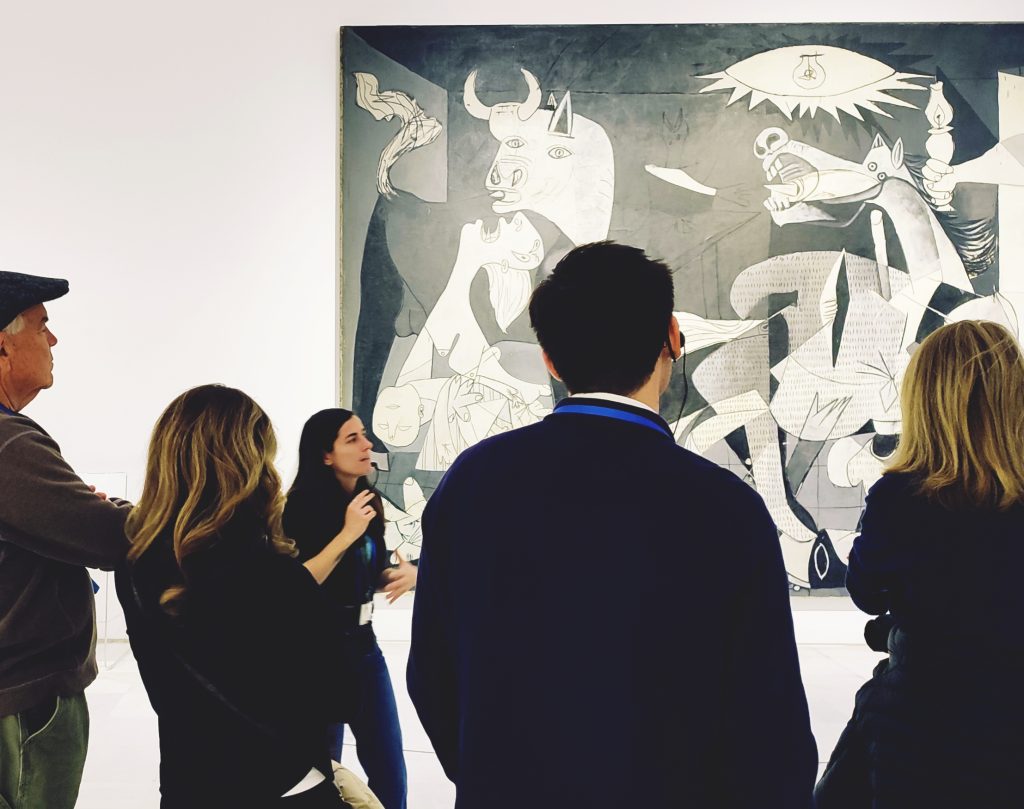
Few works demonstrate the importance of context better than Guernica. We can be impressed by its enormous size, fragmented figures and lack of colour without knowing its history. However, understanding the bombing of the Basque town, the commission for the Spanish Pavilion at the 1937 International Exposition in Paris, and the circumstances of the Spanish Civil War transforms the way we look at it.
Knowing its history also helps us avoid overly simplistic interpretations. Picasso did not create a literal depiction of the bombing. Instead, he constructed a far more complex image, filled with figures and symbols whose meanings continue to generate debate. That is precisely why it is so interesting to stop in front of the painting and examine what we are actually seeing.
Understanding history without turning the museum into a lecture
This does not mean that a guided tour has to become a long lesson on the 20th century. Context is useful when it helps us understand what is in front of us, not when it becomes an accumulation of dates and events that ultimately distracts us from the artworks.
Our aim is to use history as a tool. We want to explain only what helps you look more closely at a painting, sculpture or photograph and understand why it was created in that particular way. From there, every visitor can observe, ask questions and reach their own conclusions.
2. Contemporary art will stop feeling impossible to understand
“I could have done that.” It is probably one of the most common reactions to certain works of 20th-century art. And actually, it is not a bad starting point. If a painting made up of just a few lines or an everyday object displayed in a museum makes us react that way, the interesting question is why it ended up there in the first place.
The Reina Sofía Museum allows us to explore precisely the period when many artists began questioning what a work of art should be. Faithfully representing reality was no longer necessarily the goal, and new ways of working with form, colour, materials and ideas began to emerge.
Why did they make art like this?
Cubism, Surrealism, abstraction and other movements can seem confusing if we do not understand the questions their artists were trying to answer. Learning what Picasso, Dalí, Miró or Juan Gris were exploring helps apparently strange works begin to make much more sense.
A guided tour can provide those keys without requiring any previous knowledge of art history. The point is not to convince you that you have to like a particular work, but to explain what the artist was trying to achieve and why it represented such a radical break at the time. Afterwards, you are perfectly free to decide that you still do not like it.
Learning to look at art differently
One of the most interesting things about this museum is that it forces us to leave some expectations behind. We will not always find perspective, realistic proportions or stories that are easy to recognise. Sometimes we need to look at how a face has been fragmented, why an object appears out of context or what effect a particular combination of forms creates.
Once we understand these new rules of the game, many works stop simply looking strange. We can begin to question them and compare the different solutions artists found. And this new way of looking at art can stay with us even after we have left the museum.
3. You will know which contemporary artworks are essential
Every work in a museum deserves to be seen, but visitors only have a limited amount of time. Faced with such an extensive collection, the question is not which works have value and which do not, but which ones are essential for understanding the major artists, movements and transformations of 20th- and 21st-century art.
A guide can build a route around a reasonable selection and establish connections between different works. Instead of rushing through dozens of galleries, we can stop in front of key pieces and understand what makes them important reference points in the history of art.
There is much more than Picasso, Dalí and Miró
The biggest names are an excellent starting point, but limiting the experience to them would mean missing much of the richness of the collection. María Blanchard, Ángeles Santos and Juan Gris can considerably broaden our understanding of the Spanish avant-garde and reveal very different ways in which artists responded to the transformations of their time.
We may also encounter artists we had never even heard of before entering the museum. One of the advantages of exploring a carefully selected group of works with a guide is precisely the opportunity to combine some of the pieces we expect to see with others that can broaden our understanding of what contemporary art was — and what it can be.
Not every group has to see exactly the same things
There is no single perfect route either. Some visitors are mainly interested in the Spanish Civil War, others want to explore the avant-garde, while others are particularly curious about why Guernica became one of the most important paintings of the 20th century.
Working with small groups allows us to take those interests into account. We can spend longer with a work that raises questions, introduce a different piece or slightly adjust the route depending on the conversation. The goal is not to complete a compulsory checklist, but to discover some essential works while opening the door to many others.
4. You can ask as many questions as you want
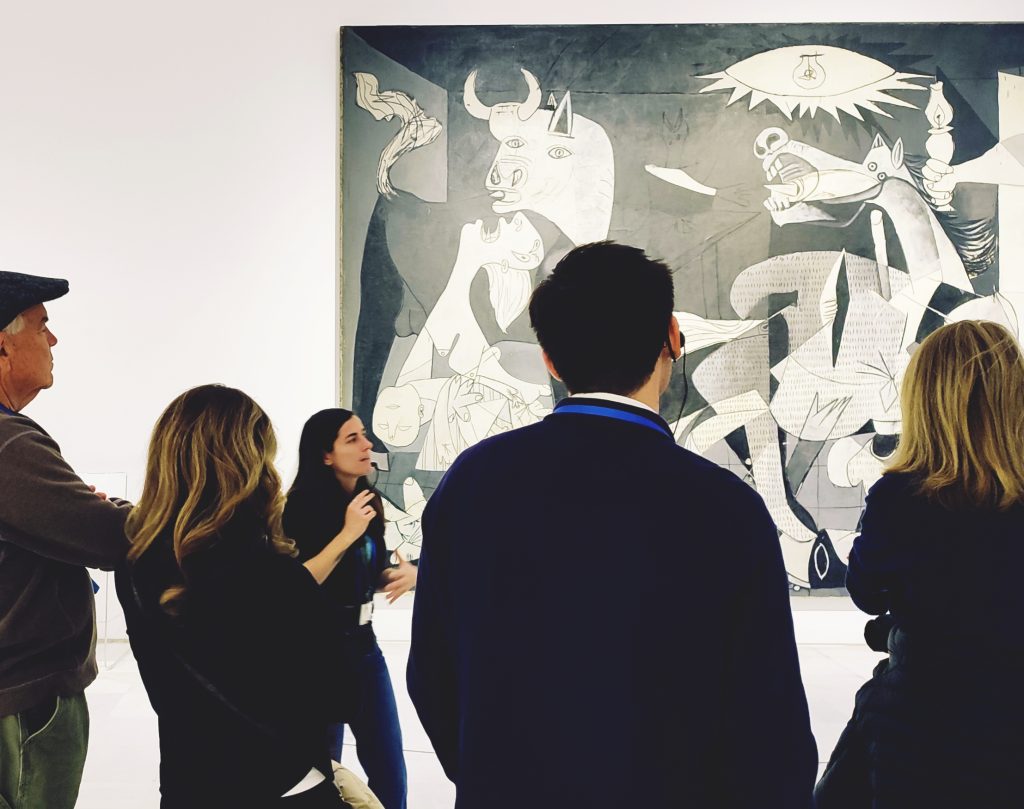
Contemporary art constantly raises questions. Why does Picasso represent a face from several different viewpoints? What is really happening in Guernica? Why did some artists abandon traditional ways of representing reality? And what were the Surrealists trying to achieve when they began creating seemingly impossible images?
A book or an audio guide can provide plenty of information, but they cannot answer the question that has just occurred to you while standing in front of an artwork. On a guided tour, you can stop, ask questions and let the conversation develop around whatever has caught your attention.
There are no stupid questions
You do not need to know anything about art history before you walk in. In fact, some of the simplest questions can lead to fundamental ideas. Asking why a painting is important, what exactly we are looking at, or even why something is considered art can take us straight to the heart of some of the major artistic debates of the 20th century.
And you do not need to use specialist vocabulary either. Part of a guide’s job is to make complex ideas understandable without requiring any previous knowledge. If something does not make sense, just ask. It really is that simple.
Small groups make conversation easier
Asking questions becomes much more difficult when you are walking through the galleries in a huge group. That is why, at The Guides You Need, we work with a maximum of seven people. We want everyone to have the opportunity to participate and the guide to be able to genuinely listen to the people in front of them.
This also means that every tour is slightly different. A question might lead us to notice a detail we had not discussed, compare two works or spend a few extra minutes with a particular artist. Conversation is part of the experience and, quite often, it takes us in directions we had not expected when we started.
5. You will enjoy the Reina Sofía Museum more
Sometimes we walk into a contemporary art museum with an unnecessary concern: the feeling that we have to understand everything. If we cannot immediately recognise what a painting represents or understand why a particular work is important, we may think we lack some essential knowledge needed to enjoy it.
That is not the case. Understanding an artist’s context and intentions can help enormously, but art also gives us room to be surprised, disagree and develop our own interpretations. A guided tour should give you tools to look at art, not tell you what you are supposed to think.
You don’t have to like everything
You can understand a work perfectly well and still decide that you do not like it. In fact, explaining what puzzles us, makes us uncomfortable or simply leaves us indifferent can lead to some of the most interesting conversations during the tour.
The 20th century is full of artists who deliberately wanted to provoke reactions from viewers and challenge previous ideas about what art should be. That is why surprise, rejection and even humour can also be part of the experience.
What matters is leaving wanting to see more
After two hours, we do not expect you to remember every date, artistic movement or name that came up during the tour. We would rather some of the works stay in your memory and that you leave with new tools for approaching others you have yet to discover.
For us, that is one of the best possible outcomes: leaving the museum with a better understanding of contemporary art, but also with new questions. And if you enjoyed yourself along the way, then we have achieved our goal.
Why take your tour with The Guides You Need?
👥 Groups of no more than 6 people.
🎓 Professional guides, with no memorised scripts.
🎟️ Reina Sofía Museum admission included in the price.
⏱️ Tickets purchased in advance.
🇪🇸 🇬🇧 Tours in Spanish and English. Ask us if you would prefer French or Italian.
💬 Ask questions, participate and share your thoughts: we want a conversation, not a lecture.
🖼️ A carefully selected route through the essential works, adapted to the group and its interests.
👉 Want to discover contemporary art with us? Book your guided tour here.