On October 3, 1685, Juan Carreño de Miranda died in Madrid. He was one of the great painters of the Spanish Baroque. He had come a long way from Avilés, Asturias, where he was born in 1614: he trained in Madrid, worked on some of the most important religious and courtly projects of his time, and eventually became court painter to Charles II.
His life became closely connected to the final decades of the Spanish Habsburgs and to some of their most recognizable faces. He portrayed Mariana of Austria, helped shape the image of Charles II that has come down to us, and painted Eugenia Martínez Vallejo, the girl historically known as La Monstrua, the subject of two of his most famous works, now housed in the Prado Museum.
On the anniversary of his death, we trace the life of Carreño Miranda, from his Asturian origins to his final years at court. It is a story that begins in Avilés and that, more than four centuries after his birth, remains present both in the streets of his hometown and in the galleries of the Prado.
In this article
Who Was Carreño Miranda?
Juan Carreño de Miranda was a Spanish Baroque painter born in Avilés, Asturias, in 1614. Although he left his hometown while still a child, he went on to build a long career in Madrid that eventually took him to the court of the Spanish Habsburgs. In 1669, he was appointed painter to the king, and two years later he became court painter to Charles II.
His career, however, had begun much earlier. For decades, he worked on religious paintings and took part in major decorative projects, some of them alongside Francisco Rizi. It was only during the final stage of his career that court portraiture gained the prominence for which he is particularly well known today.
As court painter, Carreño Miranda had direct access to some of the most important figures at court. He repeatedly portrayed Charles II and his mother, Mariana of Austria, helping to shape the public image of a monarchy going through a particularly difficult period. He also painted people outside the royal family, including Eugenia Martínez Vallejo, La Monstrua, whose portraits are among his most famous works.
Carreño died in Madrid on October 3, 1685, after more than half a century devoted to painting. Many of his works associated with the Royal Collections eventually became part of the Prado Museum, while Avilés has preserved the memory of the painter who left Asturias as a child and eventually rose to one of the most important positions in seventeenth-century Spanish painting.
Carreño Miranda: From Avilés, Asturias, to Madrid
Carreño Miranda’s Early Years in Avilés
Juan Carreño de Miranda was born in Avilés on March 25, 1614, into a family connected to the minor Asturian nobility. His father, also named Juan Carreño de Miranda, and his mother, Catalina Fernández Bermúdez, belonged to families with roots in the region. However, the future painter’s years in Asturias were relatively brief.
This is important when considering his biography. Carreño Miranda did not train as an artist in Asturias, nor did he begin a career there before later continuing it at court. While Avilés, Asturias, was the place of his birth and early childhood, Madrid would be the city where he learned to paint and developed virtually his entire professional career.
Even so, Avilés has never stopped considering him one of its great historical figures. More than four centuries after his birth, the city preserves several reminders of the boy who left Asturias long before becoming one of the most important painters at the court of Charles II.
Avilés, Asturias: A City That Has Not Forgotten Carreño Miranda
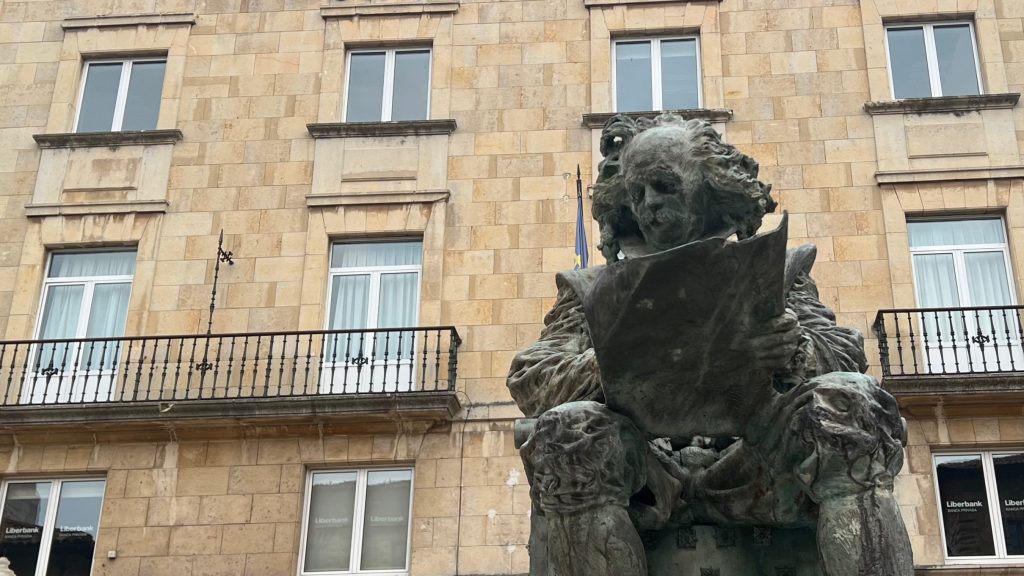
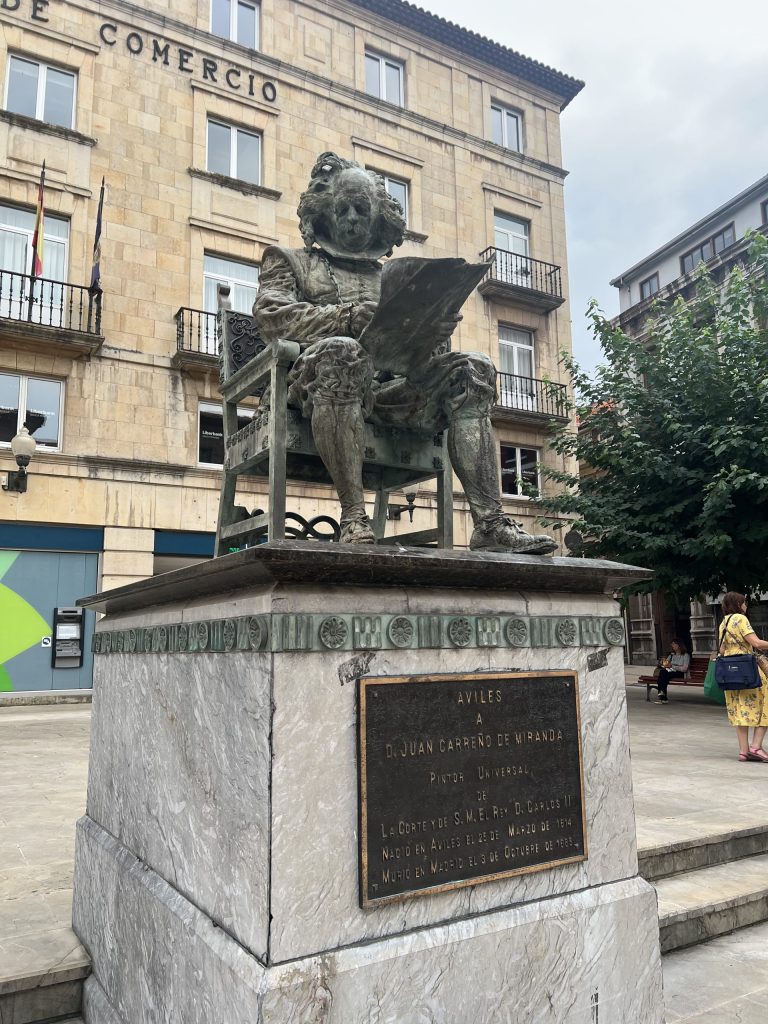
One of the most visible tributes can be found in Plaza de Camposagrado, where a bronze sculpture by Vicente Menéndez-Santarúa depicts the painter seated and working with a sketchbook. Installed in 2000, the monument commemorates the connection between Carreño and his hometown in the heart of its historic center.
His name also appears on the streets of Avilés. But there is another, rather more unusual tribute that is particularly appropriate to the story we are telling. Avilés remembers not only the painter, but also one of the most famous people ever to sit for him.
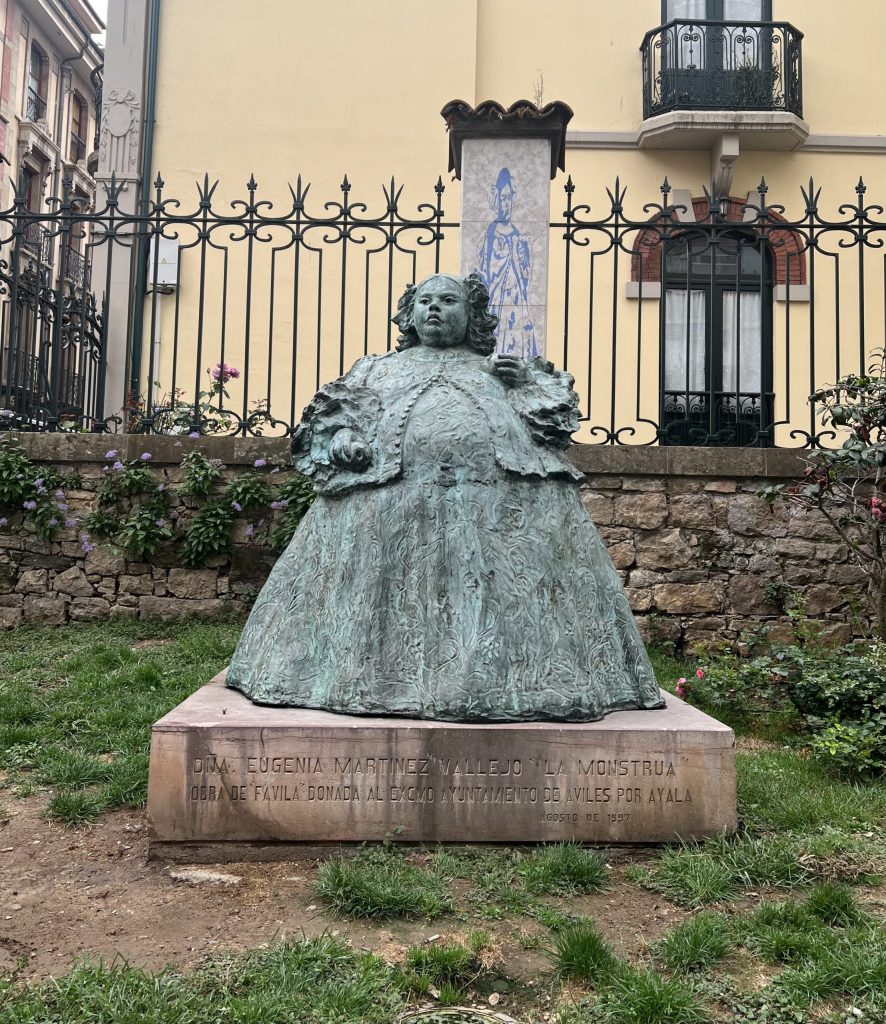
The city is home to a sculpture of Eugenia Martínez Vallejo, created by Amado González Hevia, Favila, and inspired by the famous portrait of La Monstrua. In this way, painter and model have been symbolically reunited in Avilés more than three centuries after their encounter at the court of Charles II.
Their presence in the city shows just how deeply Carreño Miranda remains part of Avilés’ cultural memory. But to understand the painter who would eventually portray Eugenia, we must now leave Asturias, just as he did during his childhood.
Moving to Madrid and Training as a Painter
Carreño moved to Madrid with his family while he was still young. There, he encountered a city profoundly shaped by the presence of the royal court. Churches, convents, aristocrats, and the monarchy itself generated a demand for art that Avilés in the early seventeenth century could hardly have matched.
His training began in the workshop of Pedro de las Cuevas, a particularly important master because of the number of artists who studied under him. He later continued his education with Bartolomé Román, a painter known primarily for his religious compositions and connected to some of Madrid’s leading artistic circles.
The Masters of a Young Carreño Miranda
A seventeenth-century painter’s education involved far more than receiving lessons from a master. Young artists learned by copying, working in workshops, and studying the paintings available to them. Madrid offered him an extraordinary advantage in this respect: proximity to the Royal Collections, which generations of Spanish monarchs had enriched with masterpieces from across Europe.
Titian, Rubens, and Van Dyck formed part of that visual world. Their approaches to color, composition, and especially portraiture left a profound mark on Spanish court painting. Carreño Miranda was able to absorb those influences without becoming a mere imitator of any of them.
Gradually, he left his years as an apprentice behind and began to establish a reputation of his own. The young man born in Avilés was ready to begin an independent career as a painter in Madrid. Charles II and La Monstrua were still decades away: his first successes would come through very different kinds of painting.
Carreño Makes His Way as a Painter in Madrid
Once his training was complete, the young artist began to receive commissions of his own. He was still far from the royal court and the portraits that would eventually bring him greater fame. During this first stage of his professional life, it was mainly religious painting that allowed him to demonstrate his abilities and establish himself among the artists working in Madrid.
Churches and convents required large canvases for altarpieces, chapels, and altars. The painter from Avilés found in these commissions an opportunity to develop ambitious compositions and experiment with color. Works devoted to saints, the Virgin, and episodes from the Scriptures occupied a considerable part of his production and show that his career cannot be understood solely through his portraits of the royal family.
Carreño’s First Commissions
During the 1640s and 1650s, his reputation began to grow. His work included paintings for various religious institutions in Madrid, as well as commissions that gradually brought him closer to circles connected with the monarchy.
These years also helped him develop a style of his own. The tradition of the Madrid school coexisted with his knowledge of Venetian and Flemish painting, which he had been able to study in the royal collections. Color and movement became increasingly important and would later play a significant role in his portraits as well.
But canvas was not the only medium in which he worked. One professional partnership would allow him to take part in much more ambitious decorative projects while bringing him a little closer to the king’s circle.
Francisco Rizi: A Decisive Collaboration
Francisco Rizi became one of the most important collaborators of his career. Together, they participated in major fresco decorations, a demanding discipline that required artists to work across monumental surfaces and coordinate complex decorative programs.
Their collaboration led them to work in places directly connected with the monarchy, including the Royal Alcázar of Madrid. Velázquez himself played an important role in some of these decorative projects. For the Asturian painter, working in such spaces meant more than securing a prestigious commission: it brought him into direct contact with the artistic and political heart of the Spanish Monarchy.
A considerable part of these decorations has been lost, particularly as a result of the fire that destroyed the Alcázar in 1734. The portraitist we know today therefore represents only one side of an artist whose contemporaries also valued him for monumental works that we can no longer see.
Carreño and the Madrid of Velázquez
The figure of Diego Velázquez inevitably dominated the artistic environment of the royal court. By the time Carreño was building his career, the Sevillian painter had been working for Philip IV for years and had achieved an exceptional position, not only as an artist but also as a servant of the king.
Their careers crossed paths, but Carreño should not be presented as a disciple of Velázquez. He had received an independent artistic education and had already developed a career of his own. Velázquez’s influence should instead be understood through the courtly environment in which both men worked and through an approach to royal portraiture that would leave a profound legacy after his death.
Velázquez died in 1660. By then, the young man who had once arrived from Avilés was already an experienced and respected artist. During the following decade, his career would take its decisive step forward: after years of working in Madrid and participating in projects connected with the Crown, he would finally enter the official service of the monarchy.
1669: Carreño Miranda Enters the King’s Service
The major turning point in his career came in 1669, when he was appointed painter to the king. He was already 55 years old. This was not, therefore, the sudden success of a young artist, but the recognition of a career built over decades through religious commissions, large decorative projects, and works connected with the Crown.
The court he entered was very different from the one he had known during the years of Velázquez. Philip IV had died in 1665, and the throne belonged to his son Charles II, who was only four years old when he inherited the Crown. Because of his young age, his mother, Mariana of Austria, assumed the regency.
His Appointment as Painter to the King
Officially entering the service of the monarchy meant reaching a privileged position within the Spanish artistic world. The appointment brought prestige, but it also placed the painter before new responsibilities and models whose representation had a significance that went far beyond physical resemblance.
A portrait of the royal family was also a political image. It could be sent to other European courts, used in marriage negotiations, or displayed as a representation of royal power wherever the monarch could not be physically present. Clothing, posture, setting, and attributes all helped identify not only an individual, but also that person’s position within the dynasty.
For the artist, this marked the beginning of a period in which court portraiture would become increasingly important. The experience accumulated over so many years now found a different purpose: his models would be the people at the very heart of the monarchy.
Mariana of Austria and the Court Carreño Encountered
Mariana of Austria was one of the central figures of this new stage. Following the death of her husband, Philip IV, she had gone from queen consort to regent during the childhood of Charles II. Her portraits had to reflect that transformation.
The painter depicted her wearing the widow’s headdress that came to characterize her image during these years. The austerity of her black clothing contrasts with the palatial settings and elements that emphasize her position. Mariana appears as a particular woman, but also as the person exercising power on behalf of her son.
These portraits show how painting was beginning to occupy a different place in the professional life of the artist from Avilés. After decades of depicting religious scenes and participating in monumental decorative projects, he now had to portray real individuals on a regular basis while simultaneously transforming them into images of power.
Only two years after his first royal appointment, his position improved once again. In 1671, he was appointed court painter, reaching one of the most important positions available in his profession. From then on, his life and work would become closely connected with those of the young Charles II.
1671: Carreño Miranda Becomes Court Painter
The new appointment brought the painter even closer to the royal family. He was 57 years old and had reached the period of greatest recognition in his career. The child who had left Asturias decades earlier now held a position reserved for a very small number of artists.
His principal model during these years would be Charles II. The image we have inherited of the last Habsburg king to rule Spain owes much to the portraits produced during this period.
Charles II Becomes One of His Great Models
Charles had highly distinctive physical features, related to the high degree of consanguinity accumulated over generations by the Habsburg dynasty. The family’s characteristic prognathism was particularly evident in the young monarch and presented the portraitist with a delicate problem: he had to preserve a recognizable likeness while remembering that he was creating the official image of a king.
The artist did not completely conceal these features. In his portraits, we can still recognize Charles II’s elongated face and pronounced jaw. But everything surrounding the sitter works in a different direction. His black clothing, long hair, the Order of the Golden Fleece, curtains, and palatial settings all emphasize the dignity of the man before us.
The aim was not simply to make Charles look more attractive, but to make his status as monarch visible. This tension between the individual and the king makes these portraits some of the most fascinating documents of the Spanish court in the late seventeenth century.
The Painter’s Years of Greatest Prestige
During the 1670s, the artist from Avilés was firmly established within the court. His position allowed him to portray the royal family repeatedly, as well as other figures close to them, while he continued to undertake commissions of a different nature.
This was also the period in which his name became permanently associated with portraiture. Paradoxically, his later fame has partly obscured the earlier decades of his career. Anyone looking today at his portraits of Charles II in the Prado Museum might easily imagine an artist primarily devoted to painting aristocrats and members of the royal family. His biography shows that this success was actually the culmination of a much longer professional journey.
And one person was still to appear who would become the subject of his two most unusual portraits. Around 1680, a young girl arrived at court whose extraordinary physical appearance aroused enormous curiosity. Her name was Eugenia Martínez Vallejo.
1680: Carreño Miranda Paints Eugenia Martínez Vallejo, Known as “La Monstrua”
Around 1680, when he was already in the final stage of his career, Carreño received one of the commissions that would eventually bring him the greatest fame. His model was Eugenia Martínez Vallejo, a six-year-old girl whose extraordinary size had aroused such curiosity that she was brought to the court of Charles II.
The two portraits that resulted from that encounter are now among the painter’s best-known works. They are also paintings that require context if we are to understand what we are looking at and, above all, what they tell us about the society that commissioned them.
A Warning: We Explain These Paintings So That We Can Be Critical of Them
Understanding a work of art does not mean justifying the world that produced it. Sometimes the opposite is true: understanding its context allows us to see more clearly the behaviors of the past that we can and should question today.
This is one of those cases. We are talking about a six-year-old girl whose body was turned into an object of curiosity and entertainment. Eugenia attracted attention precisely because her appearance differed from what her contemporaries considered normal, and that fascination eventually led to her body being described, exhibited, and ultimately represented in two paintings.
That is why we want to examine these works carefully. Art history also helps us understand how past societies looked at people they considered different. Understanding that gaze can help us recognize behaviors that should not be repeated. We are critical of the objectification of anyone’s body, all the more so when we are talking about a child turned into a spectacle for the adults around her.
The paintings are of enormous historical and artistic interest. That is precisely why they deserve to be viewed without ever forgetting who the person inside them was.
Eugenia Martínez Vallejo Arrives at the Court of Charles II
Eugenia was born in 1674 in Bárcena, in present-day Cantabria. During her childhood, she developed extraordinary obesity and, when she arrived in Madrid in 1680 at just six years old, she weighed nearly 70 kilograms. Her appearance quickly attracted the attention of the court.
That curiosity had several dimensions. For centuries, European courts had included people with physical characteristics considered exceptional as part of their entertainment. But during the sixteenth and seventeenth centuries there was also a pre-scientific interest in observing and describing anything that seemed to deviate from what was considered the normal order of nature.
These two ways of looking at Eugenia could overlap. She was a person, yet her contemporaries could regard her body as a rarity worthy of observation, description, and preservation through an image. Indeed, her arrival in Madrid prompted the publication of texts describing her.
We also know that it was Charles II who ordered Carreño to produce two portraits of Eugenia, one clothed and the other nude. Painting therefore acquired a purpose that went beyond traditional portraiture: it could create a visual record of something the court regarded as extraordinary.
The Two Portraits of Eugenia Martínez Vallejo
Carreño portrayed Eugenia in two radically different ways. In one painting, she wears a luxurious red dress decorated with golden details while holding fruit in her hands. In the other, she is nude, crowned with vine leaves and holding bunches of grapes, attributes that identify her with Bacchus.
The two paintings were conceived to work together. Clothing and nudity, reality and mythology, courtly luxury and the body confront one another in two images constructed around the same person. What the court may have regarded as a visual game and a representation of something extraordinary becomes considerably more uncomfortable when we remember that the model was six years old.
The way these paintings were perceived also changed over time. In 1827, when works kept at La Zarzuela were being selected for the Prado Museum, the clothed portrait was accepted, while the nude was excluded because it was considered inappropriate. Ferdinand VII eventually gave the latter painting to the artist Juan Gálvez.
The two portraits remained separated for more than a century. It was not until 1939 that a donation made it possible to reunite them at the Prado Museum.
Today, we can once again see the two paintings together. They allow us to appreciate Carreño’s extraordinary abilities as a portraitist, but they also force us to confront a much less comfortable aspect of the society in which he lived. Eugenia Martínez Vallejo was not simply “La Monstrua”: she was a child whom her time chose to look at in that way.
The Final Years of Carreño Miranda
During the first half of the 1680s, the painter continued to work from the prestigious position he had achieved at court. He was already in his late sixties and belonged to a generation that was gradually beginning to disappear.
His former collaborator Francisco Rizi remained another major figure in court painting, while younger artists such as Claudio Coello were becoming increasingly prominent. A generational shift was taking place in Spanish court painting.
A Painter Who Continued to Work for the Court
Age did not lead to immediate retirement. He continued to paint portraits and accept commissions during his final years, maintaining the position he had earned after an extraordinarily long career. By then, the image of Charles II had become closely associated with the formulas he had helped establish.
Some of these paintings passed from royal residences into the Royal Collections and, eventually, the Prado Museum. Their provenance helps explain why Madrid today preserves such an important group of works for reconstructing the final stage of the artist’s life.
His career, however, was approaching its end. Francisco Rizi died in August 1685. Only a few weeks later, the painter born in Avilés would also pass away.
October 3, 1685: Carreño Miranda Dies
On October 2, 1685, seriously ill, the artist made his will in Madrid. He died the following day, October 3, at the age of 71. A life that had begun in Avilés and had taken him from Madrid’s workshops to the rooms of the royal family had come to an end.
His death also marked the end of an era in Spanish court painting. Other artists, particularly Claudio Coello, would become increasingly prominent during the final years of Charles II’s reign. Fifteen years later, the king himself would die without an heir, bringing the Spanish branch of the Habsburg dynasty to an end.
Carreño did not live to see that outcome. His legacy remained scattered across churches, convents, former royal residences, and collections. An essential part of it would eventually come together at the Prado Museum, where his portraits still allow us to follow the final twenty years of his life: Mariana of Austria, Charles II, and Eugenia Martínez Vallejo continue, in a sense, to tell the story of the man who painted them.
From Avilés to the Prado Museum: The Legacy of Carreño Miranda
The life of Juan Carreño de Miranda had followed a path that would have been difficult to imagine when he left Avilés, Asturias, as a child. He trained as a painter in Madrid, spent decades building his reputation, entered the service of the Crown when he was already in his fifties, and eventually became one of the leading figures responsible for shaping the image of the court of Charles II.
His paintings allow us to trace much of that journey. His religious works recall the long years before he entered the royal court; the portraits of Mariana of Austria and Charles II belong to the period of greatest professional recognition; and La Monstrua appeared when the artist was already approaching the end of his life. Today, many of those works can once again be found under the same roof at the Prado Museum.
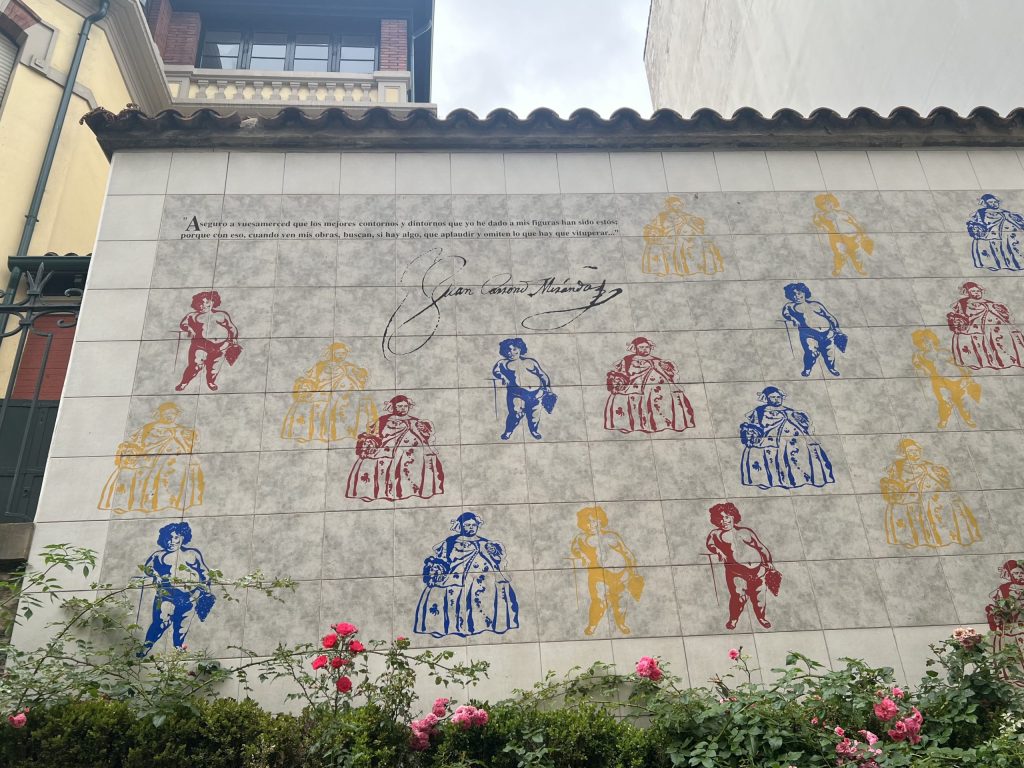
But his memory also returned to the place where everything had begun. The sculptures, streets, and tributes found in Avilés today keep the painter present in his hometown. That is why every October 3, the anniversary of his death offers an opportunity to remember not only the great portraitist of Charles II, but the full life of the man from Avilés who became court painter to one of the last kings of the Spanish Habsburg dynasty.
🎨 Discover the Prado Museum with The Guides You Need
Would you like to discover the stories behind Carreño Miranda and the other great masters of the Prado Museum? At The Guides You Need, we believe a Guided Tour should be much more than a succession of names and dates.
🏛️ Guided tours of the Prado Museum
🎟️ Admission included and tickets purchased in advance
👥 Small groups of no more than 7 people
🗣️ Tours in English, Spanish, French, and Italian
🖼️ Velázquez, Goya, Rubens, Titian, Bosch, and many more
Our guides use the artworks to explore the people, conflicts, and stories behind them. Because understanding a painting also means understanding the world in which it was created.
👉 Book here your guided tour of the Prado Museum with The Guides You Need and discover one of the world’s great art collections with a professional guide.