Retiro Park is one of Madrid’s great landmarks, but it is also a place full of stories, monuments and hidden corners that can easily go unnoticed during a simple stroll. From the Crystal Palace to the Great Pond and the famous Fallen Angel statue, its gardens preserve part of the history of the city and the Spanish monarchy.
Retiro Park is also part of the Landscape of Light, declared a UNESCO World Heritage Site together with Paseo del Prado and some of Madrid’s most important cultural and scientific buildings. In this article, we answer 10 frequently asked questions about Retiro Park: how much it costs to enter, how long you need to visit it, what you can do there and which monuments are particularly worth seeing.
In this article
What Were the Gardens of the Buen Retiro?
The Gardens of the Buen Retiro were part of the royal estate created during the reign of Philip IV in the 17th century. They extended around the Buen Retiro Palace and formed a vast courtly space with ponds, canals, fountains, hermitages and areas designed for royal entertainment and spectacles. The Great Pond, which can still be visited today in the park, dates back to this original complex.
However, we should not imagine that today’s park reproduces those gardens. The area was altered over the centuries and underwent profound transformations before gradually acquiring its present appearance. To understand how these royal gardens eventually became one of the great parks of Madrid, we must first look at the palace around which they developed.
What Was the Buen Retiro Palace?
The Buen Retiro Palace was built mainly during the 1630s at the initiative of Philip IV and his favourite, the Count-Duke of Olivares. Conceived as a royal residence for leisure and recreation, it soon acquired an important ceremonial function and became one of the great settings in which the Spanish Habsburg monarchy displayed its power.
Art played a fundamental role in this representation. One of the finest examples was the Hall of Realms, which was decorated by some of the leading painters of the period. Velázquez painted The Surrender of Breda, while Zurbarán created his celebrated series of the Labours of Hercules. Other artists contributed to an ambitious decorative programme celebrating military victories and the continuity of the monarchy.
What Remains of the Buen Retiro Palace?
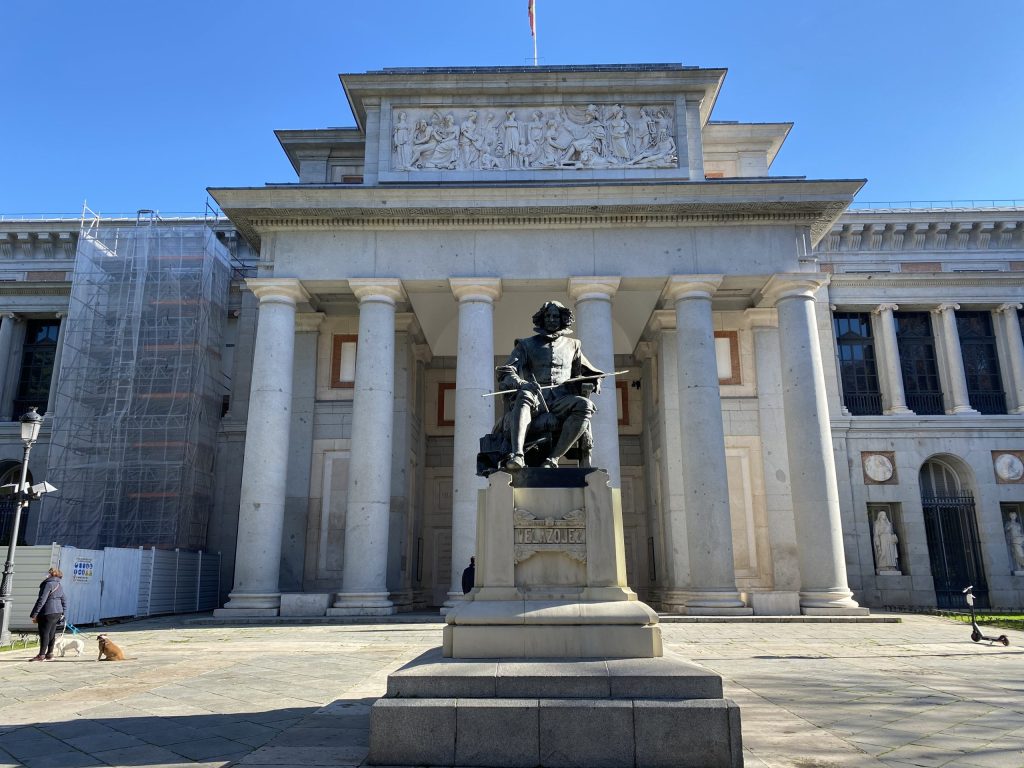
Only two major buildings survive from the enormous palace complex: the Hall of Realms and the Casón del Buen Retiro. Both stand beside the Prado Museum and outside the present boundaries of Retiro Park, making it difficult today to imagine the vast scale of the original complex.
Both buildings are now connected to the Prado Museum. The Hall of Realms preserves the memory of the great artistic programme created during the reign of Philip IV, while the Casón contains a spectacular ceiling painted by Luca Giordano in the late 17th century. They are two exceptional remnants of an almost entirely lost palace and help us understand the historical relationship between this part of Madrid, the Prado and today’s Retiro Park.
When Did Retiro Become a Municipal Park?
The decisive change came with the Revolution of 1868, known as the Glorious Revolution. Following the overthrow of Isabella II, the gardens were transferred to Madrid City Council and became a public space. The former royal gardens were thus definitively incorporated into the everyday life of the city.
During the following decades, Retiro Park continued to evolve. New monuments and buildings were added, including Velázquez Palace and the Crystal Palace, adding new layers to a space whose origins stretched back more than two centuries. This historical evolution is also one of the keys to understanding why Retiro Park is now part of the Landscape of Light.
What Can I Do in Retiro Park?
Retiro Park offers much more than a walk among the trees. Across its 125 hectares, you can visit some of the best-known sights in Madrid, including the Great Pond, the Monument to Alfonso XII, the Crystal Palace, Velázquez Palace and the Fountain of the Fallen Angel. You can also explore historic gardens such as the Parterre, the Rose Garden and the Cecilio Rodríguez Gardens.
One of the park’s most popular activities is renting a rowing boat on the Great Pond, but it is well worth exploring the park on foot to discover its historical and artistic heritage. Retiro originated as part of the former Buen Retiro Palace complex and, after centuries of transformation, is now part of the Landscape of Light, declared a UNESCO World Heritage Site in 2021. Its proximity to the Prado Museum also makes it easy to combine both places in a single visit.
How Much Does It Cost the Ticket?
There is no ticket to go in, is free. You do not need to buy a ticket or make a reservation to enter its gardens, so you can explore one of the most important green spaces in Madrid freely during opening hours.
Admission to buildings such as the Crystal Palace and Velázquez Palace is also free when they are open to the public. However, some activities inside the park, such as renting a rowing boat on the Great Pond, do have an additional cost.
How Long Does It Take to Visit The Whole Park?
To see the main attractions in there, we recommend allowing approximately one and a half to two hours. This gives you enough time to explore highlights such as the Great Pond, the Monument to Alfonso XII, the Crystal Palace, Velázquez Palace and some of its historic gardens at a comfortable pace.
However, the amount of time you need will depend on what you want to do. Retiro covers around 125 hectares, so a more complete visit can easily take several hours. If you also want to go rowing, stop at its exhibitions or explore the park’s history and monuments in greater detail, it is worth setting aside at least a morning or an afternoon.
Where Is It?
Retiro Park is located in the heart of Madrid, in the Retiro district and very close to the Prado Museum. The park has several entrances, including those near Puerta de Alcalá, Calle O’Donnell, Avenida de Menéndez Pelayo and Plaza de la Independencia.
Its location makes it easy to combine a visit with some of the city’s most important museums and cultural attractions. In fact, Retiro Park and Paseo del Prado together form the Landscape of Light, declared a UNESCO World Heritage Site in 2021. This area brings together gardens, monuments and some of Madrid’s most important cultural and scientific buildings.
What Interesting Monuments Can You See There?
It is filled with monuments, fountains and historic buildings that reflect different periods in the history of Madrid. Among the best known are Velázquez Palace, the Crystal Palace, the Artichoke Fountain, the equestrian statue of General Martínez Campos and the Fountain of the Fallen Angel. However, two monuments deserve particular attention for their scale, history and unusual design.
The Monument to Alfonso XII: the Great Stage of the Pond
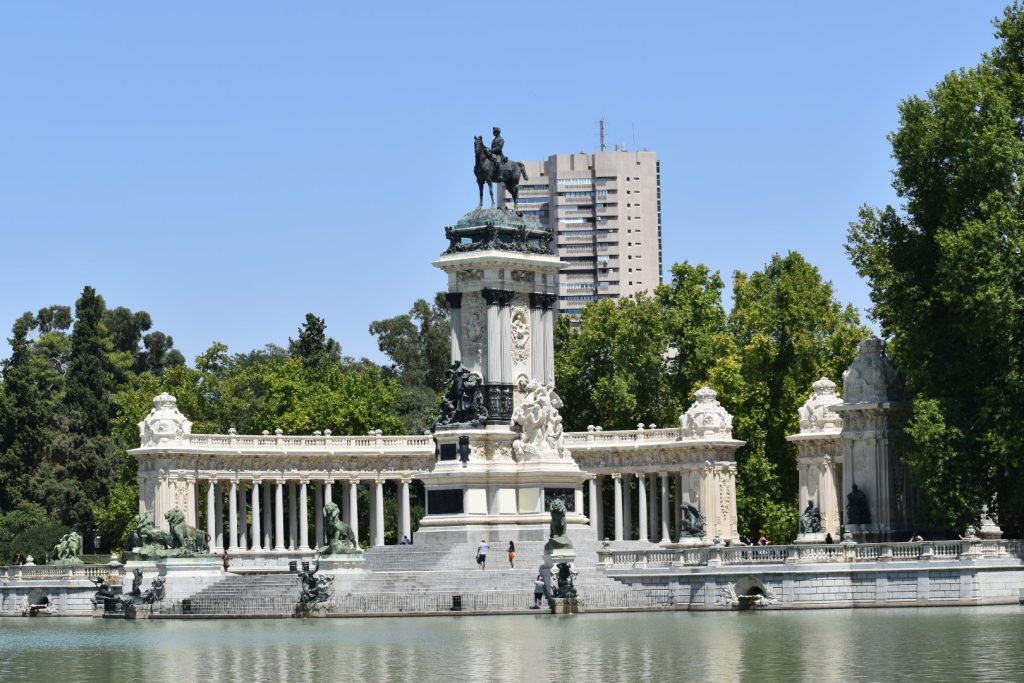
The Monument to Alfonso XII is probably the most imposing monumental ensemble in Retiro Park. Standing beside the Great Pond, it was designed by architect José Grases Riera in the early 20th century as an enormous commemorative space dominated by the figure of the king. Its design combines a large semicircular colonnade with staircases, reliefs and numerous sculptures created by different artists.
At its centre stands the equestrian statue of Alfonso XII by Mariano Benlliure, raised high above the surrounding ensemble. The monument’s setting is fundamental to its design: the architecture opens towards the Great Pond, incorporating the water and the park itself into the composition. Rather than simply being a statue of a king, it is one of the great sculptural and architectural ensembles of Madrid.
The Monument to the Álvarez Quintero Brothers: a Theatrical Scene in Retiro Park
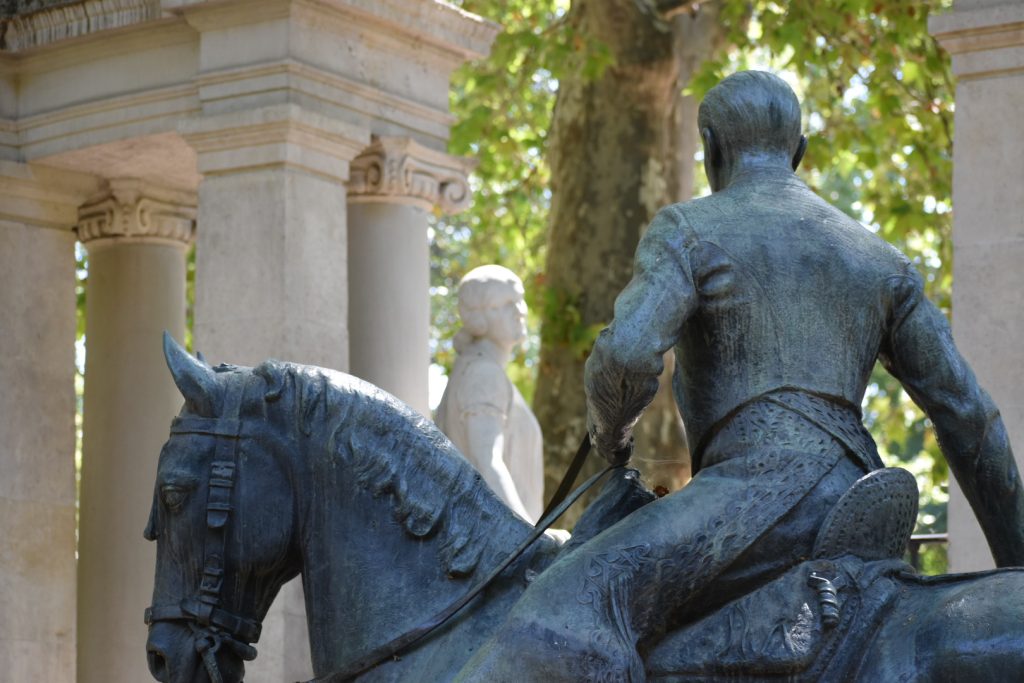
Far less famous is the monument to Serafín and Joaquín Álvarez Quintero, the celebrated playwrights from Seville who achieved enormous popularity between the late 19th and early 20th centuries. Created by sculptor Lorenzo Coullaut Valera and unveiled in 1934, the monument takes a very different approach from the conventional memorial dedicated to writers.
The brothers themselves appear as busts, but the true visual focus is a scene inspired by the world of their plays: a woman leans out from a balcony while a horseman approaches below. The architecture, figures and surrounding vegetation turn the monument into something resembling a small open-air stage.
This choice makes the tribute particularly interesting. Coullaut Valera did not simply portray the two playwrights; he also gave physical form to the theatrical and Andalusian world with which they were associated. The result is one of the most distinctive monuments in Madrid, yet also one of the easiest to overlook during a visit.
What Is Its History?
Its history is closely linked to the Spanish monarchy. Its origins date back to the 17th century, when the Buen Retiro Palace was built during the reign of Philip IV as a vast complex designed for the leisure and entertainment of the royal court. Gardens, ponds and spaces for festivities, theatrical performances and other spectacles developed around the palace.
The complex suffered extensive damage during the Peninsular War, and much of the former palace eventually disappeared. The gardens also underwent major transformations over time. In 1868, following the Glorious Revolution, they were transferred to Madrid City Council and opened to the public, marking the beginning of Retiro’s transformation into the great urban park we know today.
Where Does Its Name Come From?
The name Retiro Park can be traced back to the former Royal Site of Buen Retiro, created during the reign of Philip IV in the 17th century. Retiro literally means “retreat”, which perfectly describes the original purpose of the site: a place where the king and his court could escape, at least temporarily, from the formalities and obligations of court life.
The Buen Retiro Palace was therefore conceived as a royal residence for leisure and entertainment on what was then the eastern outskirts of Madrid. The palace itself has almost entirely disappeared, but its name has proved far more enduring. Retiro eventually came to identify not only the park that grew out of the former royal gardens, but also the surrounding district of Madrid.
What Is the Crystal Palace?
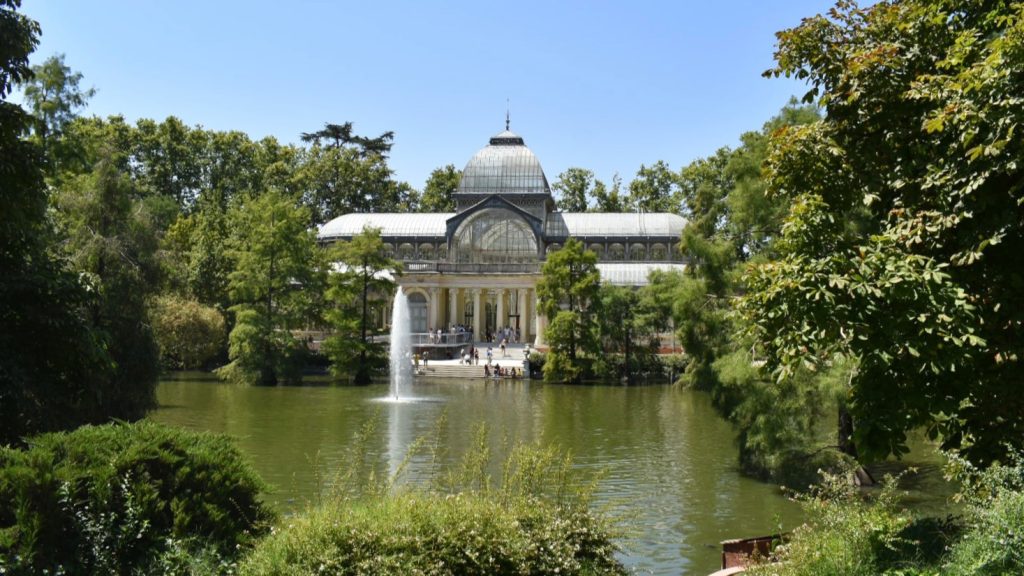
The Crystal Palace is one of the most recognisable buildings in the Retiro. It was designed by architect Ricardo Velázquez Bosco in 1887 for the General Exhibition of the Philippine Islands. Its striking iron-and-glass structure was originally intended to house a display of tropical plants from the Philippines, which at the time was under Spanish colonial rule.
The building therefore belongs to the tradition of the great international exhibitions of the 19th century and cannot be separated from the colonial context in which it was created. Today, the Crystal Palace is managed by the Reina Sofía Museum and is used as an exhibition space. Its architecture and exceptional setting beside a small lake have also made it one of the most photographed landmarks in Madrid.
Can You Go Rowing on the Great Pond in Retiro Park?
Yes. One of the most popular activities in Retiro Park is renting a rowing boat on the Great Pond, directly in front of the Monument to Alfonso XII. Boat rental is not free and allows visitors to row around one of the park’s most iconic spaces for a limited period of time.
The Great Pond, however, has a much longer history than today’s recreational boats. It was created in the early 17th century as part of the Buen Retiro complex and was once used for elaborate water spectacles and performances organised for the royal court. Today’s rowing boats are therefore just the latest chapter in the history of a place originally designed for royal entertainment.
Where Is the Fallen Angel Statue?
The Fountain of the Fallen Angel stands in the Glorieta del Ángel Caído, in the southern part of the park. At its centre is a sculpture by Ricardo Bellver inspired by John Milton’s Paradise Lost, depicting Lucifer at the moment of his fall. Bellver created the work in Rome, and it earned him a First-Class Medal at Spain’s National Exhibition of Fine Arts in 1878.
The sculpture was later cast in bronze and installed on a fountain designed by Francisco Jareño. Its unusual subject has inspired numerous legends, including the famous claim that the monument stands exactly 666 metres above sea level. It makes for a good story, but the figure is not exact, and there is no evidence that the location was deliberately chosen for that reason.
Did You Know There Is a Copy at the Royal Academy of Fine Arts of San Fernando?
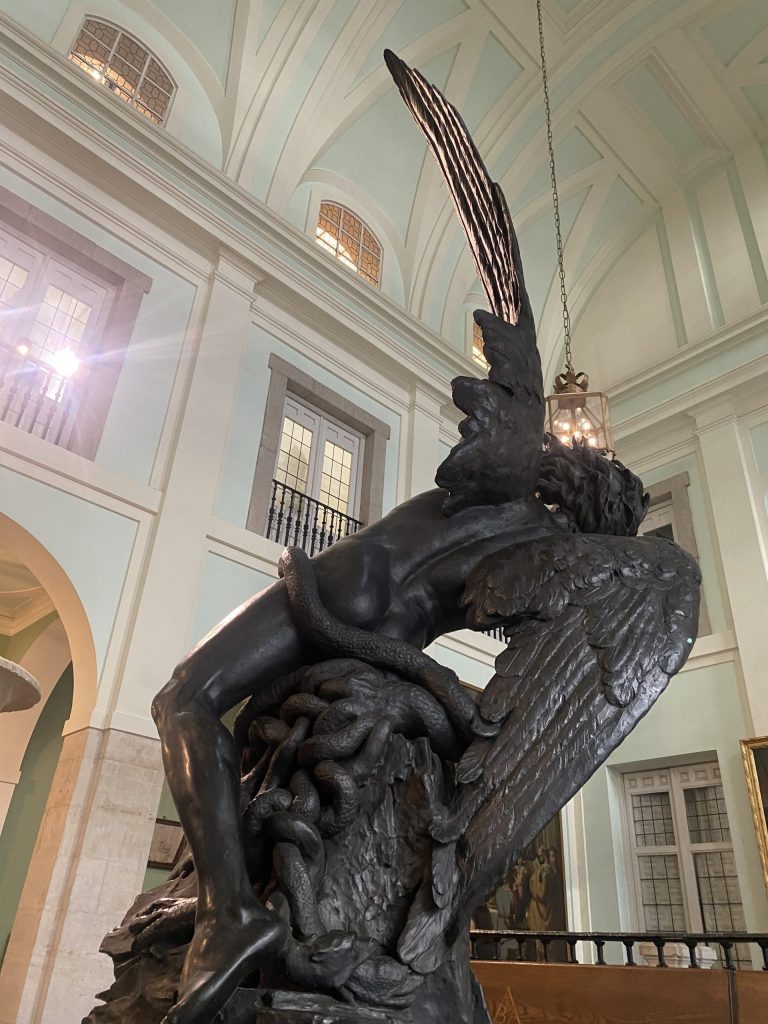
Before the bronze version now standing in Retiro Park, Bellver created the original model in plaster. This work belongs to the collection of the Royal Academy of Fine Arts of San Fernando in Madrid, where visitors can see the sculpture without the fountain and from much closer range.
Comparing the two versions is particularly revealing. In Retiro Park, the Fallen Angel has become a public monument; at the Academy, you can focus on Bellver’s sculpture itself and appreciate more clearly the tension of Lucifer’s body, the expression on his face and the serpent coiling around him.
When Is the Best Time to Visit?
Retiro Park can be visited throughout the year, although each season offers a different experience. Spring and autumn are probably the best times to explore it, thanks to Madrid’s generally milder temperatures and the changing colours of its gardens. In summer, it is advisable to avoid the hottest hours in the middle of the day.
As for the time of day, early mornings usually offer a quieter experience, while afternoons and weekends tend to be busier. If you also want to visit places such as the Crystal Palace or enter other buildings in the park, it is worth checking their opening hours beforehand, as they do not necessarily match those of Retiro Park itself.
Guided Tour of the Prado Museum and Retiro
After exploring its origins as a royal garden, its monuments and some of the buildings that shaped its history, one final question remains: is a guided tour of Retiro Park worth it? For us, the answer is clear. Retiro is a wonderful place to explore on your own, but much of what we have discussed in this article can easily go unnoticed if you are unfamiliar with its history.
At The Guides You Need, we offer an experience that combines Retiro Park with the Prado Museum. Our tour begins with a guided visit to the Prado Museum and continues with a walk through Retiro Park. The two are only a few minutes apart on foot, and their histories are far more closely connected than they might initially seem.
From the Prado Museum to Retiro
The connection is not merely geographical. As we have seen, today’s Retiro Park developed from the gardens surrounding the Buen Retiro Palace, while two surviving buildings from that complex — the Hall of Realms and the Casón del Buen Retiro — are now associated with the Prado Museum. Centuries later, Paseo del Prado and Retiro have once again been brought together as part of the Landscape of Light, declared a UNESCO World Heritage Site.
Visiting both places consecutively therefore reveals two different sides of Madrid’s history. Inside the Prado, we encounter works commissioned, acquired and collected by the Spanish monarchy; outside, we walk through a landscape that was itself created for the royal court. Some of the paintings now hanging in the Prado were, in fact, originally commissioned to decorate the Buen Retiro Palace.
A Different Way to Experience Retiro Park
A guided tour of the park is not simply about pointing out buildings or listing dates. It allows us to reconstruct a place that has changed dramatically over almost four centuries, from the private gardens of Philip IV to the public park enjoyed by millions of people today.
The Great Pond is no longer simply the place where visitors rent rowing boats; the surviving traces of the Buen Retiro help us imagine the scale of the former royal estate; and monuments such as those dedicated to Alfonso XII and the Álvarez Quintero brothers reveal how successive generations continued to reshape the park.
That is precisely the aim of the visit: after the tour, Retiro should still be a wonderful place to walk, relax or sit beneath a tree, but also a place where you can recognise the stories hidden behind the spaces and monuments you pass.
Museum, History and Nature in a Single Tour
Combining the Prado and Retiro also offers a different way to organise a cultural day in Madrid. After exploring the galleries of one of the world’s great art museums, the second part of the experience takes place outdoors, among gardens, sculptures and monuments.
With The Guides You Need, you can experience both places accompanied by a professional guide. If you want to understand the Prado Museum while also seeing how its history continues beyond its walls, our Prado Museum and Retiro guided tour brings these two essential parts of Madrid together in a single experience.