At the beginning of the 20th century, Pablo Picasso and Georges Braque began to dismantle one of the great certainties of Western painting: that a picture should represent reality as we perceive it from a single point of view. Analytical Cubism took this rupture much further, fragmenting objects, figures, and spaces to construct an entirely new way of seeing.
But this revolution did not take place only inside the artists’ studios. While Picasso and Braque experimented with the possibilities of painting, Guillaume Apollinaire helped defend and spread this new artistic language through criticism and theory. Together, they provide many of the keys to understanding how a movement that initially bewildered audiences eventually exerted an enormous influence on 20th-century art.
What exactly is Analytical Cubism? What are the three types of Cubism? What is the difference between Analytical and Synthetic Cubism? Throughout this article, we will answer these questions and, above all, address a more ambitious one: why did Analytical Cubism triumph and change the rules of painting forever? To find out, we will also explore some of the works that can be seen today at the Reina Sofía Museum and the Thyssen-Bornemisza Museum.
In this article
What Is Analytical Cubism?
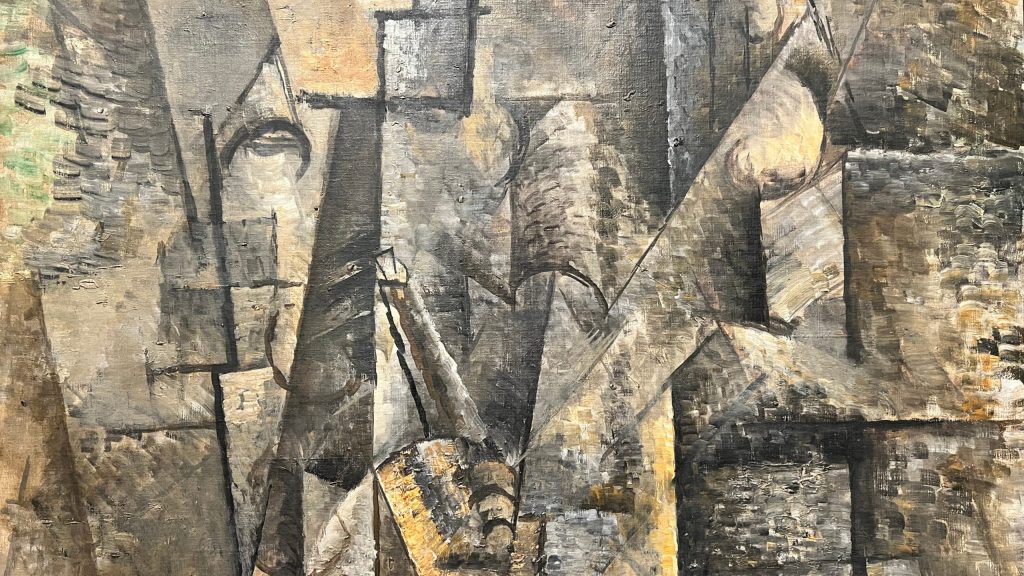
Analytical Cubism is one of the fundamental stages of Cubism, developed primarily by Pablo Picasso and Georges Braque between 1909 and 1912. During these years, both painters took an idea they had already been exploring to its furthest consequences: an object did not have to be represented from a single point of view. It could be observed, broken down, and reconstructed on the canvas, showing different perspectives simultaneously.
The result was a type of painting increasingly removed from traditional representation. Faces, musical instruments, bottles, tables, and landscapes were fragmented into numerous planes that seemed to merge with the space around them. Depth was no longer constructed according to the traditional rules of perspective, while color lost some of its prominence. Browns, grays, ochres, and muted greens allowed Picasso and Braque to concentrate on the structure of what they were representing.
Pablo Picasso, Georges Braque, and Apollinaire: The Protagonists of a Revolution
The emergence of Analytical Cubism cannot be understood simply as a succession of formal innovations. Behind this transformation was the extraordinarily close collaboration between Picasso and Braque, but also an intellectual environment willing to question what a work of art should be. In this context, Guillaume Apollinaire played a fundamental role as a poet, critic, and defender of the new avant-garde movements.
Picasso and Braque transformed painting through their canvases; Apollinaire helped build a critical discourse capable of defending that transformation. Their roles were different, but all three are essential to understanding not only the birth of this new artistic language, but also its subsequent influence.
Picasso and Braque: The Revolution Through Painting
During these years, the artistic relationship between Pablo Picasso and Georges Braque was exceptionally close. They shared their investigations, observed each other’s work, and developed such similar pictorial solutions that some of their paintings from this period can be difficult to distinguish at first glance. Braque would later compare their collaboration to two mountaineers tied together by the same rope.
Their aim was not simply to distort objects. The challenge was much deeper: to question the need to reproduce what the eye saw from a fixed position. A guitar, for example, could show different parts and perspectives simultaneously. The viewer had to mentally reconstruct what the artist had fragmented across the surface.
This transformation challenged one of the foundations of Western painting since the Renaissance: the idea of the picture as a kind of window opening onto a coherent space. With Picasso and Braque, the canvas increasingly asserted its condition as a surface on which a different reality could be constructed.
Apollinaire: The Revolution Through Theory and Criticism
Guillaume Apollinaire did not invent Cubism alongside Picasso and Braque, but he became one of its great defenders and theorists. Personally close to many artists of the Parisian avant-garde, he quickly understood that these new experiments could not be judged solely according to the rules of traditional painting.
His importance reached a crucial point with the publication of Les Peintres cubistes. Méditations esthétiques in 1913. Apollinaire sought to explain and defend these new forms of representation and helped place Cubism within a much broader artistic transformation. New painting also required new tools with which to interpret it.
This combination is essential to understanding its later success. Picasso and Braque were changing the way people painted; Apollinaire helped change the way people thought and spoke about painting. Cubism thus began to move beyond an experiment conducted by a handful of artists and became one of the great debates in 20th-century European art.
What Are the Main Characteristics of Analytical Cubism?
Although works from this period can differ considerably, several features help us identify Analytical Cubism. The first is the fragmentation of figures into numerous geometric planes. The second is the simultaneous use of different points of view, breaking with traditional perspective. This is accompanied by a generally limited palette dominated by ochres, browns, and grays, as well as a progressive integration of objects with the space surrounding them.
All of this can make these paintings seem difficult at first. In some works, it is not immediately clear what we are looking at. However, that difficulty is part of the proposal. Picasso and Braque no longer wanted to offer viewers a completely resolved image: they required them to participate in its reconstruction.
And here we find one of the reasons why this brief period had such lasting consequences. Analytical Cubism did not simply propose a new appearance for paintings. It questioned what it meant to represent something and what role the viewer should play when standing before a work of art.
What Are the 3 Types of Cubism?
Although we usually speak of Cubism as a single movement, its development was far from uniform. Between the early experiments of Pablo Picasso and Georges Braque and the works produced in the years before the First World War, Cubism underwent an extraordinarily rapid transformation. Art history generally distinguishes three major stages: Cézannian Cubism or Proto-Cubism, Analytical Cubism, and Synthetic Cubism.
These categories are useful for understanding the movement, although they should not be seen as completely separate compartments. Picasso and Braque did not abandon one style one day and begin another the next. New solutions appeared gradually, while certain characteristics of earlier stages remained present.
Cézannian Cubism: The Beginning of the Rupture
Before Analytical Cubism, there was an initial stage closely connected to the experiments of Paul Cézanne. The French painter had questioned traditional perspective and sought geometric structures with which to organize nature. After his death in 1906, the major retrospective held in Paris in 1907 allowed a new generation of artists to study his work closely.
Picasso and Braque took these investigations much further. During these early years, figures and landscapes began to be reduced to increasingly simple volumes, while traditional space lost its stability. In Picasso’s case, Les Demoiselles d’Avignon, painted in 1907, is generally considered one of the great works announcing this rupture, although we cannot yet properly speak of Analytical Cubism.
Braque, meanwhile, worked at L’Estaque in 1908, a place closely associated with Cézanne. His landscapes transformed houses, trees, and mountains into geometric volumes within a space where conventional perspective began to disappear. It was precisely when looking at some of these paintings that the critic Louis Vauxcelles referred to forms reduced to “cubes,” an expression connected with the origin of the term Cubism.
Analytical Cubism: Fragmenting Reality
Between approximately 1909 and 1912, Pablo Picasso and Georges Braque moved toward a much more radical fragmentation. The large volumes of the previous stage were divided into increasingly smaller planes, while the boundary between figures and background became difficult to establish. This is the central period of Analytical Cubism.
The word “analytical” is particularly useful for understanding what was happening. Picasso and Braque seemed to analyze objects, separate them into their different components, and then transfer that information onto the canvas. The result was not intended to reproduce exactly what could be seen from one particular position, but to bring different perceptions together within a single image.
This is why some paintings from these years can initially seem difficult to decipher. A guitar, a bottle, or a face is still present, but we have to search for it among the planes that make up the composition. Immediate recognition is no longer the priority. Painting begins to demand a slower and more active gaze from the viewer.
Synthetic Cubism: Reconstructing the Image
From around 1912, another transformation began to take place. After pushing fragmentation to extraordinary limits, Picasso and Braque started moving in the opposite direction. Instead of continually breaking the object apart, they used simpler forms and signs capable of suggesting it with very few elements. This marked the emergence of what we call Synthetic Cubism.
The materials changed as well. Braque began using papier collé, incorporating printed papers into his compositions, while Picasso experimented with collage and the introduction of elements taken from everyday life. A piece of newspaper or paper imitating wood could now coexist with painted forms.
The change was profound. Artists no longer had to paint a convincing imitation of reality: they could literally introduce a fragment of reality into the artwork itself. At the same time, compositions recovered more clearly defined forms and, progressively, a greater variety of color.
The three types of Cubism therefore reveal an extraordinary evolution concentrated within a short period of time. The first began to dismantle traditional space; Analytical Cubism pushed that rupture toward the fragmentation of the image; and Synthetic Cubism used those discoveries to construct a new pictorial reality.
What Is the Difference Between Analytical and Synthetic Cubism?
The fundamental difference between Analytical Cubism and Synthetic Cubism lies in the way they represent objects. The former breaks reality down, while the latter reconstructs it through simplified forms.
In Analytical Cubism, developed mainly between 1909 and 1912, Pablo Picasso and Georges Braque fragmented figures and objects into numerous planes and combined different points of view. Colors tend to be restrained—ochres, grays, and browns—and, at times, it can be difficult to recognize what is being represented.
From 1912 onwards, Synthetic Cubism partially reversed this process. Forms became simpler and more recognizable, color became more prominent, and techniques such as collage and papier collé appeared, allowing artists to incorporate real materials, such as newspaper clippings or decorative papers, into their works.
In short, the difference can be summarized easily: Analytical Cubism fragments an object to represent it from a new perspective; Synthetic Cubism uses simplified forms and signs to reconstruct it.
First Key: Analytical Cubism Put an End to the Single Point of View
One of the fundamental reasons behind the triumph of Analytical Cubism during the 20th century was its challenge to a convention that had dominated much of Western painting for centuries: the representation of space from a single point of view. Pablo Picasso and Georges Braque proposed that an object could be observed from different positions and that these perceptions could coexist within the same work.
The consequences went far beyond a simple aesthetic innovation. Artists were no longer obliged to reproduce what an immobile viewer would see from a fixed position. They could select different aspects of reality and bring them together on the canvas. Painting thus acquired a freedom that would have enormous consequences for the avant-garde movements that followed.
A Break with Centuries of Western Perspective
Since the Renaissance, linear perspective had provided European artists with an extraordinarily effective system for representing depth. Lines converged toward one or more vanishing points, making it possible to create the illusion of three-dimensional space on a flat surface. A painting could function as a window through which the viewer contemplated another reality.
Analytical Cubism challenged that window. Picasso and Braque did not reject the centuries of painting that came before them, nor were they the first artists to alter the rules of perspective, but they made this rupture one of the foundations of a new artistic language. It was no longer necessary to choose a single position from which to represent an object.
Imagine a guitar placed on a table. From one position, we see certain parts of the instrument while others remain hidden. If we move, we gain new information. Cubism made it possible to bring some of these different experiences together on the same surface. The painting ceased to reproduce a single visual instant and became a construction made up of different perceptions.
This also changed the role of the viewer. In a traditional representation, we can quickly identify much of what appears before us. In an Analytical Cubist work, however, we must search for clues, connect planes, and mentally reconstruct the objects. Looking was no longer simply a matter of recognizing.
Picasso and Braque: Looking at an Object from Different Positions
Pablo Picasso and Georges Braque pushed this investigation to extremes that few artists had previously imagined. Faces, musical instruments, bottles, and tables could appear fragmented because preserving their external appearance was no longer the objective. What mattered was providing different kinds of information about them and finding a new way to organize that information on a flat surface.
However, we should avoid an overly simple explanation of Cubism. Picasso and Braque did not merely paint an object first from the front, then from the side, and finally from above. The planes in their compositions resulted from a much more complex process of observation, selection, and pictorial construction. Multiple viewpoints are one of the movement’s fundamental tools, but they are not a mechanical formula for interpreting every fragment of a work.
This is precisely where we find one of the reasons for its enormous influence. Analytical Cubism demonstrated that traditional perspective was a possibility, not an obligation. After this rupture, 20th-century artists had much greater freedom to decide how to organize pictorial space.
Cubism had therefore won its first battle: the artist no longer had to accept a single point of view when representing reality. But Picasso and Braque went even further. If they could break with traditional space, they could also challenge a much deeper idea: that the purpose of painting was to imitate what stood before us.
Second Key: Analytical Cubism Freed Painting from the Need to Imitate Reality
The second reason behind the triumph of Analytical Cubism was even more profound. If painters were no longer required to observe the world from a single point of view, neither did they have to reproduce its appearance faithfully. Pablo Picasso and Georges Braque began to separate two concepts that had been closely connected for centuries: representing reality and imitating it.
This does not mean that Cubism abandoned real objects. On the contrary, Picasso and Braque repeatedly painted musical instruments, bottles, glasses, newspapers, tables, people, and landscapes. What was revolutionary was that these elements could remain present even after losing much of their immediate resemblance to the things they represented.
A Painting No Longer Had to Be a Window onto the World
For centuries, much of the Western pictorial tradition had valued the artist’s ability to create a convincing illusion. The canvas was a flat surface, but perspective, the modelling of volume, light, and color could make us believe that we were looking into a three-dimensional space.
Analytical Cubism made something explicit that had always been true: a painting is not actually a window. It is a surface on which the artist organizes forms, lines, and colors. Picasso and Braque stopped concealing this material condition of painting and began to make it a fundamental part of their investigations.
This explains why their figures seem to break apart across the canvas. If their goal had simply been to reproduce the appearance of a guitar, traditional techniques would have been sufficient. Picasso and Braque were looking for something else: they could preserve certain features of the instrument, eliminate others, alter its proportions, and distribute its different elements across the surface.
The viewer could still find a guitar, but was no longer given a finished image that could be recognized immediately. Instead, the viewer had to participate in constructing its meaning.
Fragmenting to Understand: Reality Behind the Planes
The term Analytical Cubism itself helps us understand this process. To analyze means to separate something into its different components in order to study it. Although the name of this stage was established later and should not be interpreted as a program written by Picasso and Braque themselves, it describes one of the fundamental effects of their paintings remarkably well.
A face could cease to be a closed unit and become a succession of planes. The same could happen to a bottle, a table, or a musical instrument. Some parts remained recognizable, while others seemed to merge with the background. The traditional distinction between object and space therefore began to weaken.
For this reason, it would be a mistake to think that Cubism simply consisted of turning reality into geometric shapes. Geometrization is evident, but behind it lies a much more important question: how much information do we actually need to recognize an object?
Picasso and Braque discovered that we need much less than we might think. A few lines could suggest the strings of a guitar; a curve, part of an instrument; certain letters, the presence of a newspaper. The viewer’s mind completed what the painting had deliberately left incomplete.
This idea survived Analytical Cubism itself. Once artists had demonstrated that representation did not necessarily mean copying visible appearances, the possibilities of painting multiplied. Artists could distort, simplify, fragment, or even progressively dispense with the object without necessarily depriving the work of its ability to construct meaning.
Here we find a second decisive victory. Cubism did not destroy reality: it destroyed the obligation to imitate it. Once that obligation disappeared, much of 20th-century art could begin to ask just how far it was possible to go.
Third Key: Analytical Cubism Opened the Door to 20th-Century Art
The first two keys explain the rupture. The third explains the triumph of Analytical Cubism. Pablo Picasso and Georges Braque did not persuade every 20th-century artist to paint like them. Something far more important happened: they demonstrated that some of the rules that had seemed fundamental to painting could be questioned. From that point onwards, other artists could take those questions in entirely different directions.
Cubism had a relatively brief life as an avant-garde movement, but many of its ideas survived for decades. The fragmentation of space, the autonomy of the painting from visible appearances, the geometrization of forms, and the possibility of constructing an image rather than copying one were adopted, transformed, or challenged by later movements. In this sense, its triumph did not consist of imposing a style, but of permanently expanding the possibilities of art.
From Cubism to Abstraction and the New Avant-Gardes
Analytical Cubism was not an abstract movement. Picasso and Braque continued to include recognizable references to people, landscapes, and everyday objects. However, by fragmenting figures and progressively reducing their resemblance to visible reality, they brought painting close to some of the questions that abstraction would later explore.
Other artists drew different conclusions from these experiments. The Italian Futurists found in Cubist fragmentation a tool that could be adapted to their interest in movement and speed. Robert and Sonia Delaunay developed new investigations into color and geometric forms. Fernand Léger took certain Cubist discoveries in his own direction, while different currents of abstraction and, later, Constructivism made use of a formal freedom that would have been difficult to imagine within the pictorial conventions of the previous century.
We should not understand these relationships as a simple chain in which one movement automatically produced the next. The avant-gardes developed through exchanges, confrontations, and simultaneous experiments. But Cubism established a decisive precedent: it had demonstrated that radically altering representation did not necessarily mean abandoning painting, but rather expanding its possibilities.
Picasso, Braque, and a Revolution That Outlived Cubism
This is where the role of Guillaume Apollinaire becomes particularly important. An artistic revolution needs works, but to spread it also needs debate, the circulation of ideas, and people capable of defending new artistic languages. Apollinaire was closely connected to the Parisian avant-garde and was one of the critics who understood the importance of what was happening.
In 1913, he published Les Peintres cubistes. Méditations esthétiques, when the movement had already evolved considerably from the early experiments of Picasso and Braque. His importance lies not in having created Analytical Cubism, but in helping to think about, defend, and disseminate the artistic revolution of which he was part. Painting was changing, and the language used to discuss it also had to change.
For this reason, Pablo Picasso, Georges Braque, and Apollinaire occupy different but complementary positions in this story. The first two radically transformed pictorial practice; the third helped provide an intellectual and critical framework through which these new ideas could be understood. The Cubist revolution thus moved beyond the studios of a handful of artists and became part of the wider debate about the future of European art.
The First World War profoundly altered that world and brought an end to the extraordinary artistic closeness Picasso and Braque had maintained during the previous years. Yet there was no returning to the starting point. The questions raised by Cubism had begun to circulate across Europe, and numerous artists were offering their own answers.
Here we find the third and final key to its triumph. Analytical Cubism did not triumph because the 20th century became Cubist. It triumphed because, after Cubism, painting could be many more things than it had ever been before.
Where Can We See Analytical Cubism in Madrid?
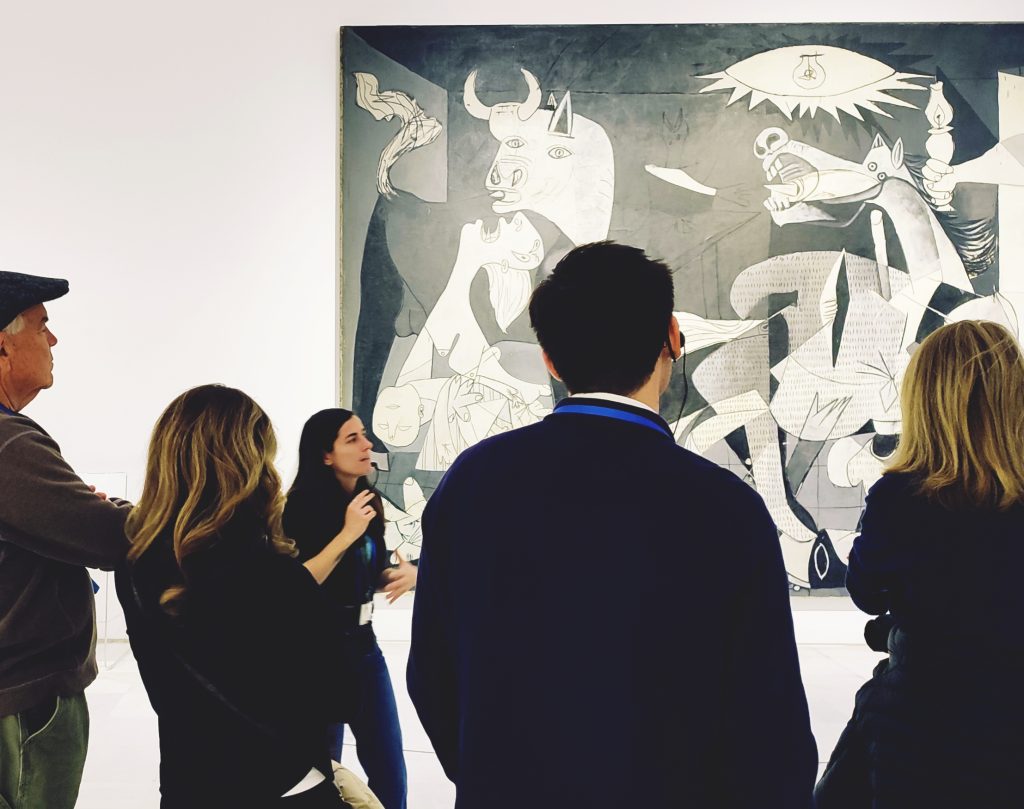
Madrid offers an exceptional opportunity to understand Analytical Cubism directly through its artworks. Both the Reina Sofía Museum and the Thyssen-Bornemisza Museum hold works connected to the investigations of Pablo Picasso and Georges Braque, allowing us to see how both artists transformed representation during the first decades of the 20th century.
Seeing these paintings in person helps us understand what words can only partially explain: the fragmentation of space, multiple perspectives, and the new relationship between painting and reality. Cubism may seem complex until we learn how to look at it.
🖼️ Discover Cubism with The Guides You Need
🎨 Picasso, Braque, and the great avant-garde movements are much easier to understand when you are standing in front of their works. At The Guides You Need, we want to help you discover not only what you are looking at, but also why it changed the history of art.
🏛️ Join us on a guided tour of the Reina Sofía Museum or the Thyssen-Bornemisza Museum and discover the stories, ideas, and revolutions behind their collections.
👥 Small groups and professional guides.
🎟️ Admission tickets included in our tours.
🗣️ Tours available in several languages.
👉 Book your guided tour with The Guides You Need and discover the avant-garde from a new perspective.