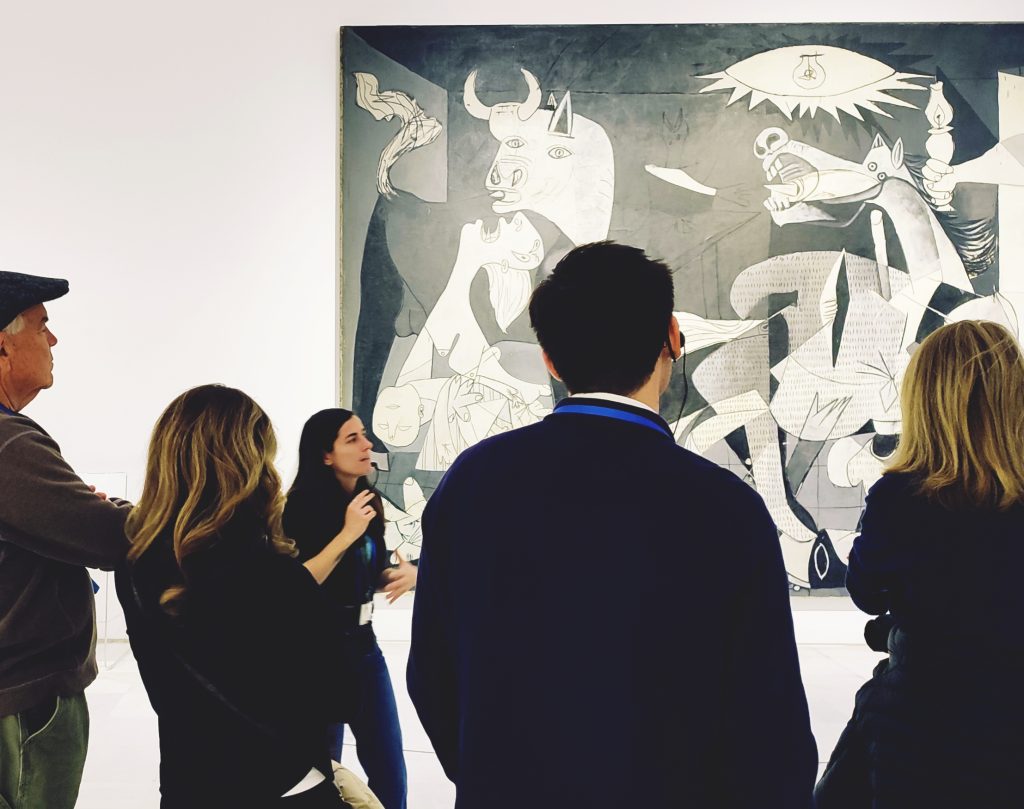
Few figures have transformed the history of art as profoundly as Pablo Picasso. Over the course of a career spanning almost eight decades, the Málaga-born painter reinvented his style time and time again, making it difficult to find another artist whose work embraces such a wide range of artistic languages. From the melancholic figures of his Blue Period to the revolution of Cubism and the expressive power of Guernica, Picasso turned painting into a laboratory of ideas that would shape the art of the twentieth century.
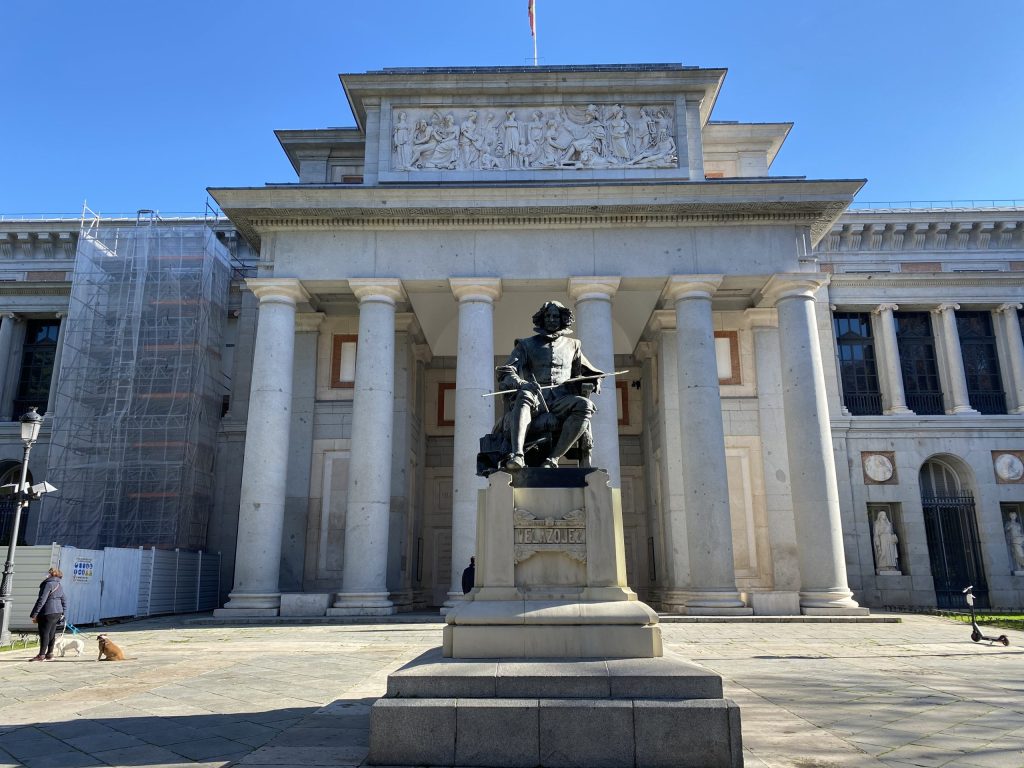
This remarkable ability to evolve is also why the Reina Sofía Museum is the ideal place to understand his artistic journey. While the Prado Museum houses the masterpieces of the great painters who profoundly influenced him, it is at the Reina Sofía where visitors can follow the development of Picasso’s own art through some of his most important creations. Before exploring three of those works, it is worth taking a brief look at the life of an artist who never stopped experimenting.
In this article
Beginnings
Pablo Ruiz Picasso was born in Málaga on 25 October 1881. His father, José Ruiz Blasco, was a drawing teacher and the person who sparked his interest in painting from a very early age. The family first moved to A Coruña and later to Barcelona, where the young Picasso completed much of his artistic training and began to immerse himself in the city’s intellectual circles.
His talent was recognised early on. At just fourteen years old, he was admitted to the School of Fine Arts in Barcelona, and shortly afterwards continued his studies at the Royal Academy of Fine Arts of San Fernando in Madrid. Academic training, however, failed to satisfy him. Picasso preferred to learn by visiting museums, especially the Prado Museum, where he carefully studied the works of Velázquez, El Greco and Goya—artists whose influence would resurface, in one way or another, throughout his career.
The Different Periods
Picasso’s career is usually divided into several periods, each reflecting his constant search for new ways of expression. After his early years of academic training came the Blue Period (1901–1904), characterised by a cool colour palette and scenes depicting humble, often marginalised figures. Soon afterwards came the Rose Period (1904–1906), when warm tones and characters from the world of the circus replaced much of the earlier melancholy.
From 1907 onwards, alongside Georges Braque, Picasso led one of the greatest revolutions in the history of art: the birth of Cubism. Over the following decades, he continued to explore new artistic directions, embracing elements of Surrealism, distorting the human figure and experimenting with an extraordinary variety of techniques and materials. This creative freedom reached one of its highest points in 1937 with Guernica, a painting that has since become a universal symbol against war.
Final Years
After the Spanish Civil War, Picasso remained in exile in France and never returned to live in Spain. His international reputation continued to grow over the following decades as he kept painting, drawing, making prints and creating sculptures with remarkable energy. He died on 8 April 1973 in Mougins, in the south of France, leaving behind an astonishing body of work numbering in the tens of thousands.
More than half a century after his death, Picasso remains one of the most influential artists in history. The Reina Sofía Museum houses the most important collection of his work in Spain, centred around Guernica and complemented by other masterpieces that allow visitors to understand the extraordinary evolution of an artist who never stopped reinventing himself.
1. The Blue and Rose Periods
To talk about Picasso’s early periods is to talk about an artist who was still searching for his own voice. Before revolutionising the history of art with Cubism, the Málaga-born painter went through a period of intense artistic development in which the colours, subjects and emotional tone of his work changed dramatically in just a few years. That journey began with the so-called Blue Period and continued with the Rose Period, two essential stages for understanding the young Picasso.
The Blue Period
The Blue Period lasted from 1901 to 1904 and takes its name from the predominance of blue and green tones throughout Picasso’s paintings. Yet the colour itself is only the outward expression of something much deeper: his desire to portray poverty, illness, old age and loneliness. Beggars, blind men, prostitutes and mothers with their children populate many of the works from these years, all enveloped in an atmosphere of melancholy that reflects both the artist’s own concerns and the profound impact of the suicide of his close friend Carlos Casagemas.
The figures are elongated, silent and introspective. They still reveal the influence of masters such as El Greco and even Velázquez, whose works Picasso had carefully studied during his visits to the Prado Museum. At the same time, however, a distinctive artistic personality was beginning to emerge—one that would transform Western painting just a few years later.
Woman in Blue
If we had to choose one painting in the Reina Sofía Museum to explain Picasso’s early years, it would probably be Woman in Blue. Painted in 1901, it belongs to the beginning of the Blue Period and shows us an artist who was still searching for his own voice. Although Cubism was still years away, many of the concerns that would define his entire career are already present.
At first glance, the painting may seem quite simple. In reality, however, it reflects a decisive moment in Picasso’s artistic development. He had just spent countless hours studying the great masters of the Prado Museum, especially El Greco, Velázquez and Goya. Those visits not only refined his technique but also taught him how a painting could convey emotion without relying on dramatic effects.
The influence of Velázquez’s portraits of Philip IV’s family is particularly striking. The skirt, the mannerisms and the pose all recall his portraits of the Infanta Margarita and Queen Mariana of Austria. Here, however, the sitter is not a princess but an ordinary woman whom Picasso “dresses as an aristocrat.” Rather than idealising her, he presents her with a quiet dignity that connects directly with the great tradition of Spanish painting.
The palette is dominated by cool tones that envelop the sitter in an atmosphere of silence and introspection. Yet the true “blue” of this period does not lie in the colour alone. Above all, it lies in the state of mind. Picasso uses painting to express loneliness, melancholy and introspection, transforming colour into an emotional language rather than a purely aesthetic device.
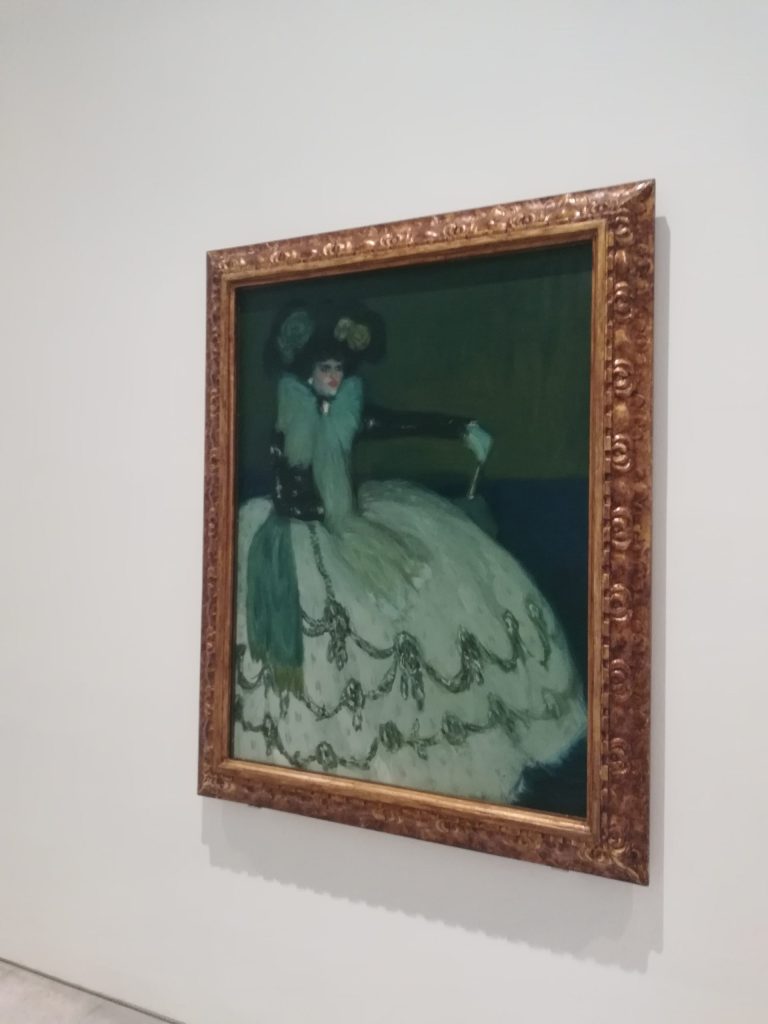
Although Guernica attracts the attention of most visitors to the Reina Sofía Museum, spending a few minutes in front of Woman in Blue reveals a very different Picasso: a young painter who was still learning from the great masters of the Prado and who, just a few years later, would change the course of art history forever.
The Rose Period
Around 1904, after settling permanently in Paris, the mood of Picasso’s paintings began to change. The blues gave way to pinks, ochres and oranges, while the sorrowful figures of his earlier work were gradually replaced by acrobats, harlequins and circus performers.
Although the Rose Period is often seen as a more optimistic phase, that contrast should not be overstated. Many of Picasso’s figures still convey a profound sense of isolation. What changed was not only his colour palette, but also his growing interest in simplifying forms and developing an increasingly personal artistic language. That process would soon lead to one of the greatest revolutions in the history of art: Cubism.
2. Cubism
In 1907, Pablo Picasso took a step that would change the history of art forever. Together with the French painter Georges Braque, he began developing a new pictorial language that broke with a tradition stretching back centuries. Since the Renaissance, artists had sought to represent the world as the human eye perceived it: from a single point of view, using perspective to create the illusion of depth. Picasso decided that this was no longer enough.
His goal was not to paint an object as we see it in a single moment, but to show everything we know about it. Why depict a violin only from one side when we also know its back, its profile and even its interior? Cubism was born from precisely that question. Forms became fragmented, objects were broken down into multiple planes, and the viewer was given a far more active role: it was no longer enough simply to look—one had to interpret.
Although Cubism may seem familiar to us today, it caused a genuine shock when it first appeared. Many critics believed that Picasso and Braque had abandoned any attempt to represent reality. In fact, the opposite was true. Their aim was to offer a more complete vision of objects by combining several viewpoints within a single image—perspectives that the human eye could never perceive simultaneously.
Cubism is generally divided into two major phases: Analytical Cubism, in which forms are fragmented to their greatest extent, and Synthetic Cubism, where objects become more recognisable again and new techniques, such as collage, begin to appear. Together, these two phases transformed the course of twentieth-century art and exerted an enormous influence on later generations of artists.
Analytical Cubism
Between 1909 and 1912, Picasso and Georges Braque pushed Cubism to its highest level of complexity. This period, known as Analytical Cubism, marked the moment when both artists abandoned the traditional representation of reality in favour of breaking objects down into a multitude of geometric planes.
The idea was as simple as it was revolutionary: our eyes never observe an object from just one point of view. When we look at a guitar, a bottle or a fruit bowl, our minds combine information gathered from different angles to construct a complete image. Picasso sought to transfer that mental process onto the canvas, presenting multiple perspectives of the same object at once.
To achieve this, he reduced his palette to ochres, greys and browns. Colour ceased to be the main focus, allowing the viewer to concentrate entirely on the structure of forms. At first, the result may seem confusing, but it follows a precise logic: the painting no longer aims to copy reality, but to analyse it.
Fruit Bowl
One of the best paintings in the Reina Sofía Museum for understanding this period is Fruit Bowl. If you spend a few seconds looking at it, you’ll probably experience the same reaction as most visitors: it’s surprisingly difficult to recognise what you’re looking at.
Our boss, who insists he has a great sense of humour, always plays the same game in front of Fruit Bowl: he asks visitors to guess which object Picasso has painted. Almost nobody gets it right. Don’t worry—it’s not an Art History exam. What really matters is understanding why it is so difficult to recognise something that, in theory, we have all seen hundreds of times.
The answer lies at the very heart of Analytical Cubism. Picasso did not want to paint a fruit bowl as it would appear from a single viewpoint. Instead, he wanted to represent everything our minds know about the object. That is why it is fragmented into multiple planes that the viewer must mentally reconstruct. Far from being a mere artistic whim, this new way of painting permanently changed our understanding of artistic representation and paved the way for much of modern and contemporary art.
Synthetic Cubism
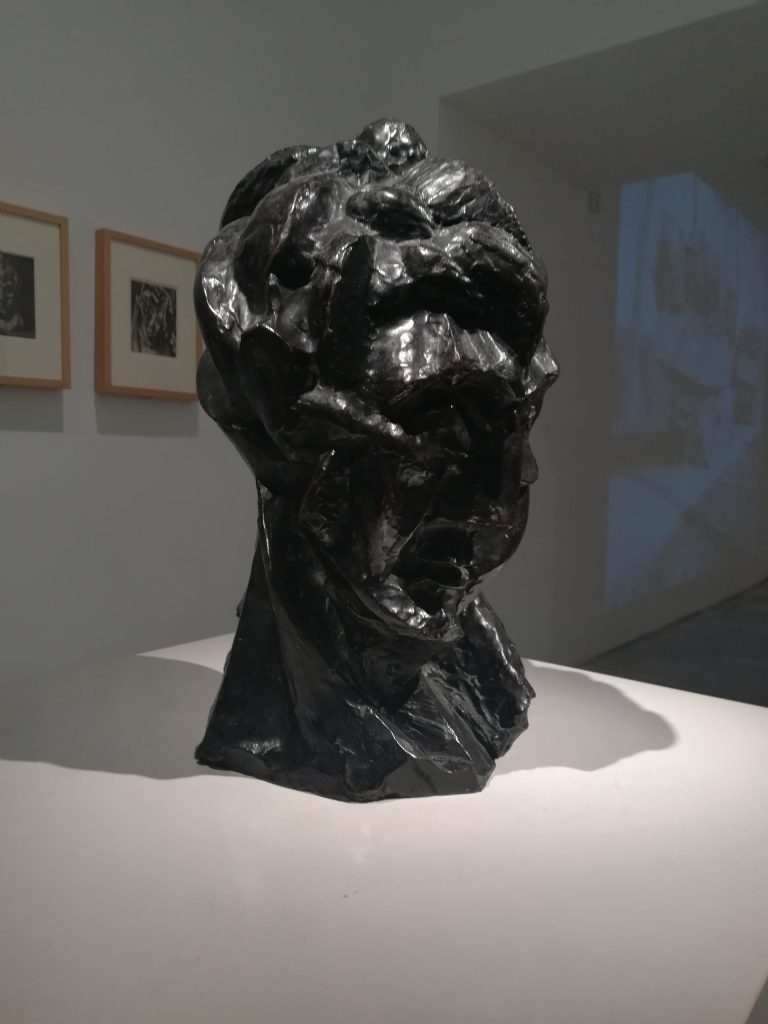
Around 1912, Picasso and Braque began to move in a different direction. Without abandoning the ideas that had given birth to Cubism, they realised that fragmentation could become so extreme that viewers might completely lose sight of the object being represented. Thus emerged Synthetic Cubism, a second phase in which forms regained some of their clarity and colour once again took on a leading role.
One of the greatest innovations of this period was the introduction of collage. For the first time in the history of art, painters began attaching everyday materials such as newspapers, wallpaper and commercial labels directly onto the canvas. Painting was no longer limited to imitating reality—it could now incorporate fragments of reality itself.
Interestingly, the Reina Sofía Museum preserves very few works by Picasso from this stage of his career. That does not mean, however, that Synthetic Cubism is absent from its galleries. Quite the opposite. If you want to understand how this movement evolved, be sure to spend some time with the works of Juan Gris and María Blanchard, two of the most important figures of Spanish Cubism.
In fact, many art historians believe that Juan Gris brought Synthetic Cubism to an extraordinary level of refinement. His compositions are brighter, more orderly and easier to interpret than those of the early Cubist years, making them an excellent introduction for anyone discovering the movement for the first time. So, although Picasso’s name tends to dominate the conversation, no visit to the Reina Sofía Museum is truly complete without taking a few minutes to appreciate these two remarkable artists.
3. Picasso in the 1930s: The Road to Guernica
By the late 1920s and, above all, throughout the 1930s, Picasso’s painting underwent another profound transformation. Having already revolutionised art with Cubism, he refused to be confined to a single style. His figures became increasingly distorted, colours regained their intensity, and the influence of Surrealism became evident in many of his compositions.
This transformation, however, was driven by more than artistic curiosity. Europe was entering a period of intense political and social turmoil. The rise of totalitarian regimes, growing international instability and, above all, the outbreak of the Spanish Civil War deeply affected Picasso, who closely followed events in his homeland despite living in France.
During these years, his work acquired an expressive power unlike anything he had produced before. Figures twist in agony, faces become dramatically distorted, and human suffering moves to the centre of his compositions. Picasso was no longer experimenting with form for its own sake—he was using it to communicate emotion and denounce violence.
This artistic journey reached its culmination in 1937 with the creation of Guernica, arguably the most famous painting in the history of Spanish art and the defining masterpiece of the Reina Sofía Museum. Before exploring the painting itself, it is worth understanding the event that inspired this extraordinary work.
The Bombing of Guernica
On 26 April 1937, during the Spanish Civil War, the small Basque town of Guernica was bombed by the German Condor Legion and the Italian Aviazione Legionaria, both operating in support of the Nationalist forces. It was market day, meaning the town was unusually crowded. For several hours, bombs and the fires they caused devastated much of the town and claimed the lives of a large number of civilians.
Beyond its military significance, the bombing had an enormous international impact. Foreign correspondents based in Spain quickly reported the tragedy, turning Guernica into one of the first aerial attacks against a civilian population to shock public opinion around the world. The British journalist George Steer, reporting for The Times, played a particularly important role by describing the scale of the destruction in vivid detail.
By the time Picasso learned of the bombing, he had already accepted a commission to create a large painting for the Spanish Republican Pavilion at the 1937 Paris International Exposition. Until then, however, he had struggled to find a suitable subject. The destruction of Guernica changed everything. Within a matter of weeks, he abandoned his original ideas and began work on the monumental canvas that would become a universal symbol against war and violence directed at civilians.
The result was not a literal depiction of the bombing. Picasso did not paint aeroplanes, explosions or soldiers. Instead, he created a composition filled with symbols that, nearly ninety years later, continues to confront and move anyone who stands before it. That is, perhaps, the secret behind the extraordinary power of Guernica.
The Spanish Pavilion of 1937
Although it may be difficult to imagine today, Guernica was never intended for a museum. Picasso painted it for the Spanish Republican Pavilion at the 1937 Paris International Exposition, an event where countries from around the world showcased their scientific, technological and cultural achievements.
At the time, Spain was in the midst of the Civil War. The Republican government decided to use the exhibition to draw international attention to the conflict and denounce the consequences of war. To achieve this, it commissioned architects Josep Lluís Sert and Luis Lacasa to design the pavilion, bringing together some of the most important Spanish artists and intellectuals of the period.
Alongside Guernica, the pavilion featured works by Joan Miró, Alexander Calder, Julio González and Alberto Sánchez, among others. More than an art exhibition, it served as a political and cultural statement through which the Spanish Republic sought to win the support of international public opinion.
Picasso’s monumental canvas occupied one of the pavilion’s main walls. Visitors who encountered it for the first time did not find a heroic battle scene or a traditional representation of war. Instead, they were confronted by shattered bodies, terrified animals and anguished figures that conveyed the horror of conflict without depicting a single act of combat.
As the years passed, Guernica became the most celebrated work displayed at the exhibition. The pavilion itself disappeared once the event had ended, but the painting embarked on a long international journey that would eventually establish it as one of the world’s greatest symbols of peace and the condemnation of war.
The Symbols of Guernica
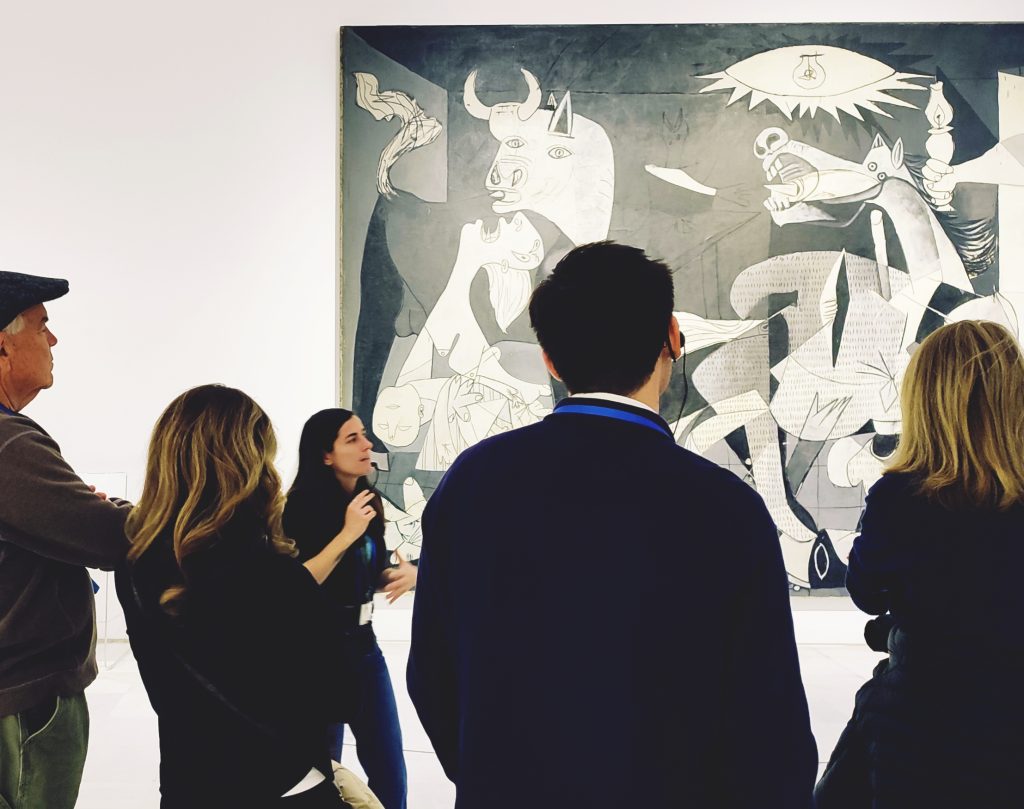
One of the reasons Guernica continues to fascinate millions of people is that it does not offer a single, definitive interpretation. Picasso never left behind a guide explaining how to decode the painting and, in fact, deliberately avoided revealing the exact meaning of its figures. That has not stopped art historians from identifying some of its most significant symbols over the years.
The first is the bull, positioned on the far left of the composition. For some, it represents brutality and violence; for others, it symbolises Spain or even the resilience of the Spanish people. Picasso never confirmed any of these interpretations, so they should all be regarded as informed hypotheses rather than established facts.
Beneath the bull, a mother cradles the lifeless body of her child. Her cry of anguish inevitably recalls the Pietà of Christian art, although here there is no promise of redemption. It is one of the painting’s most moving images and has become a universal symbol of the suffering endured by civilians in times of war.
At the centre of the composition stands a wounded horse, pierced by a spear and crying out in agony. Like the bull, its meaning has inspired countless interpretations. What matters most, however, is the overwhelming sense of pain it conveys, making it the emotional heart of the entire scene.
Other elements—including the light bulb illuminating the room, the woman carrying an oil lamp, the fallen soldier, and the flower blooming beside his hand—have generated endless scholarly debate. Some writers see them as references to destructive technology, hope or resistance. Picasso, however, preferred to leave the final interpretation to each individual viewer.
Perhaps that is Guernica‘s greatest achievement. More than a painting about a specific bombing, it is a work about pain, fear and the human cost of war in any place and at any time. Nearly ninety years after its creation, its figures continue to speak to visitors with the same emotional force they possessed in 1937.
Discover the Reina Sofía Museum with The Guides You Need 🎨
If you’d like to truly understand Picasso, Dalí and Miró, we’d be delighted to show you around. Here are just a few of the advantages of joining one of our tours:
👤 Small groups of no more than 6 people, so you can enjoy a more personal experience.
🎟️ Museum tickets included, with no need to worry about booking in advance.
🇬🇧🇪🇸 Tours available in English and Spanish. With advance notice, we can also offer tours in French and Italian.
❓ Plenty of time to ask questions throughout the tour—you won’t have to wait until the end.
🎨 Masterpieces explained in a clear and engaging way. We don’t want you to memorise dates—we want you to understand why these artists changed the history of art.
😊 A friendly and welcoming atmosphere.