How do we know that a man holding a trident is Poseidon? Why do we recognise Saint Peter when he carries a set of keys? The answer lies in iconography, one of the fundamental languages of art and an essential tool for understanding many of the works we encounter in museums.
For centuries, artists used objects, animals, colours, gestures and other attributes to identify characters and convey stories. These elements allowed viewers to recognise what they were seeing, while also providing information that could easily go unnoticed by anyone unfamiliar with their codes.
Learning about iconography, therefore, means learning to look at a painting differently. In this article, we will explore what it is, how it differs from iconology and how it works through two of the great visual traditions in the history of art: classical mythology and Christianity.
Because a trident or a set of keys may seem like minor details. Once we understand their meaning, they begin to tell us a story.
In this article
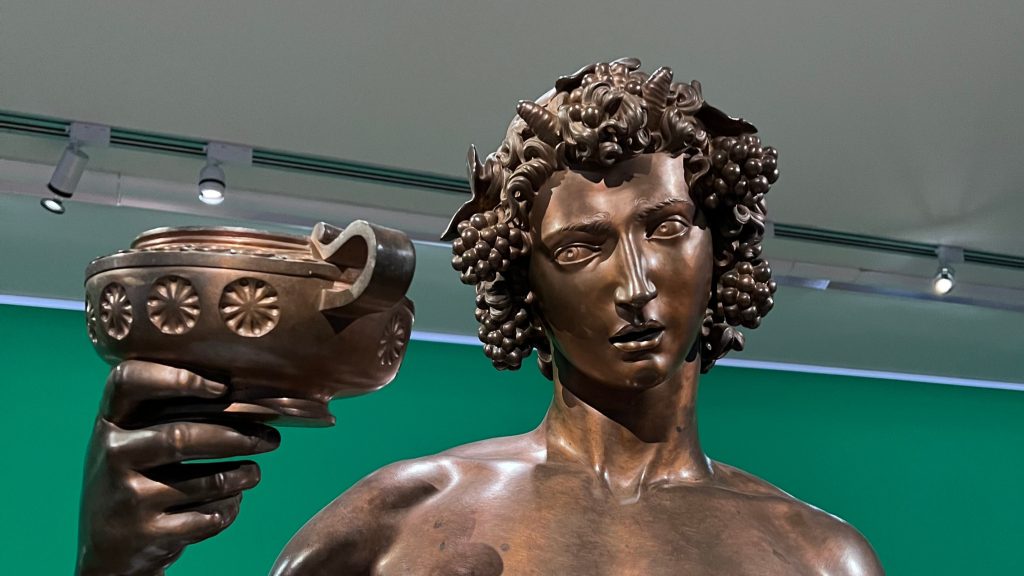
What Is Iconography?
Iconography is the discipline that studies and identifies the subjects, characters, symbols and attributes represented in a work of art. Its name comes from the Greek terms eikón — image — and gráphein — to write or describe — an etymology that gives us a good idea of its purpose: learning to identify what images are showing us.
Imagine a male figure holding a thunderbolt and accompanied by an eagle. Through iconography, we can recognise Zeus. If we see a set of keys in the hands of an apostle, we can identify Saint Peter. A character’s physical appearance may change depending on the artist and the period, but certain attributes allow their identity to remain recognisable.
This is particularly important in painting, where a work can contain far more information than we perceive at first glance. Apparently secondary objects, animals, clothing or even certain gestures can help us identify the protagonist and, from there, understand the episode the artist is representing.
Iconography and Iconology: What Is the Difference?
Although their names are similar and the two disciplines are closely related, iconography and iconology do not mean exactly the same thing. We can understand the difference through two very simple questions: What are we looking at? and What does what we are looking at mean?
Iconography is primarily concerned with the first question. If a woman appears wearing a helmet and carrying a spear and a shield decorated with the head of Medusa, these attributes allow us to identify her as Minerva. We have recognised the character and the elements that construct her visual identity.
Iconology goes one step further. It seeks to interpret the meaning of that representation by considering its historical and cultural context. Once we have identified Minerva, we can ask why she appears in that particular work, what idea she represents, who commissioned the painting or what her presence might have meant to viewers at the time.
The two disciplines are therefore related, but they are not interchangeable. Iconography provides us with the tools needed to recognise the visual language of a work; iconology also uses that language to explore its deeper meaning. This distinction will be particularly useful when we examine how classical mythology and Christianity created some of the most recognisable visual traditions in the history of art.
Why Do We Use Iconography?
Iconography allows an image to communicate information without the need for words. To understand its importance, we need to think about societies very different from our own, in which a large part of the population could not read and access to books was far more limited. As we explained in our article on the Baroque, images could therefore become a powerful tool for transmitting stories, ideas and beliefs.
Christianity offers an obvious example. A person who could not read a text about the martyrdom of a saint could learn their story through a painting, sculpture or altarpiece. Certain attributes also allowed viewers to recognise the protagonists immediately. Keys identified Saint Peter; a gridiron, Saint Lawrence; and a wheel, Saint Catherine of Alexandria. The repetition of these elements eventually created a visual language shared by artists and viewers.
A Language That Also Had to Be Learned
However, this does not mean that everyone could automatically understand every image. Iconography also had to be learned. Sermons, religious celebrations, oral tradition and repeated exposure to certain images helped viewers become familiar with particular characters and stories.
Something similar happened with classical culture, although for centuries knowledge of it was particularly associated with courtly circles and those who had received a humanist education. Recognising an eagle beside Jupiter or Mercury’s caduceus required prior knowledge of these codes. The greater the viewer’s visual culture, the more information they could extract from a work.
This is why we still use iconography today. We no longer depend on images because we cannot access written texts; instead, knowing their codes allows us to understand a work of art more fully. Identifying a character may be only the beginning: from there, we can reconstruct their story, understand the artist’s choices and uncover meanings that might otherwise remain hidden at first glance.
Iconography in Classical Mythology
The gods of classical mythology presented artists with an obvious problem: many of them had a human appearance and, without something to distinguish them, they could be difficult to identify. How do we know that a bearded man is Zeus rather than Poseidon? Iconography provides the answer through attributes that were repeated for centuries until they became associated with particular characters.
These codes originated in the ancient stories themselves, but they also evolved over time. Animals, weapons, plants and objects eventually became part of each deity’s visual identity. Zeus’s thunderbolt, Poseidon’s trident or Athena’s helmet allow us to recognise them even when the artist is not depicting a specific episode from their lives.
The revival of classical culture during the Renaissance gave new impetus to these images. Artists studied ancient texts, sculptures and other visual sources, while humanists helped recover and interpret an enormous repertoire of stories. Mythological painting in art thus developed a visual language capable of transforming stories written many centuries earlier into images that viewers could recognise.
Some Examples of Mythological Iconography
The best way to understand this system is to see how it works with specific characters. Each god has an iconography built up over centuries and may possess numerous attributes, although these do not all have to appear simultaneously in the same work. Sometimes a single object, animal or even a particular transformation is enough to reveal who we are looking at.
These codes are not completely fixed either. Representations of the gods evolved from Antiquity onwards and changed again when European artists rediscovered these stories. Learning their principal attributes, therefore, does not mean memorising a rigid formula, but acquiring a series of clues that help us interpret painting and recognise its protagonists.
Zeus
Zeus is the ruler of the gods and one of the central figures of classical mythology. The son of Cronus and Rhea, he rules from Mount Olympus after defeating his father and the Titans. His position as the supreme divine authority explains why his iconography generally presents him as a powerful, mature, bearded man, an appearance intended to convey authority.
His two most characteristic attributes are the thunderbolt and the eagle. The former is associated with his command over the sky and storms and functions almost as his personal weapon. The eagle, meanwhile, became closely associated with the god and may appear beside him or even become a central figure in some of his stories.
However, recognising Zeus can become considerably more difficult when we encounter his numerous love affairs. The god repeatedly changes his appearance to approach mortals and other mythological figures: he takes the form of a bull to abduct Europa, becomes a shower of gold to reach Danaë, and appears as a swan in the story of Leda. In these cases, the transformation itself becomes an attribute that allows us to identify him.
Zeus therefore demonstrates that iconography is not simply a matter of looking for objects beside a character. Sometimes we need to know the myth being represented to understand that the animal or extraordinary phenomenon before us is actually the god himself.
Poseidon
Poseidon is the brother of Zeus and one of the great deities of the classical pantheon. Following the Olympian gods’ victory over the Titans, the division of the world made him ruler of the seas. This relationship with water determines many of the elements used to represent him in art.
His most characteristic attribute is the trident, a three-pronged weapon that became his principal identifying symbol. He can use it to stir the waters, cause storms or strike the earth. As a result, even when he appears simply as a mature, bearded man physically similar to Zeus, the trident makes him relatively easy to recognise.
His iconography also incorporates numerous elements associated with the sea. Poseidon may appear surrounded by fish, dolphins and fantastic marine creatures or travelling across the water in a chariot. There is also another animal whose connection with the god may be less obvious to modern viewers: the horse. Several stories from classical mythology associate Poseidon with horses, which can therefore also form part of his representations.
In the Roman tradition, he was identified with Neptune, a name frequently encountered in European painting and sculpture. As with other characters from classical mythology, knowing both names helps avoid confusion: even when a work is entitled Neptune, the trident continues to provide us with the same visual clue.
Hermes
Hermes is one of the easiest gods to recognise thanks to the variety of attributes that make up his iconography. The son of Zeus and Maia, he performs numerous functions within classical mythology, although one of the best known is his role as messenger of the gods. His ability to travel between different worlds explains many of the elements artists used to represent him.
One of his most characteristic attributes is the caduceus, a staff around which two snakes are intertwined. He may also wear a broad-brimmed hat known as a petasos and winged sandals, referring to the speed with which he carries out the gods’ commands. In some representations, the wings appear directly on his hat or feet, making his identification almost immediate.
Hermes, however, was not merely a messenger. He was also associated with travellers, merchants, eloquence and even thieves. Furthermore, he acted as a psychopomp, a guide responsible for leading the souls of the dead to the Underworld. This diversity of functions explains why his image can appear in very different contexts within art.
In the Roman tradition, he was identified with Mercury, the name frequently used in European painting. Therefore, when we encounter a young man carrying a caduceus or wearing winged attributes, iconography provides an essential clue: we are probably looking at Hermes or Mercury, two names used by the Western artistic tradition for one of the most versatile figures in classical mythology.
Athena
Athena is the daughter of Zeus and one of the principal deities of Olympus. She is associated with wisdom, military strategy and various intellectual and artisanal activities. Her birth is also one of the most extraordinary episodes in classical mythology: after Zeus swallowed Metis, Athena emerged from her father’s head fully armed.
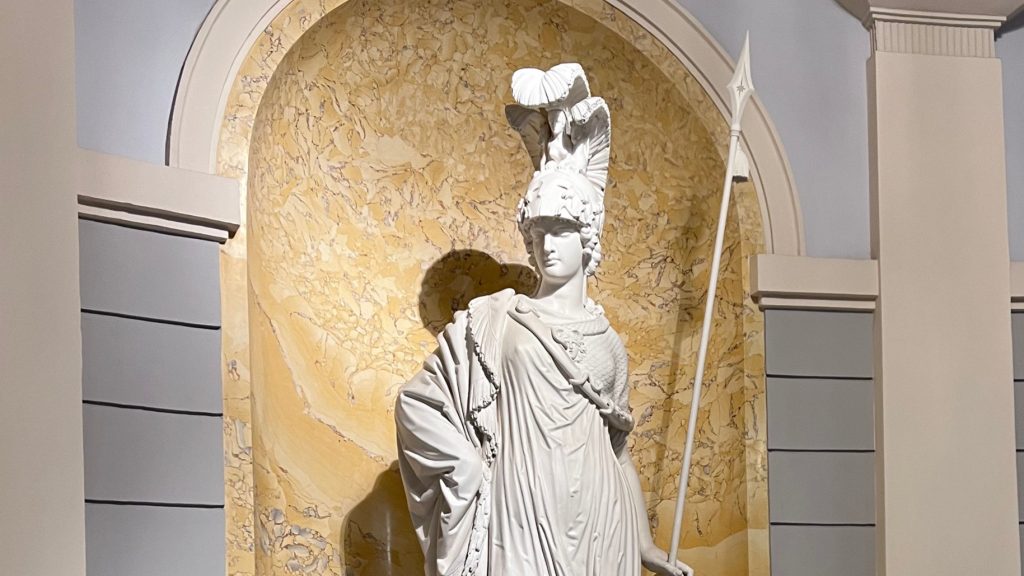
Her warrior nature immediately shapes her iconography. Athena is usually depicted wearing a helmet and carrying a spear and shield, elements that distinguish her from other female deities. Unlike Ares, however, she does not primarily represent the uncontrolled violence of war, but rather its strategic, disciplined and intelligent dimension.
One of her most important attributes is the aegis, a form of protection associated with both Zeus and Athena that may be decorated with the head of Medusa. According to the myth, Perseus later gave the Gorgon’s head to the goddess, who incorporated it into her protection. In this way, an apparently secondary character from another story becomes part of Athena’s visual identity.
She may also appear accompanied by the owl, an animal associated with wisdom and closely connected with the city of Athens. The Romans identified the goddess with Minerva, a name frequently encountered in Western art. Helmet, spear, aegis, Medusa and owl thus form a set of clues that allow us to recognise her even before we know the particular story represented in the work.
Iconography in Christianity
Christianity developed one of the most extensive iconographic systems in the history of art. Christ, the Virgin Mary, the apostles, the Evangelists and an enormous number of saints needed to be recognisable to viewers, even when several characters shared similar ages, clothing or physical features.
Iconography once again solved this problem through attributes. Some come directly from biblical episodes, while others are associated with martyrdom, miracles or traditions surrounding a particular saint. Through repetition, these elements became genuine signs of identity: a set of keys could be enough to recognise Saint Peter, while a sword could identify Saint Paul.
In other cases, the attribute recalls the very manner in which the character died. This explains some images that may seem puzzling to modern viewers: saints accompanied by arrows, wheels, gridirons or even the instruments used during their martyrdom. These are not merely decorative elements. They tell us who is being represented and, in many cases, provide a clue to their story.
Some Examples of Christian Iconography
As with the gods of classical mythology, a Christian figure may have several attributes, and they do not necessarily appear together in every representation. Conventions may also vary depending on the period, region or particular scene depicted.
The Four Evangelists
One of the most interesting examples of Christian iconography can be found in the Four Evangelists. Matthew, Mark, Luke and John may be shown writing their Gospels or holding a book, but Christian tradition also developed an extraordinarily effective system for distinguishing them: each became associated with a different creature.
Matthew is represented by a man or an angel; Mark by a lion; Luke by an ox; and John by an eagle. Together, these four figures form what is known as the Tetramorph, an iconographic tradition related to the four creatures described in the visions of Ezekiel and the Book of Revelation.
The animals may appear beside the Evangelists or even represent them on their own. A viewer familiar with the code can therefore identify Saint Mark through the presence of a lion, while an eagle points towards Saint John. Once again, iconography transforms a visual element into a means of identification.
The Tetramorph also demonstrates how these codes can operate on different levels. At the most immediate level, they allow us to recognise the Four Evangelists. Understanding the origin and meaning of each symbol can then lead us towards a deeper interpretation of the image.
Saint Peter
Saint Peter possesses one of the most recognisable attributes in Christian iconography: the keys. Their origin can be found in the Gospel of Matthew, when Christ gives Peter the keys to the Kingdom of Heaven. For this reason, one or more keys may appear in representations of the apostle.
His appearance also gradually acquired certain conventional features. He is often represented as an older man with a beard and short or partially balding hair. Nevertheless, it is usually the keys that remove any doubt about his identity.
Saint Peter perfectly demonstrates how this visual language works. Even when viewers do not know the particular episode they are looking at, recognising his attribute may allow them to identify the character and begin reconstructing the scene.
Saint John the Baptist
Saint John the Baptist has one of the most recognisable iconographies in Christianity. According to the Gospels, he preached in the wilderness and baptised Christ in the River Jordan. This life away from society explains one of his most characteristic features: he is often depicted wearing camel skin, a direct reference to the biblical description of him.
Another of his usual attributes is a reed cross, which may bear a scroll with the words Ecce Agnus Dei — “Behold the Lamb of God”. The lamb itself is another essential element for recognising him, recalling the words with which John identifies Christ in the Gospel of John. In some representations, the Baptist even appears pointing towards the Lamb of God, as in the sculpture created by Juan de Mesa in 1623, now in the Museum of Fine Arts of Seville.
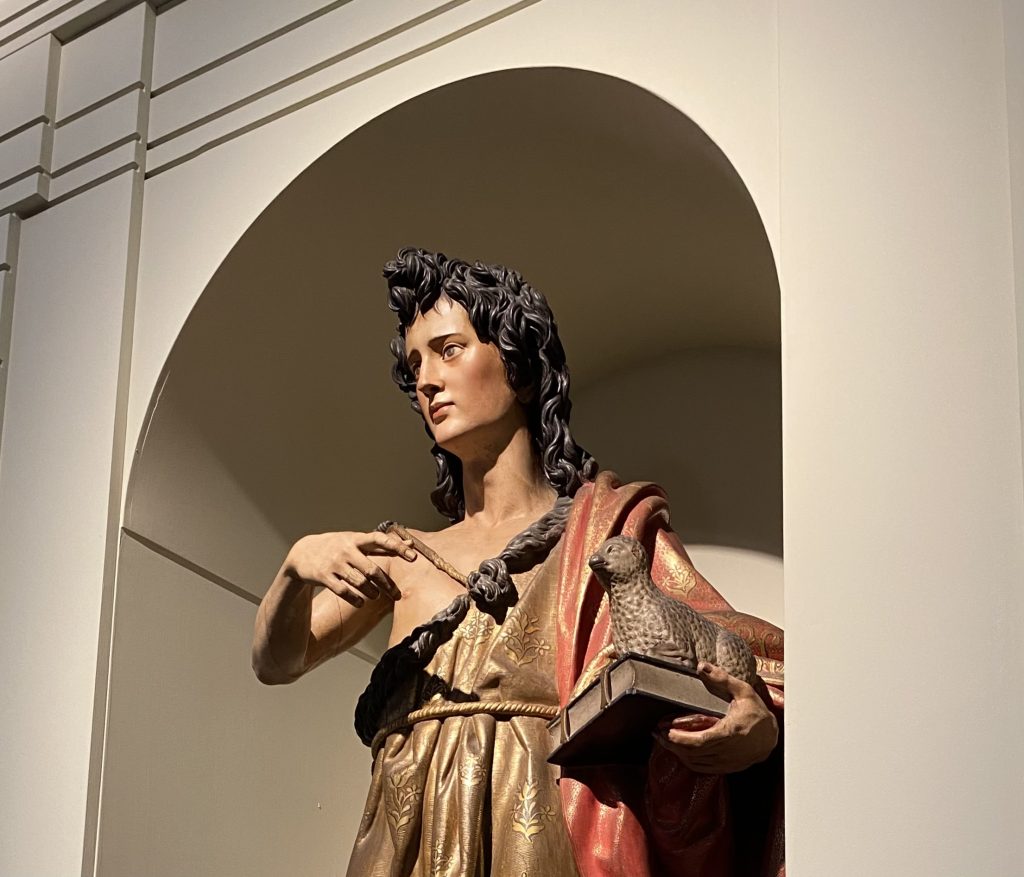
His story also provided Christian art with some of its most dramatic images. After denouncing the marriage of Herod Antipas to Herodias, John was imprisoned and later beheaded. His head can therefore appear represented on a platter, particularly in scenes connected with Salome.
Saint John the Baptist demonstrates just how much iconography can condense an entire biography into a handful of elements. The camel skin recalls his life in the wilderness; the lamb, his relationship with Christ; and the head on the platter, his martyrdom. Recognising these attributes allows us to identify the figure while also reconstructing some of the most important episodes of his story.
Learn to Read the Prado’s Masterpieces with The Guides You Need
Recognising a god through their attributes or understanding why a saint is holding a particular object can completely transform the way we experience a museum. At The Guides You Need, we do not want you simply to look at the Prado Museum’s great masterpieces: our guides will help you understand the stories, symbols and visual codes that artists used to communicate with their audiences.
🎟️ Admission to the Prado Museum is included in the price.
⚡ We purchase tickets in advance to make access to the museum easier, although all visitors must still pass through the security check.
👥 Small groups of no more than 7 people.
🎨 Professional guides specialising in art and history, helping you interpret the works rather than simply memorising names and dates.
🌍 Tours available in English, Spanish, French and Italian.
🔎 Learn to look at the details: attributes, characters, stories and symbols that can completely change the way we understand a work of art.