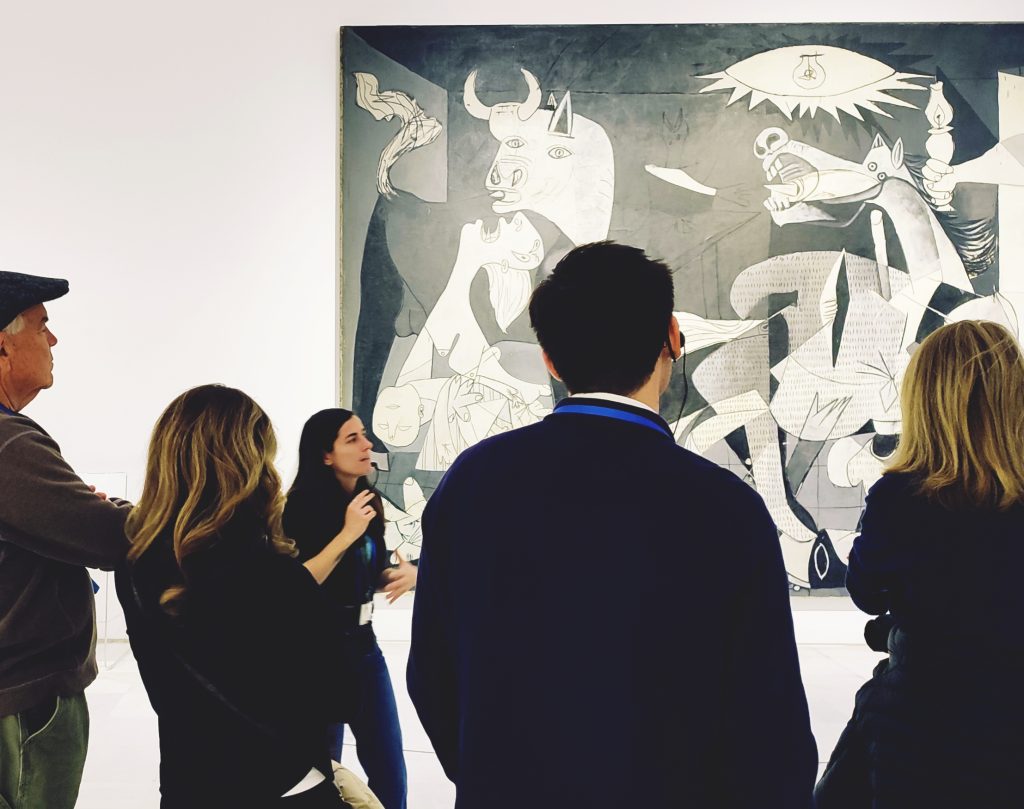
To speak about Velázquez is to speak about one of the greatest painters in the history of art. His masterpieces, led by Las Meninas, have become part of the collective imagination of millions of people and occupy a privileged place in the Prado Museum. Yet before becoming the celebrated painter of Philip IV, Diego Velázquez was a young man from Seville who learned his craft in one of the most fascinating cities of his time.
In this article, we’ll explore the early years of Velázquez’s life: his birth, his artistic training and his first journey to Italy, an experience that transformed his painting forever.
The Birth of Velázquez in Golden Age Seville
Diego Rodríguez de Silva y Velázquez was born in Seville in 1599. Although the exact date of his birth remains unknown, we do know that he was baptised on 6 June in the Church of San Pedro, so he must have been born only a few days earlier, as was customary at the time.
The Seville that Velázquez knew was very different from the city we see today. Thanks to trade with the Americas, it had become the wealthiest and most cosmopolitan city in the Spanish Monarchy. Italian and Flemish merchants, bankers, noblemen, clergymen, craftsmen, sailors and enslaved Africans all shared its streets. This unique environment turned Seville into an extraordinary artistic melting pot, where influences from across Europe came together.
It is no coincidence that some of the greatest names of the Spanish Baroque emerged from this city. Murillo, Zurbarán and Velázquez himself all grew up in a place where artistic commissions were abundant and competition encouraged painters to constantly refine their skills.
Velázquez’s First Steps as a Painter
The young Velázquez received his artistic training under two very different masters.
According to contemporary sources, he first spent a short period in the workshop of Francisco Herrera the Elder. The experience, however, was brief. Herrera had a reputation for being an exceptionally harsh man, and the young apprentice soon left his studio.
His true mentor was Francisco Pacheco, one of the most cultured figures in seventeenth-century Seville. Although Pacheco is not remembered today as one of Spain’s greatest painters, he played a decisive role in Velázquez’s education. Beyond teaching him the technical aspects of painting, he introduced him to an intellectual circle where literature, philosophy, archaeology and artistic theory were regularly discussed.
Their relationship eventually became much more than that of master and pupil. In 1618, Velázquez married Juana Pacheco, his teacher’s daughter, establishing a personal bond that would last for the rest of his life.
During these years, he began to develop the style that already hinted at the extraordinary artist he would become. Rather than idealising reality, Velázquez preferred to observe it with almost scientific honesty. He painted ordinary people, everyday objects and domestic interiors with a naturalism that astonished his contemporaries.
Works such as Old Woman Frying Eggs, The Waterseller of Seville and Christ in the House of Martha and Mary reveal his remarkable ability to transform a humble kitchen or a simple clay jug into the true protagonists of a painting. Caravaggio’s naturalism clearly influenced these early works, yet the young Sevillian was already displaying a highly individual artistic personality that would soon attract the attention of the royal court.
From Seville to the Royal Court
It did not take long for Velázquez’s talent to reach Madrid.
In 1622 he travelled to the Spanish capital for the first time, hoping to obtain a royal commission. Although the visit did not bring immediate success, it allowed him to study the Habsburg royal collection, where he encountered the paintings of Titian, an artist who would profoundly influence his career.
Only a year later he received another invitation. In 1623 he painted a portrait of Philip IV, and the result impressed the young king so deeply that he appointed Velázquez as his court painter. At just twenty-four years of age, the Sevillian artist left his hometown for good and settled in Madrid, where he would spend the rest of his life.
Velázquez’s First Journey to Italy
Despite the extraordinary success he had achieved at court, Velázquez was fully aware that there was still much to learn.
In 1629, Philip IV granted him permission to travel to Italy. At the time, this was almost an essential step for any ambitious European artist: those who wished to perfect their craft had to study the masterpieces of the Renaissance firsthand.
For nearly eighteen months he travelled through Venice, Ferrara, Bologna, Rome and Naples. There he admired the works of Raphael, Michelangelo, Tintoretto, Veronese and, above all, Titian, whose paintings had become the artistic benchmark of the Spanish court.
The journey marked a turning point in his career. Velázquez returned to Madrid with a far deeper understanding of colour, composition and perspective. He also acquired the technical freedom that would later become one of the defining characteristics of his mature style.
Paintings produced during this period, such as The Forge of Vulcan and Joseph’s Tunic, already reveal an artist who had left behind the promising young painter from Seville and had become one of the most ambitious masters in Europe. Several decades still separated him from Las Meninas, but the road towards that masterpiece had begun during this first journey to Italy.
The Making of a Master
When Velázquez returned from his first journey to Italy, he was no longer simply the young Sevillian painter who had impressed Philip IV with his talent. He had studied Titian, Tintoretto, Veronese and Michelangelo firsthand; he had discovered new ways of constructing space and had refined a technique that was already remarkable. From that moment onwards, the most brilliant period of his career began, a time in which he not only strengthened his position at court but also produced some of the greatest masterpieces in the history of Western painting.
Over the following thirty years, his reputation continued to grow. Every new portrait, every mythological composition and every historical scene demonstrated that the painter from Seville had achieved a level of technical mastery that few artists could rival. Yet his success cannot be explained by his skill with a brush alone. He also knew how to navigate one of the most complex environments in Europe: the Habsburg court, where protocol, politics and personal relationships were almost as important as talent itself.
Velázquez and Philip IV: A Unique Relationship
The relationship between Velázquez and Philip IV is one of the most remarkable partnerships in the history of art. The young king quickly realised that the painter possessed an extraordinary ability to capture not only a person’s physical appearance but also their character. After seeing the first portrait completed in 1623, Philip IV was so impressed that he appointed him as his court painter, a position he would hold for the rest of his life.
That trust continued to grow over the years. Velázquez portrayed the monarch on numerous occasions, from his youth to his later years, creating what is almost a visual biography that allows us to follow the passing of time across the king’s face. Few artists have ever had the opportunity to observe a sovereign so closely for nearly four decades.
Philip IV’s confidence extended far beyond painting. The Sevillian artist held several positions within the Royal Household, organised official ceremonies, oversaw the royal art collections and even supervised the decoration of parts of Madrid’s Royal Alcázar. These responsibilities left him with less time to paint, but they also reflected the immense prestige he enjoyed at court.
Paradoxically, this close connection to power explains why his body of work is not particularly extensive. While many painters produced hundreds of canvases, Velázquez preferred to devote considerable time to each painting. The result was a relatively small catalogue of works, but one of extraordinary quality.
Velázquez’s Second Journey to Italy and the Portrait of Pope Innocent X
In 1649, Velázquez set out on a second journey to Italy. This time, he was no longer travelling as a young artist eager to learn, but as one of Europe’s most respected painters. Philip IV had entrusted him with acquiring sculptures, paintings and other works of art to enrich the royal collections, yet the journey also gave him the opportunity to work freely once again.
During his stay in Rome, he painted one of the works most admired by artists and historians alike: the portrait of Pope Innocent X.
It was far from an easy commission. Portraying the Pope meant painting one of the most powerful men in the world while avoiding excessive idealisation. Velázquez solved this challenge with extraordinary honesty. The Pope appears dressed in vivid shades of red, seated with great dignity, yet his expression conveys intelligence, suspicion and an unmistakable strength of character.
According to tradition, when Innocent X saw the finished portrait, he exclaimed, “Troppo vero!” (“Too true!”). Whether the story is entirely authentic remains uncertain, but it perfectly captures the impact of the painting. Velázquez did not paint the Pope the Church wished to present to the world; he painted the man who stood before him.
The influence of this portrait has been immense. Centuries later, Francis Bacon used it as the starting point for one of the most celebrated series of paintings of the twentieth century, proving that its psychological power remained undiminished more than three hundred years later.
Las Meninas: Why It Changed the History of Painting
If a single painting had to be chosen to explain the greatness of Velázquez, it would almost certainly be Las Meninas. Painted around 1656, this masterpiece has inspired thousands of studies and continues to raise questions that remain unanswered to this day.
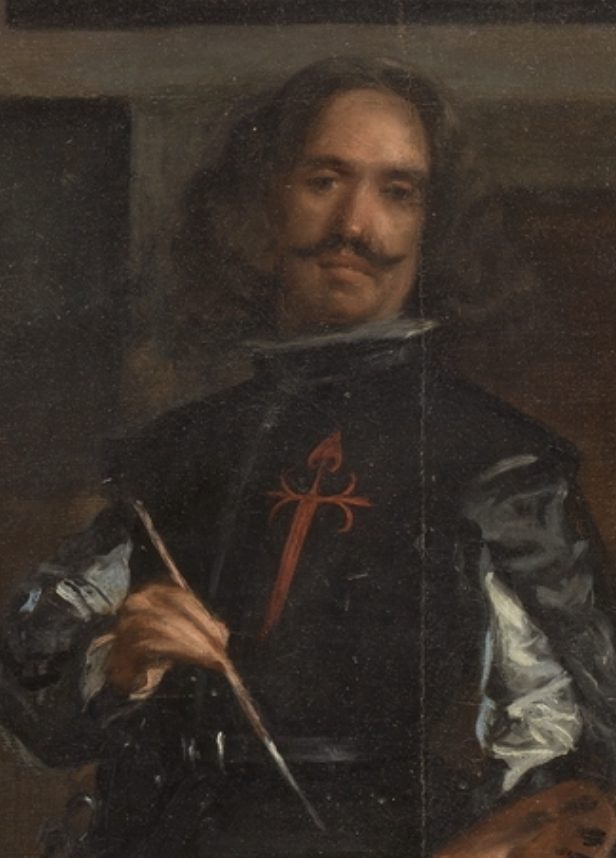
At first glance, it appears to depict an ordinary scene at the royal court. The Infanta Margaret is surrounded by her ladies-in-waiting, attendants, a dog and Velázquez himself, who portrays himself standing before a large canvas. Yet anyone who spends a few moments looking at the painting soon realises that nothing is quite as straightforward as it seems.
Who is the artist painting? Why do Philip IV and Mariana of Austria appear reflected in a small mirror at the back of the room? Where is the viewer actually standing? And who, in the end, is observing whom?
Velázquez turns the visitor into the central figure of the scene. Suddenly, the person looking at the painting occupies what appears to be the position of the King and Queen. The pictorial space ceases to function as a simple representation and instead becomes an intricate game of gazes, reflections and perspectives that challenges the traditional rules of painting.
Beyond its intellectual complexity, Las Meninas also represented a technical revolution. The brushwork is so free that, viewed up close, many forms appear to be little more than patches of colour. Yet when seen from a distance, everything comes together with astonishing precision. This innovative technique would later inspire the Impressionists and lead Édouard Manet to describe Velázquez as “the painter of painters.”
The Death of Velázquez and the Mystery of His Tomb
The final years of Velázquez’s life were marked by intense activity at court. In 1660, he played a crucial role in organising the meeting between Philip IV and Louis XIV of France to celebrate the marriage of the Infanta Maria Theresa to the French king. The complexity of the journey and the elaborate ceremonies demanded an enormous physical effort from a man who was already sixty years old.
Shortly after returning to Madrid, he fell seriously ill. He died on 6 August 1660 and was buried the following day in the Church of San Juan Bautista, close to the present-day Royal Palace. Just eight days later, his wife, Juana Pacheco, also passed away.
His final resting place, however, would not remain undisturbed. At the beginning of the nineteenth century, the church was demolished during the Napoleonic occupation, and the exact location of his grave was lost. Since then, numerous researchers have attempted to locate his remains, but to this day it has not been possible to determine with certainty where they lie.
That mystery has only added to the painter’s enduring legacy. His works are preserved and admired by millions of visitors every year, especially at the Prado Museum. His tomb, by contrast, remains one of the greatest unsolved mysteries in the history of Spanish art.
Want to Learn More About Velázquez? Visit the Prado Museum with The Guides You Need
There is no better place to discover Velázquez than the Prado Museum. No book, documentary or photograph can replace the experience of standing just a few feet away from Las Meninas, The Surrender of Breda or The Spinners. It is there that you truly understand why so many art historians consider him the greatest painter of his time and, for many, the greatest painter in history.
At The Guides You Need, we want your visit to be much more than simply admiring beautiful paintings. Our goal is to help you understand who Velázquez was, how he transformed Western painting and why artists as different as Goya, Manet, Picasso and Dalí admired him so deeply. By the end of the tour, you will not only have seen his greatest masterpieces, but you will also understand the historical context in which they were created and discover the small details that most visitors overlook.
We work exclusively with small groups of no more than seven people, allowing every tour to be personal, interactive and adapted to each traveller’s pace. If your group is larger, we’ll be delighted to organise a private tour exclusively for you.
Your Prado Museum admission ticket is included in the price of the tour. We offer guided tours in Spanish, English, French and Italian, each with its own schedule. If you’re unsure which tour is right for you, we’ll be happy to help you choose.
Do we offer skip-the-line tours? Yes, we do. Before booking, however, we recommend reading the article we’ve written on the subject (click here!). It explains exactly what skip-the-line access means in Madrid, so you’ll know exactly what to expect on the day of your visit.
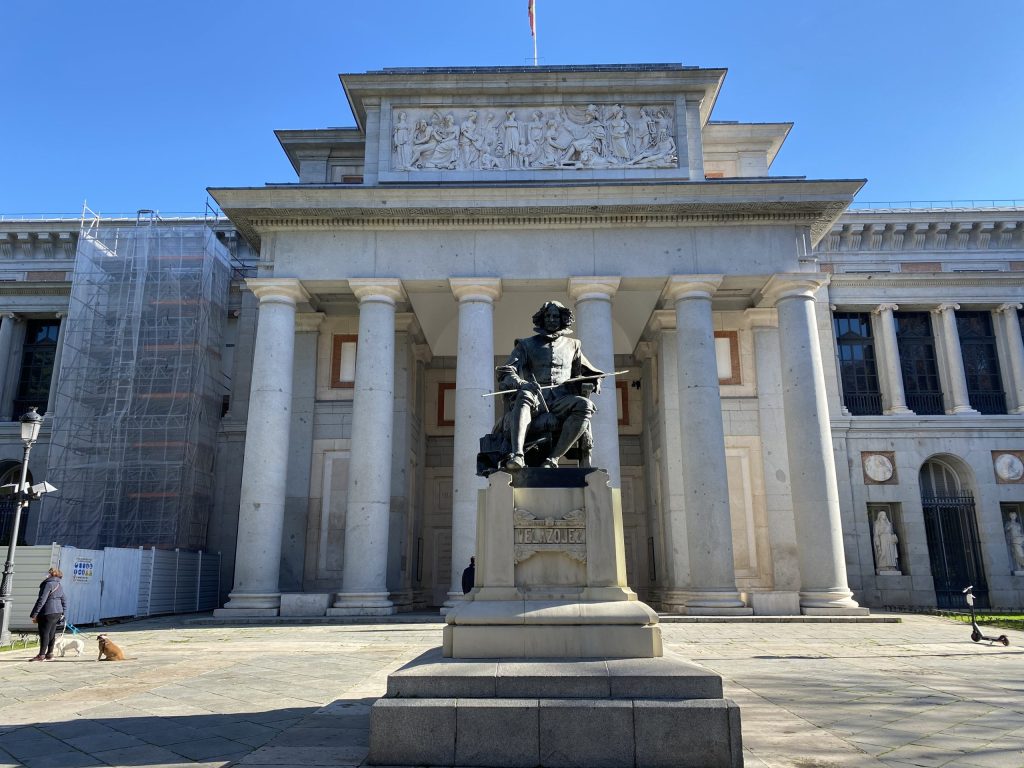
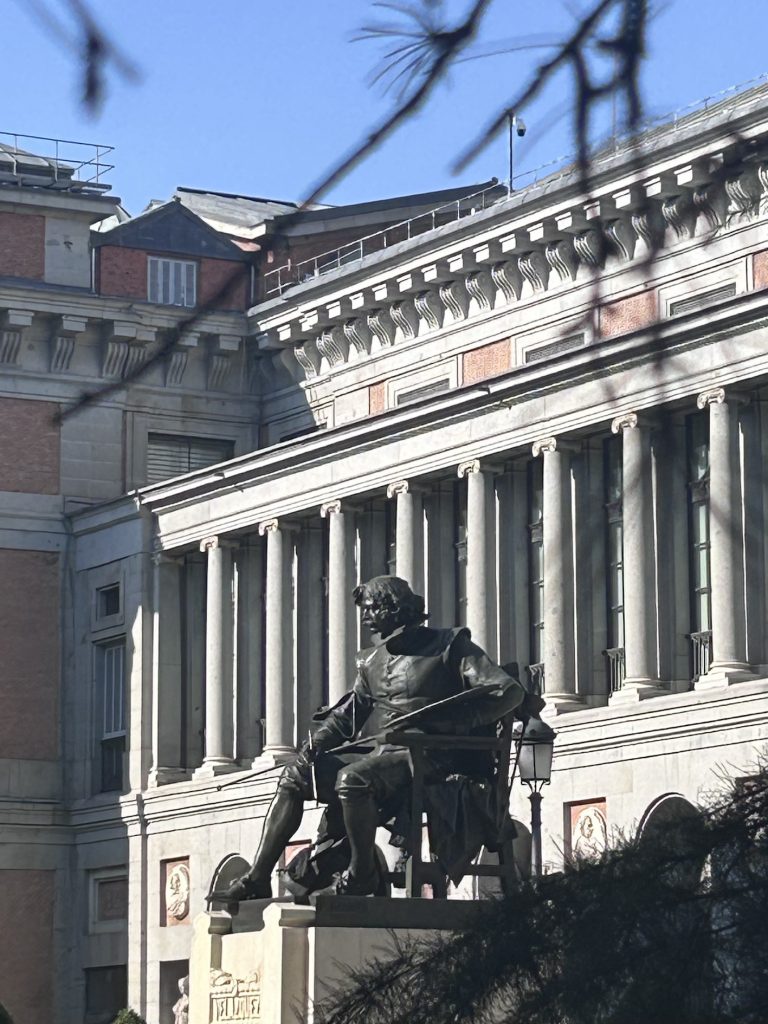
Finally, here’s a detail you’ll probably recognise after reading this article: our meeting point is next to the Velázquez statue on Felipe IV Street, directly opposite the Prado Museum ticket office. The day before your tour, we usually send an email with an infographic showing the exact meeting point, together with your guide’s phone number, so everything is as straightforward as possible.
We look forward to welcoming you and introducing you to the fascinating world of Velázquez. Click here to book!