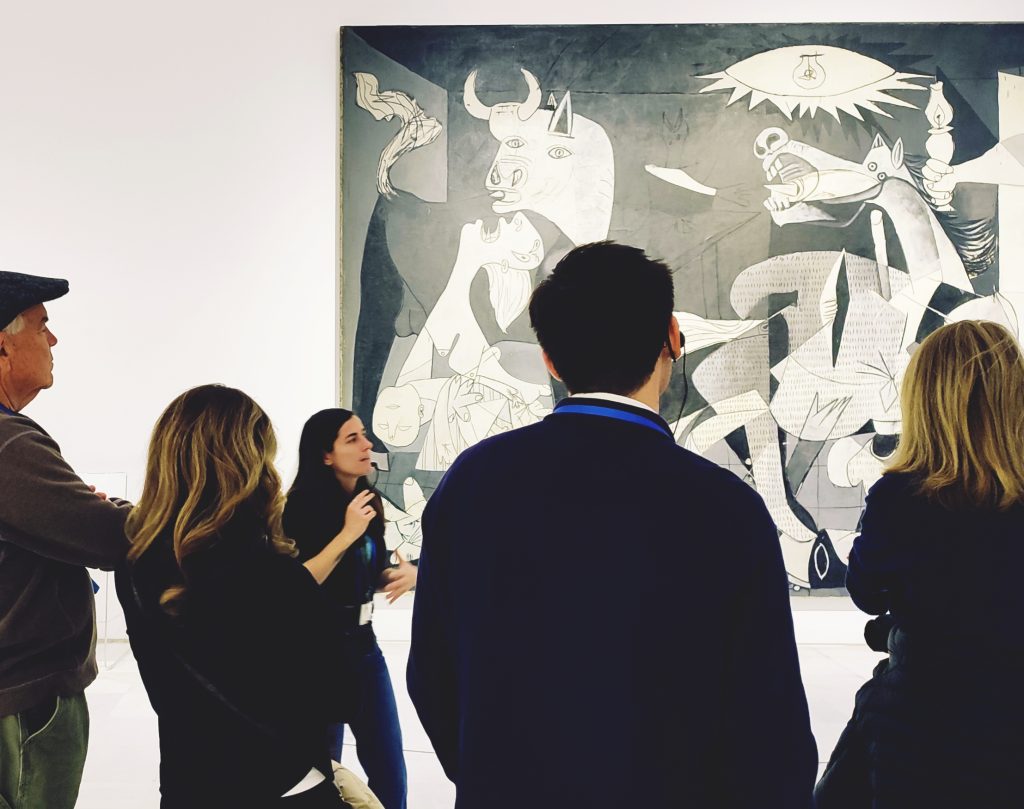
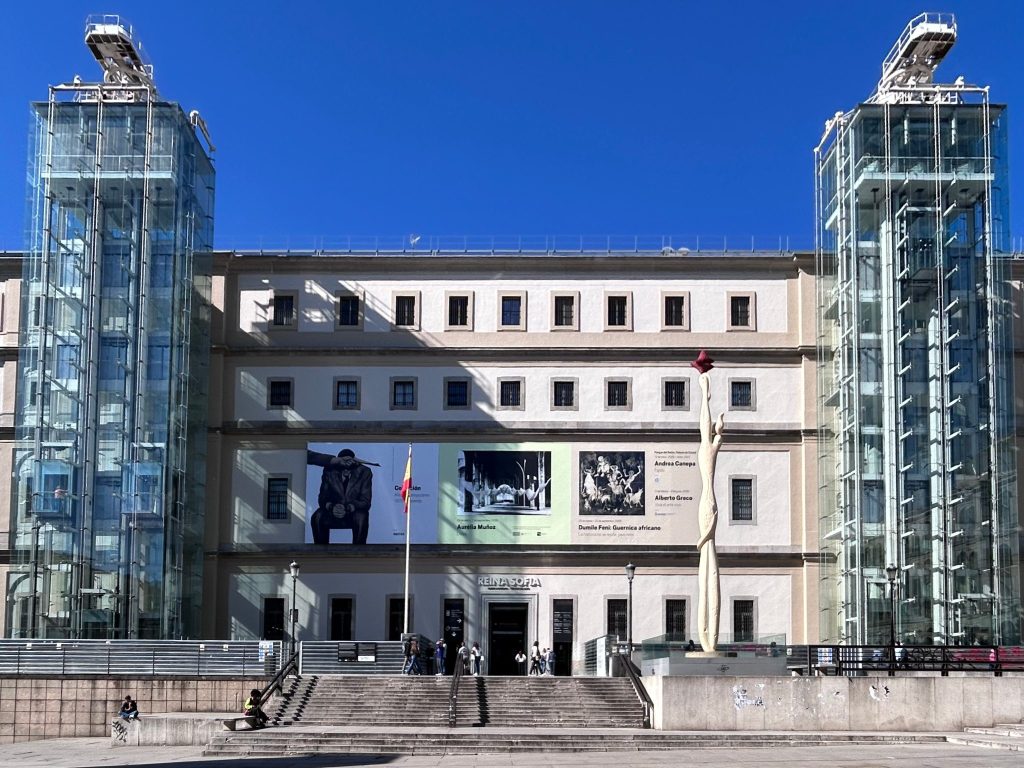
The Reina Sofía Museum is one of the world’s leading art museums and, together with the Prado Museum and the Thyssen Museum, forms what we know as Madrid’s Art Walk (Paseo del Arte). It is home to Picasso’s Guernica, one of the most influential paintings in the history of art, as well as an outstanding collection devoted to twentieth- and twenty-first-century art. Even so, it’s perfectly normal to walk through its doors feeling a little lost. Contemporary art has that peculiar ability to make us think everyone else understands what they’re looking at… except us.
The good news is that you’re not alone. We’ve all had questions before visiting the Reina Sofía Museum. Some are highly practical (“Can I eat inside?”), others feel slightly embarrassing (“What if I don’t understand Guernica?”), and a few are probably things you wouldn’t even dare ask your best friend.
To spare you that small amount of suffering, we’ve gathered the questions we hear most often during our tours, along with a few that, we suspect, plenty of people think about but rarely say out loud. We hope we’ve answered them all—or, at the very least, saved you from having to ask them in front of fifty complete strangers.
In this article
Questions About Visiting the Reina Sofía Museum
1. How much does admission to the Reina Sofía Museum cost? €12.
2. Are there any discounts? Yes. You can check all discounts and free admission categories on the Museum’s official website.
3. When is the best time to visit? Any time is a good time, but lunchtime between (14:00 and 16:00) is usually the quietest part of the day at the Reina Sofía Museum and pretty much everywhere else. While everyone else is looking for somewhere to eat, you’ll often find the galleries noticeably less crowded.
4. Is there a cloakroom? Yes. You’ll need a one-euro coin to use the lockers, but don’t worry—you’ll get it back when you leave the Museum.
5. Can I leave the Museum and come back later? Yes, as long as you keep your ticket. The Reina Sofía Museum, regarding this, goes easier than the Prado.
6. Is there a café? There are actually two! In fact, Café Nubel is one of the reasons to visit the Reina Sofía Museum besides seeing Guernica (check our article here!). If you have a little extra time, it’s well worth stopping for a coffee before or after your visit.
7. How much time do I need? Quite a lot. The Reina Sofía Museum is enormous. Bear in mind that your eyes get tired too. In our experience, spending more than three consecutive hours inside any museum can become overwhelming. That’s why we recommend taking a break from time to time, sitting in the beautiful central garden and simply letting your mind rest before continuing your visit.
8. Are there lifts? Yes! The Reina Sofía Museum is fully accessible. If you’re visiting in a wheelchair, however, we recommend entering through the Nubel entrance rather than the Sabatini entrance, as it’s generally much more convenient.
Questions About the Art
9. Is it called Modern Art or Contemporary Art? Contemporary Art. The Modern Age refers to the historical period that stretches from Columbus’s arrival in the Americas to the French Revolution. Contemporary Art, on the other hand, begins much later (this is a debate itself, but you could just say from Picasso on) and is precisely what you’ll find throughout most of the Reina Sofía Museum.
10. Is Guernica really as big as people say? It’s probably even bigger. According to our boss, its size is actually part of the artwork. Picasso wanted the painting to overwhelm the viewer, and it’s difficult to remain indifferent when you’re standing in front of a canvas that measures almost eight metres wide.
11. Can I take a photo of Guernica? Yes, as long as you don’t use flash. Our boss finds this deeply upsetting, so naturally the rest of the company is delighted about it.
12. Why is Guernica black and white? We don’t know for certain. It was an artistic decision, and Picasso never left a definitive explanation. According to our boss, using only black, white and grey makes the painting even more dramatic while stripping away any possible symbolism associated with colour. Then again, it’s always a good idea to consult more than one source—especially when that source happens to be our boss.
Questions About the Artists at the Reina Sofía Museum
13. Are there any Dalí’s? Absolutely! The Reina Sofía Museum houses one of the world’s most important collections of Salvador Dalí’s work. Here you’ll find masterpieces such as The Great Masturbator, Girl at the Window, The Invisible Man and The Endless Enigma, allowing you to follow much of his artistic evolution, from his early years to the height of Surrealism.
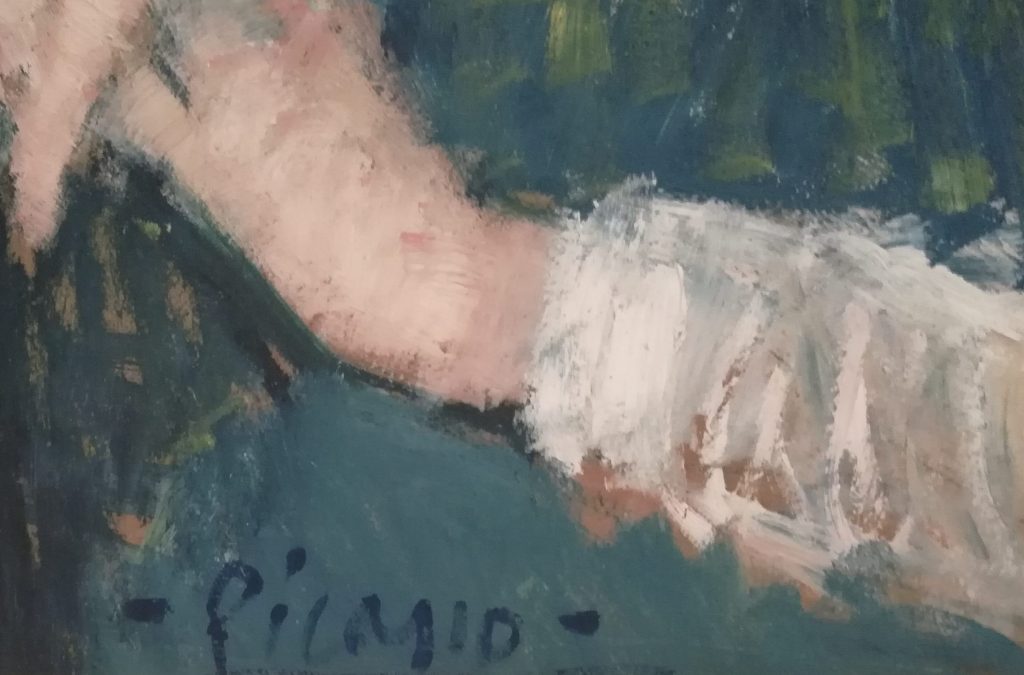
14. Are there any Miró’s at the Reina Sofía Museum? Yes—and plenty of them. Joan Miró is one of the Museum’s leading figures. If Guernica is the undisputed star of the collection, Miró would certainly be one of the headliners. His works include Woman and Dog in Front of the Moon, The House with the Palm Tree, Painting (The Red Spot) and Figures by the Sea, which beautifully illustrate how his artistic language evolved into the universe of symbols, colours and forms for which he is now famous.
15. Are there any Magritte’s? Yes, although it’s worth lowering your expectations slightly. The Museum owns works by René Magritte, including Pink Bells, Torn Skies (Grelots roses, ciels en lambeaux) and The Secret of the Procession (Le secret du cortège). That said, if your dream is to make a pilgrimage devoted entirely to the Belgian painter, the Magritte Museum in Brussels is probably a better destination. Even so, his paintings here help explain just how international Surrealism really was, and how closely it interacted with Spanish artists such as Dalí and Miró.
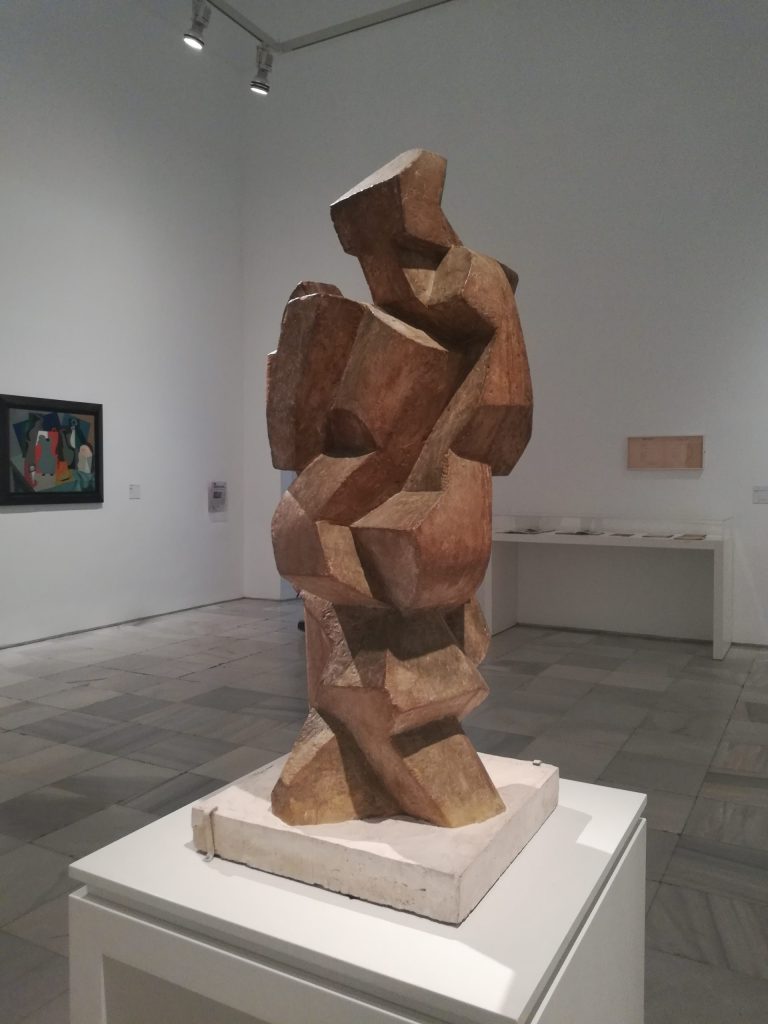
16. Is there any contemporary art “that I won’t understand”? Of course there is. By the way, Stairway to Heaven by Led Zeppelin is also one of the great masterpieces of contemporary art, and nobody has fully explained it yet. If you listen to it while walking through the Reina Sofía Museum, there’ll be one more artwork you do not understand in the Reina Sofía Museum, which is something to celebrate. That said, if you can enjoy Stairway to Heaven without understanding every single line of the lyrics, why not do exactly the same with a sculpture?
17. Do I have to understand every artwork? No. Art is there to be enjoyed. Sometimes it’s perfectly fine not to analyse everything. Sometimes it’s enough simply to look.
Questions About Our Tours
18. Is the admission ticket included?
Yes. In fact, that’s the main reason we can’t offer refunds for cancellations made less than 24 hours before the tour. We purchase your tickets in advance so you don’t have to queue at the ticket office. Which brings us to the next question…
19. Do you offer skip-the-line tours at the Reina Sofía Museum?
Yes, we do. However, we’d recommend reading our article on the subject first (click here!). “Skip the line” doesn’t always mean what people think it does, especially in Madrid, and we’d rather you know exactly what to expect before booking.
20. How long does the tour last?
Ninety minutes. We believe that’s enough time to introduce you to the Museum without overwhelming you. Afterwards, you’re welcome to stay inside for as long as you like and continue exploring on your own.
21. Are the groups small?
Yes. At the Reina Sofía Museum, we work with a maximum of six people per tour. If you’d like to come with a larger group, we’ll be happy to organise a private tour just for you. In that case, we’ll need to purchase a different type of ticket, so we’d really appreciate it if you could let us know in advance.
22. Can I stay inside the Museum after the tour?
Of course! Once the guided tour has finished, you’re free to remain inside the Museum for as long as you wish.
23. Which languages do you offer?
We run tours in Spanish, English and Italian. We also offer French, although we usually need a little more notice to organise it properly.
24. Are the tours accessible?
Absolutely. If you have any specific accessibility requirements, the best thing you can do is tell us before the tour. That way, we’ll come prepared, and the experience will be better not only for you, but for the rest of the group as well.
Questions (and Comments) from uncle
After many years guiding visitors around the Reina Sofía Museum, we’ve heard just about everything. These are the comments that appear again and again. They’re perfectly fair questions… but perhaps it’s time we answered them once and for all.
“I could have painted that!”
Yeah… But you didn’t, did you? For some mysterious reason that our minds are unable to comprehend… you didn’t. It had to be Picasso to come along and paint it instead.
Let us give you another example. There’s a Beatles song called And I Love Her. Paul McCartney once explained that, at first, the song wasn’t quite working, so George Harrison came up with its now-famous four-note guitar riff. Well, if you pick up a guitar for the first time, I can almost guarantee that—even if you’re the least talented person on Earth—you’ll be able to play those four notes. So, could you do it? Yeah, but it had to be good old Harrison to come along and write it. Here’s the song!
Why Did Picasso Paint Like That? Couldn’t He Draw?
He could draw extraordinarily well. If you don’t believe us, take a look at First Communion or Science and Charity, two paintings he completed as a teenager that already display astonishing academic skill. Still not convinced? We can do even better. At the age of sixteen, Picasso painted a copy of Velázquez’s Philip IV. Click here to see Picasso’s copy, and here to compare it with Velázquez’s original.
So why did he end up painting the way he did?
Because he was no longer interested in copying reality. Picasso believed that a camera could do that far better than any painter ever could. His goal was to represent objects from several viewpoints at the same time, simplify their forms and create an entirely new visual language. Put simply, he first mastered every rule… and then decided to break them.
By the way, one quotation commonly attributed to Picasso sums up his artistic journey rather well:
“It took me four years to paint like Raphael, but a lifetime to paint like a child.”
Whether or not those were his exact words is still debated, but they capture the spirit of his career remarkably well.
And the most important question of all: Can I join a tour with The Guides You Need?
Of course you can!
Our guided tours are designed to help you discover the Reina Sofía Museum without feeling overwhelmed. We work with small groups of no more than six people, so there’s always time for questions, discussion and the occasional terrible joke from your guide.
Your museum ticket is included in the price, and after the tour you’re welcome to stay inside and continue exploring the collection at your own pace. We offer tours in English, Spanish and Italian, and we can also organise French tours with a little advance notice.
Do we offer skip-the-line access? Yes—but before booking, we’d recommend reading our article explaining exactly what skip the line means in Madrid. We’d much rather you know what to expect than promise something that no museum can guarantee. Click here and we will take you to the article.