Salvador Dalí is one of those artists whose fame has ultimately transcended his own paintings. His impossible moustache, extravagant public appearances, and provocative behavior have become part of an image recognized around the world. Yet behind the persona was a painter of remarkable technical skill, with a career far more complex than his immediate association with Surrealism might suggest.
The Reina Sofía Museum offers the perfect opportunity to explore this evolution. Its collection includes works from different stages of Dalí’s career, from his formative years and early experiments to some of the images that helped shape his distinctive artistic universe.
In this article, we will explore five works to understand how his painting evolved and what we can discover about him by looking closely at them. We will also answer some of the most common questions about his life: Why did he become so famous? Why did he eventually clash with the Surrealists? What is his most famous work? And how old was he when he died?
In this article
Quick Questions About Salvador Dalí
What are some quick facts about Salvador Dalí?
Salvador Dalí was born in Figueres on May 11, 1904, and died in the same town on January 23, 1989. He studied at the Royal Academy of Fine Arts of San Fernando in Madrid and lived at the Residencia de Estudiantes during his youth, where he met Federico García Lorca and Luis Buñuel. He became one of the most important figures of Surrealism and developed what he called the paranoiac-critical method.
Why is Dalí so famous?
His fame stems both from his extraordinary artistic output and from the creation of an instantly recognizable public persona. He developed a universe filled with impossible images, landscapes, distorted figures, and unexpected associations, while also displaying an exceptional command of drawing and painting techniques. His public appearances, provocations, and famous moustache also turned him into an icon of popular culture.
Why was Dalí expelled from the Surrealist movement?
His break with the Surrealists was the result of several years of conflict, rather than a single incident. André Breton and other members of the group criticized his political positions, his attitude toward figures such as Hitler, and his growing interest in commercial success. Tensions culminated in 1939 with his definitive break from the group. Breton famously coined the anagram “Avida Dollars” to mock his relationship with money.
What was the difference between Dalí and the other Surrealists?
One of the main differences was his paranoiac-critical method. While some Surrealists, particularly André Breton, advocated techniques such as automatic writing or drawing to reduce rational control, the Catalan painter constructed carefully calculated images capable of producing several interpretations simultaneously.
He also stood out for his remarkable command of traditional painting techniques, which he used to depict completely irrational scenes with extraordinary precision. His desire to turn his own personality into a public spectacle, his relationship with money, and his political positions further distinguished him from many members of the movement.
What is Salvador Dalí’s most famous work of art?
Probably The Persistence of Memory, painted in 1931 and known worldwide for its famous melting clocks. However, the painting is not at the Reina Sofía Museum; it belongs to the Museum of Modern Art (MoMA) in New York. In Madrid, visitors can see other major works such as The Great Masturbator and The Invisible Man.
How old was Dalí when he died?
He was 84 years old. He died on January 23, 1989, in Figueres, the Catalan town where he had been born in 1904. He was buried in the Dalí Theatre-Museum, one of the most important places for exploring his life and career.
Is Dalí worth seeing at the Reina Sofía Museum?
Yes, especially because the collection allows visitors to explore very different stages of his career. A visit to the Reina Sofía Museum takes us from his early portraits and landscapes to his experiments with Cubism and some of his major Surrealist creations. Works such as Figure at the Window, The Great Masturbator, and The Invisible Man allow us to see firsthand how his painting evolved.
1. Portrait of Luis Buñuel: The Years at the Residencia de Estudiantes
In 1924, Salvador Dalí painted one of the most important portraits of his early career: that of his friend Luis Buñuel. The future director of Un Chien Andalou is shown from the waist up, with his arms crossed and a serious expression that conveys remarkable self-confidence. We are still far from the distorted figures and unsettling associations that, only a few years later, would turn the painter into one of the great names of Surrealism.
The work belongs to a decisive period in his youth. Dalí had arrived in Madrid in 1922 to study at the Royal Academy of Fine Arts of San Fernando and moved into the Residencia de Estudiantes. There, he came into contact with some of the leading figures of an exceptional generation in Spanish culture
Dalí, Buñuel, and Lorca in 1920s Madrid
At the Residencia de Estudiantes, three young men destined to achieve international fame crossed paths: Dalí, Federico García Lorca, and Luis Buñuel. Their relationship went far beyond ordinary student friendship. They shared books, conversations about new artistic movements, and a desire to challenge many of the cultural conventions of their time.
Buñuel was six years older than the painter, and the two developed a particularly important intellectual relationship. A few years after the portrait, they collaborated on Un Chien Andalou (1929), a landmark of Surrealist cinema. Both worked on the screenplay, deliberately creating a succession of images designed to resist conventional rational explanation.
The portrait at the Reina Sofía Museum takes us back to an earlier moment. Buñuel was not yet the celebrated filmmaker he would become, and his friend had not yet fully developed the visual universe that would make him famous around the world. We are looking at two young creators just before their careers changed dramatically.
A Portrait Before Surrealism
The painting is also fascinating precisely because of what we do not yet find in it. There are no melting clocks, impossible figures, or dreamlike scenes built from irrational associations. Instead, we see a solid, austere, carefully constructed portrait.
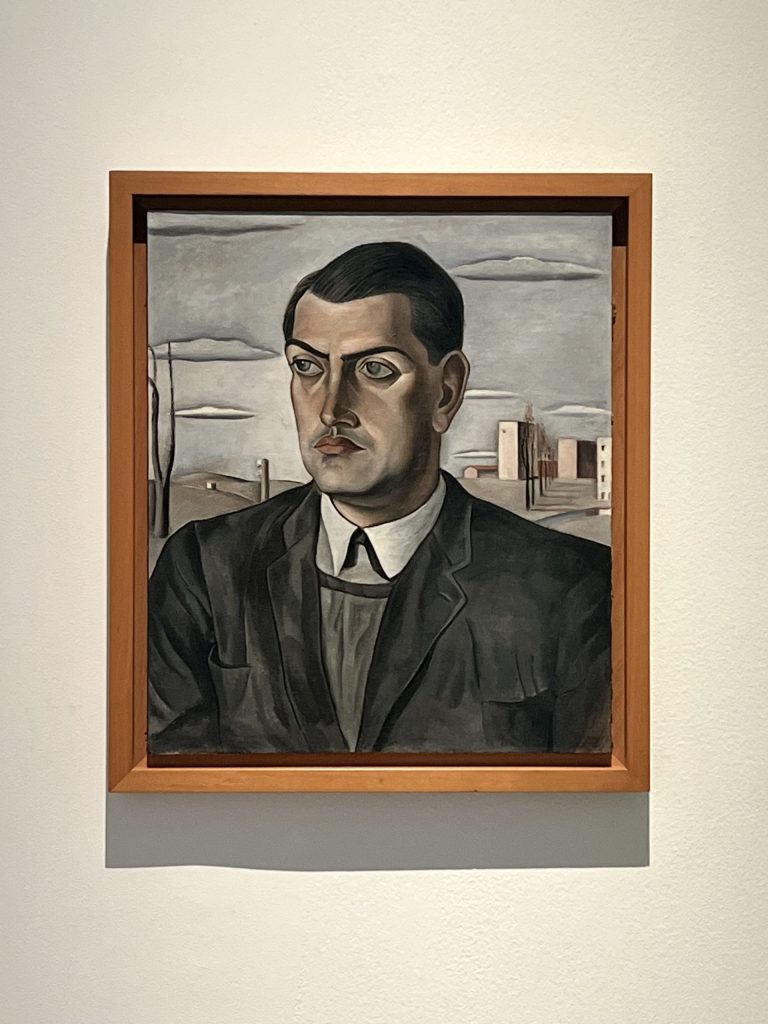
The face commands much of our attention. Buñuel looks directly at the viewer, while his crossed arms reinforce the impression of a strong and self-assured personality. The sobriety of the composition also reveals something that can sometimes be obscured by the extravagant public persona the artist would later develop: before becoming one of the leading figures of Surrealism, he had acquired considerable technical training and experimented with very different artistic languages.
That is precisely what makes Portrait of Luis Buñuel such an interesting starting point for exploring his work at the Reina Sofía Museum. We have not yet reached the Dalí most people recognize. Instead, we encounter a young painter searching for his own path, surrounded by some of the figures who would transform Spanish culture in the twentieth century.
2. Figure at the Window: A Very Different Dalí
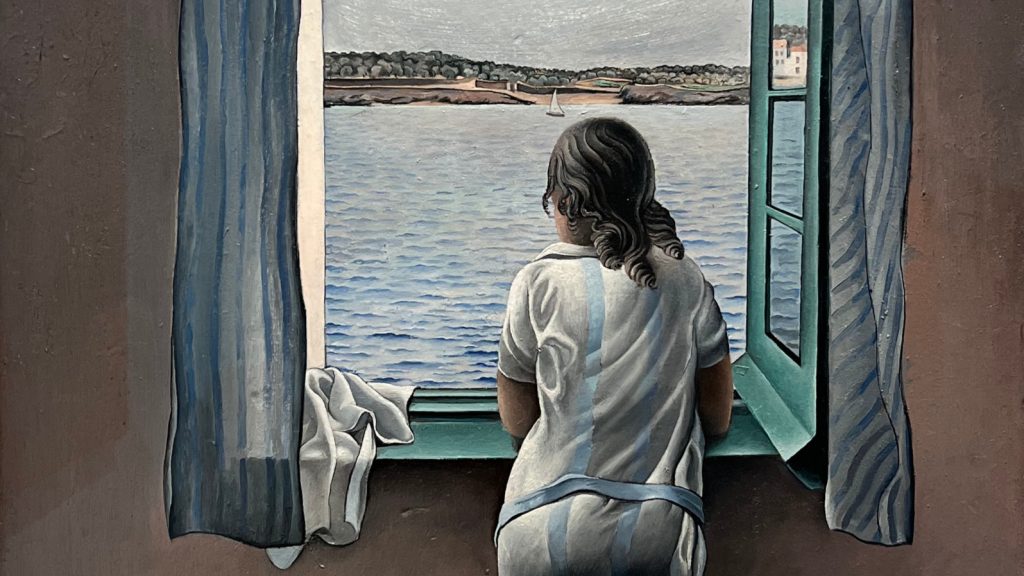
One year after the portrait of Buñuel, in 1925, Dalí painted one of the best-known works of his youth: Figure at the Window. A young woman stands with her back to us in front of an open window, quietly looking out at the landscape. The composition is simple, but it clearly reveals some of the young painter’s main concerns at the time: the representation of space, Mediterranean light, and the relationship between a figure and the landscape unfolding before her.
The woman is Anna Maria, the painter’s sister and one of his most frequent models during these years. Before her lies the sea at Cadaqués, a place that would become fundamental to both the painter’s life and his work.
Anna Maria, the Painter’s Sister and Model
Before Gala became the central female figure in his life and artistic production, Anna Maria occupied a privileged position. Her brother portrayed her numerous times during the 1920s, particularly during the periods the family spent in Cadaqués. In this painting, however, we do not see her face. We recognize her through her posture, her dress, and the relationship between her body and the surrounding space.
The decision to portray her from behind also shapes the way we look at the painting. We observe Anna Maria, but at the same time we share her view of the landscape. The window therefore acts as a frame within the painting itself: first we see the room, then the figure, and finally our gaze moves beyond both of them toward the sea.
The apparent simplicity of the scene is deceptive. The light entering from outside, the tones of the dress, the curtains, and the water reveal the artist’s interest in representing space and his command of a figurative style still closely connected to tradition.
Cadaqués, a Fundamental Landscape in Dalí’s Work
The landscape visible through the window is Cadaqués, on the coast of Catalonia. It is far more than simply the background chosen for this painting. This setting accompanied Dalí from his youth and would eventually become one of the great geographical references throughout his career.
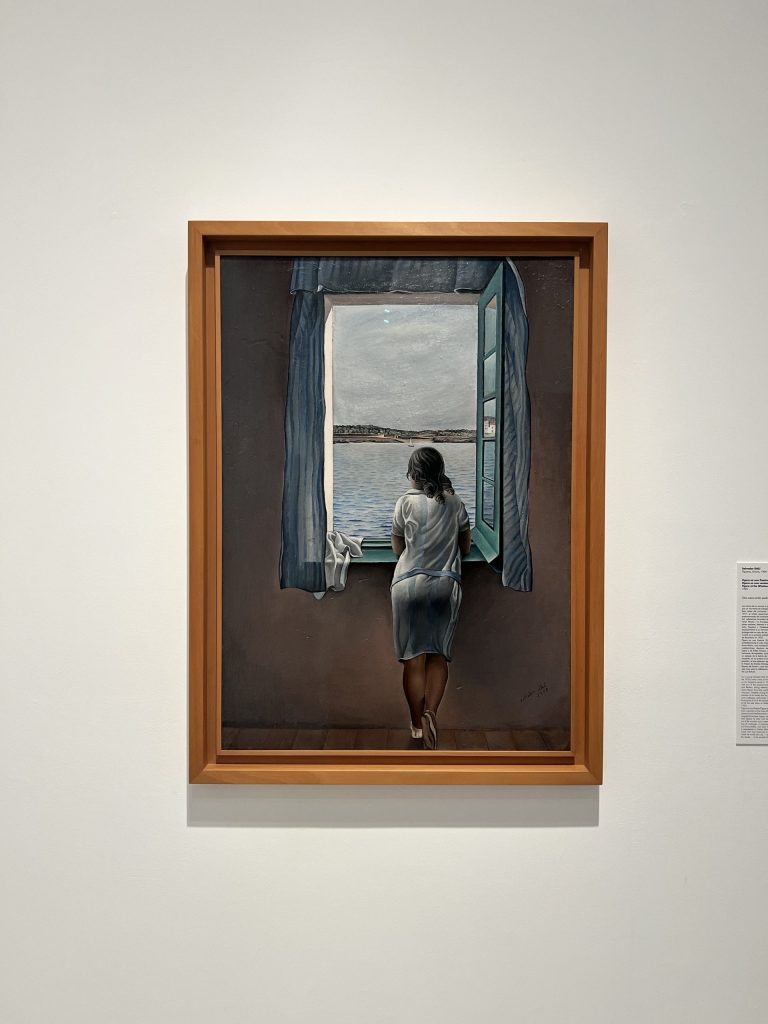
The Mediterranean, open horizons, and especially the unusual rock formations found around Cadaqués and the surrounding area would appear repeatedly in his paintings. Figure at the Window therefore allows us to recognize some of the visual material he would continue to use for decades, even as his artistic language changed profoundly.
The work at the Reina Sofía Museum shows us a painter of barely twenty-one who already possessed a remarkable ability to construct figures, spaces, and landscapes. Yet this way of painting would not last long either. During these years, he was rapidly absorbing the artistic innovations arriving from elsewhere in Europe. The next work in our journey shows just how willing he was to experiment: in 1926, we will find him trying his hand at Cubism.
3. Still Life: Dalí’s Foray into Cubism
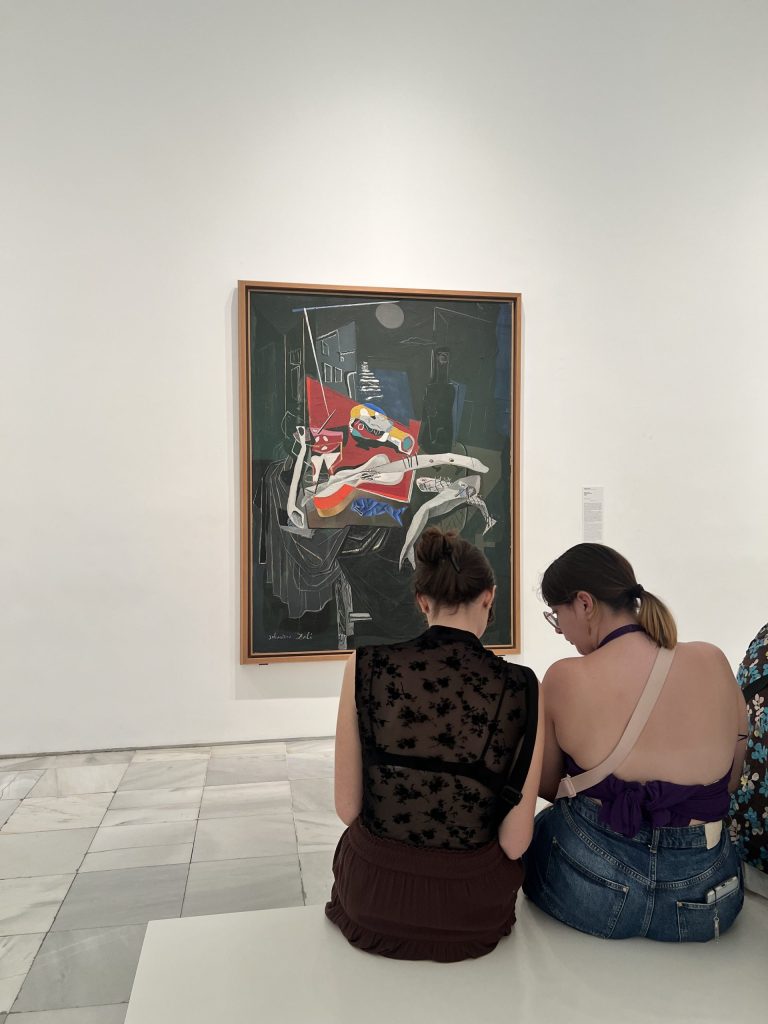
In 1926, we encounter a considerable change. Still Life takes us away from the serenity of Figure at the Window and introduces us to the young painter’s experiments with the European avant-garde. This time, the protagonist is neither a person nor a landscape, but a group of everyday objects subjected to a much more geometric construction.
The work is particularly interesting because it demonstrates how quickly the painter shifted between different styles during these years. He had not yet found a definitive artistic language and seemed willing to explore very different possibilities. Cubism was one of them.
Picasso and the Influence of the Avant-Garde
To understand this change, we inevitably have to talk about Pablo Picasso. Cubism had begun to develop almost two decades earlier, so the painting at the Reina Sofía Museum does not belong to the origins of the movement. Instead, we are looking at a young artist studying and absorbing a pictorial revolution that had already profoundly transformed European art.
It was precisely in 1926 that he made his first trip to Paris and visited Picasso. The encounter was particularly significant: the Málaga-born artist was already an international figure, while the young Catalan painter was beginning to make a name for himself. His admiration for Picasso did not mean, however, that he intended simply to become a Cubist painter.
In Still Life, we can see this experimentation in the simplification of forms and the way the objects are arranged within the composition. Representation no longer depends exclusively on faithfully reproducing what stands before Dalí. Volumes and geometric relationships take on much greater importance.
Experimenting Before Finding His Own Language
This painting is particularly useful within our journey because it challenges any attempt to explain Dalí’s youth as a simple, perfectly ordered evolution. During the 1920s, he experimented with ideas drawn from different, and sometimes apparently contradictory, artistic movements.
For that reason, Still Life should not be understood as the beginning of a long Cubist period. Its importance lies precisely in what it reveals about his search for a direction. The painter observed what was happening within the avant-garde, borrowed elements that interested him, and experimented with them without permanently committing himself to a single movement.
This ability to appropriate very different artistic resources would ultimately become fundamental to understanding his career. His excellent command of drawing would coexist with a constant desire to experiment with new ways of constructing images.
The work at the Reina Sofía Museum therefore captures a moment of artistic exploration. Within just a few years, these experiments would lead to something far more personal. By the end of the 1920s, the painter had begun creating the unsettling, ambiguous images and psychological associations that would mark a new stage in his career.
4. The Great Masturbator: Dalí’s Full Entry into Surrealism
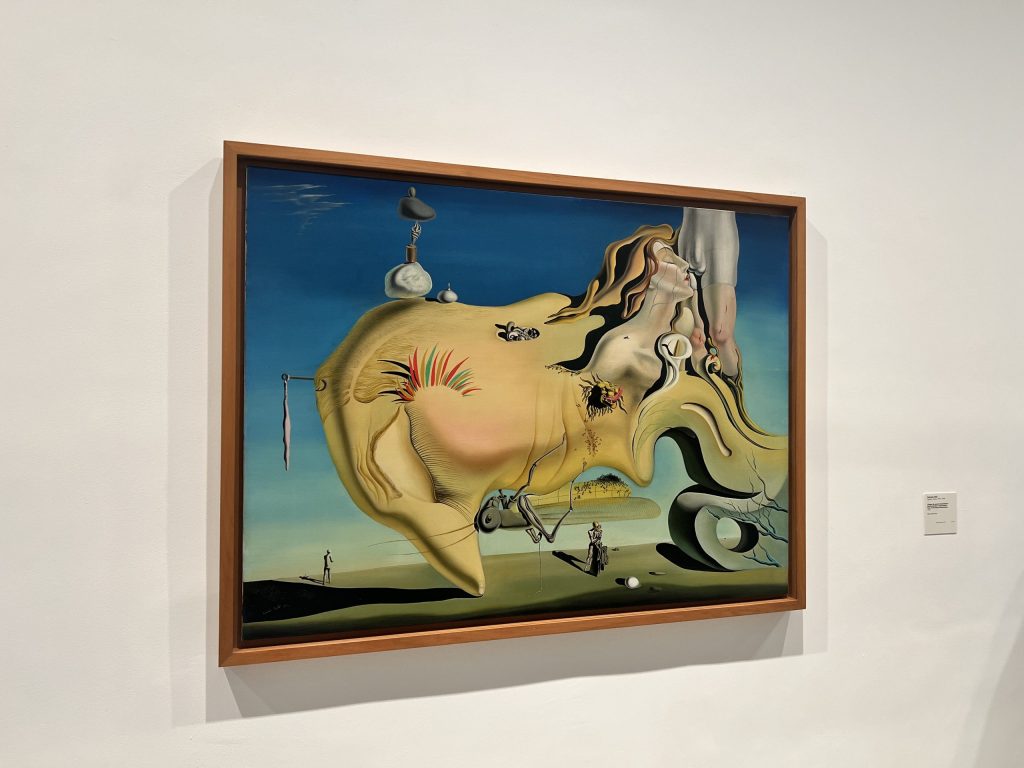
In 1929, everything changes. The Great Masturbator no longer belongs to a period of experimentation between different artistic languages: we are now faced with a deeply personal, disturbing painting built around associations that seem to escape everyday logic. Surrealism now becomes a means of exploring desire, fear, sexuality, and the subconscious.
The work was painted toward the end of the summer of 1929, at a decisive moment in the master’s life. That same year, he met Gala, then the wife of poet Paul Éluard, during a stay in Cadaqués. Their relationship transformed his personal life and immediately left its mark on his painting. The Reina Sofía Museum itself describes The Great Masturbator as an eminently autobiographical work.
A Self-Portrait Transformed into an Impossible Form
The enormous yellowish figure dominating the composition can be difficult to recognize at first. This is not a conventional self-portrait. The head is distorted, with closed eyes and an enormous nose that almost touches the ground. The form acts as a representation of the painter himself and would reappear in other works from this period.
Here we encounter a much more profound rupture than the Cubist experimentation of Still Life. The aim is no longer simply to alter the traditional way of representing an object. A form can now transform itself, contain other scenes, and bring together images that apparently have no relationship with one another.
The result resembles the workings of a dream more than a conventional narrative. The individual elements appear perfectly recognizable when viewed separately, but their combination creates a scene that resists any single rational interpretation.
Gala, Desire, and Fear
At the center of the composition appears a couple with an unmistakable sexual charge. The female figure approaches the body of a man while the enormous head remains with its eyes closed. Desire therefore occupies a fundamental place in a painting created precisely when Gala’s arrival was causing a profound emotional and erotic transformation in the paiter’s life.
But desire does not appear alone. It is accompanied by images of fear and repulsion. One of the most striking elements is the grasshopper attached to the large central figure. The insect was not chosen at random: the painter had experienced an intense fear of grasshoppers since childhood.
This coexistence of attraction and rejection is one of the keys to the painting. Sexuality, anxiety, personal memories, and phobias are brought together within the same space. Rather than resolving these contradictions, the work places them side by side.
The Symbols That Build a New Universe
The Great Masturbator finally allows us to understand why Surrealism proved so fertile for Dalí. The movement, theoretically articulated by André Breton from 1924 onward, sought to challenge certain forms of rational thought and give greater space to desire and the subconscious.
However, this painting is not simply an application of ideas developed by Breton. Its power comes from the way the painter transforms intimate experiences into images. His own fears, desires, and obsessions provide the material from which he constructs a recognizable visual vocabulary.
This is why, standing before this work at the Reina Sofía Museum, we are much closer to the creator who would achieve international fame. Recognizable objects remain, but they no longer obey ordinary rules. A face can become a landscape, a personal experience can take physical form, and different images can coexist within a single figure.
The next step would take this ambiguity even further. In The Invisible Man, it will no longer be enough to ask what the objects in the painting mean. First, we will have to ask ourselves what we are actually looking at.
5. The Invisible Man: Learning to See Two Images at Once
Between 1929 and 1932, Dalí worked on The Invisible Man, a painting that takes some of the experiments we have just encountered in The Great Masturbator considerably further. At first glance, we see a landscape populated by figures, architecture, and objects. However, once our eyes begin to connect them, something different emerges: together, all these elements simultaneously form the body of an enormous seated figure.
The painting therefore forces the viewer to distrust their first impression. What appears to be one thing can become another without any element on the canvas changing position. This ambiguity would become fundamental to understanding some of the painter’s most characteristic contributions during the 1930s.
The Birth of Double Images
The enormous figure is not depicted conventionally. We have to construct it mentally from the different elements within the composition. Architectural forms help define the head; different figures and objects become part of the body, while other sections of the landscape acquire a second function when we look at the composition as a whole.
That is where the visual game begins. We can concentrate on the individual elements and make the giant disappear, or shift our attention to the whole and allow those same elements to become parts of its anatomy. Both images exist simultaneously, even though our perception tends to favor one over the other.
The Invisible Man is one of the artist’s first major experiments with this technique. It was also left unfinished, allowing us to observe a process of investigation that he would later develop with much greater precision. The double image would eventually become one of the most recognizable devices in his work.
The Paranoiac-Critical Method
In the early 1930s, these experiments became associated with what Dalí himself called the paranoiac-critical method. The term may sound complicated, but the basic idea becomes much easier to understand when standing in front of The Invisible Man: it involves creating a form of perception in which the same reality can generate different associations and images.
It was not simply a matter of painting dreams. The aim was to deliberately use mechanisms of association and interpretation to produce ambiguous images. A rock could become a face; several bodies could form another body; a landscape could conceal a monumental figure. The viewer’s own perception actively participates in the transformation.
This also marks an important difference between his approach and that of other Surrealists. While techniques such as automatism sought to reduce rational control during the creative process, the paranoiac-critical method required extraordinarily calculated pictorial construction. The image had to be executed with enough precision to sustain several interpretations simultaneously.
The Invisible Man, at the Reina Sofía Museum, allows us to observe this mechanism while it was still being developed. After the young portraitist of Buñuel, the landscapes of Cadaqués, and the experiments with Cubism, we have reached an artist who is no longer content simply to represent what he sees. Now, he attempts to alter the way we ourselves see. And perhaps that is one of the reasons why his paintings remain so compelling. When faced with a work like this, looking once is not enough.
🎨 Discover Dalí at the Reina Sofía Museum with The Guides You Need
After more than 3,000 words about Dalí, we could probably keep going. But perhaps it is time to see his works for yourself.
At The Guides You Need, we offer guided tours of the Reina Sofía Museum in small groups of no more than 6 people. Admission is included, and our professional guides will help you understand not only Salvador Dalí at the heart of this article, but also Picasso, Miró, María Blanchard, Ángeles Santos, and other essential figures of 20th-century art.
🎟️ Museum admission included
👥 Groups of up to 6 people
🖼️ Professional guides
🇪🇸🇬🇧 Tours in Spanish and English
🇫🇷🇮🇹 French and Italian available on request
Because after reading about The Great Masturbator or The Invisible Man, the most important part remains: standing in front of the painting and starting to look.
👉 Book your guided tour of the Reina Sofía Museum with The Guides You Need and discover just how much a work of art can change when someone helps you truly see it. Click here!