Surrealism was born with an ambition that was difficult to contain: to explore what reason could not explain. Dreams, the unconscious, chance, and unexpected associations offered artists a territory where the rules of reality could cease to apply. An everyday object could appear in an impossible setting, a figure could transform before our eyes, or an apparently simple image could force us to question what we are actually seeing.
However, Surrealism was never a single way of painting. Dalí, Magritte, and Ernst followed very different paths in their attempts to confront the inexplicable. While Salvador Dalí turned irrational images into scenes of almost unsettling precision, René Magritte challenged our perception through familiar objects and visual paradoxes. Max Ernst, meanwhile, experimented with chance, textures, and new techniques to reduce conscious control over the creative process.
Through these three artists, we can understand what Surrealism is, what its main characteristics are, and why it transformed the way we understand art. We will also see why their works continue to invite us to look beyond what seems logical at first glance.
in this article
What Is Surrealism and What Does It Consist Of?
Surrealism was an artistic and literary movement that emerged in Europe during the 1920s and sought to expand the boundaries of reality by exploring the unconscious, dreams, and mental processes that escape the control of reason. Its purpose was not simply to depict strange or impossible scenes: behind these images lay a much deeper reflection on how we think, imagine, and perceive the world.
Its origins were closely connected to the consequences of the First World War. For many European artists and intellectuals, the confidence in reason, progress, and order that had characterized much of the 19th century had been profoundly shaken. A society that considered itself rational had been capable of producing an industrial war of extraordinary violence. Some creators therefore began to question whether reason should continue to occupy such a dominant position.
From Dada to the Surrealist Manifesto
One of its most important predecessors was Dada, a movement that had used absurdity, provocation, and the rejection of artistic conventions as a response to that crisis. The Surrealists, however, wanted to go further. Breaking the old rules was not enough: they also wanted to find new forms of creation.
In 1924, the French writer André Breton published the first Surrealist Manifesto. In it, he defended psychic automatism as a way of expressing the workings of thought while reducing the conscious intervention of reason. The aim was to allow ideas, images, and associations that would normally be repressed or dismissed to emerge during the creative process.
For this reason, Surrealism cannot be understood simply as a style of painting. It also encompassed literature, poetry, photography, cinema, and experimentation. Nor is there a single visual appearance that immediately identifies every Surrealist work. Some artists painted with extraordinary technical precision; others turned to chance, collage, or experimental techniques. What they shared above all was a desire to investigate a reality beyond rational conventions.
Freud, Dreams, and the Unconscious
Sigmund Freud’s theories were enormously influential in this context. His research into the unconscious and dreams offered the Surrealists a new way of thinking about the mind. Something that apparently made no sense could conceal associations, desires, memories, or fears that consciousness did not entirely control.
Dreams were particularly attractive because many of the rules that organize our everyday experience disappear within them. People, places, and objects can merge without respecting time, space, or causality. For an artist, this freedom opened up almost unlimited possibilities.
This does not mean that every Surrealist approached Freud’s ideas in the same way. The movement brought together very different personalities and was full of debates, conflicts, and contradictions. This is precisely why Dalí, Magritte, and Ernst provide three particularly interesting examples: all three belonged to the Surrealist universe, but each found a different way to challenge what we consider real.
What Are the Characteristics of Surrealism?
Talking about the characteristics of Surrealism presents a difficulty: there is no single formula that allows us to recognize all its works in the same way. A painting by Dalí may appear technically precise and almost academic, while Max Ernst experiments with textures, marks, or processes involving chance. Magritte, meanwhile, can use an apparently simple image to pose a problem that ultimately becomes far more complex than it first seemed.
Despite these differences, certain ideas help us understand what many artists associated with the movement were seeking. The unconscious, dreams, unexpected associations, and the questioning of logic appear repeatedly, although each artist approached them differently.
Dreams and the Unconscious
One of its fundamental characteristics was an interest in what happens beyond conscious control. Dreams offered a particularly fertile model because they allow elements to be connected that, while awake, we would consider incompatible. A space can suddenly transform, an object can acquire an unexpected meaning, or two completely different images can merge into one.
However, the Surrealists did not necessarily seek to paint their dreams literally. What truly mattered was the possibility of freeing themselves, at least partially, from the rational structures that determine how we interpret reality.
Familiar Objects in Impossible Situations
Many artists used perfectly recognizable elements to construct images that challenge our logic. A clock remains a clock, an apple still looks like an apple, and a human figure retains its familiar appearance. It is the relationship between these elements that no longer behaves as we expect.
This contradiction is fundamental to understanding Dalí and Magritte. Both could use extremely clear figurative painting, yet this clarity did not make their works easier to interpret. On the contrary, the more recognizable each object appears, the more disconcerting the situation in which it appears can become.
The viewer is therefore confronted with a paradox. We understand perfectly well what we are seeing and, at the same time, cannot fully explain what is happening.
Chance, Automatism, and Experimentation
Another important characteristic was the attempt to reduce rational control during the creative process. Automatism sought to allow words, lines, or images to emerge without completely conscious planning. Chance could therefore become an artistic tool.
Ernst took this investigation particularly far through techniques such as frottage and grattage. The resulting textures could suggest forms that the artist would later develop. Instead of always beginning with a perfectly defined image in his mind, he could observe what had appeared accidentally and work from it.
This even changes the traditional idea of the artist as someone who controls every element of a work from the beginning. Part of the creative process now consists of responding to the unexpected.
A Reality Broader Than Logic
Perhaps one of the best ways to understand Surrealism is to abandon the idea that it simply wanted to depict absurd things. Its purpose was far more ambitious: to question where what we call reality actually ends.
Dreams are real as mental experiences. So are our memories, desires, involuntary associations, and fears, even though they cannot be physically observed in the same way as a table or a building. The Surrealists explored precisely this territory.
For this reason, the movement’s strange images are not merely exercises in imagination. In many cases, they function as a question addressed directly to the viewer: why do we accept some relationships as normal and others as impossible?
That question becomes much easier to understand when we examine how Dalí, Magritte, and Ernst responded to it. All three shared an interest in what escapes rational explanation, but they developed profoundly different artistic strategies to approach it.
Dalí, Magritte, and Ernst: Three Ways to Explain the Inexplicable
If the characteristics we have discussed so far seem broad, the works of Dalí, Magritte, and Ernst allow us to understand them in much more concrete terms. All three took part in the same artistic adventure, yet they achieved such different results that it would be difficult to confuse their paintings.
This is precisely one of the keys to the movement. There was no compulsory technique or visual appearance that everyone had to share. What mattered was finding ways to move beyond the usual associations imposed by reason. To achieve this, each of these three artists developed his own strategies.
Salvador Dalí: Painting Dreams with Precision
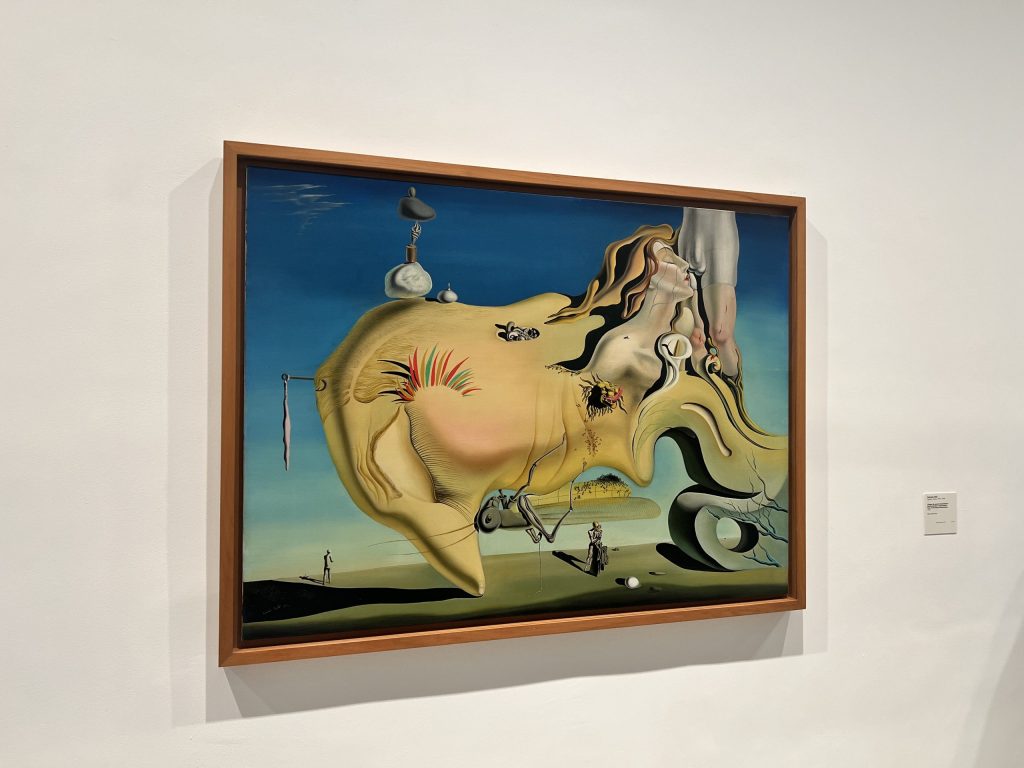
Few figures in 20th-century art are as instantly recognizable as the painter from Figueres. His public personality, provocations, and the image he created around himself eventually turned him into a character almost as famous as his paintings. Yet behind that spectacle was a painter of extraordinary technical ability.
This apparent contradiction is essential to understanding his work. Dalí could depict an impossible scene using meticulous, precise, and perfectly recognizable forms. The viewer identifies a landscape, a face, or an object, but the relationships between them follow rules that no longer belong to everyday life.
The Paranoiac-Critical Method
Dalí developed what he called the paranoiac-critical method, through which he sought to encourage irrational associations and multiple perceptions. One form could become another depending on how it was observed, and the same image could contain several different possibilities.
This is why transformations, ambiguous figures, and double images appear throughout his work. The painter did not need to abandon figurative representation to alter our perception. On the contrary, he used his technical mastery to make the impossible acquire an unsettling appearance of reality.
This approach distinguishes him from other artists who relied more directly on automatism or chance. In Dalí’s case, the final image is extremely deliberate. The irrational does not necessarily imply uncontrolled painting: it can be represented with almost obsessive precision.
Dalí Beyond the Avant-Garde
It is also important to avoid a common mistake: reducing the Catalan artist’s entire career to his involvement with this movement. Before becoming fully associated with it, he had explored different languages of the European avant-garde, and his work continued to evolve after he moved away from André Breton’s circle.
This development can be seen particularly well at the Reina Sofía Museum, whose collection allows us to explore different stages of his career. Looking at these works together helps us understand that the extravagant persona Dalí created around himself should never obscure the complexity of his painting.
With him, we have seen one way of approaching the inexplicable: making an impossible image appear extraordinarily real. Magritte also started with recognizable objects, but he used them to confront us with a very different problem.
René Magritte: When Everyday Life Stops Making Sense
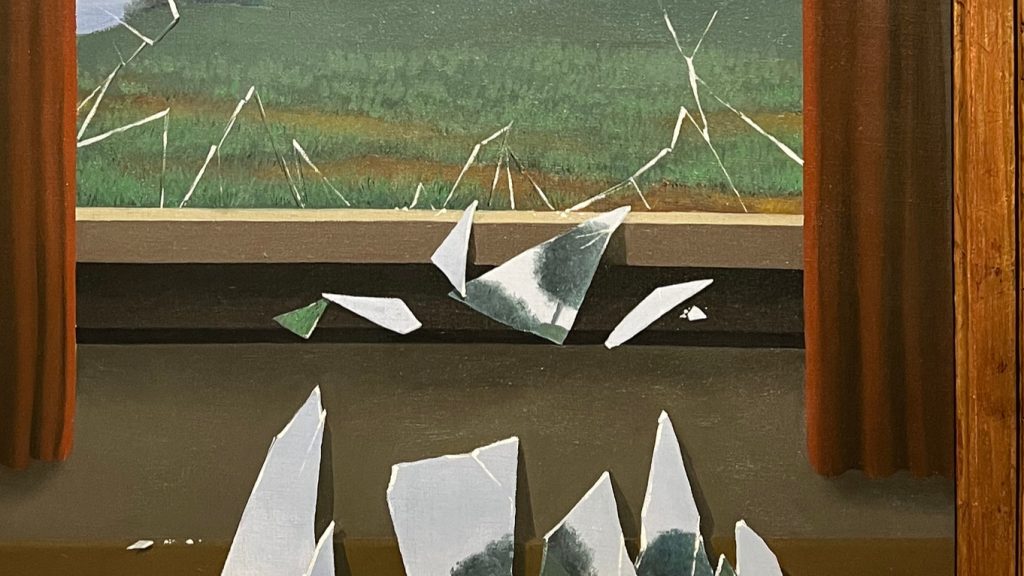
While the Catalan artist made impossible scenes appear real, René Magritte followed a different path. His paintings are often constructed from simple, perfectly recognizable elements: men wearing hats, windows, clouds, apples, houses, or rooms. None of these things seems strange on its own. The problem begins when they appear together.
The Belgian painter altered the relationships we expect to find between things. A room may contain a disproportionately large object; a landscape may become confused with its own representation; a face may be hidden precisely when we expect to recognize it. There is no need for fantastic creatures. Slightly changing the rules is enough to make familiar things stop behaving as they should.
Magritte Does Not Paint Dreams: He Creates Problems
We often associate this avant-garde with images drawn from dreams. However, understanding the Belgian artist’s work solely from this perspective would be insufficient. Many of his paintings work better as visual problems. We recognize every element, yet the relationship between what is represented and what we think we know about reality becomes unstable.
One of his fundamental interests was precisely the difference between an object and its representation. A painting of a pipe is not a pipe that we can fill with tobacco. It seems like an obvious statement, but it raises an important question: when we look at an image, to what extent do we confuse representation with reality?
These kinds of games also explain the importance that words acquired in some of his works. Image, language, and object do not always coincide. What we see, what we name, and what actually exists can have far less straightforward relationships than we might assume.
The Unease of an Apparently Simple Painting
Much of the power of these images comes from their clarity. We do not need to decipher a complicated technique to recognize what appears before us. The sky looks like a sky and a house looks like a house. Precisely for this reason, when something breaks our expectations, the contradiction becomes even more evident.
Magritte thus transformed everyday life into unfamiliar territory without having to alter it completely. His painting reminds us that the inexplicable can appear among the objects we see every day. Sometimes, simply changing their scale, position, or relationship with words is enough to force us to look again.
While here the disruption comes from combining familiar elements in a different way, Max Ernst will take experimentation one step further: he will allow chance to intervene in the very creation of the image.
Max Ernst: When Chance Becomes Part of the Creative Process
With Max Ernst, we find a third way of approaching the inexplicable. In his case, the disruption does not occur only in what is represented. It also affects the process through which the image itself comes into being. The German artist experimented with techniques that introduced chance and allowed him to find forms that had not been planned in advance.
His career helps us understand this approach. Before joining André Breton’s circle, he had been actively involved in Dada. From that experience, he retained an interest in questioning artistic conventions and using materials and processes far removed from traditional painting. Collage became one of his essential tools: by bringing together images from different contexts, he could construct unsettling scenes whose logic seemed to belong to another world.
Frottage and Grattage: Finding Images Where There Were None
One of his most interesting contributions was the development of frottage. The process begins with something very simple: placing a sheet of paper over a textured surface — wood, for example — and rubbing it with a pencil to capture its irregularities. The initial result is not entirely controlled by the artist.
These marks could suggest forests, creatures, landscapes, or undefined forms. From them, the painter would intervene and develop the image. Creation thus became a kind of dialogue between what appeared accidentally and the decisions made afterwards.
A similar principle can be found in grattage, applied to painting. In this case, layers of pigment were spread across the support and then scraped or worked to reveal the textures of surfaces placed underneath. Once again, the starting point could produce forms that were difficult to predict.
The Artist Who Tries to Give Up Some Control
These techniques do not mean that the creator disappears from the work or that everything depends on chance. A process of selection still follows: observing, choosing, modifying, and deciding which possibilities are worth developing. What was truly innovative was that the artist no longer needed to determine every element of the composition in advance.
Here we find an important difference from the two previous painters. In the Catalan artist’s meticulously calculated images or the Belgian painter’s visual paradoxes, the final effect largely depends on a carefully constructed composition. Ernst, by contrast, allows the process itself to suggest unexpected possibilities.
This way of working connects directly with one of the avant-garde’s central interests: temporarily reducing the supervision of reason to see what might emerge in its absence. Chance ceases to be an accident that needs to be corrected and becomes a tool capable of opening new paths.
With these three artists, then, we arrive at very different results. One makes the impossible appear believable; another transforms everyday life into a paradox; and the third changes the creative process itself to find images he might never have consciously imagined.
Magritte and Ernst in Madrid’s Museums
There is no need to leave Madrid to see works by two of the artists featured in this article. René Magritte is represented at both the Reina Sofía Museum and the Thyssen-Bornemisza Museum. Their collections allow us to experience firsthand the interplay between reality, representation, and perception that characterizes much of his work.
The Thyssen-Bornemisza Museum also holds works by Max Ernst, making it a particularly interesting place to see how two artists associated with the same avant-garde arrived at completely different solutions. While the Belgian painter explored visual paradoxes, the German artist experimented with chance, textures, and techniques that transformed the creative process itself.
Together with the works by Dalí already mentioned at the Reina Sofía, these collections make both museums essential places for exploring this artistic movement in Madrid. Seeing the original paintings also reveals aspects — scale, texture, technical precision, and detail — that are inevitably lost when we encounter a work only through a reproduction.
Discover These Works with The Guides You Need
Understanding a work of art while standing in front of the original completely changes the experience. At The Guides You Need, we offer guided tours of the Reina Sofía Museum and the Thyssen-Bornemisza Museum, exploring not only the highlights of their collections but also the ideas, artists, and historical context that help us understand them.
Our professional guides approach each visit as a conversation with the artworks, without memorized scripts and adapting their explanations to the group. If you would like to explore Dalí, Magritte, Ernst, and other major figures of 20th-century art, you can join us on a guided tour of two of Madrid’s essential museums.
We also offer tours of the Prado Museum and other important sites across the city. Explore our tours and choose the experience that best suits your visit to Madrid.