Juan Gris holds a fundamental place in the history of Cubism. However, his name tends inevitably to be overshadowed by Pablo Picasso and Georges Braque, the two great protagonists in the birth of this movement. Yet it only takes a look at some of his paintings to see that reducing him to a mere follower would be deeply unfair.
The Museo Reina Sofía offers us a wonderful opportunity to explore his work and understand what made his painting different. His compositions often begin with seemingly simple objects—a guitar, a violin, a bottle or a table—but behind them lies an extraordinary concern with geometry, balance, colour and the way we visually construct reality.
In this article, we will focus on five particularly interesting works: Violin and Guitar, The Bottle of Anís, Portrait of Josette Gris, The Guitar on the Table and Harlequin with Violin. Five paintings that will allow us to explore different sides of the artist and understand why his contribution was essential to the development of twentieth-century art.
Ready? Let’s step inside the Museo Reina Sofía.
In this article
The essential questions before we begin
Who was Juan Gris?
Juan Gris was one of the leading figures of Cubism and one of the most important Spanish artists of the early twentieth century. Born in Madrid in 1887, he spent much of his career in Paris, where he came into contact with some of the leading figures of the European avant-garde.
Although Picasso and Braque had begun their Cubist experiments before him, Gris developed a language of his own. His paintings stand out for their carefully constructed compositions, use of geometry and particular attention to colour. He did not simply adopt the innovations introduced by other artists, but helped develop and transform this new pictorial language.
What was his relationship with Picasso?
The two artists met in Paris and shared the artistic environment in which the first avant-garde movements of the twentieth century developed. Gris initially admired Picasso and closely followed the experiments he was carrying out alongside Braque, although he would eventually develop a different approach to constructing his paintings.
Comparing the two is particularly interesting because it shows just how differently two painters associated with the same movement could approach their work. Later, when we look at some of the paintings at the Museo Reina Sofía, we will be able to understand these differences more clearly.
How important was Juan Gris to Cubism?
His contribution was crucial to the evolution of the movement, particularly during the 1910s. In contrast with some of the more fragmented compositions produced by its early pioneers, his paintings tended towards carefully ordered structures in which forms, objects and colours interact through precisely calculated relationships.
This search for clarity and balance is one of the most recognisable characteristics of his work. So, although he came to Cubism after Picasso and Braque, he ultimately became one of its fundamental figures.
Where can we see his works?
His paintings can now be found in some of the world’s leading modern art collections. In Spain, the Museo Reina Sofía holds a particularly significant group of works that allows us to explore different periods of his career. We can also go to the Thyssen Museum and see some more.
This is precisely where we find the five paintings at the heart of our journey. Through them, we will move from musical instruments and still lifes to the human figure, while observing how his approach to painting evolved over time.
5 essential works at the Museo Reina Sofía
It is time to take a closer look at the paintings. The museum’s collection allows us to explore some of the characteristics that made Juan Gris an essential figure in Cubism: geometry, the reconstruction of objects, the use of colour and, above all, an extraordinary ability to organise every element within a composition.
The five paintings we have selected are not intended to summarise his entire career. Instead, we will use them as five windows into his approach to painting and learn to recognise some of his main artistic concerns.
1. Violin and Guitar
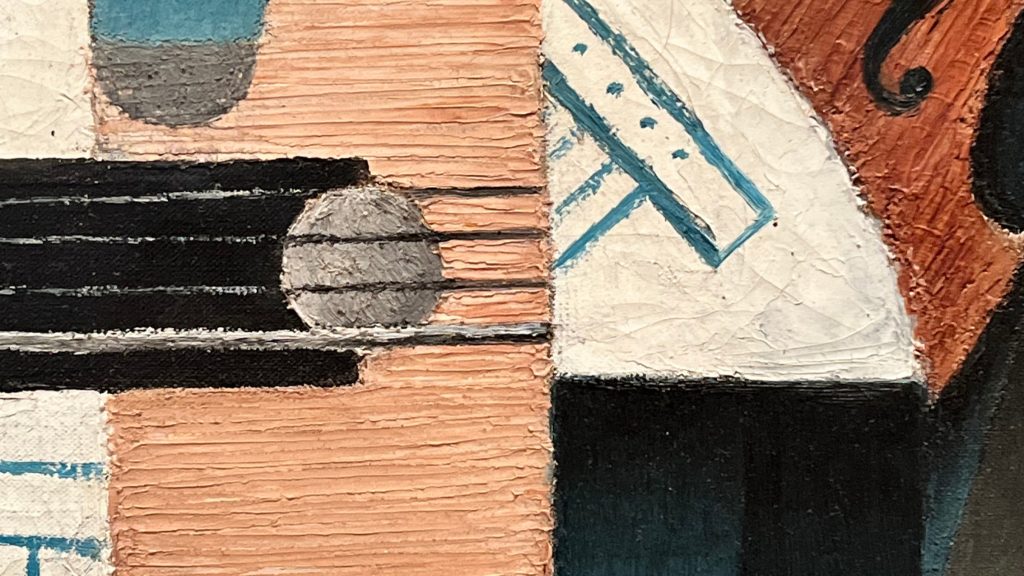
Violin and Guitar, painted in 1913, belongs to a crucial moment in the artist’s career. The two instruments that give the painting its title remain recognisable, but they no longer occupy a conventional space. They are fragmented and reconstructed through overlapping planes, lines that alter our perception and different viewpoints brought together on a single surface.
This is not simply about distorting a violin or a guitar. The aim is to question the need to represent an object from a single viewpoint. We can recognise certain parts of the instruments, but our eyes have to participate actively in reconstructing them.
A painting we have to learn how to look at
Here we find one of the keys to approaching this kind of work: we should not simply ask whether the object resembles its real-life counterpart. The point is precisely to discover how the artist takes apart something familiar and reorganises it according to a different set of rules.
That is why Violin and Guitar deserves time. At first glance, the painting may seem somewhat confusing; after a few minutes, the forms, the instruments and the relationships between the different planes begin to emerge. The painting demands something from the viewer: to look before recognising.
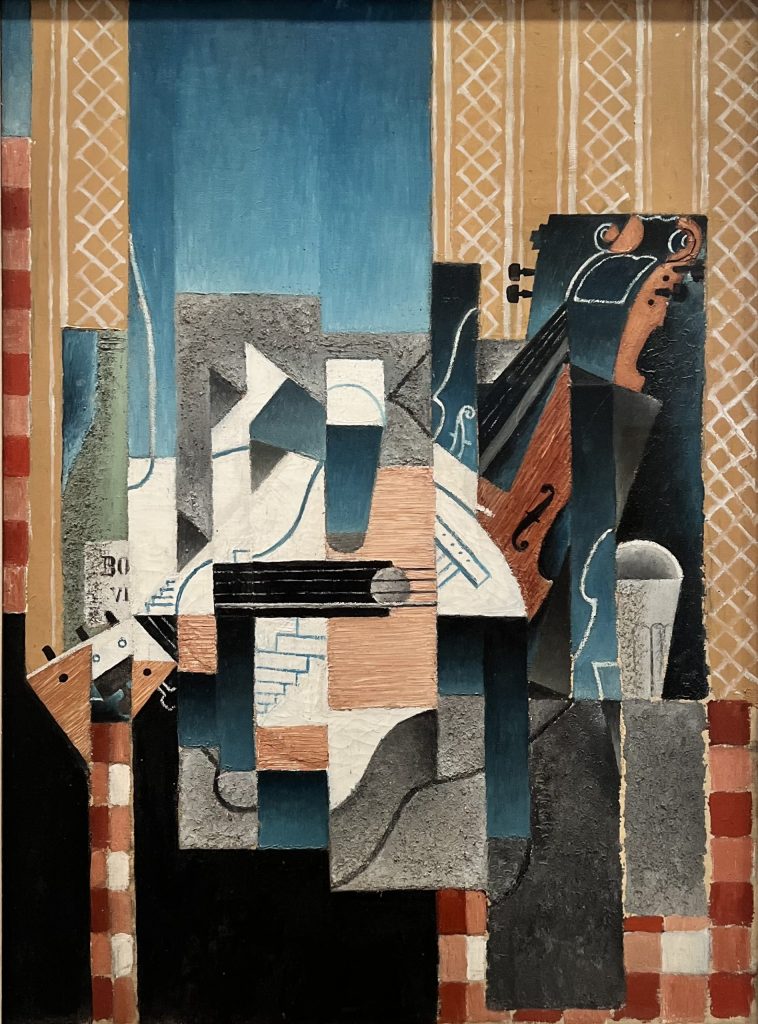
This experience is particularly useful for understanding Cubism. We are not looking at a painting that has abandoned reality, but at a different way of asking how reality can be represented.
2. The Bottle of Anís
One year after Violin and Guitar, we find a work that allows us to take another step forward in our exploration of his painting. The Bottle of Anís, painted in 1914, once again takes everyday objects as its starting point, but transforms them into pieces of a carefully constructed composition.
The bottle occupies a prominent position and we can identify it through some of its most recognisable features. Around it, geometric forms, fragments of objects, letters and planes interact until it becomes almost impossible to distinguish clearly where one element ends and another begins. The table no longer behaves like a conventional surface, and the space seems to be constructed directly before our eyes.
Why are there letters in the painting?
The presence of words and letters is no accident. Picasso and Braque had already incorporated typography, newspapers and other elements from everyday life into their Cubist experiments. Here too, letters play an interesting role: while forms seem to fragment and shift position, writing remains immediately recognisable.
This creates a curious paradox. We may struggle to determine exactly where a bottle ends or another object begins, yet we can identify a word without having to reconstruct it. The painting constantly plays with what our eyes recognise and what our brain needs to interpret.
A bottle transformed into architecture
In The Bottle of Anís, the objects matter, but so does the structure they create together. Nothing seems to have been placed at random. Lines guide our gaze, planes balance one another, and the different forms ultimately function almost like the components of an architectural structure.
This concern with order would become one of the defining characteristics of Juan Gris. In Cubism, he found a language that allowed him to dismantle reality, but also to rebuild it. And it is precisely this desire for construction that helps us understand why his painting developed such a distinctive personality.
3. Portrait of Josette Gris
So far, we have encountered musical instruments, bottles, letters and everyday objects. Portrait of Josette Gris, painted in 1916, presents us with a different challenge: what happens when this same pictorial language is used to represent a person?
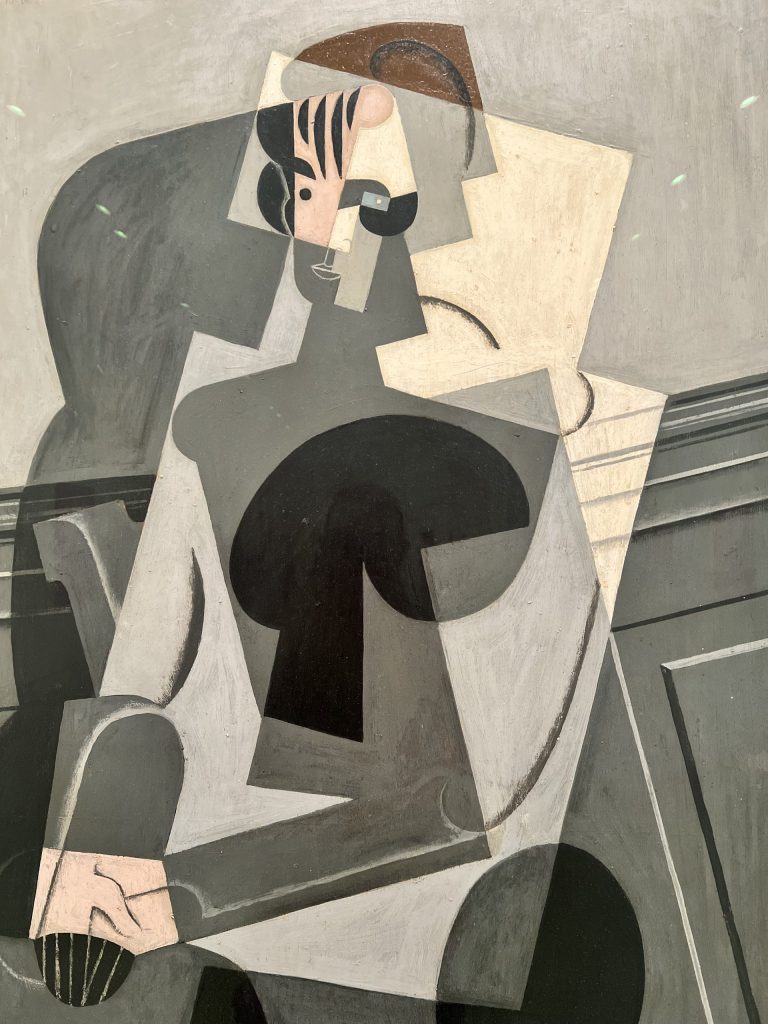
The sitter is Josette, the artist’s partner and a fundamental presence in his life. The figure remains perfectly recognisable, but she is not constructed according to the traditional rules of portraiture. Her body, face and the space surrounding her are organised through simplified forms and interlocking planes. The result is particularly interesting because geometry does not erase the sitter’s presence. We still perceive a specific person sitting before us, even though her appearance has undergone a process of reorganisation.
Cubism could portray people too
When we think of this movement, it is easy to picture guitars, newspapers, bottles or tables. Yet the human figure also offered enormous possibilities. Here, the challenge was greater: a face is not simply another object. We instinctively look for an identity, an expression and certain individual features.
Gris manages to preserve that sense of recognition without returning to traditional portraiture. Instead of meticulously reproducing Josette’s features, he constructs her presence through relationships between forms, lines and colours. Resemblance no longer depends exclusively on a faithful reproduction of physical appearance.
A Renaissance composition in the language of the twentieth century
There is something particularly fascinating about Portrait of Josette Gris: behind an unmistakably modern painting lies a composition rooted in the Renaissance. The sitter is shown seated, approximately half-length, and arranged according to a formula that we can recognise in some of the great portraits of the fifteenth and sixteenth centuries.
We might think, for example, of Leonardo da Vinci’s Mona Lisa or Raphael’s Portrait of a Cardinal. Of course, we are not talking about a copy of these works, but rather a way of conceiving portraiture that places the figure at the centre and gives it a stable, monumental presence. Centuries later, Gris draws on a similar compositional tradition to create something entirely different.
And therein lies one of the great paradoxes of the painting. The composition may look back to the Renaissance, but its pictorial language belongs entirely to the twentieth century. Space is reorganised, forms become geometric, and naturalistic representation gives way to a new way of constructing the figure.
Portrait of Josette Gris thus reminds us that the avant-garde did not necessarily have to destroy the past in order to create something new. Artists could also draw on structures that had been part of the history of painting for centuries and reconstruct them through a radically contemporary language.
4. The Guitar on the Table
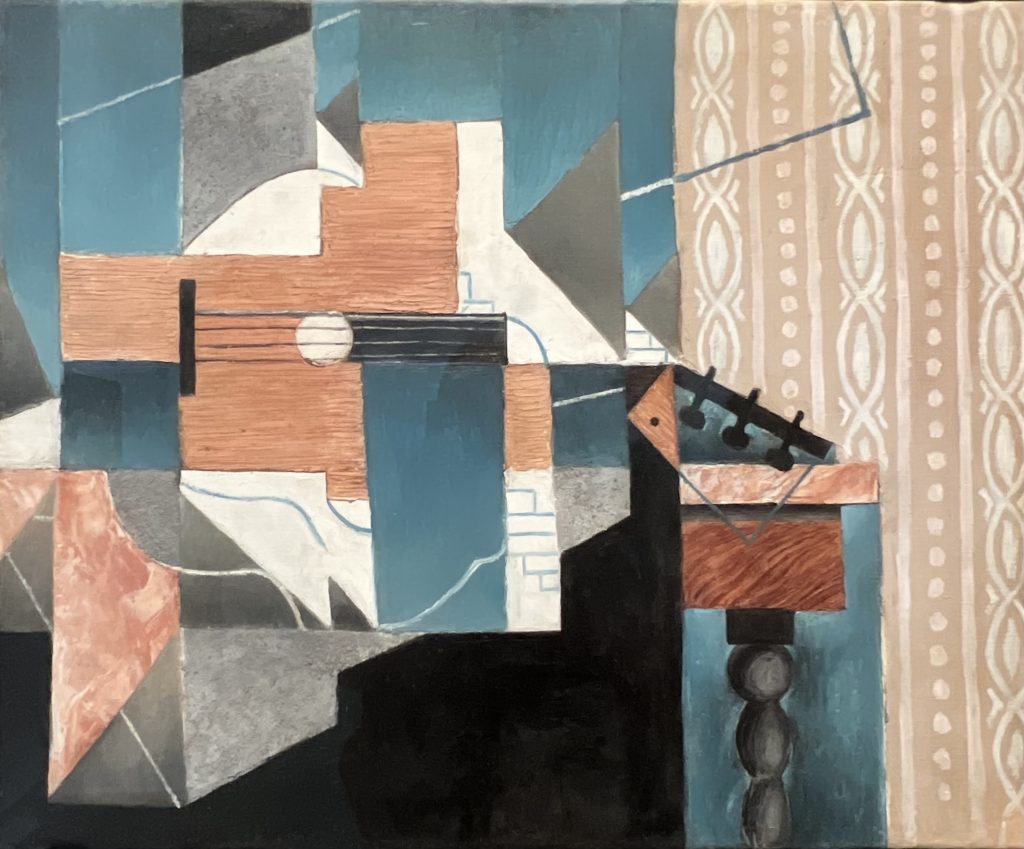
The guitar was one of the recurring motifs in Cubist painting. Its shape offered artists the opportunity to play with curves, straight lines, the circular sound hole and the strings—elements that remain easily recognisable even after the object has been profoundly transformed. In The Guitar on the Table, Gris once again uses this instrument to construct a composition in which every form seems carefully related to the others.
The table does not simply function as the surface on which the objects rest. Its edges, the different planes and the surrounding space all form part of the same structure. Rather than creating a setting first and then placing objects within it, everything seems to have been conceived simultaneously.
Why are there so many guitars in Cubism?
It is no coincidence that we encountered a guitar in the first work of our journey and find another one here. Picasso, Braque and Gris repeatedly turned to musical instruments, particularly guitars and violins.
There is a visual reason for this. A guitar can be broken down remarkably easily without completely losing its identity. The curves of the body, the neck, the strings and the sound hole allow us to recognise it even when its different parts have been displaced, simplified or transformed into geometric forms.
But there is also an everyday dimension. These instruments belonged to the world of cafés, musicians and domestic spaces that surrounded the artists.
Cubism did not need to look for grand historical or mythological subjects: a guitar resting on a table could provide enough material to investigate a new way of painting.
The object as a starting point
This helps us understand something important. The guitar is not necessarily the true subject of the painting. In a sense, it is the starting point for a pictorial problem: how to distribute forms, how to relate different surfaces to one another and how to create depth without relying on traditional perspective.
Once we stop trying to immediately reconstruct a real guitar, we begin to pay attention to these relationships. And this is where one of the most interesting characteristics of his painting emerges: behind completely ordinary objects lies an extraordinarily complex reflection on how an image works.
5. Harlequin with Violin
We end our journey with a work in which the violin reappears, but this time accompanied by a human figure. In Harlequin with Violin, painted in 1919, Gris turns to one of the most recognisable characters in the European theatrical tradition and, at the same time, to a figure that had already acquired an important place within the avant-garde.
The harlequin’s distinctive costume is particularly well suited to this pictorial language. Its geometric pattern allows the body to become integrated into the structure of the painting, while the violin introduces some of the forms that we have already learned to recognise throughout our journey. Figure, instrument and space therefore seem to follow the same compositional logic.
Who is Harlequin?
Harlequin comes from the Italian commedia dell’arte, a form of popular theatre that developed from the sixteenth century onwards, whose characters were identified by recognisable personalities, costumes and behaviours. Traditionally, Harlequin was a clever, irreverent and comic servant, visually distinguished by his diamond-patterned costume.
Over time, the character moved beyond the boundaries of the stage and appeared repeatedly in European painting. His costume made him instantly recognisable, while also allowing artists to explore ideas such as masks, performance and identity. In this way, a character born in the theatre went on to enjoy a long life in the visual arts.
From Picasso to Gris: a shared character
Picasso had made Harlequin a recurring presence in his paintings years earlier. We find him particularly associated with Picasso’s Rose Period, when acrobats, circus performers and other figures from the world of entertainment began to populate his canvases. For Picasso, these characters could also become a way of reflecting on the artist and his place within society.
When Gris uses the same character, however, the result is very different. Harlequin is subjected to a more geometric structure: the diamonds of his costume, the forms of his body and the lines of the violin all participate in the overall organisation of the surface. The character does not simply occupy the space of the painting, but seems to be constructed according to the same rules that organise everything around him.
The comparison is revealing because sharing a subject does not mean sharing a way of painting. Picasso and Gris could look at the same character and transform him into two completely different visual experiences, allowing us to appreciate the artistic personality of each painter more clearly.
A figure made of geometry
Perhaps this is why Harlequin seems particularly appropriate for concluding our selection. Unlike a bottle or a guitar, his body already enters the painting covered in geometry. The diamonds of his costume facilitate the transition between the recognisable figure and the forms that construct the composition.
After five works, we can understand more clearly what is happening. We are no longer simply trying to identify the character or the violin; instead, we notice how the lines interact, how certain forms are repeated and how each element occupies a precise place within the whole. Our way of looking at these paintings has changed as we have progressed through the journey.
That change in our own way of looking is precisely one of the best ways to approach Gris’s work. Cubism then stops appearing simply as a fragmented reality and begins to reveal itself as a different way of constructing it.
Pablo Picasso, Georges Braque and Juan Gris: three ways of understanding Cubism
Throughout these five works, the names of Pablo Picasso and Georges Braque have appeared several times. The comparison is inevitable: all three played a role in the development of Cubism, shared artistic concerns and explored similar subjects. However, regarding Juan Gris simply as the third name on a list would prevent us from understanding what he actually contributed to the movement.
Pablo Picasso and Georges Braque had begun their pictorial revolution earlier. When Juan Gris started to fully develop this language, he was able to build on some of their experiments while searching for solutions of his own. His painting gradually acquired an increasingly recognisable personality, particularly through the importance he gave to structure, colour and compositional balance.
What distinguishes Juan Gris from Pablo Picasso and Georges Braque?
The differences cannot be reduced to a simple formula, as all three artists constantly evolved and experimented. Even so, there is one characteristic that is particularly useful when approaching Juan Gris: his tendency to construct paintings through a highly calculated organisation. Objects may appear fragmented, but the composition as a whole often conveys a powerful sense of order.
Colour also helps us identify some of these differences. In contrast to the deliberately limited palette that characterised much of the Analytical Cubism of Pablo Picasso and Georges Braque, Juan Gris gradually gave greater importance to chromatic relationships. Colour does not function merely as decoration; it actively participates in the construction and organisation of the image.
Order and geometry in Juan Gris
This concern helps us better understand some of the paintings we have just explored. A bottle, a violin, a guitar or a human figure may be profoundly transformed, but the different elements never seem to be arranged arbitrarily. In Juan Gris’s compositions, forms, lines and colours establish relationships that hold the whole image together.
This is why it is worth spending a few minutes looking at his paintings before trying to identify every object. Gradually, what may initially seem like an accumulation of fragments begins to reveal an underlying structure. Geometry then ceases to be merely a way of breaking reality apart and becomes a tool for reconstructing it.
Here we find one of Juan Gris’s most distinctive contributions. He shared some of the great questions of early twentieth-century painting with Pablo Picasso and Georges Braque, but he did not provide exactly the same answers. Looking at the work of all three therefore helps us understand that Cubism was never a single, unchanging language, but rather a field of experimentation in which different ways of understanding painting could coexist.
🎨 Discover Juan Gris with a guided tour of the Museo Reina Sofía
🖼️ Guernica is a must-see, but the Museo Reina Sofía has so much more to offer. Its galleries give us the opportunity to explore Pablo Picasso, Salvador Dalí, Joan Miró, María Blanchard, Ángeles Santos and, of course, some of the great works of Juan Gris.
🔎 A guided tour can help you look at these paintings in a different way. Our guides do much more than simply point out names and dates: we want to give you the tools to understand what you are looking at, why these works were revolutionary and how they changed the way we represent reality.
🎟️ With The Guides You Need, admission is included and we purchase the tickets in advance. Our groups are small, with a maximum of 6 people, so you can ask questions, talk to your guide and enjoy the experience without feeling like part of a large group.
🌍 We offer tours in Spanish and English, as well as French and Italian upon request. If you want to understand Cubism and discover everything that lies beyond Guernica, join us as we explore one of Madrid’s great museums.
👉 Book your guided tour by clicking here.