On August 22, 1878, Maria Cristina of Bourbon and the Two Sicilies passed away in France. She had been Queen Consort, Regent, and mother of Isabella II, becoming one of the most influential and controversial women in 19th-century Spain. Her political influence extended well beyond the years in which she officially governed the country.
On the anniversary of her passing, we look back at her life to understand how a princess born in Palermo came to occupy a central position in the dynastic and political struggles that transformed Spain. Her story takes us from her marriage to Ferdinand VII to the First Carlist War, the development of the liberal state, her secret marriage, and the controversies that marked the later years of her life.
In this article
Who Was Maria Cristina of Bourbon and the Two Sicilies?
Maria Cristina of Bourbon and the Two Sicilies was Queen Consort of Spain, wife of Ferdinand VII and, after the king’s death, Regent during the minority of her daughter Isabella II. Her rise to prominence coincided with one of the most turbulent periods in 19th-century Spanish history: the end of Ferdinand VII’s reign, the outbreak of the First Carlist War, and the difficult advance of liberalism.
She was born in Palermo on April 27, 1806, the daughter of Francis I, King of the Two Sicilies, and Maria Isabella of Spain. The princess therefore belonged to the extensive family network connecting the different European branches of the House of Bourbon. Indeed, Ferdinand VII, her future husband, was her mother’s brother and therefore her uncle.
From Princess of the Two Sicilies to Queen of Spain
In 1829, the young princess travelled to Spain to marry Ferdinand VII. She was twenty-three years old; he was forty-five. It was already the king’s fourth marriage: his three previous wives had died without leaving him an heir who could secure the succession to the Spanish Crown.
The succession had become an increasingly important issue. With no children of his own, Ferdinand’s brother, Carlos María Isidro, was in a privileged position to succeed him. A child from the new marriage could completely change that situation.
The wedding took place in December 1829, making the new bride Queen Consort of Spain. Barely ten months later, on October 10, 1830, their first daughter, Isabella, was born. Two years later, they had a second daughter, Luisa Fernanda.
Isabella’s birth did not solve the succession problem. Instead, it transformed it. The dispute over who should inherit the throne after Ferdinand VII would eventually pit supporters of his daughter against those of Carlos María Isidro, shaping much of the future Regent’s political life. What began as a dynastic dispute would ultimately lead to civil war.
Isabella II: The Daughter Who Became Queen
One of the most common questions about the Spanish Regent concerns the identity of her daughter. The best-known answer is Isabella II, born in Madrid on October 10, 1830, and destined to become Queen of Spain before reaching the age of three. She was not, however, the couple’s only daughter: Ferdinand VII and his wife also had Luisa Fernanda of Bourbon, born in 1832.
Isabella’s birth had consequences that went far beyond the royal family. In 1830, Ferdinand VII had promulgated the Pragmatic Sanction, allowing a woman to inherit the Crown in the absence of a male heir. His firstborn daughter could therefore succeed him, altering the position of the king’s brother, Carlos María Isidro.
Isabella’s Birth and the Succession Crisis
Carlos María Isidro and his supporters refused to accept this solution. His cause gradually attracted groups that defended not only his dynastic claim but also a traditionalist and absolutist conception of the monarchy. The liberals, meanwhile, increasingly became essential allies of the young princess’s cause.
The situation became particularly delicate during the final months of Ferdinand VII’s life. The king was seriously ill, and the struggle over the succession was no longer a distant possibility. Defending Isabella’s rights now required enough political support to confront those who backed Carlos’s claim to the throne.
1833: Ferdinand VII Dies
Ferdinand VII died on September 29, 1833. Isabella was only two years old and just days away from her third birthday. She was proclaimed Queen Isabella II, while her mother assumed the Regency on her behalf.
Carlos María Isidro refused to recognise his niece as queen and claimed the Crown for himself. Spain was consequently divided between supporters of Isabella and the Carlists. A dynastic dispute within the Bourbon family had developed into a much broader conflict over the monarchy, society, and Spain’s political future.
The First Carlist War had begun. For the new Regent, this marked a dramatic change in circumstances: only four years earlier, she had arrived in Spain as the king’s young bride. Now, she found herself governing the country in the name of a child queen.
From now on, I’d use the exact “Maria Cristina of Bourbon” very sparingly — roughly once every 400–500 words at most. That should bring the accumulated density down as the article grows.
1833–1840: The Regency of Spain
The Regency began under extraordinarily difficult circumstances. The new government not only had to defend the rights of a three-year-old queen; a significant part of the country supported Carlos María Isidro as the legitimate monarch. Within days of Ferdinand VII’s death, the first Carlist uprisings broke out and the succession dispute turned into a war.
The First Carlist War soon became much more than a conflict between two members of the same dynasty. The Carlist cause attracted sectors that defended a traditional conception of the monarchy and opposed the advance of liberalism, with particularly strong support in the Basque Country, Navarre, Catalonia and parts of eastern Spain. Isabella’s mother, meanwhile, needed political and military allies capable of keeping her daughter on the throne.
The Liberals: An Alliance of Necessity
This created a striking political contradiction. The Regent was not a committed liberal, and she had grown up in a deeply conservative royal court. Yet the threat posed by Carlism pushed her towards an alliance with liberal forces whose ideas she did not necessarily share.
The relationship was therefore driven largely by political necessity. In 1834, the Royal Statute established a new parliamentary framework with two chambers, although it fell far short of the demands of the more progressive liberals.
Further reforms followed as the war continued. Juan Álvarez Mendizábal became head of government in 1835 and promoted the Mendizábal confiscations, which involved the seizure and sale of extensive properties belonging to religious orders. Among their objectives were raising money for a state desperately in need of funds and strengthening the liberal cause during the conflict.
The Mutiny of La Granja and the Constitution of 1837
Relations between the Crown and the liberals remained difficult. In August 1836, a group of sergeants from the Royal Guard rebelled at the Royal Palace of La Granja de San Ildefonso and forced the restoration of the Constitution of 1812. The episode revealed both the authority of the Regency and the limits of that authority when it came into conflict with the political forces supporting Isabella’s throne.
The process eventually led to the Constitution of 1837, which sought a degree of compromise between moderate and progressive liberal positions. Meanwhile, the war continued. The Convention of Vergara in 1839 brought the main Carlist front to an end, although fighting continued elsewhere until 1840.
The fundamental objective had been achieved: Isabella II remained Queen of Spain. Yet the political transformation that had helped preserve her throne had also strengthened liberal forces whose relationship with the Crown was increasingly tense. By 1840, conflict with the progressives and General Espartero would bring the Regency to an end.
The Secret Marriage to Fernando Muñoz
While the Regent was struggling to secure Isabella II’s throne, her private life took an unexpected turn. Only a few months after Ferdinand VII’s death, she met Agustín Fernando Muñoz, a young member of the royal bodyguard who was several years her junior. Their relationship developed quickly, and the couple married in secret on December 28, 1833.
Keeping the marriage hidden was politically important. Public knowledge of the relationship could have seriously complicated her position as Regent at a moment when the new reign was already threatened by a dynastic war. For years, therefore, the union remained officially concealed.
The Children of the Regent and Fernando Muñoz
The couple had eight children, in addition to Isabella and Luisa Fernanda from the previous royal marriage. The queen mother was therefore the mother of ten children in total. The existence of this second family created an unusual situation: publicly, she remained Ferdinand VII’s widow and governed on behalf of his daughter, while privately she had formed a new family.
The relationship survived the end of the Regency and eventually became public. During Isabella II’s reign, Fernando Muñoz received the title of Duke of Riánsares, and the marriage was formally recognised.
Their union lasted until the former Regent’s passing in 1878. It was therefore far more than a brief romantic episode: Muñoz remained beside her through political conflicts, periods of exile and the years in which the queen mother continued to exercise influence around her daughter’s court.
1840–1854: Exile, Return, Power and Business
The end of the First Carlist War did not bring political stability. In 1840, tensions with the progressives intensified over the Municipalities Act, which increased the Crown’s influence over the appointment of mayors. General Baldomero Espartero, whose prestige had grown enormously during the war, emerged as the leading figure of the opposition to the Regent.
Faced with mounting political pressure, she resigned from the Regency in October 1840 and left Spain. Espartero subsequently assumed the role on behalf of the young queen. Exile, however, did not mean complete withdrawal from Spanish politics. From France, Ferdinand VII’s widow maintained contacts with the Moderates and remained involved in efforts to bring Espartero’s rule to an end.
The Former Regent Returns to Spain
Espartero fell in 1843, and the Cortes declared Isabella II of age even though she was only thirteen. Her mother returned to Spain the following year and once again acquired considerable influence at court. Her marriage to Fernando Muñoz was publicly recognised, and he was granted the title of Duke of Riánsares.
The former Regent no longer governed the country officially, but her proximity to the young sovereign gave her an important position within the royal circle. At the same time, she and Muñoz developed extensive economic interests that would become an increasingly controversial part of their public image.
Power, Wealth and Accusations of Corruption
The couple accumulated a substantial fortune and became involved in different business ventures during Isabella II’s reign. Their interests included railways and enterprises connected with public concessions, leading contemporary critics to accuse them of using their privileged access to political power for personal enrichment.
Those accusations need to be treated carefully, since political attacks against members of the royal family were particularly fierce during this period. What is clear, however, is that the combination of private business, proximity to the Crown and political influence contributed significantly to the queen mother’s growing unpopularity.
In 1854, that hostility had serious consequences. A new revolution brought the Moderate government down, while popular anger also turned against the royal entourage. Fourteen years after losing the Regency, Isabella’s mother was once again forced to leave Spain.
The Final Years of Maria Cristina of Bourbon
The revolution of 1854 opened a new chapter in her life. The former Regent left Spain and returned to France with Fernando Muñoz. Although she would occasionally visit Spain again, her ability to intervene directly in the country’s political affairs was considerably reduced.
Meanwhile, Isabella II remained on the throne. Her reign was marked by political instability, frequent changes of government and the Crown’s active involvement in public life. In 1868, fourteen years after her mother had left the country, another revolution forced the queen herself into exile.
1868: Isabella II Loses the Throne
The Glorious Revolution, known in Spain as La Gloriosa, began in September 1868 and brought Isabella II’s reign to an abrupt end. By then, dissatisfaction with the monarchy had grown considerably. Political exclusion, economic difficulties and criticism of the queen and her court had strengthened an opposition increasingly determined to remove her from power.
In 1866, progressives and democrats had signed the Pact of Ostend, agreeing to overthrow the monarchy and establish a new political order. The uprising finally began in Cádiz in September 1868, led by Admiral Juan Bautista Topete and soon supported by generals Juan Prim and Francisco Serrano.
The decisive confrontation came at the Battle of Alcolea on September 28, when Serrano’s forces defeated troops loyal to the government. Isabella II crossed the French border and went into exile. The revolution opened the period known as the Sexenio Democrático, during which Spain experimented with a new monarchy under Amadeo I and, later, the First Spanish Republic.
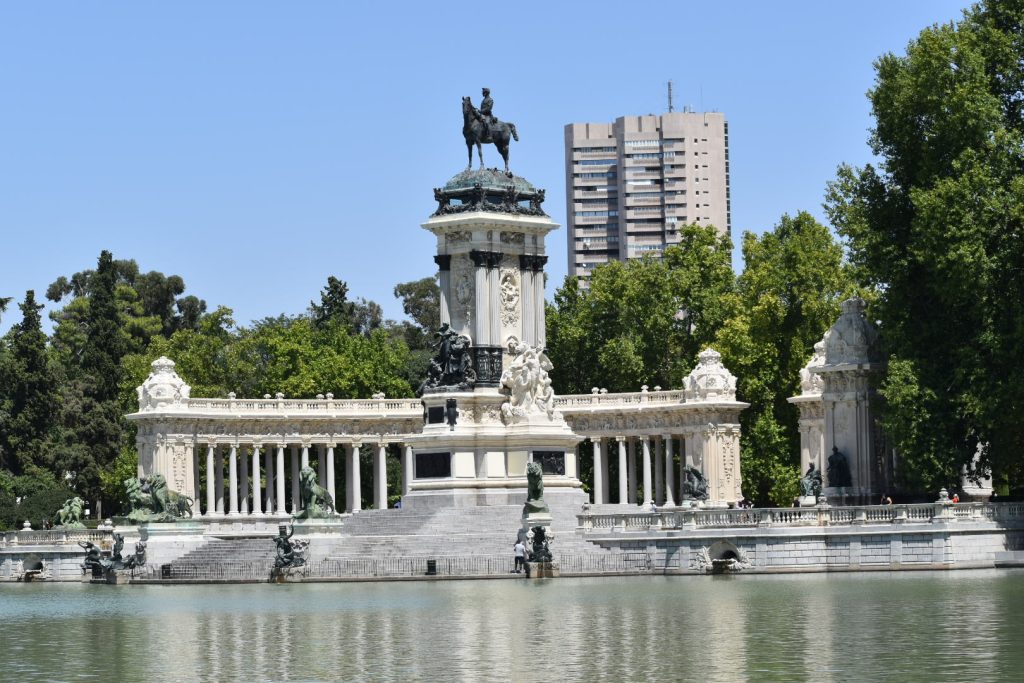
The former Regent thus lived to see the fall of the throne she had fought to preserve since 1833. Yet Isabella’s removal did not mark the end of the Bourbon dynasty in Spain. In 1870, she renounced her dynastic rights in favour of her son Alfonso, and four years later the Restoration placed the young Alfonso XII on the Spanish throne.
1878: The Former Regent Passes Away in France
She therefore lived long enough to witness the restoration of the dynasty through her grandson. Her final years were spent mainly in France alongside Fernando Muñoz, with whom she had shared more than four decades of marriage.
On August 22, 1878, she passed away in Sainte-Adresse, near Le Havre, at the age of 72. Her remains were taken to Spain and buried in the Pantheon of Kings at El Escorial, the traditional burial place of Spanish monarchs and queens who were mothers of kings.
Her passing closed a life deeply intertwined with the great political conflicts of 19th-century Spain. She had arrived in the country as Ferdinand VII’s fourth wife and lived to see a civil war, the rise of liberalism, two periods of exile, her daughter’s removal from the throne and, finally, the Bourbon Restoration under her grandson.
Discover Madrid’s History with The Guides You Need
The story of the Spanish monarchy is closely connected to some of the places we can still visit in Madrid today. The Royal Palace, the city’s great museums and their collections offer a fascinating way to understand the people and events that shaped Spain’s history.
At The Guides You Need, we offer guided tours of the Royal Palace and Madrid’s major museums. Join us at the Prado Museum, Reina Sofía Museum and Thyssen-Bornemisza Museum, or explore the Royal Palace with a professional guide.
Our small-group tours are designed not only to show you extraordinary works of art and historic spaces, but also to explain the stories behind them. Explore our guided tours and experience Madrid’s history, art and heritage with us.