Ian McKellen and Brendan Fraser recently shared one of those small moments that can take a seemingly academic word out of textbooks and send it circulating across social media. Speaking about Fraser’s performance, McKellen highlighted something that had particularly surprised him: his naturalism. But what exactly does it mean to be naturalistic? And what does the performance of a contemporary actor have to do with some of the greatest painters of the 17th century?
Much more than you might think! Naturalism encouraged artists to look at reality differently. Instead of idealisation, we find wrinkles, dirt, ageing bodies, everyday gestures and figures who seem to belong to the world beyond the canvas. Even when depicting saints, philosophers or religious episodes, their models retain a profoundly human presence.
To understand it, we are going to focus on three extraordinary representatives of Naturalism: Caravaggio, Ribera and Velázquez. Three painters connected by a new way of observing and representing the world, but also three artists capable of taking that search in very different directions.
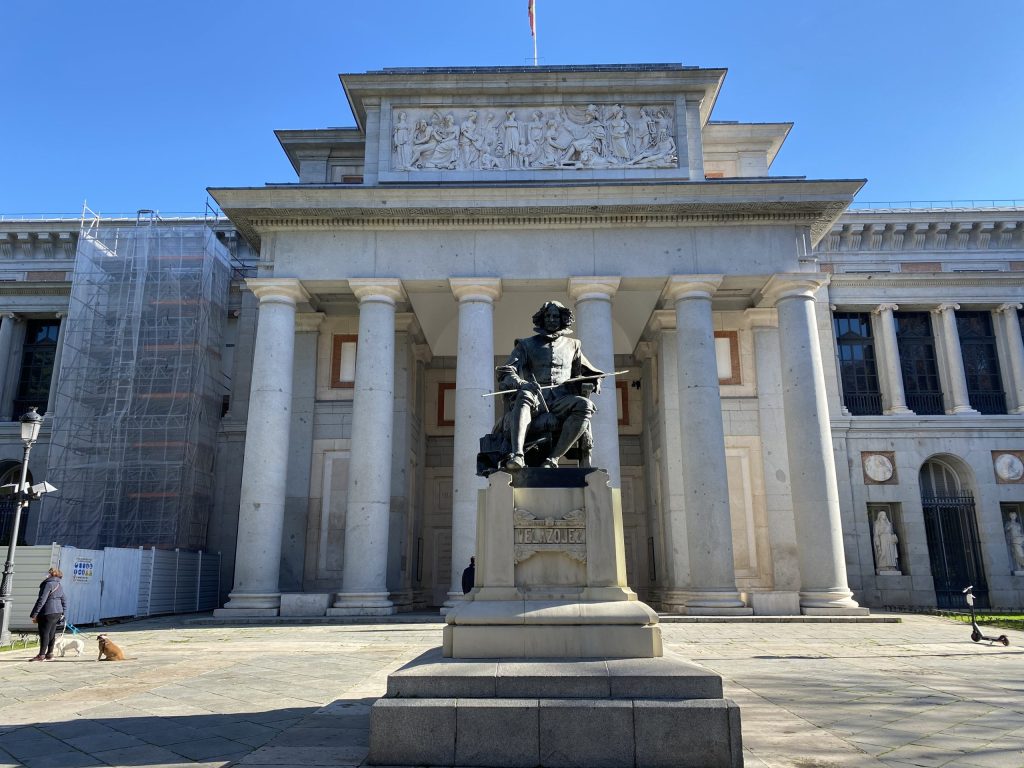
We will also use several works from the Thyssen-Bornemisza Museum to explore their painting. There is a very simple reason: we can show them to you through our own photographs. At the Prado Museum, where some of the masterpieces featured in this article are housed, photography is not permitted in the galleries. And perhaps, after looking at these paintings, we will understand a little better what Ian McKellen saw in Brendan Fraser when he chose that particular word: naturalism.
In this article
What Is Naturalism?
When we talk about Naturalism in painting, we are referring primarily to a way of representing the world based on the direct observation of reality. Artists do not necessarily begin with how things should be, but with how they are — or, at least, how they perceive them. This may seem obvious today, but for centuries European painting was deeply influenced by models of beauty, artistic conventions and ideal types inherited from the classical tradition.
This way of looking at the world became enormously important in the late 16th and early 17th centuries. Painters began introducing recognisable faces, imperfect bodies, dirty feet, hands marked by work, wrinkles and everyday objects into their paintings. Reality could enter a religious painting without asking permission and even take centre stage.
Does That Mean Earlier Painters Did Not Represent Reality?
Not at all. We only need to look at certain Renaissance portraits or 15th-century Flemish painting to see just how closely earlier artists could observe what was in front of them. The difference lies in the role this observation began to play and, above all, in the decision not to correct certain aspects of reality to make them more beautiful, noble or appropriate.
Here we encounter one of the fundamental names in our story: Caravaggio. His saints could have dirty feet; his religious figures could look like people encountered in a Roman tavern or on the streets of the city. What was extraordinary was not simply that he painted them with remarkable truthfulness, but that he considered these models perfectly suitable for representing a sacred story.
Naturalism and Realism: Are They the Same?
Although we use both terms frequently and the boundaries between them can be blurred, we should not treat them as absolute synonyms. In art history, Realism is particularly associated with the movement that developed during the 19th century, with artists such as Gustave Courbet, whereas the tendency that concerns us here belongs primarily to the artistic context of the late 16th and 17th centuries.
Moreover, our three protagonists demonstrate that observing reality does not mean painting it in exactly the same way. Ribera would explore the material quality of skin, wrinkles and battered bodies with extraordinary intensity. Velázquez would take this observation towards increasingly complex painting, transforming seemingly ordinary figures into some of the most fascinating images of the Baroque.
Before either of them, however, came Caravaggio, whose approach to painting and choice of models had an enormous impact on early 17th-century Europe.
Rather than searching for a single formula that applies to all three, then, we are going to do something much more useful: look at three different ways of confronting reality. We will begin with the man who played a decisive role in changing the rules of the game.
Caravaggio: When Saints Began to Look Like Flesh-and-Blood People
Michelangelo Merisi da Caravaggio was born in Milan in 1571, although his name would forever be associated with the small Lombard town his family came from. His arrival in Rome during the last decade of the 16th century coincided with a period of extraordinary artistic activity in the city. Churches, cardinals and powerful families commissioned paintings, while the Catholic Church also used images as a powerful means of communication.
Into this context came a painter willing to depict religious stories in a way that could be deeply unsettling. Caravaggio did not need to turn his figures into physically perfect beings to convey the importance of a scene. And this is precisely where we find one of the keys to understanding his revolution.
Caravaggio and Models Taken from Real Life
One of the most striking features of his painting is the sense of physical proximity created by his figures. Apostles, saints, young men, old men and mythological characters all have tangible bodies. They have fingernails, wrinkles, muscles, wounds and feet that may even be dirty. They do not necessarily seem to belong to some higher world, separate from the viewer.
This was particularly powerful in religious painting. If a saint could have the face of someone you might encounter on the streets of Rome, the sacred story acquired an entirely different sense of immediacy. The viewer was no longer simply looking at a distant figure from the past: they could recognise something of their own world.
This choice also caused problems. Some of Caravaggio’s paintings were rejected or replaced because his solutions were considered inappropriate for the places for which they had been commissioned. One of the best-known examples is The Death of the Virgin, in which Mary is depicted with a heavy body and an extraordinarily physical presence, far removed from the expectations of those who had commissioned the work.
Saint Catherine of Alexandria: Caravaggio at the Thyssen Museum
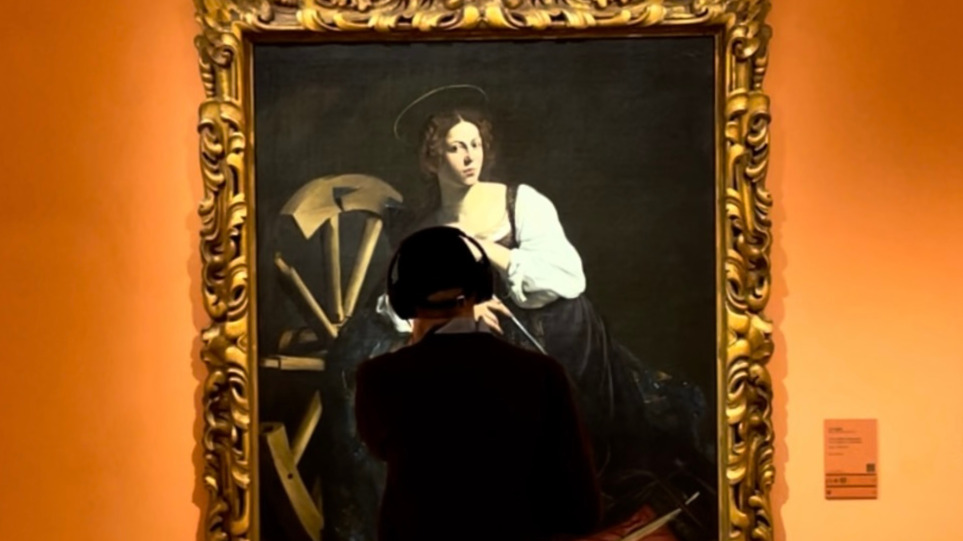
In Madrid, we have an exceptional opportunity to experience this way of painting. The Thyssen-Bornemisza Museum houses Saint Catherine of Alexandria, painted around 1598–1599.
The protagonist is a saint, but the woman before us has an unmistakably tangible presence. She is seated, occupies a recognisable space and looks directly towards us. Around her we find the attributes that allow us to identify her: the spiked wheel associated with her martyrdom, the sword and the palm.
And here we can pause on something fundamental: Caravaggio does not eliminate the sacred. Instead, he constructs it using elements that the viewer recognises as real. The character’s holiness does not depend on transforming her body into an impossible or distant figure.
The lighting intensifies this sensation even further. Light picks out certain areas while others disappear into darkness, causing the body and objects to emerge with tremendous intensity. This device would become one of the most influential features of his painting and have enormous consequences for countless European artists.
From Caravaggio to Ribera
The Italian painter’s influence spread rapidly. Artists from different parts of Europe travelled to Rome, encountered his works directly — or those of painters who had followed in his footsteps — and subsequently developed their own solutions.
Among them was a young man born in Xàtiva in 1591 who would spend virtually his entire career in Italy. Ribera would learn a great deal from this new artistic language, but he would never simply copy it.
If Caravaggio has shown us bodies that make saints and biblical figures feel extraordinarily close, José de Ribera will take us even closer to the skin, ageing, suffering and the marks that time leaves on the human body.
Ribera: The Dignity of Imperfect Bodies
José de Ribera was born in Xàtiva in 1591, but his career developed in Italy. We know that he spent time in Rome during his youth and that, in 1616, he settled permanently in Naples, a city that was then part of the Spanish Monarchy. There he achieved enormous prestige and received commissions from some of the most important figures of his time.
His time in Rome is fundamental to understanding his painting. Ribera encountered an artistic environment transformed by Caravaggio and absorbed some of his techniques: strong contrasts of light and shadow, the physical proximity of the figures and, especially, an interest in models far removed from ideal beauty.
But Ribera developed this artistic language in a deeply personal way.
Wrinkles, Skin and the Marks of Time
There is something extraordinarily physical about many of his figures. When he depicts an old man, age is not simply a characteristic that allows us to identify him. It is written across his body.
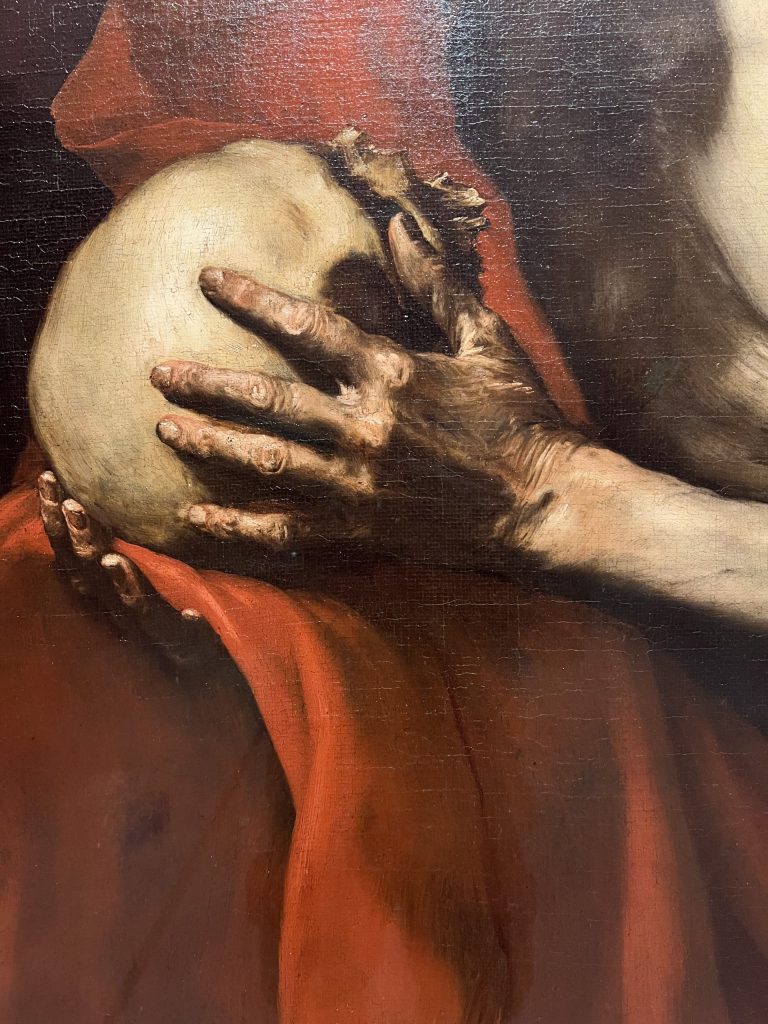
Wrinkles cover the forehead, the beard grows unevenly and the hands reveal the effects of passing time. The skin acquires a texture that we can almost imagine through touch. At times, the poverty of their clothing reinforces the sensation that we are standing before real people.
This becomes particularly interesting because many of these bodies belong, within the fiction of the painting, to extraordinary characters. Ribera depicts saints, apostles, philosophers and figures from Antiquity using models whose appearance could have come directly from everyday life. He did not need to make them beautiful in order to give them dignity.
Why Did He Paint So Many Old Men and Philosophers?
His philosophers provide some of the best examples. There was already a tradition of depicting thinkers from Antiquity during the 17th century, but Ribera transformed many of them into men dressed in worn clothes, with weathered faces and powerful hands. Wisdom is not necessarily associated with wealth, elegance or an idealised appearance.
The contrast is fascinating. We may be looking at a character who represents one of the great minds of history and yet see before us a man who appears to be poor. That is precisely why these images work so well. The painter forces the viewer to separate a person’s dignity from their social position or physical appearance.
The Pietà at the Thyssen-Bornemisza Museum
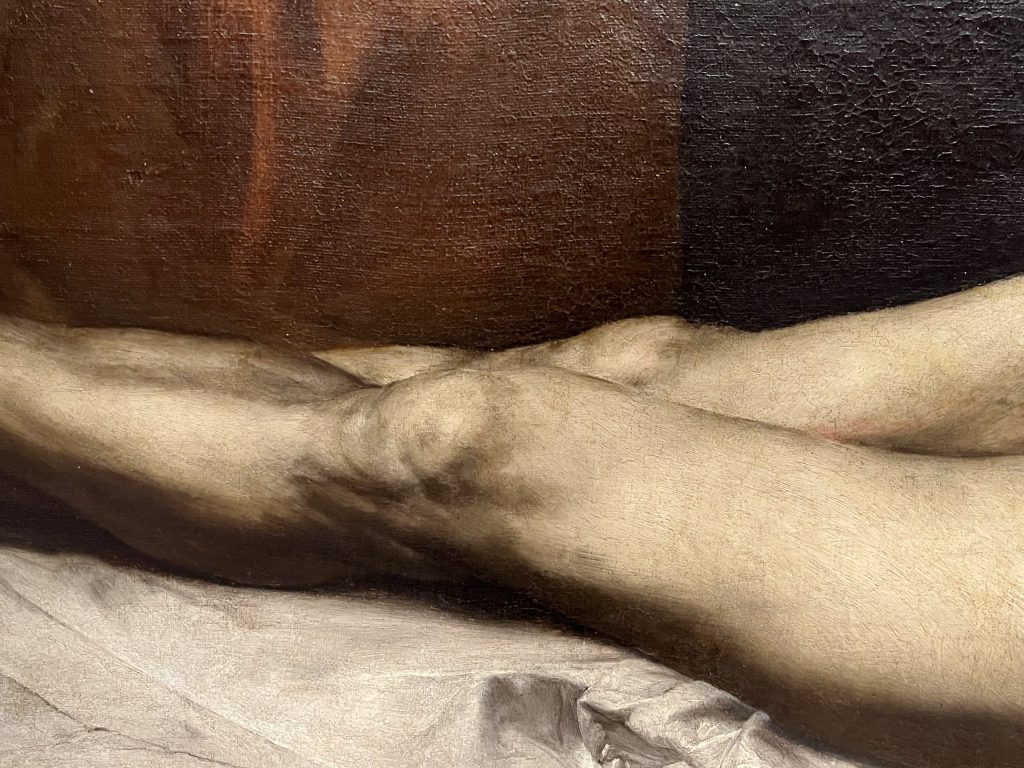
The Thyssen houses a magnificent work that allows us to see how this understanding of the body could also be applied to a religious subject: The Pietà, painted in the 1630s. Here we are not looking at a Christ whose suffering has been carefully softened. His body has weight. Death manifests itself physically, and those around him react to a corpse that occupies real space.
That weight is essential. The scene represents one of the central episodes of Christianity, yet much of its emotional power comes from something profoundly human: a group of people are confronted with the dead body of someone they love.
Religious painting could therefore bring the extraordinary closer to the viewer’s own experience. Pain does not need to become abstract in order to be transcendent.
Not Simply “the Painter of the Unpleasant”
Here we should avoid a common oversimplification. Ribera’s interest in wrinkles, wounds, ageing and martyrdom has contributed to an image of the artist that is excessively associated with darkness and horror.
But observing an ageing body with precision does not mean treating it with contempt. In many of his paintings, almost the opposite occurs. His old men have an enormous presence; his philosophers may wear rags without losing their authority, and his saints remain saints even when their bodies bear the marks of suffering. The absence of idealisation does not mean the absence of dignity.
And that idea leads us directly to the last of our three painters. Velázquez would also depict people whose presence had rarely occupied the centre of great painting. He would do so, however, by developing an approach very different from Ribera’s.
With him, we will enter taverns and kitchens, encounter everyday objects and meet figures from the royal court who had long remained on the margins of official representation. And we will see that looking closely at reality could lead much further than what Caravaggio had begun.
Velázquez: From Seville’s Reality to Mythology
Diego Velázquez was born in Seville in 1599 and trained in the workshop of Francisco Pacheco. His early paintings belong to a very different environment from the one we would later find at the court of Philip IV. Before painting kings, princes and other prominent figures, the artist turned his attention to kitchens, food, vessels and ordinary people.
This early period is fundamental to our journey because it reveals a Velázquez deeply interested in the specific appearance of things. Ceramics, glass, metal, food and human skin all have different qualities, and the painter strives to capture them.
Naturalism in the young artist’s Early Bodegones
Old Woman Frying Eggs, The Water Seller of Seville and Christ in the House of Martha and Mary are among the best-known examples. In these works, everyday objects acquire an importance that may surprise us if we think only of the later Velázquez of Las Meninas or the great portraits of Philip IV.
In Old Woman Frying Eggs, for example, we can focus on a wooden spoon, a knife, a mortar, an onion or an earthenware jug. But we can also look at the ageing face of the woman and the boy beside her. Velázquez observes each element individually and seems to ask himself how it should be painted in order to convey what distinguishes it from everything else.
Something similar happens in The Water Seller of Seville. The enormous earthenware vessel in the foreground is not merely an accessory. Its imperfections, rough surface and the drops of water running down it receive extraordinary attention. In contrast to the ceramic surface, we find the glass of the cup and, alongside both materials, the ageing skin of the protagonist.
People and objects therefore belong to the same physical world. Velázquez is still very young, but we can already see one of the characteristics that would remain with him throughout much of his career: an enormous curiosity about whatever stood before him.
Moving to Madrid and Discovering Caravaggio
In 1623, this Prado’s captain settled in Madrid, and his career changed radically. That same year, he painted Philip IV and was appointed painter to the king. The court gave him more than a privileged professional position: it also gave him access to the royal collections and allowed him to expand his artistic horizons enormously.
Here we need to return to good old Micchell’Angelo Merissi. The painter from Seville could never have met the Italian painter personally, as Caravaggio died in 1610, when the Sevillian artist was still a child. Nor should their relationship be presented as that of master and pupil. During his formative years, however, Velázquez had already encountered Spanish painting deeply affected by artistic developments arriving from Italy and by the followers of the Lombard painter.
Madrid broadened those horizons. Velázquez was able to become more familiar with Italian painting and with a Caravaggesque tradition that had transformed the use of light, the choice of models and the physical representation of figures. His first journey to Italy would follow shortly afterwards, between 1629 and 1631. But just before setting off, he painted a work that allows us to make a fascinating comparison.
Caravaggio’s Influence on Velázquez: Bacchus
Before travelling to Italy, between 1628 and 1629, the Sevillian artist painted The Triumph of Bacchus, now housed at the Prado Museum and popularly known as The Drunkards. Two important references should be kept in mind when considering these years. On the one hand, Rubens was in Madrid on a diplomatic mission and was in permanent contact with the Andalusian painter. On the other, the painting of the Lombardian master and his followers had helped transform the European artistic landscape. In this respect, it is particularly interesting to compare Velázquez’s Bacchus with the one painted by the Italian artist around 1596, now housed in the Uffizi Gallery in Florence.
The subject comes from classical mythology: Bacchus, the god of wine, appears surrounded by a group of men as he crowns one of them with vine leaves. If we mentally isolate the god from the rest of the composition, we find something familiar. Bacchus does not have the muscular, perfect body of an ancient hero. He is a young man with very pale skin, partially nude, with a soft, real body that physically occupies the space.
Both artists present Bacchus as a flesh-and-blood young man, pale-skinned, partially nude and crowned with leaves. In both cases, we are looking at a god from Antiquity, yet his body moves away from the heroic anatomy we might associate with a classical deity. They are young bodies, certainly, but they are also believable bodies.
A God Among Men
The comparison becomes even more interesting because Velázquez does not simply reproduce a solution used by Caravaggio. In The Triumph of Bacchus, he places the god among men whose faces seem to come directly from everyday life. Some look straight at us and smile. Their faces are weathered, and their clothes make no attempt whatsoever to appear mythological. The distance between the world of the gods and the world of ordinary people almost disappears.
We cannot claim that Velázquez directly copied the Bacchus in the Uffizi when creating his own. The relationship between the two artists is more complex, and we should avoid turning a visual resemblance into a documented dependence that we cannot prove. But placing the two figures side by side helps us understand just how many affinities existed between their approaches to representation.
A god could have a real body, and mythology could unfold among people who seemed to have stepped out of a street, a tavern or a public square. After Caravaggio, and with painters such as the one we speak about in this article, everyday reality had conquered a space from which it would be very difficult to remove it.
3 Painters + 2 Actors = 5 Ways of Looking
By this point, we can understand why the three painters in our article work so well together and, at the same time, why it would be a mistake to consider them interchangeable.
Caravaggio had demonstrated how a model taken from everyday life could transform even a sacred scene. Ribera explored the materiality of the body, ageing and the marks of suffering with extraordinary intensity. Velázquez also began with direct observation, but gradually developed a form of painting in which that way of looking became increasingly subtle. All three shared something essential: the reality before them was interesting enough to become the subject of art.
Actors and Naturalism
And here we can return to the unexpected place where our article began: two actors talking about their craft. Four centuries later, when McKellen used the word naturalism to describe what had impressed him about Fraser, he was talking about something remarkably similar: how can you make a performance stop feeling like a performance and start feeling real?
But the story between the two actors does not end with McKellen’s admiration. Fraser has also spoken about how much working alongside the British actor meant to him and how deeply McKellen influenced his own performance.
In a way, the circle closes. McKellen admires what Fraser achieves in front of a camera; Fraser acknowledges how much he learned by watching McKellen. And we can return to pictorial naturalism with a similar question: how much can an artist learn by looking at other artists and, above all, how much can they learn simply by paying close attention to the people in front of them?
🎨 Want to Keep Exploring Naturalism in Madrid?
🏛️ Prado Museum: Caravaggio is not represented in its collection, but here we can see some of the great works we have mentioned in this and other articles, including The Triumph of Bacchus. On our Guided Tour, we will explore some of the museum’s essential masterpieces and learn to notice the details that help us understand them much better.
🖼️ Thyssen-Bornemisza Museum: here we can come face to face with Caravaggio and admire his extraordinary Saint Catherine of Alexandria. The Thyssen collection allows us to continue our journey through European painting and understand how artists influenced one another across the centuries.
🎟️ With The Guides You Need, admission tickets are included, and our professional guides turn every visit into a conversation about art, history and the people behind the works.
👉 Book your Tour of the Prado Museum or the Thyssen-Bornemisza Museum and come look at art with us.