Empezamos por este primer fragmento, manteniendo el sentido y una redacción natural en inglés.
The Royal Palace of Madrid is one of the capital’s great landmarks, but it is also the result of a history shaped over generations. Its grand rooms, works of art and even the way its spaces are arranged reflect the decisions made by different monarchs. Learning about some of its former residents therefore helps us understand much more of what we see as we walk through its rooms.
Among them, we have chosen three particularly important kings: Philip V, Charles III and Charles IV. All three belonged to the Bourbon dynasty, but each had a very different relationship with the building. The first promoted its construction after the old Royal Alcázar was destroyed; the second became the first monarch to actually live there; and the third continued transforming its interiors during one of the most fascinating artistic periods of the Spanish court.
A quick note:
We are not going to pass judgement on the reigns of any of these monarchs. This article focuses strictly on the Royal Palace of Madrid and their relationship with the building. That said, we strongly recommend doing some background research before visiting the monument.
In this article
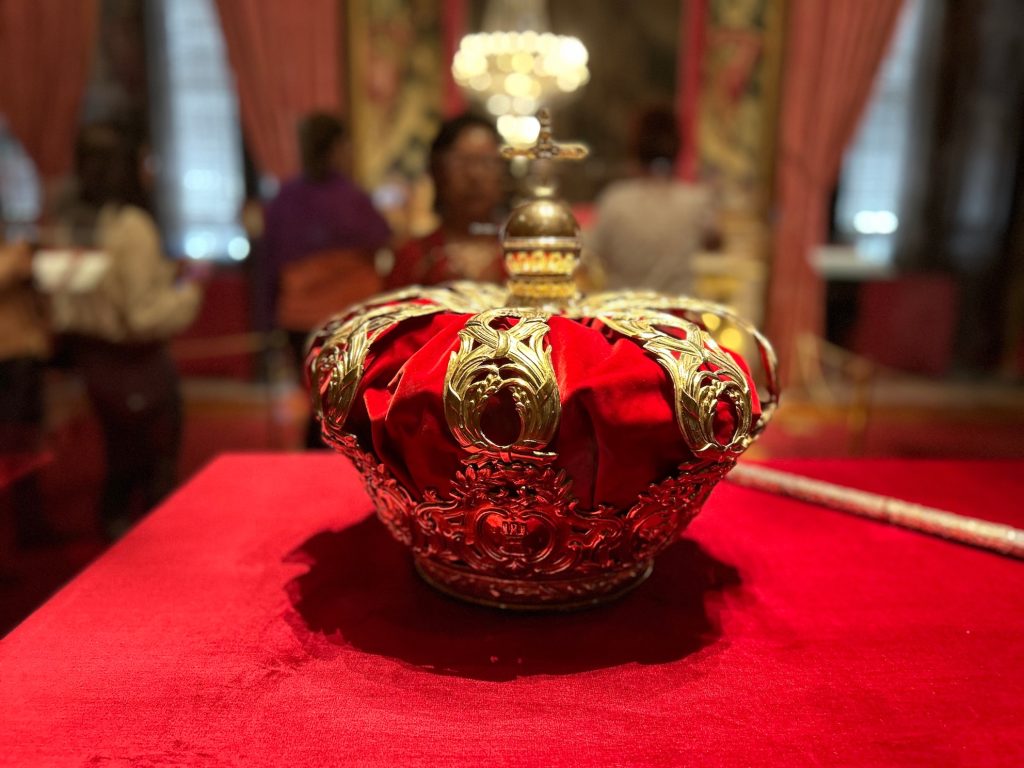
Why is the Royal Palace of Madrid important?
The Royal Palace of Madrid is important because it is one of the great witnesses to the history of the Spanish monarchy, allowing us to physically explore much of its evolution since the 18th century. Built after the fire that destroyed the old Royal Alcázar in 1734, the new building was conceived during the reign of Philip V and eventually became the official residence of the Spanish monarchs. Charles III was the first king to live there, in 1764, and from then on its rooms were closely connected to successive generations of the royal family.
Its importance, however, is not purely historical. The building is also an extraordinary work of architecture and preserves some of the most spectacular interiors in Spain. Ceremonial halls, frescoes, tapestries, clocks, furniture and countless examples of decorative arts show how the Crown used art not only to embellish its residences, but also to project its power and status to those who entered them.
3,418 rooms filled with history
Its rooms also allow us to approach these kings as historical figures rather than simply as names in a royal dynasty. The decisions made by Philip V, Charles III and Charles IV left different marks on the building, while later monarchs continued altering its spaces throughout the 19th and 20th centuries. Understanding who used each room, what it was used for and why it was decorated in a particular way can completely change the experience of walking through it.
Its importance continues to this day. Although it is no longer the regular residence of the Spanish royal family, it is still used for official events and state ceremonies. This combination of historic residence, artistic heritage and institutional setting makes the building much more than a former royal home: it is one of the essential places for understanding the history of the monarchy and its presence in Madrid
A Building That Tells the Story of a Dynasty
Following these three figures will take us through almost the entire 18th century and help us understand how the monarchy changed in Spain after the arrival of the Bourbons. The building was not conceived simply to replace a destroyed residence: it also had to represent a new royal dynasty and project a particular image of power. Architecture, decoration and court ceremony were closely intertwined.
Many of those decisions can still be recognised during a visit today. We are not simply talking about events that took place almost three centuries ago, but about rooms, paintings and decorative elements that have survived to the present day. Philip V, Charles III and Charles IV will therefore be our three protagonists as we discover how one of Madrid’s most spectacular buildings gradually took shape
Philip V: The King Who Wanted a New Palace
Philip V was the first Bourbon to occupy the Spanish throne. His accession in 1700, following the death of Charles II without an heir, led to the War of the Spanish Succession and opened a new chapter for the monarchy. A grandson of Louis XIV of France, he had grown up at Versailles and belonged to a dynasty with a different approach to court life and the representation of royal power from that of the last Habsburgs.
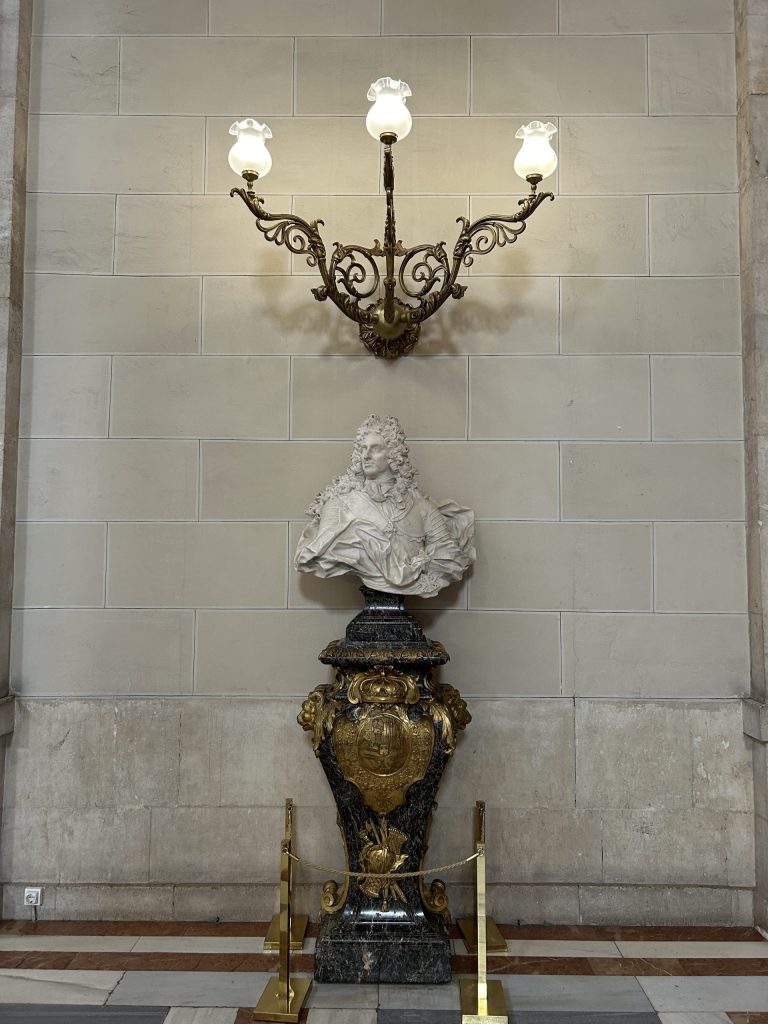
However, when he arrived in Madrid, the enormous building we know today did not yet exist. Spanish monarchs lived in the Royal Alcázar, a building of medieval origin that had undergone numerous extensions and renovations over the centuries. The Habsburgs had lived there, and it also housed an extraordinary collection of paintings belonging to the Crown.
The Fire at Madrid’s Royal Alcázar
Everything changed on Christmas Eve in 1734. A fire broke out in the Alcázar and continued for several days, destroying much of the building. The flames also threatened the monarchy’s art collection: many paintings were saved by removing them from the rooms and even throwing them out of the windows, while others were lost in the fire.
The destruction of the Alcázar immediately raised a fundamental question: the king needed a new residence. Philip V now had the opportunity to build an entirely new palace on the same site as the former fortress. The disaster thus became the starting point for the construction of the building we can visit today.
A New Palace for a New Dynasty
The project was initially entrusted to the Italian architect Filippo Juvarra, who envisioned a residence on an enormous scale. His proposal, however, required a much larger site and could not be built where the old Alcázar had stood. After Juvarra’s death in 1736, his disciple Giovanni Battista Sacchetti developed a new design adapted to the location chosen by Philip V.
The foundation stone was laid in 1738, beginning a construction project that would continue for decades. The extensive use of stone and brick instead of easily flammable wooden structures also reflected the memory of the fire. The new building had to be monumental, but also far more resistant to fire than the residence it replaced.
Philip V Never Saw It Completed
Here lies one of the paradoxes of his story. Philip V was the monarch who set the construction project in motion, but he never had the chance to live in the building he had ordered to be built. He died in 1746, when the works were still far from complete, and his son Ferdinand VI inherited both the Crown and the enormous project begun by his father.
For this reason, when we walk through its halls today, Philip V almost feels like an absent king. Without his decision, the present building would not exist, yet another monarch would eventually be the one to cross its doors and turn it into the residence of the royal court. To meet the first king who actually lived there, we have to move forward to 1764 and the reign of Charles III.
Charles III: The First King to Live in the Royal Palace
Charles III occupies a very different place in this story from Philip V. When he came to the throne in 1759, work on the new royal residence was already well advanced, although much still remained to be done. The monarch had spent a large part of his life outside Spain and arrived in Madrid after ruling in Italy for decades.
His experience as King of Naples and Sicily had also brought Charles III into contact with some of the major artistic and architectural movements of 18th-century Europe. When he finally settled in Madrid, he did not simply inherit a finished building: he played a role in its decoration and turned those monumental spaces into the everyday setting of the monarchy.
From Naples to Madrid
Charles III had not originally been expected to inherit the Spanish throne. He was the son of Philip V and his second wife, Elisabeth Farnese, and his half-brothers Louis I and Ferdinand VI were ahead of him in the line of succession. His political career therefore began in Italy, where he first became Duke of Parma and later King of Naples and Sicily.
The situation changed in 1759, when Ferdinand VI died without an heir. Charles left Naples and returned to Spain to become king. He arrived with extensive experience of government and a court where artists from different parts of Europe had worked, something that would have important consequences for the decoration of his new residence in Madrid.
1764: The Court Moves into the New Palace
On 1 December 1764, Charles III finally moved with his family into the Royal Palace of Madrid. Thirty years had passed since the fire that destroyed the old Alcázar and more than a quarter of a century since the foundation stone had been laid. For the first time, the enormous project begun during the reign of Philip V was fulfilling the purpose for which it had been conceived.
The monarch’s arrival did not mean that everything was definitively finished. The interiors continued to be decorated and altered to suit the needs of the court and the tastes of the new sovereign. This is precisely why Charles III left such a visible mark on the rooms that have survived to the present day.
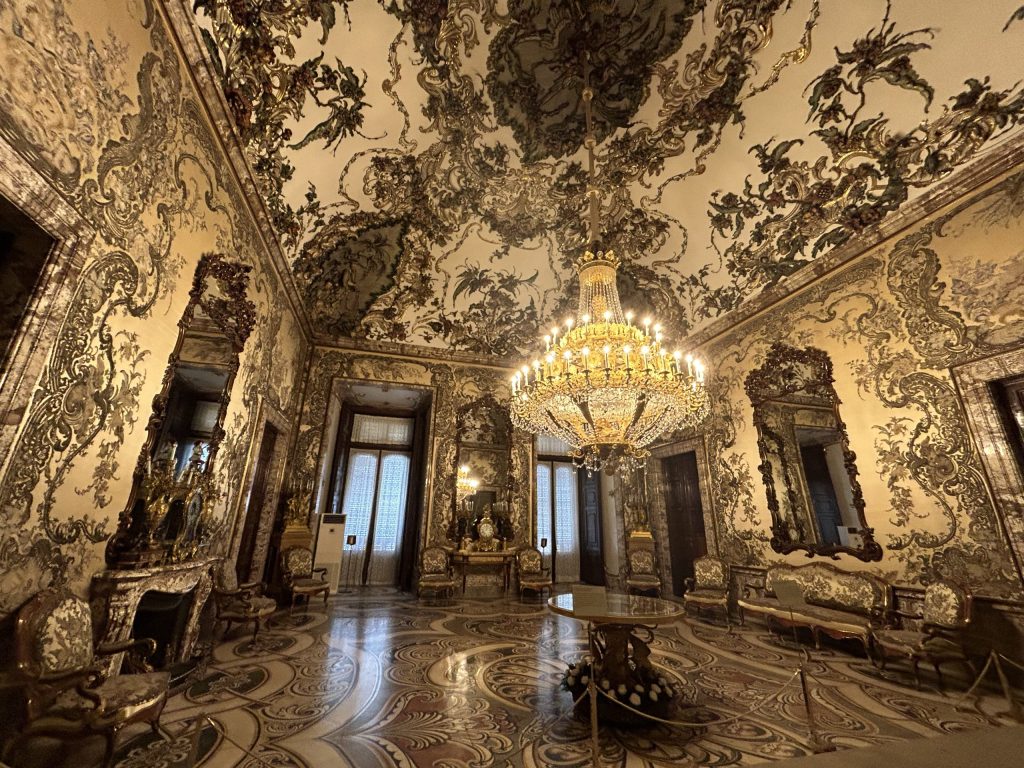
The Rooms of Charles III
One of the finest examples is the room known as the Gasparini Chamber, conceived as one of the king’s private apartments. Its exuberant Rococo decoration combines marble, stucco, textiles, furniture and plant motifs to the point where the boundaries between walls, floor and ceiling almost disappear. It is one of those spaces where it is difficult to decide where to look first.
Some of the most important artists working in 18th-century Europe also contributed to the building during his reign. Anton Raphael Mengs and Giovanni Battista Tiepolo took part in decorating its interiors, creating works intended to reinforce the magnificence of both the royal residence and the monarchy itself. The result shows just how closely art was connected to the representation of royal power.
The King Who Also Transformed Madrid
Charles III’s relationship with the building was also part of a much broader project. His reign saw major urban transformations in Madrid and the creation of several landmarks that we still immediately associate with the city today. The Puerta de Alcalá, the Paseo del Prado and the fountains of Cibeles and Neptune all belong to this process of reshaping the capital.
This is why Charles III has gone down in popular memory as the “best mayor of Madrid”, although, of course, he never actually held that office. In our story, he represents the king who turned the new palace into a truly inhabited royal residence while also seeking to transform the city around it. But the royal apartments would continue to change after his death: his son Charles IV would bring his own tastes, artists and requirements.
Charles IV: Art and Luxury in the Royal Apartments
Charles IV inherited the Crown in 1788 and, with it, a residence that his father had already turned into the great setting of court life. However, the new sovereign did not simply preserve what he had inherited. During his reign, the interiors continued to evolve, and several rooms were adapted to suit his tastes and those of his wife, Maria Luisa of Parma.
His relationship with the arts was particularly strong. He was an important collector, took a keen interest in the decorative arts and, during his reign, one of the greatest names in Spanish painting worked at the court: Francisco de Goya. All of this makes this period essential for understanding the artistic richness that the building still preserves today.
A Palace That Had to Adapt to a New Monarch
Every change of monarch could also bring changes to the spaces used by the royal family. The rooms were not unchanging settings: their functions could be altered, new furniture could be introduced, or they could be redecorated according to the preferences of their occupants. With the beginning of the new reign, some areas were transformed once again to meet the needs of the court.
A magnificent example is the Hall of Mirrors, originally conceived during the previous reign and subsequently transformed. Its decoration, large mirrors and rich materials reveal the extraordinary level of sophistication these interiors could achieve. More than simply a residence, the building served as a permanent representation of the Crown’s status.
Goya and the Court of Charles IV
Francisco de Goya allows us to connect Historywith some of the best-known works in Spanish art. The painter spent a decisive part of his career connected to the court and was appointed court painter in 1789. Years later, he became First Court Painter, establishing himself as one of the leading artists in the service of the royal family.
This relationship produced some extraordinary portraits and allows us to observe the monarchy from a very different perspective from that offered by the magnificent ceremonial rooms. Goya portrayed the king, Maria Luisa of Parma and other members of the family, leaving us images that have become an essential part of our understanding of the court. His presence also provides a fascinating link between the history of the royal residence and the collections found in Madrid’s other major museums.
“The Family of Charles IV”, Goya’s Masterpiece
Among the works that best allow us to approach this court is The Family of Charles IV, painted by Goya between 1800 and 1801. The artist brings together many members of the monarch’s family in a single painting, with Maria Luisa of Parma occupying a particularly prominent position at the centre of the composition. Goya himself also appears in the background, working in front of a large canvas.
The comparison with Velázquez’s Las Meninas is inevitable. Goya depicts himself alongside the reigning family and uses the setting of the artist’s studio to assert his own position within the court. The result, however, is very different: the figures are covered in jewels, decorations and luxurious fabrics, yet every face retains a remarkable sense of individuality.
A Painting Open to Many Interpretations
The painting is also fascinating because of the many interpretations it has generated. It has often been claimed that Goya created a kind of concealed caricature of the royal family, deliberately portraying its members in an unflattering way. It is an appealing interpretation, but there is not enough evidence to state that this was his intention. In fact, the painting was an official commission and appears to have satisfied its subjects.
Today, The Family of Charles IV is housed in the Prado Museum, so we will not see it while walking through the royal apartments. Nevertheless, knowing the painting helps us put faces to the people who once inhabited these spaces and creates a wonderful connection between two of Madrid’s most significant monuments.
Decoration During the Reign of Charles IV
The monarch’s interest in the decorative arts is particularly evident in several spaces associated with his period. One of the most remarkable examples is the Porcelain Room, an extraordinary chamber whose walls are covered with porcelain plaques featuring reliefs and ornamental motifs. Rooms like this show how the decoration of a royal residence could become a work of art in its own right.
Furniture also acquired considerable importance. Clocks, lamps, tapestries and pieces of furniture were not merely accessories to the paintings or architecture, but formed part of carefully designed decorative ensembles. When exploring these rooms, it is therefore worth looking beyond the paintings: many objects that might initially seem secondary help us reconstruct the everyday life and tastes of the people who inhabited these spaces.
From Palace Life to the Crisis of the Monarchy
However, the reign that began in 1788 was shaped by events that went far beyond decoration. Barely a year later, the French Revolution broke out, plunging Europe into a period of profound political instability. Relations with revolutionary France and, later, with Napoleon placed the Spanish monarchy in an increasingly difficult position.
The crisis came to a head in 1808. Following the Mutiny of Aranjuez, the king abdicated in favour of his son Ferdinand VII, and shortly afterwards both ended up in Bayonne, where Napoleon intervened directly in the succession. Thus, the story of Charles IV in the Palace begins amid art, luxury and court ceremony and ends with one of the most serious crises the Spanish monarchy had faced up to that point.
Discover the Royal Palace of Madrid with The Guides You Need
Would you like to discover all these stories while exploring the very rooms where they unfolded? At The Guides You Need, we organise each guided tour in small groups of no more than 8 people, accompanied by professional guides who will help you uncover the history behind every room, work of art and decorative detail.
Our tours run Monday to Friday at 2:00 pm, and the meeting point is next to the statue of Philip IV in Plaza de Oriente. Admission is included, and we take care of all the arrangements so that you can simply enjoy the experience. If you want to explore the Royal Palace of Madrid beyond its spectacular interiors and discover the people who shaped it, you can book your tour with us here.
In Short:
👥 Small groups of no more than 8 people.
🎓 Professional guides to discover the history, art and people behind the Palace.
🎟️ Admission included in the price of the tour.
📅 Monday to Friday.
🕑 Starting time: 2:00 pm.
📍 Meeting point: the statue of Philip IV in Plaza de Oriente.
🇪🇸🇬🇧🇮🇹 Tours in Spanish, English and Italian. Italian tours are available on Mondays, Thursdays and Fridays.
👑 Discover the stories hidden inside the royal apartments with The Guides You Need.
👉 Would you like to join us? Book your guided tour here.