In this article
Biography of Lucian Freud
Lucian Freud was one of the great masters of portraiture of the 20th century. Born in Berlin in 1922 and raised in England from childhood, he developed a career spanning more than six decades in which the human figure became the central focus of his painting. His models were people from his own circle, from family members and friends to fellow artists, lovers and members of high society.
His style, however, changed enormously over the years. The precise surfaces and carefully drawn forms of his youth gradually gave way to a much denser and more physical approach to painting, eventually producing the bodies built up through thick brushstrokes that we immediately associate with his name today.
Sigmund’s Grandson Who Devoted Himself to Portraiture
There is one fact that is almost impossible to avoid when talking about Lucian Freud: he was the grandson of the fao¡mous Sigmund , the founder of psychoanalysis. His father, the architect Ernst, was Sigmund’s youngest son, while his mother, Lucie Brasch, came from a family involved in the grain trade.
The family connection has inevitably encouraged comparisons between the two. While Sigmund devoted his career to studying the human mind, Lucian spent much of his observing human beings. The comparison is appealing, but we should not take it too far: Our Lucian did not regard his portraits as exercises in psychoanalysis.
What interested him was the person physically present before him. A face, the skin, a posture and the way a body occupied a space could keep him working for months. This obsession with observation made portraiture one of the defining territories of his career and explains why he needed his models to sit for him in person over long sessions.
Youth
Our artist was born in Berlin in 1922, into a Jewish family. His German childhood came to an early end: in 1933, just months after Adolf Hitler came to power, his family left Germany and settled in England. Lucian was ten years old.
His artistic training therefore took place in his adopted country. He briefly attended the Central School of Arts and Crafts in London and later studied at the East Anglian School of Painting and Drawing, run by Cedric Morris. In 1939, he became a British citizen and, during the Second World War, briefly served in the Merchant Navy.
His early works look very different from the great portraits of thickly painted flesh that we usually associate with Freud. He painted with fine brushes, smooth surfaces and almost obsessive precision, creating sharply defined figures and an atmosphere that can sometimes feel strange or unsettling.
During the 1940s and 1950s, he also came into contact with other important British artists. His friendship with Francis Bacon was particularly significant: they spent a great deal of time together, constantly discussed painting and even painted portraits of one another. Although their relationship would eventually break down, Bacon was an important influence during a decisive period in our artist’s development.
Maturity
From the 1950s onwards, his painting began to change. He gradually abandoned his fine brushes, started working with broader brushstrokes and allowed the physical substance of the paint itself to play an increasingly important role. Skin ceased to look like a smooth surface and began to be constructed through layers, marks and shifts in tone.
This evolution produced the painter we immediately recognise today. His bodies have weight, volume, wrinkles, blemishes and folds; he does not attempt to correct them to fit a particular ideal of beauty. Even when he portrayed wealthy or powerful figures, the model’s social position did not appear to guarantee particularly flattering treatment.
His working process was also extraordinarily slow. Freud painted from life and could require dozens of sittings to complete a work, with some portraits taking months. He was not trying to capture a single instant, but to construct an image through prolonged observation of the same person.
Over the decades, this approach made Freud one of the central figures in contemporary British painting. He died in London in 2011, aged 88, leaving behind an extensive body of work dominated by the faces and bodies of the people who had passed through his life.
Among them was one person of particular importance to this article. Baron Hans Heinrich Thyssen-Bornemisza did not simply buy Lucian Freud’s paintings: he eventually sat before him and became one of his models.
The Relationship Between Lucian Freud and Baron Thyssen
Lucian Freud’s presence at the Thyssen Museum cannot be explained simply by the collection’s broader interest in 20th-century art. Behind it lies a personal relationship between the painter and Hans Heinrich Thyssen-Bornemisza, one of the great art collectors of his time and the man responsible for considerably expanding the collection he had inherited from his father.
The Baron became interested in Freud’s work when the British artist was still far from achieving the market prices he would command later in his career. His collection came to include several paintings by the artist, helping to place Freud alongside other major names in contemporary art.
From Collector to Model
Their relationship took a particularly interesting turn when the Baron went from simply looking at and buying Freud’s paintings to becoming the subject of his gaze himself. In 1981, Freud began working on a portrait of Hans Heinrich Thyssen-Bornemisza, which he completed the following year.
The choice is particularly striking when we consider the history of portraiture. For centuries, great collectors, aristocrats and powerful figures had used portraits to construct a particular public image of themselves. Freud, however, was hardly known for flattering the people who sat before him.
The Baron also had to submit to the artist’s distinctive working method. Freud required numerous sittings with his models and worked slowly, observing the face again and again before considering a painting finished. Being portrayed by Freud meant giving him not only your time, but also an enormous degree of control over the final image.
The result was Portrait of Baron H. H. Thyssen-Bornemisza, a work that allows us to look at the man who assembled much of the Thyssen Museum’s collection through the eyes of one of the artists he chose to collect.
And this creates a particularly interesting reversal: the collector accustomed to choosing works of art becomes the work of art. The man who had observed, purchased and lived among Freud’s paintings ended up sitting before the painter, subjected for months to the same intense observation experienced by so many of Freud’s other models.
Today, we can see that circle completed at the Thyssen Museum. There we find not only works acquired by Hans Heinrich Thyssen-Bornemisza, but also his own face painted by one of the artists he chose to add to his collection. And that portrait is precisely the best place to begin.
3 Works by a Master of Portraiture at the Thyssen Museum
We already know Lucian and how Baron Thyssen went from collecting his paintings to becoming one of his models himself. Now it is time to do what really matters: stand in front of his works and look.
The Thyssen Museum houses several paintings by Freud that allow us to follow different stages of his career. We are going to focus on three particularly interesting examples: Portrait of Baron H. H. Thyssen-Bornemisza, Large Interior, Paddington and Reflection with Two Children (Self-Portrait).
Each shows us a different side of his painting. We will see the collector transformed into a model, enter one of those interiors in which the artist creates strange relationships between bodies and spaces and, finally, watch the artist himself step in front of the mirror. Three very different ways of approaching portraiture and three excellent reasons to stop in front of Lucian Freud during a visit to the Thyssen Museum.
Portrait of Baron H. H. Thyssen-Bornemisza
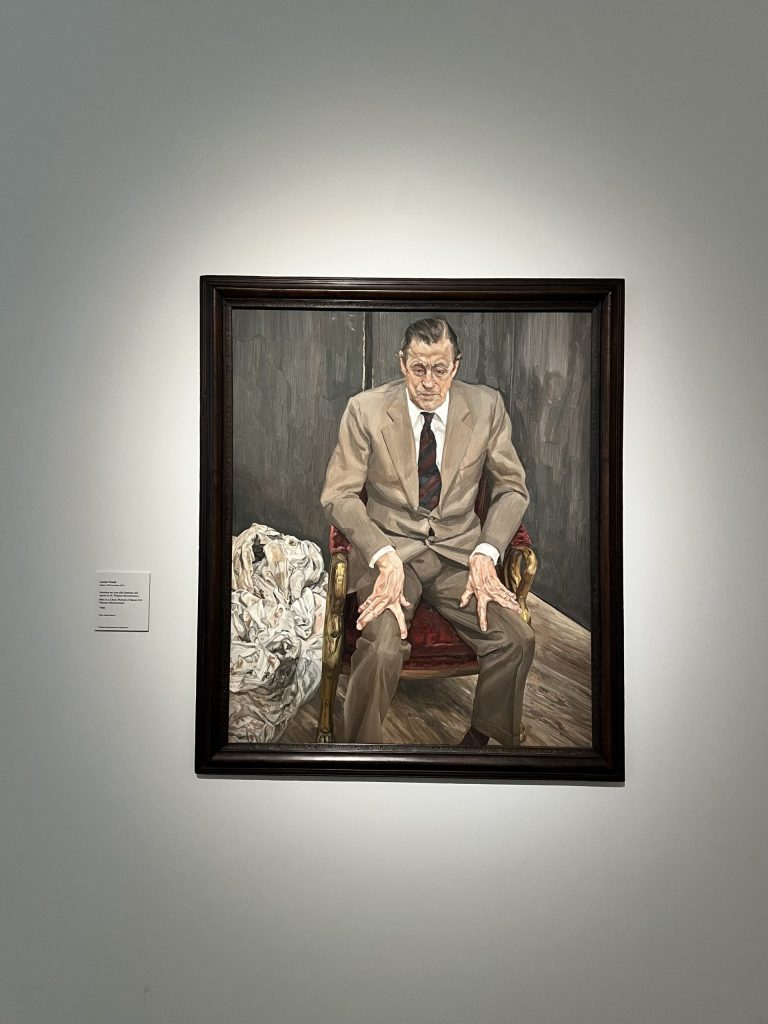
Let us begin with the painting that best connects good old Lucian with the Thyssen Museum. Between 1981 and 1982, Freud painted Hans Heinrich Thyssen-Bornemisza, the man who had added his works to his collection and who now agreed to take the place normally occupied by friends, family members and other people from the artist’s circle: that of the model.
The result is a surprisingly restrained portrait. We are looking at one of the great art collectors of the 20th century, a member of one of Europe’s most powerful industrial families and the owner of an extraordinary collection. Yet practically none of that appears in the painting. The painter dispenses with any setting designed to explain the importance of his sitter and focuses our attention on the Baron himself.
A Powerful Man Without Symbols of Power
This is particularly striking when we compare the painting with the tradition of aristocratic portraiture. Think, for example, of many of the figures we can find at the Prado Museum: palaces, curtains, armour, columns, jewellery, staffs of office and other objects help construct the public image of the person who commissioned the painting. Even when those elements disappear, posture or gaze can still be carefully designed to convey authority.
The artist does almost the opposite. The Baron is shown seated, with his arms crossed over his chest and his gaze directed downwards. He does not look at the viewer, does not seem to demand our attention and does not adopt a particularly solemn pose. If we did not know the sitter’s identity, there would be very little in the painting to suggest his social status.
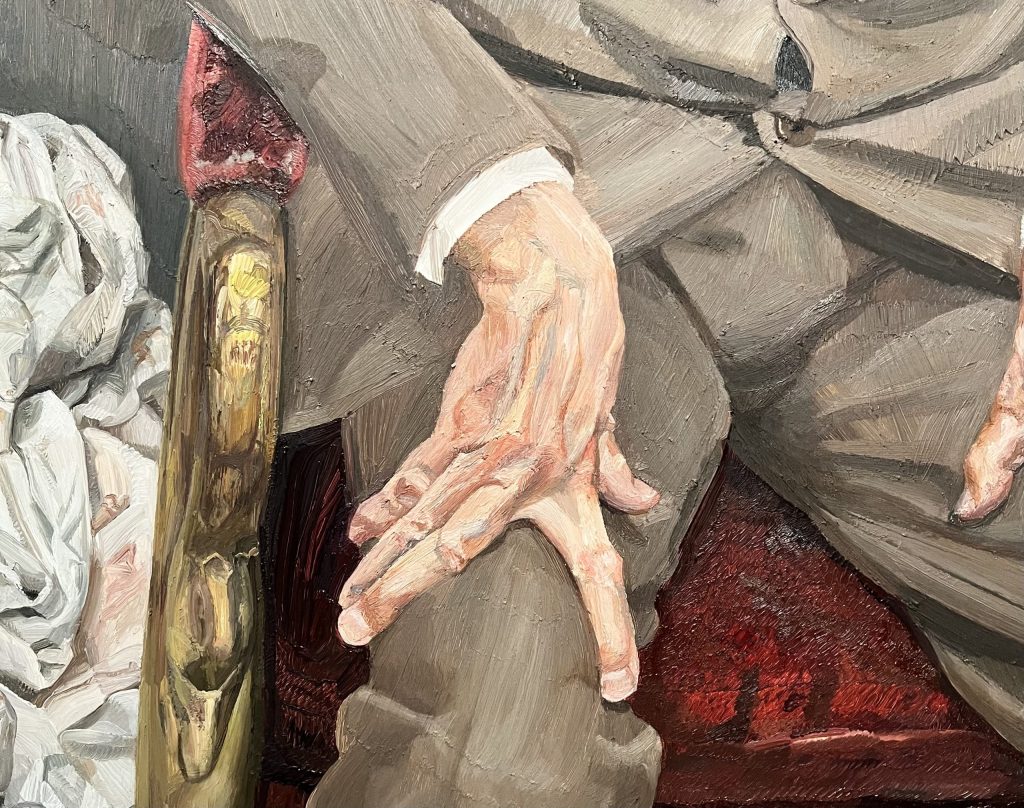
His clothing does not turn him into a spectacular figure either. The painter uses the suit to construct the volume of his body, but our attention inevitably shifts towards his face. There we encounter one of the painter’s great obsessions: skin.
Look at the Face
Get as close as the museum allows and then step back again. From a certain distance, we can perfectly recognise a human head; up close, that same head begins to break down into brushstrokes, marks and subtle variations of colour.
Freud does not simply use a pinkish tone to paint skin. Reddish, yellowish, pale and darker areas appear across the face, constructing its volumes and revealing the irregularity of the flesh. The wrinkles and bags beneath the eyes are not removed to flatter the sitter either. The painter seems interested precisely in all those small differences that make this the face of one particular person.
This helps us understand why his portraits can feel so physical. Freud does not draw a perfect face and then simply fill it with colour. The paint itself constructs the flesh. Every brushstroke contributes to the shape of the forehead, cheeks, nose or eyelids, constantly reminding us that we are looking at both a person and a surface covered in pigment.
What Does the Portrait Really Tell Us About the Baron?
There is a temptation here that is worth avoiding. It would be easy to interpret the lowered gaze as sadness, tiredness, melancholy or introspection and immediately turn the painting into a psychological diagnosis. But we do not know exactly what Hans Heinrich Thyssen-Bornemisza was thinking during those sittings.
We can say something much more interesting because it is right there in front of us: He chose to portray him without needing to explain his power. The viewer is placed very close to the sitter, yet he makes no eye contact with us. We are invited to observe him while he appears focused on something else.
In a way, this situation reproduces what happened while the painting was being created. The Baron had to remain seated while the artist observed him over numerous sittings. The man accustomed to deciding which paintings to buy and which artists would enter his collection now found himself on the other side of that relationship: he was the one being studied.
The Collector Becomes Part of His Collection
This gives the portrait a special significance when we see it at the Thyssen Museum. Hans Heinrich Thyssen-Bornemisza is not simply another historical figure hanging on its walls. He is one of the people responsible for the collection we can walk through today.
For decades, he had looked at paintings, negotiated acquisitions and decided which works deserved to join those he had inherited from his family. His interest in contemporary art also considerably expanded the boundaries of a collection that had initially been much more focused on the Old Masters.
With Lucian, however, the relationship between artist and collector came full circle. Thyssen had chosen his painting, but by agreeing to sit for him, he also allowed Freud to choose how he himself would be seen.
And the painter did not turn him into an allegory of money, collecting or power. He presented him seated, silent and apparently indifferent to our gaze. The man who collected paintings ended up becoming one of them. That is why this is such a good place to begin our journey through his work at the Thyssen Museum. The painting perfectly sums up one of the fundamental characteristics of his approach to portraiture: the person sitting in front of his easel might be a friend, a lover or one of the richest men in Europe, but what the painter wanted to paint was, before anything else, a person.
Large Interior, Paddington
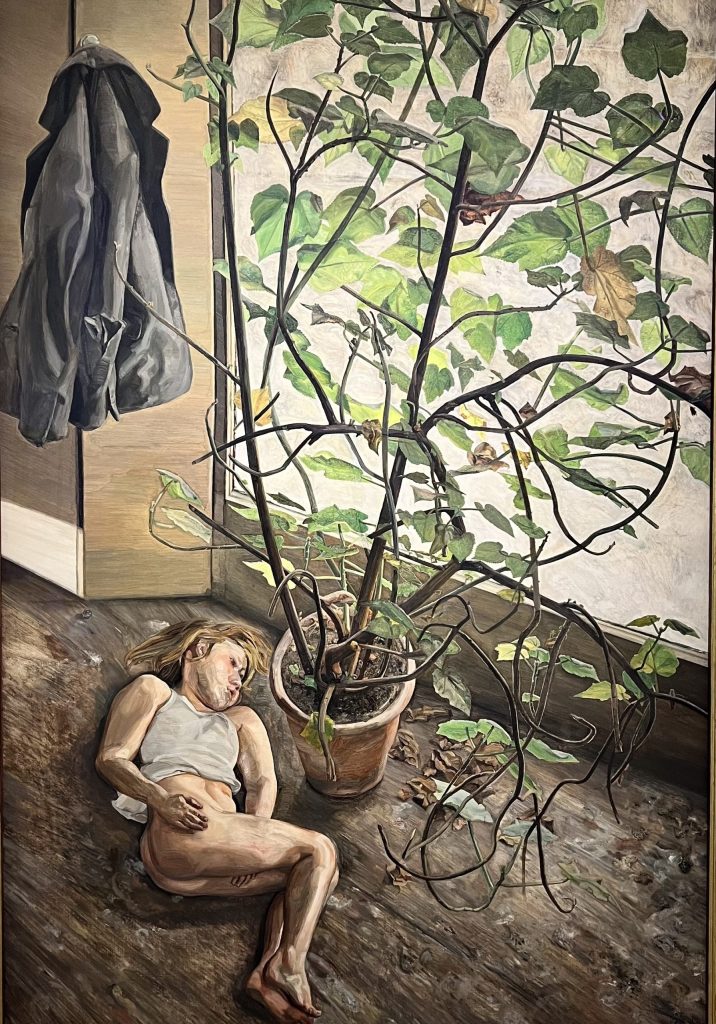
If the portrait of the Baron placed us in front of a single figure, Large Interior, Paddington takes us directly into Lucian Freud’s private world. Painted between 1968 and 1969, the work belongs to a period in which the artist had already abandoned the precision of his early years and developed a much freer and more physical approach to painting.
The scene takes place in an interior in Paddington, the London district where he lived and worked for many years. Yet this is not simply a room used as a setting. The space is as important as the people who occupy it, contributing to that strange mixture of intimacy and discomfort that we find in many of his paintings.
Two Figures Who Do Not Seem to Be Together
There are two people in the room. The female figure is Ib, one of Lucian Freud’s daughters, shown partially naked beside a large plant. On the other side, we find a second, clothed figure. They are physically close, yet it is difficult to identify any action that connects them.
And that is precisely where much of the painting’s interest lies. We do not know what has just happened or what will happen next. Nor do we find gestures that allow us to reconstruct a conversation or story easily. The artist places two people within the same space without forcing them to become part of a narrative scene.
This makes us start paying attention to distance. We look towards one figure and then the other, inevitably taking in everything that lies between them. The room ceases to function as a simple background and becomes a fundamental part of the relationship between the figures.
The enormous plant reinforces this sensation. Its leaves and branches occupy a large part of the composition and create a presence almost as important as that of the human figures. The painter paints it with extraordinary attention, making it difficult to regard it as a merely decorative element.
The Interior Is Also Part of the Portrait
Freud’s studios and rooms appear repeatedly throughout his work. They are not elegant spaces prepared for the viewer, but used, untidy places deeply connected to his everyday life. His models could spend dozens of hours there while the artist worked slowly on the canvas.
That is why it is worth looking beyond the figures when you stand in front of Large Interior, Paddington at the Thyssen Museum. Look at the plant, the walls and, especially, the empty spaces separating the figures. Everything participates in the construction of the image.
There is also an important difference from the portrait of the Baron we have just seen. There, the master concentrated our attention on a single face; here, our gaze needs to move constantly across the painting. The portrait no longer depends solely on how a person is represented, but also on the space that person occupies and their relationship with those around them.
Perhaps that is why Large Interior, Paddington feels so unsettling. Nothing spectacular is happening, yet we sense that there is some relationship we cannot quite understand. The artist does not explain it to us. He leaves us inside the room and forces us to look.
Reflection with Two Children (Self-Portrait)
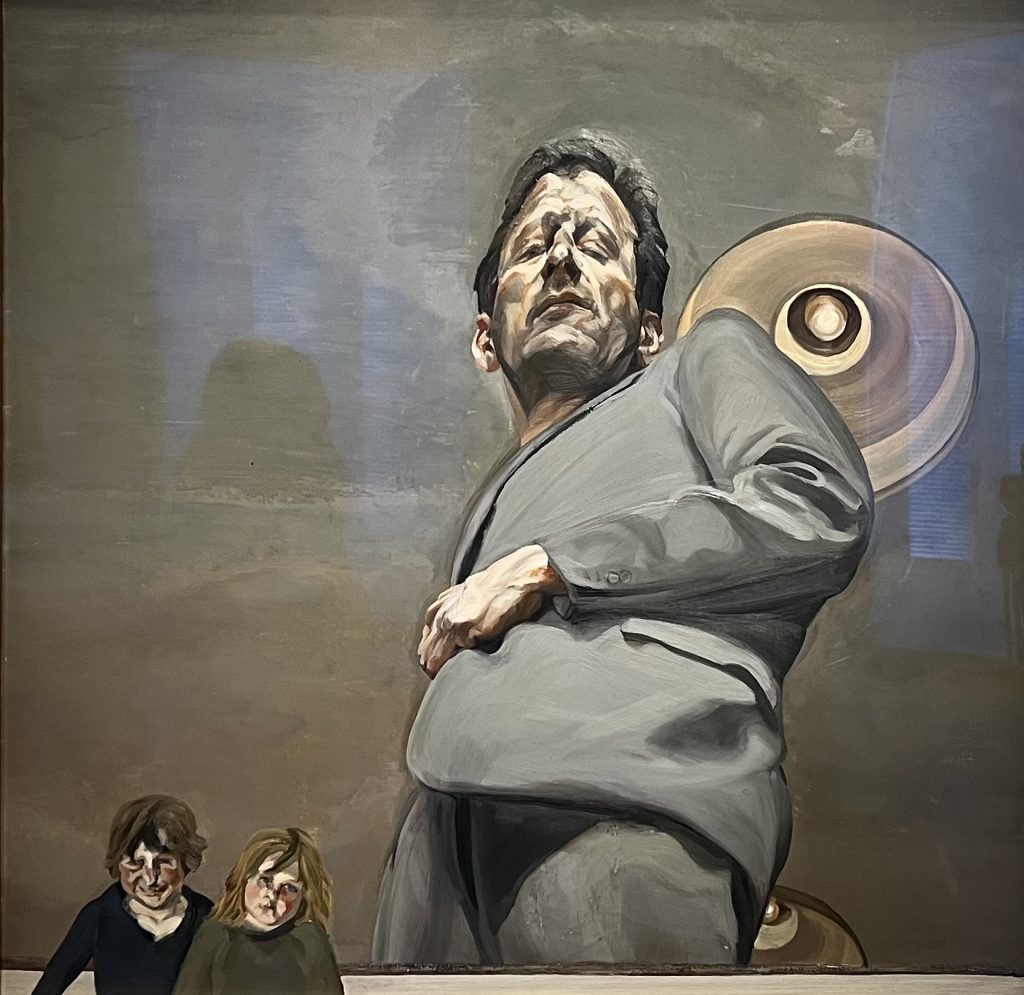
We end with an important change: this time Lucian Freud is not observing someone else, but turning the same gaze he had applied to his models upon himself. Reflection with Two Children (Self-Portrait) was painted in 1965 and shows the artist accompanied by two of his children.
But this is far from a conventional family portrait. Freud uses a mirror to paint himself, as so many artists had done before him, but places it in an unusual position. The result is a strange perspective that immediately transforms our relationship with the painter.
A Self-Portrait Seen from Below
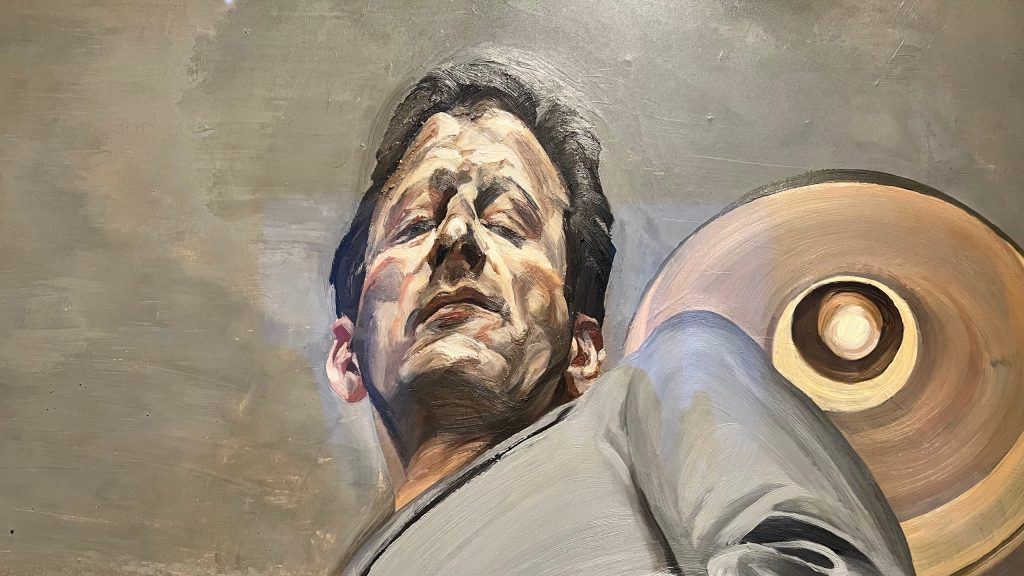
The first thing that catches our attention is the viewpoint. Freud appears from an extremely low angle, with his head dominating the upper part of the composition. The mirror was placed on the floor, meaning that the artist had to look down to observe his own reflection.
This explains the distortion we see. Freud makes no attempt to correct the effects of perspective in order to give us a more conventional image of his face; instead, he turns that effect into one of the painting’s central features. His head appears enormous and distant, while his gaze descends towards the point from which we are looking at the scene.
At the bottom are two of his children, Rose and Ali, represented on a much smaller scale. Their presence makes the composition even stranger: father and children share the painting, but they are not arranged as we would expect in a family portrait. Once again, Freud places several people within the same image without feeling the need to explain exactly what relationship we should establish between them.
The Painter Becomes the Model
The mirror also introduces an interesting reversal. Throughout much of his career, our painter was the person who decided where the model should sit and from which position he would observe them. Here he remains the painter, but he also has to submit himself to his own observation.
And he does not seem to grant himself many privileges. He makes no attempt to construct a solemn image of a great artist or to surround himself with brushes, canvases or objects proclaiming his profession. As in the portrait of Baron Thyssen, these attributes disappear and the face once again becomes the centre of our attention.
The result is not intended to flatter him either. The perspective alters his proportions and his expression is difficult to interpret. Rather than presenting himself to us, Freud seems to be examining the image returned to him by the mirror.
That is why this work provides such a fitting conclusion to our journey through the Thyssen Museum. In the first painting, we saw Freud observing a powerful collector; in Large Interior, Paddington, we saw how people relate to a shared space; now the painter himself takes the place of those he had spent years observing.
And perhaps that offers us one of the best keys to understanding his portraiture. Freud could change the model, the composition or even place himself in front of the mirror, but he was essentially doing the same thing: looking for long enough to make an apparently familiar face stop seeming entirely familiar.
Lucian Freud on Your Guided Tour of the Thyssen Museum
Would you like to see this master and the other great artists at the Thyssen Museum with us? At The Guides You Need, our guided tours are designed to help you enjoy the museum up close, understand its works and, above all, ask questions and talk to your guide throughout the visit.
👥 Our groups have a maximum of 7 people, a world away from large tours where it can be difficult to get close to the paintings or take part in the explanations.
🎓 All our tours are led by professional guides, ready to explain the works within their historical and artistic context and adapt the tour to the group’s questions and interests.
🎨 And the Thyssen has plenty of stories to tell. Lucian Freud is only a small part of a collection that allows you to travel from the Old Masters to some of the greatest names in 20th-century art. If you would like to know more before your visit, you can also take a look at our article on fascinating facts about the Thyssen Museum.
🇪🇸🇬🇧 We offer our guided tours of the Thyssen Museum in both Spanish and English.
👉 Want to book? Click here and join us for a guided tour of the Thyssen Museum.