José Gutiérrez Solana was one of the most distinctive Spanish painters of the 20th century. His paintings are populated by unsettling characters, cafés, processions, shop windows and popular entertainments, depicting a world in which everyday life almost always seems slightly strange. Unlike many other artists of his generation, Solana developed an immediately recognizable language, characterized by dark colors and an uncompromising view of the society around him.
In this article, we will explore José Gutiérrez Solana through 5 of his works: The Café de Pombo Gathering, The Shop Windows, The Procession of Death, The Circus and The Bishop’s Visit. Five paintings that will help us understand his particular vision of Spain and discover one of the most distinctive artists represented at the Reina Sofía Museum.
In this article
José Gutiérrez Solana: The Painter of Spain’s Darkest Side
José Gutiérrez Solana was born in Madrid in 1886, although he spent part of his childhood and youth in Santander. He studied at the San Fernando School of Fine Arts and soon developed a style that was difficult to place within the artistic movements of his time. While the avant-garde was transforming European art, he turned his attention to streets, taverns, popular festivities, cafés and some of the less pleasant corners of Spanish society.
His artistic universe was deeply connected to Madrid. Solana wandered through its neighborhoods, observed its inhabitants and transformed many everyday settings into subjects for his paintings. Yet he had little interest in presenting an attractive image of the city. His figures often appear rigid, serious or almost grotesque, surrounded by a heavy atmosphere that can make even a simple gathering around a table feel unsettling.
The Influence of Black Spain
To understand his paintings, we inevitably need to consider the idea of Black Spain, a vision of the country concerned with poverty, superstition, death, religious processions and the darker side of popular traditions. The expression had gained particular importance with España negra, the book by Émile Verhaeren and Darío de Regoyos published at the end of the 19th century. Solana would later take this vision in his own direction, both in his paintings and his writing.
Echoes of the Spanish artistic tradition can also be found throughout his work. El Greco, Velázquez and Goya belong to the pictorial heritage with which his art engages, but Solana used that legacy to construct an entirely personal world. His muted colors, hardened faces and interest in people far removed from official representations of society gave him a style that is recognizable almost at first glance.
An Artist Who Was Also a Writer
Painting was not his only means of expression. Solana was also a writer. Books such as Madrid. Escenas y costumbres and the two volumes of La España negra contain many of the same obsessions found on his canvases. Streets, churches, cemeteries, taverns, festivities and popular characters constantly move between his literary and visual worlds.
This dual role as painter and writer is particularly useful when trying to understand him. Solana did not simply portray a darker Spain: he spent much of his career observing, exploring and describing it. The five paintings we are about to examine show just how many different forms that distinctive vision could take.
5 Works by José Gutiérrez Solana You Should Know
1. The Café de Pombo Gathering
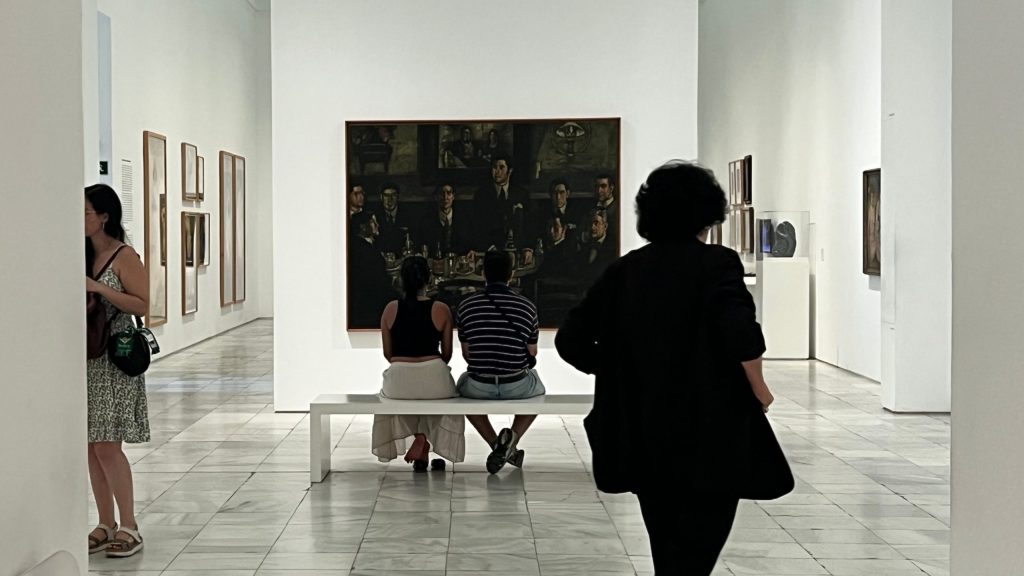
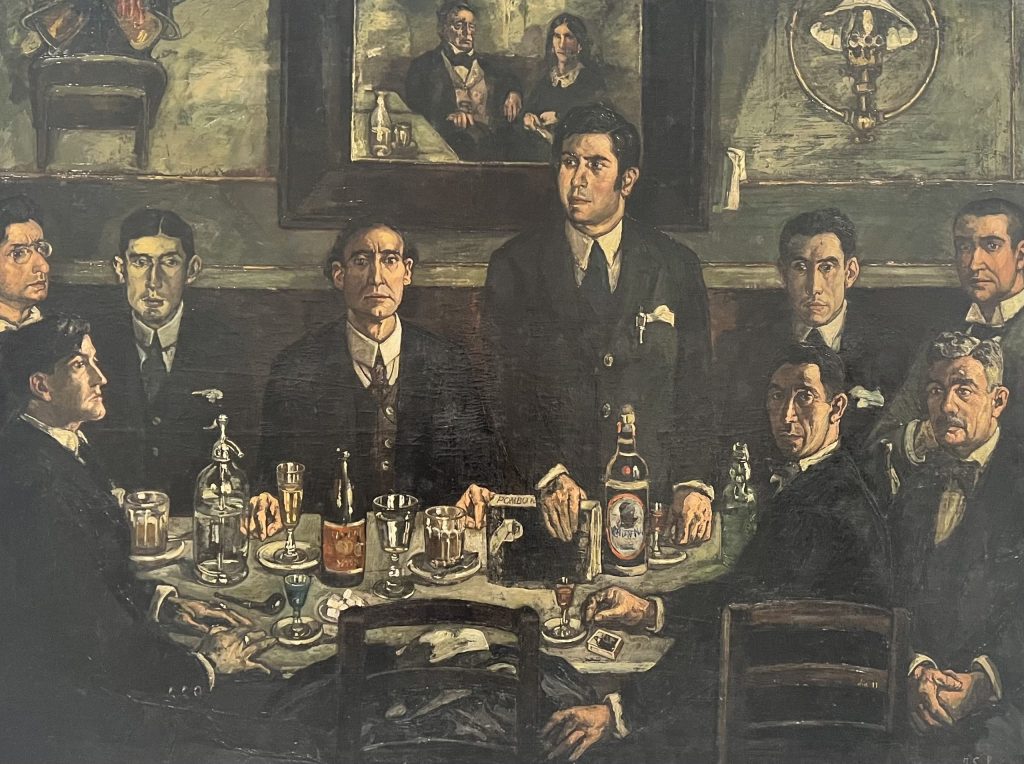
If there is one painting that brings together the artistic, literary and personal world of José Gutiérrez Solana, it is probably The Café de Pombo Gathering. Painted in 1920, the work depicts one of the meetings organized around Ramón Gómez de la Serna at Madrid’s now-defunct Café de Pombo.
At the time, literary gatherings were an essential part of Madrid’s cultural life. Writers, journalists and artists regularly met in certain cafés to discuss literature, politics and art. Ramón Gómez de la Serna turned the Pombo, located near Puerta del Sol, into one of these meeting places, bringing together figures associated with the avant-garde and the intellectual life of the Spanish capital.
Ramón Gómez de la Serna at the Center of the Scene
Solana does not portray an anonymous crowd. The men seated around the table can be identified, and the painter himself appears among them. Alongside Solana and Ramón Gómez de la Serna, we find Manuel Abril, Mauricio Bacarisse, Tomás Borrás, José Bergamín, Pedro Emilio Coll, Salvador Bartolozzi and José Cabrero.
Yet the scene is far from looking like a lively gathering of friends. The men barely interact with one another. Their serious faces and rigid bodies create a strange sense of isolation, as though each of them were enclosed within his own space despite sharing the same table.
Bottles, glasses, a coffee pot and other everyday objects occupy the table. Solana gives them an almost physical presence, comparable to that of the men themselves. The intellectual gathering thus becomes a heavy, material and dark scene, far removed from any romanticized image of Madrid’s bohemian life.
Two Very Different Gatherings: Solana and Ángeles Santos
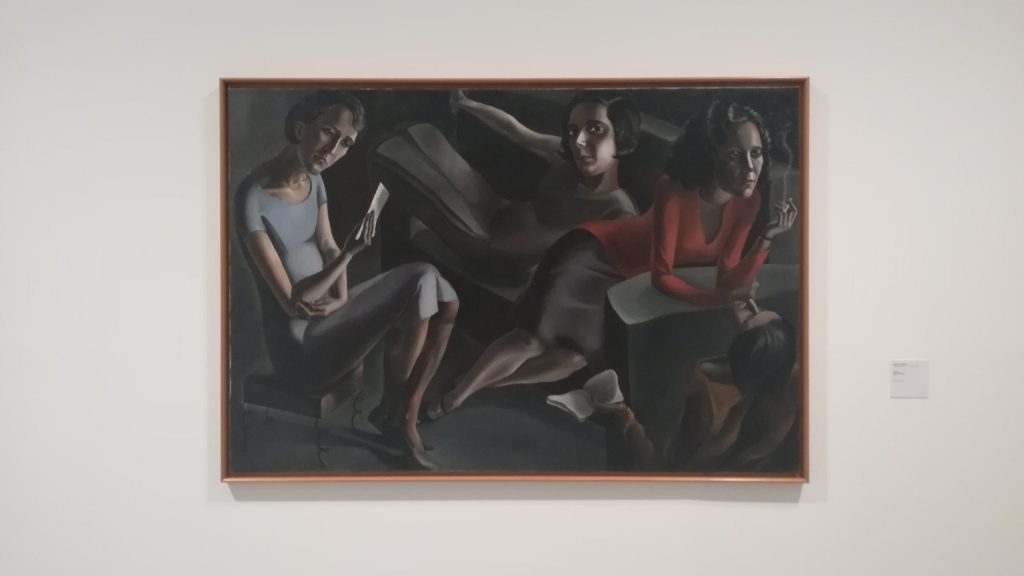
It is particularly interesting to compare this painting with Tertulia (The Gathering), painted by Ángeles Santos in 1929. Both artists depict a group of people gathered together, yet the two paintings present radically different images of social and intellectual life in Spain.
Solana portrays nine men associated with Madrid’s cultural scene inside the Café de Pombo. Santos, by contrast, depicts four young women gathered in a domestic interior. They read, smoke and interact with one another, but their meeting takes place far from the public cafés and intellectual circles traditionally occupied by men.
Men in the Café, Women at Home
This contrast makes the two paintings particularly interesting when viewed together. In Solana’s work, men occupy a public space and participate openly in Madrid’s intellectual life. In Santos’s painting, the women create their own space for conversation and cultural exchange within the confines of the home.
The difference allows us to look beyond the individual gatherings and consider the position of women in Spanish cultural life at the beginning of the 20th century. The café and the domestic interior become two very different spaces for intellectual exchange, reflecting some of the gender inequalities that shaped the society in which both artists worked.
The comparison is even more remarkable considering that Ángeles Santos was only seventeen when she painted Tertulia. If you would like to discover more about this extraordinary artist and her works at the Reina Sofía Museum, you can read our article about Ángeles Santos.
A Painting Within the Painting
There is another particularly interesting element in the background. Above the gathering hangs a painting depicting a partially nude woman. Her presence creates an obvious contrast with the men dressed in black around the table, while also establishing a visual game between the actual space of the gathering and the image represented within it.
The Café de Pombo Gathering therefore works as much more than a group portrait. Solana transformed a specific place from the Madrid of his time into one of the most recognizable images of early 20th-century Spanish culture. But he did so entirely on his own terms: rather than celebrating his subjects or presenting them as great intellectuals, he brought them together beneath the dark and uncomfortable atmosphere that characterizes so much of his painting.
2. The Shop Windows: When Objects Seem Alive
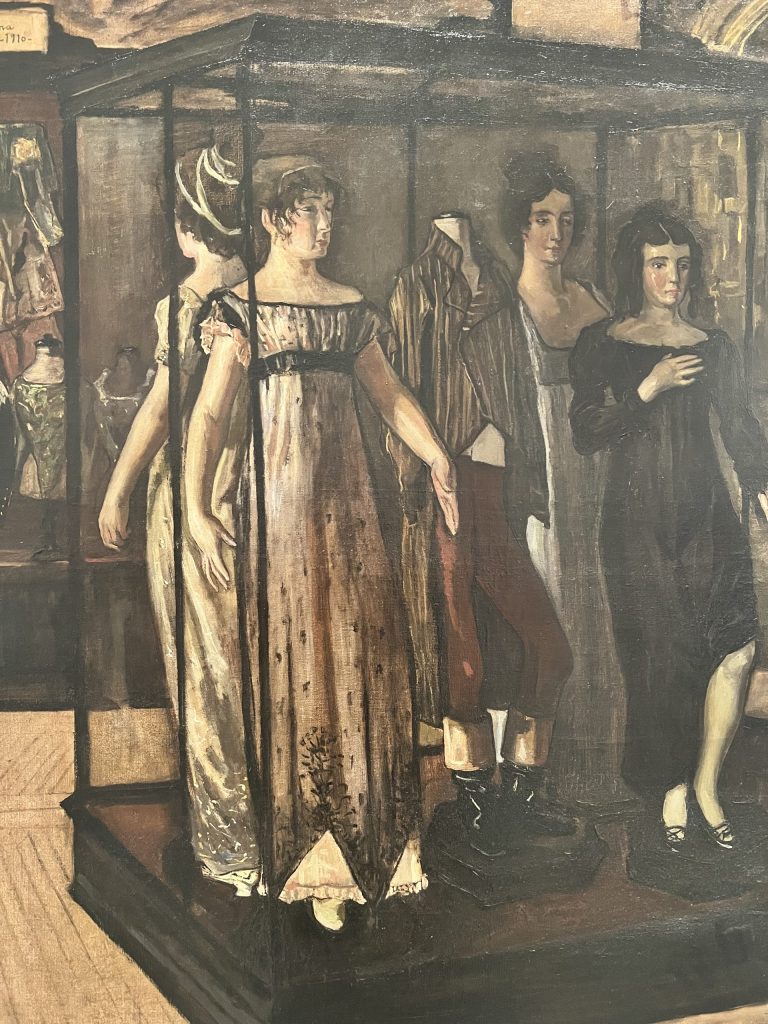
In The Shop Windows, José Gutiérrez Solana turns something as ordinary as a shop display into a deeply strange scene. Female figures appear behind the glass, surrounded by dresses, hats and other objects. Yet it is difficult to see them simply as mannequins: their faces and arrangement make them look like characters trapped in a space where the boundary between the human and the artificial becomes disturbingly blurred.
This interest was no coincidence. Solana was fascinated by shop windows, wax figures, automatons and mannequins. These objects were associated with entertainment and modern urban life, but they also had something disturbing about them: they imitated the human body without being alive. In his hands, this contradiction became a powerful artistic device.
The Madrid of Shop Windows
Shop windows were part of the landscape of the modern city. Goods were no longer simply kept inside stores: they were displayed towards the street, carefully arranged to attract the attention of passers-by. Solana focuses precisely on this world of exhibited objects, although he removes almost any sense of luxury or commercial seduction.
The figures in The Shop Windows do not seem to be inviting us to buy anything. They remain motionless, enclosed and subjected to our gaze. The darkness of the scene and the rigidity of their bodies transform the window into something resembling a small stage. The viewer therefore occupies a peculiar position: we are looking at precisely what has been placed there to be observed.
This relationship between looking and being looked at appears repeatedly in his work. Solana was interested in places where people or objects became a spectacle: shop windows, processions, cafés, circuses and popular fairground attractions. They are very different spaces, but they share something fundamental: someone observes, while someone—or something—is put on display.
A Feminist Reading of The Showcases
The Shop Windows can also be approached from a feminist perspective. The female figures are literally displayed behind glass, transformed into objects intended to be contemplated. The parallel between women and commodities is particularly suggestive: dresses, accessories and bodies occupy the same space and are all subjected to the gaze of the person standing before the window.
This does not necessarily mean that Solana intended to make a feminist critique. It would be risky to attribute an intention to the painter that the work itself cannot demonstrate. From a contemporary perspective, however, the painting allows us to reflect on the representation of the female body as an object of display and consumption, an issue that would later become highly significant in art criticism.
The nature of the mannequin itself reinforces this interpretation. These artificial women have no individual identity: their bodies have been dressed, positioned and arranged to be visible from outside. They do not act; they are observed. In this sense, The Shop Windows can raise a question today that goes beyond Solana’s dark artistic universe: to what extent did modern society also turn the image of women into part of the shop display?
Mannequins, Masks and Faces
There is another of Solana’s recurring obsessions that helps us understand the painting: masks. In many of his works, even genuinely human characters have rigid, expressionless faces. By contrast, mannequins can acquire an unsettling appearance of life.
The distinction between these two worlds therefore begins to disappear. Objects seem like people, while people sometimes seem like objects. This ambiguity explains much of the power of The Shop Windows and why such an apparently simple scene can feel so disconcerting.
Solana did not need fantastic creatures to create unease. He only had to look at what he found in the streets and subtly alter the way we perceive it. A shop window could thus become a strange place, and its mannequins some of the most characteristic inhabitants of his particular vision of Madrid.
3. The Procession of Death: A Spain Between Religion and Fear
Few works capture the world of José Gutiérrez Solana as clearly as The Procession of Death. Here we find several themes that constantly run through his work: popular religion, processions, the macabre and a presence of death that does not remain hidden but instead becomes part of a collective spectacle.
The scene also connects with a much older European tradition: representations of the Dance of Death and other medieval motifs that reminded viewers that nobody could escape their final fate. Kings, members of the clergy, the rich and the poor would ultimately share the same destiny. Solana brings this imagery into his own particular vision of early 20th-century Spain.
Death Takes to the Streets
One of the keys to the painting lies precisely in this coexistence between the extraordinary and the everyday. Death does not appear as a private experience, hidden away in a room or confined to a cemetery. It takes to the streets and becomes part of a public ceremony.
This helps us understand Solana’s fascination with processions and other expressions of popular religion. They offered an ideal combination for his paintings: crowds, religious images, ancient rituals, ceremonial clothing and a relationship with suffering and death that provided extraordinarily powerful visual material.
However, it would be too simplistic to interpret these scenes merely as a mockery of religion. The artist’s perspective is harder to reduce to a single intention. Solana observes this world with severity and emphasizes its darker, grotesque or unsettling aspects, but at the same time he clearly displays a fascination with its ceremonies and their ability to temporarily transform the streets.
A Long Tradition of Art and Death
Death also has a long history in Spanish art. Centuries earlier, paintings, sculptures and funerary monuments had used skulls and corpses to remind viewers of the brevity of life. During the Baroque period, vanitas turned this idea into one of their great themes: wealth, beauty and power inevitably disappear with the passage of time.
Solana draws on part of this heritage while transforming it through his own visual language. In his hands, death no longer belongs exclusively to a religious allegory or a distant past. It becomes part of the same world as cafés, shop windows, streets and popular entertainment.
That is why The Procession of Death is so useful for understanding his work. Something that might initially appear exceptional actually lies at the very heart of his artistic universe. Solana finds in death not merely a subject, but a way of looking at the society around him.
4. The Circus: Entertainment Without Joy
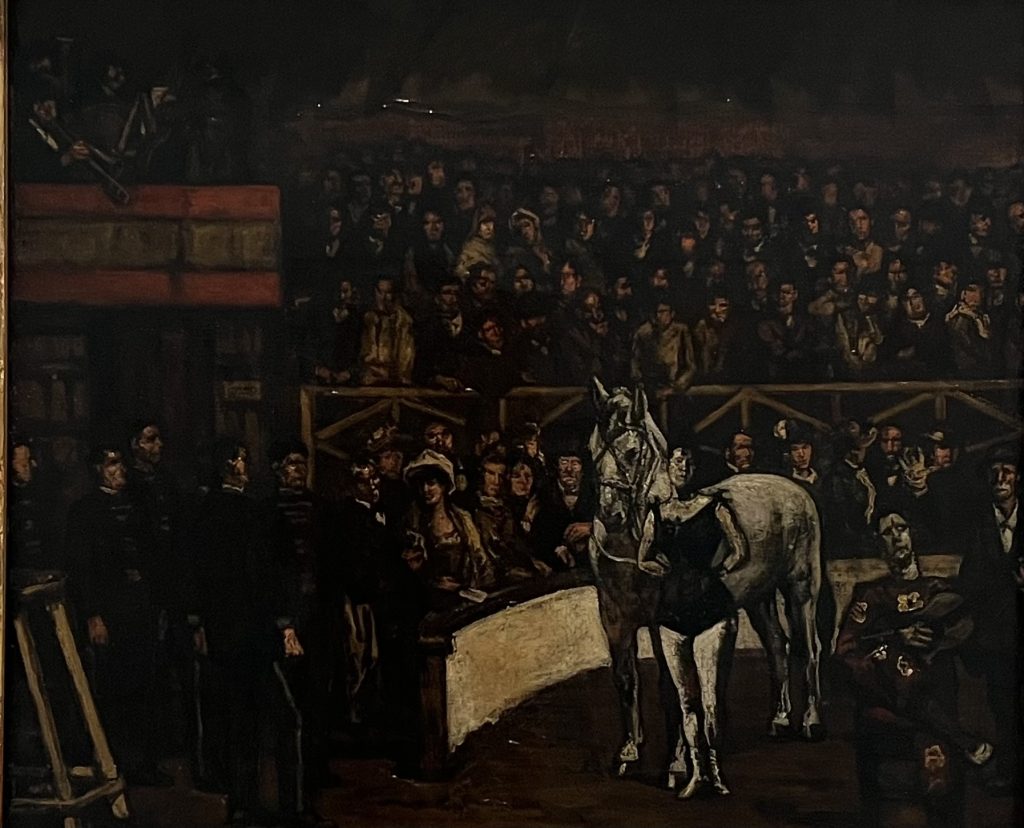
The circus might seem like an unusual subject for José Gutiérrez Solana. Compared with his processions, taverns, marginal characters and scenes dominated by death, here we find ourselves in a place created specifically for entertainment. Yet in the painter’s hands, even amusement takes on a sombre appearance.
Solana had a strong interest in popular entertainment. Circuses, fairs and fairground attractions belonged to the world he encountered while wandering through Spanish cities and which he later brought into both his paintings and his writing. He was particularly attracted to their characters: travelling performers, clowns and other entertainers whose lives existed far from the official and bourgeois culture of the period.
The People Behind the Show
In The Circus, what happens in the ring is not the only important element. Solana draws our attention towards the people who inhabit this world. As so often happens in his work, the figures have a heavy, almost motionless presence, far removed from the movement and excitement we would normally associate with a circus performance.
This creates one of the painting’s most interesting contradictions. We are looking at a place designed to produce joy, yet Solana removes much of that joy from the scene. The circus ceases to be merely a form of entertainment and becomes another setting in which to observe people living outside the most respectable spheres of society.
There is no bright or idealized depiction of the performers. The painter incorporates them into the same visual universe we have already encountered in his cafés and streets: hardened faces, muted colors and an atmosphere in which entertainment coexists with a certain sense of decay.
Solana’s Fascination with Popular Culture
This choice of subject also helps us understand what interested the artist about the Spain around him. Solana paid far more attention to popular culture than to the elegant spaces of high society. Festivities, street performances, processions and taverns offered him characters and situations that were unlikely to appear in an official representation of the country.
That is why The Circus fits so naturally within his work. The painting is not simply about popular entertainment; it invites us to look at what exists behind the spectacle. The show continues, but Solana’s gaze settles on its less glamorous side.
This ability to find darkness even in places designed for amusement is one of the qualities that makes his paintings so recognizable. And in our final work, that uncompromising gaze turns towards another important aspect of Spanish society: the Church and its authority.
5. The Bishop’s Visit: Power, Religion and Society
In The Bishop’s Visit, José Gutiérrez Solana once again turns his attention to one of the fundamental elements of Spanish society in his time: the Church. This time, however, we are not looking at a procession or an expression of popular religion. The focus is on the ecclesiastical hierarchy itself and the social relationships established around it.
The arrival of a bishop was an important event, particularly in certain Spanish towns and cities. His presence was accompanied by ceremonies, receptions and meetings with local authorities and prominent members of society. Solana finds in this kind of occasion an ideal setting for observing something that interested him throughout his career: the public display of power.
The Bishop and Those Around Him
As in so many of Solana’s paintings, the figures are not beautified. Their faces, gestures and the construction of the scene itself are far removed from a solemn representation of religious authority. The dignity one might expect from an episcopal visit is subjected to the harsh and distorting gaze that characterizes the painter.
It is particularly important here to look not only at the bishop, but also at those surrounding him. The painting depicts an entire social structure. Clothing, positions and attitudes allow us to recognize different roles within a ceremony in which each person seems to occupy the place assigned to them.
Solana therefore manages to turn an apparently anecdotal scene into something that can also be read as a portrait of Spanish society. The Church does not appear in isolation: it forms part of a broader network of social relationships and power.
An Anticlerical Painting?
It is tempting to interpret The Bishop’s Visit as a direct criticism of the Church. The unidealized treatment of its characters and Solana’s interest in the more grotesque aspects of society certainly allow for a critical reading of the scene.
However, we should avoid reducing the painting to such a simple interpretation. Throughout his career, the artist showed an enormous fascination with churches, processions, religious images, cemeteries and ceremonies. This interest could coexist with a harsh view of institutions and of those who exercised power within them.
Rather than offering an unequivocal political message, Solana seems interested in showing the social ritual surrounding authority. As with so many other environments he painted, he observes his subjects without granting them the idealized dignity with which they might have wished to be represented.
Five Paintings to Enter Solana’s World
After exploring these five paintings, the elements that shape his artistic universe become easier to recognize. The intellectuals of The Café de Pombo Gathering, the mannequins of The Shop Windows, the macabre presence of The Procession of Death, the popular performers of The Circus and the religious hierarchy of The Bishop’s Visit apparently belong to very different worlds.
Yet they are all filtered through the same gaze. Solana finds something unsettling in a shop window, a café, a religious ceremony and a popular show alike. He did not need to invent a dark world: he simply had to observe the one around him.
Discover José Gutiérrez Solana at the Reina Sofía Museum
Want to see these works and many more? At The Guides You Need, we offer guided tours of the Reina Sofía Museum in small groups.
🎟️ Museum admission included
👥 Maximum 6 people per group
🇪🇸🇬🇧 Tours in Spanish and English
🎨 Professional guides specialized in art
Alongside José Gutiérrez Solana, you will discover some of the great artists in the collection, including Picasso, Dalí and Miró.
👉 Want to book your guided tour of the Reina Sofía? Click here.