The Venetian painters turned Venice into one of Europe’s great artistic centres. Between the 15th and 18th centuries, the city was home to masters such as Titian, Tintoretto, Veronese and Canaletto, artists from different periods and with different styles who shared a particular fascination with colour and light. Their works would eventually influence some of the most important figures in European painting, and the Venetian painters became a symbol of the city’s cultural wealth.
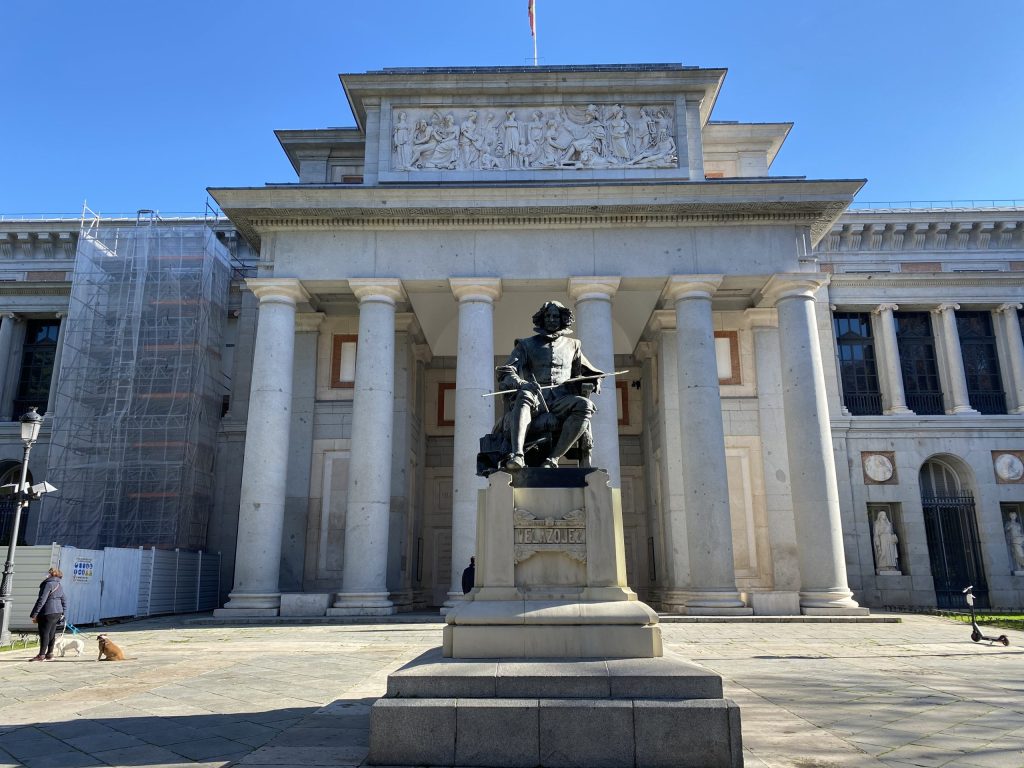
But the story of the Venetian painters did not remain within the canals of the Serenissima. Kings, aristocrats and collectors from across Europe sought out their paintings, while the Spanish monarchy developed an especially close relationship with some of these artists. As a result, Madrid now holds an extraordinary collection of Venetian painting, mainly divided between the collections of the Prado Museum and the Thyssen Museum.
In this article
Quick answers to the key questions
Who are the most famous Venetian painters?
Among the most famous artists from Venice are Titian, Tintoretto, Veronese and Canaletto. The first three were major figures in 16th-century Venetian painting, while Canaletto worked primarily during the 18th century. Although they belonged to different periods, they all contributed to making Venice one of the great centres in the history of European painting.
Which Italian artist was the leading representative of the Venetian school?
The work of the Venetian painters continues to be studied today, as it offers a unique perspective on Europe’s cultural history.
Titian is considered the leading representative of the 16th-century Venetian school and one of the great painters of the European Renaissance. His extraordinary mastery of colour, light and brushwork had a profound influence on other artists. His reputation reached Europe’s major courts, and he developed a particularly close relationship with the Spanish monarchy, especially Charles V and Philip II.
Who are some famous artists from Venice?
Venice produced many artists who became fundamental figures in the history of art. Alongside Titian, Tintoretto, Veronese and Canaletto, we can mention Giovanni Bellini, Giorgione, Jacopo Bassano, Francesco Guardi and Giambattista Tiepolo. Their careers span several centuries and different styles, meaning that Venetian painting should not be understood as a phenomenon limited exclusively to the Renaissance, but as a much broader artistic tradition.
Which artist is famous for painting Venice?
Canaletto is probably the artist most famous for painting Venice. During the 18th century, he produced numerous vedute: detailed urban views depicting the city’s canals, squares, churches and palaces. These paintings became particularly popular among European travellers visiting Italy during the Grand Tour. Be patient: we’ll devote an entire section to him later.
Where can we find more works from the Venetian school?
Naturally, Venice remains one of the best places to explore this school, particularly at the Gallerie dell’Accademia and in numerous churches and palaces. However, Madrid has an exceptional collection thanks to the collecting activities of the Spanish monarchy. The Prado Museum houses important works by Titian, Tintoretto, Veronese and other masters, while the Thyssen Museum expands the journey with artists from different periods.
What makes Venetian painting different from other schools?
Venetian painting is particularly distinguished by the importance given to colour, light and brushwork, in contrast with the greater emphasis on drawing found in other Italian Renaissance schools. These artists also constructed forms through colour and developed rich effects of light. Reflections, fabrics, landscapes and atmosphere therefore became fundamental elements of their compositions.
What was the Venetian school?
The Venetian school was one of the great painting traditions to emerge in Italy during the Renaissance. Its main centre was Venice, and it reached one of its greatest periods of splendour during the 16th century. Its origins, however, went further back, and its influence continued long afterwards, extending into the 18th century.
Talking about a “school” does not mean that all these artists painted in the same way. What we find instead is a shared tradition, developed over generations, in which certain artistic concerns became particularly important. These included colour, the effects of light, atmosphere and an increasingly free approach to applying paint. Later, you’ll find a section called “colore vs disegno”. You’ll find more information there!
Venice: a city made for colour
The Venetian environment itself helps us understand some of these characteristics. Venice was an extraordinarily wealthy trading city, connected to the eastern Mediterranean and accustomed to receiving objects, pigments and materials from many different places. Its churches and palaces also provided numerous commissions for the artists working in the city.
Light is also an unavoidable part of the Venetian experience. The water of the canals, marble façades, mosaics and changing atmospheric conditions constantly create reflections and variations in colour. It would be too simplistic to claim that Venetian painters worked as they did merely because they lived surrounded by water, but this particular cultural and visual environment contributed to the development of a tradition especially sensitive to colour and light.
The impact of Venice’s painters can still be felt today, with modern artists continuing to find inspiration in their techniques and styles.
Colore vs disegno: Venice vs Florence
One of the classic comparisons in art history contrasts Venetian colore with the disegno particularly associated with Florence and Rome. Painters such as Michelangelo placed enormous importance on drawing as the foundation of a composition: forms were defined first, and colour was then added. In Venice, the process could be different.
For the Venetian masters, colour was not simply something added to a previously constructed figure. Paint itself could build forms through patches of colour, tones, light and shadow. This approach encouraged increasingly free brushwork and surfaces in which the boundaries between objects could become less clearly defined.
Giovanni Bellini and Giorgione: before the great masters
Before the artists we are going to explore, there were two fundamental figures: Giovanni Bellini and Giorgione. Bellini helped develop a style characterised by rich colour and a new sensitivity towards light and landscape. Giorgione took some of these ideas even further, creating scenes whose meanings could sometimes be mysterious and in which atmosphere acquired an extraordinary importance.
Titian trained in precisely this environment and was closely associated with Giorgione during his early years. Building on this tradition, he would take Venetian painting onto the European stage. And this is where our story begins to move towards Madrid: no other great master from Venice established a relationship with the Spanish monarchy as significant as Titian did.
Titian: the great master of the Venetian painters
If we had to choose just one name to represent the splendour of 16th-century Venetian painting, it would probably be Titian Vecellio. Born in Pieve di Cadore around 1488–1490, he arrived in Venice at a very young age and trained in the artistic environment of Giovanni Bellini and Giorgione. Following the latter’s early death, he gradually rose to prominence until he became the most prestigious painter in the city.
His career was exceptionally long. For decades, he worked for the Republic of Venice, Italian aristocratic families, popes, princes and some of the most powerful monarchs in Europe. This international dimension is particularly important for us: many of the works by Titian that we can see today at the Prado are connected with his close relationship with the Habsburgs.
Why was Titian so important?
One of the keys lies in his extraordinary mastery of colour. Titian could build bodies, fabrics, landscapes and effects of light through successive layers of paint, creating surfaces of remarkable richness. Over the years, his technique also became increasingly free. In some of his later works, the brushstrokes seem to dissolve when viewed up close and only make complete sense when we step back from the canvas.
But reducing the great Titianus to a brilliant colourist would be selling him short. He was also a magnificent portraitist and an extraordinary narrator of religious and mythological stories. His figures have physical weight, occupy convincing spaces and, at the same time, convey a powerful psychological presence. That combination helps explain why kings and emperors wanted him to paint their portraits.
His work at the Prado
The Prado Museum holds an exceptional collection of works by the Venetian master. This is no coincidence. His relationship with Charles V and Philip II meant that numerous paintings by the artist passed directly into the collections of the Spanish monarchy. We will explore how this connection developed later; for now, we can focus on some of the works that reveal his talent.
Charles V at the Battle of Mühlberg
In 1547, Charles V defeated the forces of the Schmalkaldic League at Mühlberg. Shortly afterwards, Titian produced one of the most famous portraits of power in history: Charles V at the Battle of Mühlberg. The emperor appears on horseback, wearing armour and advancing through a landscape illuminated by reddish tones.
This is not a conventional depiction of a battle. There are no corpses, enemy soldiers or scenes of chaos. The artist focuses all our attention on Charles V, transforming a military victory into a carefully constructed image of authority. The horse, armour, lance and landscape all contribute to presenting the emperor as a calm and commanding figure.
Danaë Receiving the Golden Rain
With Danaë Receiving the Golden Rain, we enter a completely different world. According to the myth, Zeus reached Danaë by transforming himself into a shower of gold. Titian depicts the young woman reclining as golden coins fall upon her, accompanied by an old woman attempting to gather them.
The painting reveals another of the artist’s great talents: the depiction of flesh. The luminosity of Danaë’s body contrasts with the darker tones of the scene and with the aged figure beside her. Colour does not function merely as decoration; it organises the composition, directs our gaze and distinguishes between the different textures.
Tintoretto: movement, light and drama
If Titian represents the mastery of colour and a style of painting equally at home in court portraiture and mythology, Tintoretto took the Venetian school into far more dramatic territory. Jacopo Robusti, known as Tintoretto, was born in Venice in 1518 or 1519 and spent almost his entire career in the city, where many of his works can still be seen today in the places for which they were originally created.
His nickname came from his father’s profession as a dyer. More importantly, however, Tintoretto developed an artistic personality very different from those of his contemporaries. His paintings are filled with twisting bodies, diagonals, foreshortening and unexpected perspectives. Rather than always arranging scenes frontally, he searched for viewpoints capable of drawing the viewer directly into the action.
What makes Tintoretto different?
One of his most recognisable characteristics is precisely this sense of movement. Figures may appear to enter or leave the space, be seen from unusual angles or be positioned at very different distances. Architecture and perspective are no longer simply the setting in which a story takes place: they become tools for directing our gaze.
Light also plays a fundamental role. The artist uses strong contrasts and sources of light to emphasise particular figures or heighten the drama of a scene. The result can feel much more restless than the work of other Venetian painters. Rather than allowing our gaze to rest comfortably on the composition, he often forces us to move through it.
Tintoretto at the Prado and the Thyssen
To discover Tintoretto in Madrid, we can visit two of the city’s great museums. The Prado houses one of his masterpieces, The Washing of the Feet, while at the Thyssen we find Paradise. They are two very different paintings, but both reveal how Tintoretto used space, light and movement to create scenes that depart from more predictable compositions.
The Washing of the Feet: a surprising perspective
The Washing of the Feet depicts the Gospel episode in which Christ washes his disciples’ feet during the Last Supper. Yet it only takes a few seconds of looking at the painting to notice something unusual: Christ does not occupy the centre of the composition. Tintoretto shifts the main action to the right, while the apostles are spread across a vast architectural space that draws our gaze towards the background.
This unusual arrangement has a great deal to do with the location for which the work was painted. The Washing of the Feet was intended for the Venetian church of San Marcuola and was originally meant to be viewed from the side. The artist took this viewpoint into account when constructing the perspective. That is why it is worth moving around in front of the painting at the Prado: the architecture and arrangement of the figures change noticeably depending on where we stand.
Paradise: Tintoretto at the Thyssen
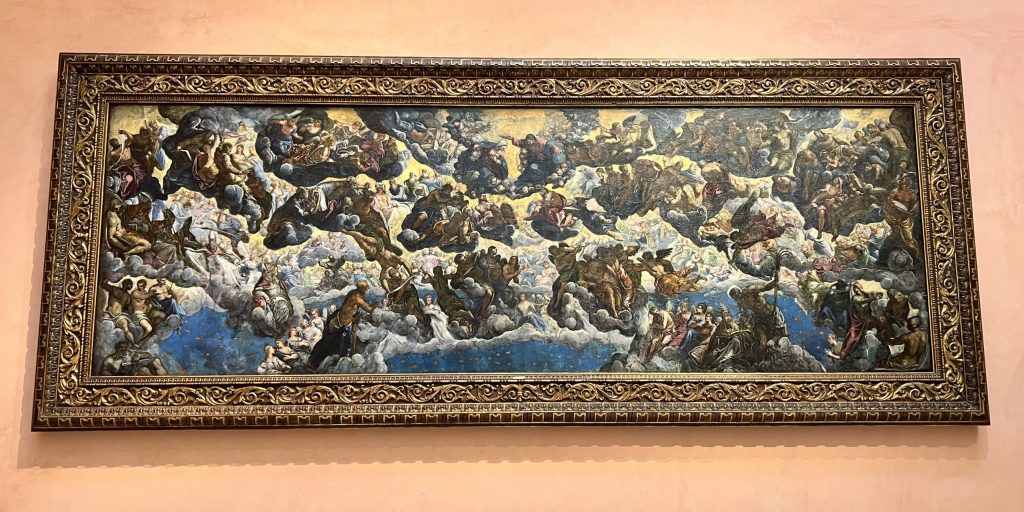
At the Thyssen we can find Paradise, a work connected with one of the most ambitious projects of his career. After a fire at the Doge’s Palace in Venice in 1577, plans were made to replace the painting that had decorated the Great Council Hall. Several artists submitted proposals for the new composition, including the great Jacopo Robusti.
The painting now in Madrid is one of the preparatory works associated with this enormous project. Dozens of figures are arranged around Christ and the Virgin in a composition that seems to expand in every direction. It is difficult to find a single point on which to rest our gaze: bodies, clouds and light follow one another, creating a continuous sensation of movement.
The project would eventually result in the gigantic Paradise in the Doge’s Palace, produced by Tintoretto’s workshop during the final years of his life. Seeing the work at the Thyssen therefore gives us an opportunity to approach the creative process behind one of the most monumental painting projects of 16th-century Venice.
Veronese: luxury, colour and spectacle
If Tintoretto turned many of his scenes into restless and dramatic compositions, Paolo Veronese represents a very different side of Venetian painting. Born in Verona in 1528, Paolo Caliari spent much of his career in Venice, where he became one of the most sought-after artists for the decoration of churches, palaces and major public buildings.
His paintings immediately attract attention for their spectacular character. Monumental architecture, columns, staircases, luxurious fabrics and numerous figures fill compositions in which colour takes on an extraordinary importance. Even when depicting religious events that took place centuries earlier, Veronese seems to transport them into the refined and cosmopolitan world of Venice in his own time.
How can you recognise one of his paintings?
One of the keys lies precisely in this combination of colour, architecture and luxury. This exotic painter uses greens, blues, reds, whites and golden tones to distinguish the figures and organise scenes that can contain dozens of characters. Fabrics, jewellery and architectural elements are not merely decorative: they help create the sensation that we are witnessing a grand spectacle.
His way of transforming stories is equally characteristic. A biblical supper could become an enormous banquet populated by musicians, servants, aristocrats and even animals. This freedom got him into trouble with the Venetian Inquisition in 1573, when he was required to explain the presence of characters considered inappropriate in a depiction of the Last Supper. Rather than substantially altering the painting, he eventually changed its title to The Feast in the House of Levi.
Veronese at the Prado
The Prado holds an important collection of paintings by this great artist, allowing us to appreciate different aspects of his work. Among them are religious and mythological scenes, as well as works that demonstrate his extraordinary ability to depict fabrics, bodies and sumptuous settings.
Venus and Adonis
In Venus and Adonis, the artist depicts one of the best-known episodes from Ovid’s Metamorphoses. Venus tries to prevent her lover Adonis from leaving to hunt, a decision that will ultimately lead to his death. The viewer knows how the story ends, but the painter chooses an intimate moment before the tragedy.
Colour helps construct the entire scene. The fabrics surrounding the protagonists, the figures’ skin and the landscape create different surfaces and effects of light. The sensuality does not come from the bodies alone: it is also present in the material richness of everything around them. It is a magnificent example of how Veronese could transform a mythological story into an elegant and profoundly Venetian image.
Canaletto: the painter of Venice
With Canaletto, we jump forward more than a century. Giovanni Antonio Canal was born in Venice in 1697, when the world of Titian, Tintoretto and Veronese already belonged to the past. However, the city remained one of Europe’s great cultural centres and, above all, an essential stop for travellers making their way through Italy.
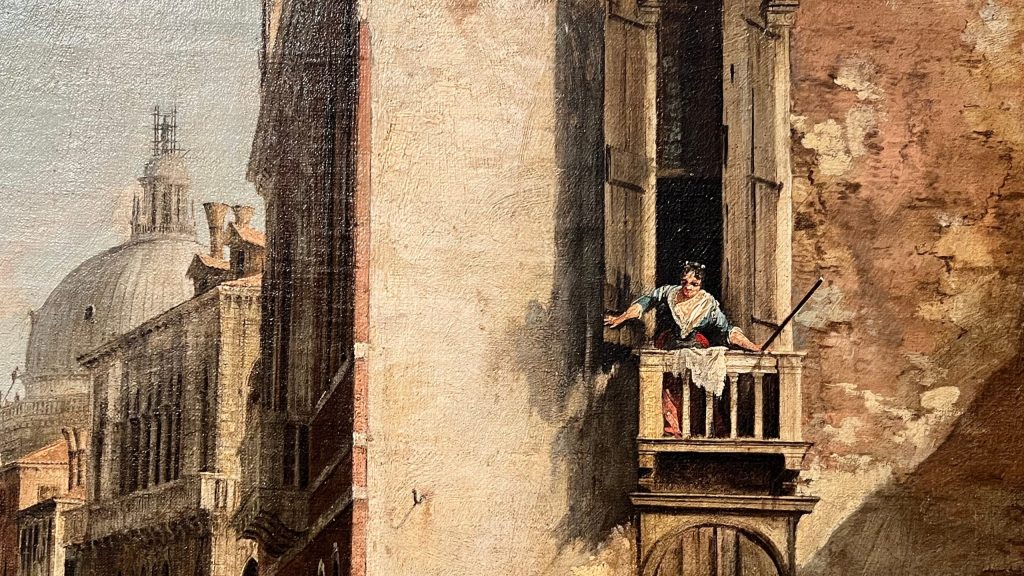
Canaletto found an important part of his audience among precisely these travellers. Instead of grand mythological or religious scenes, he specialised in depicting Venice: its canals, squares, churches, palaces and boats. His paintings allowed visitors to take home a recognisable image of the city and ultimately made him one of the great European masters of urban landscape painting.
What is a veduta?
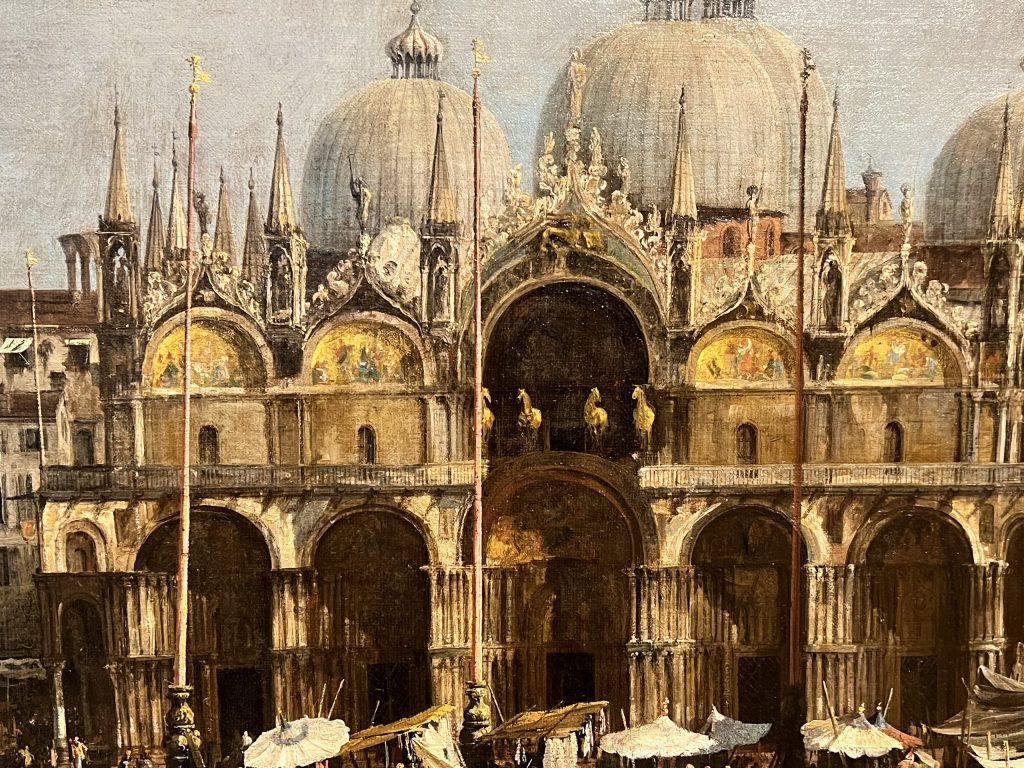
Good old Giovanni Antonio was one of the greatest exponents of the veduta, a genre based on the detailed representation of a city or some of its most recognisable spaces. In his paintings, we can identify specific buildings and visually explore places that still exist today. The architecture is depicted with remarkable precision, but his works should not be understood simply as photographs made before the invention of the camera.
The artist could modify perspectives, alter proportions or rearrange certain elements to create a more effective composition. To this architectural precision, he added something equally important: the everyday life of Venice. Gondolas, merchants, travellers and small figures populate squares and canals, preventing his views from becoming empty stages.
Canaletto and the travellers of the Grand Tour
During the 18th century, young aristocrats and members of the European elite travelled through France and Italy to complete their education on what became known as the Grand Tour. Venice was one of its major stops, and Canaletto’s views became particularly desirable souvenirs, especially among British travellers.
The success was enormous. The artist developed a body of work aimed largely at this international market and even moved to England for several years. As a result, those images of Venice circulated throughout Europe and helped shape a vision of the city that still seems surprisingly familiar to us today.
Canaletto at the Thyssen
We do not need to travel all the way to Venice to see his work. The Thyssen holds several paintings by this “urban” artist that allow us to discover his way of depicting the city and compare his work with the Venetian tradition of earlier centuries.
Piazza San Marco in Venice
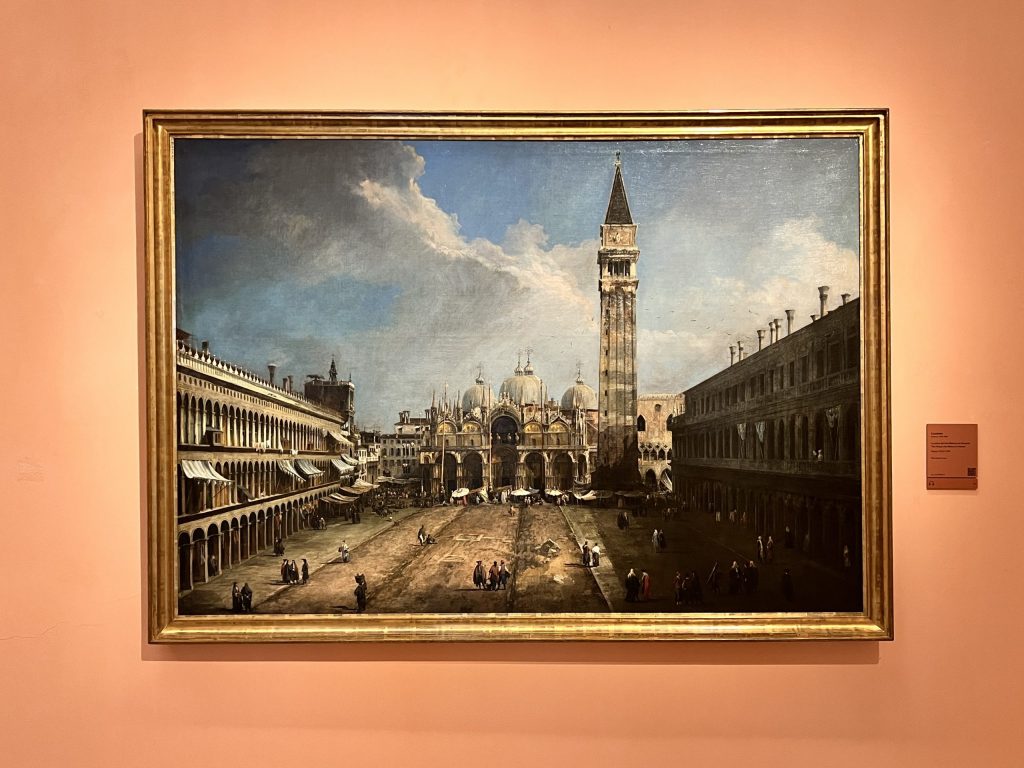
In Piazza San Marco in Venice, our painter depicts one of the city’s most recognisable spaces. Architecture structures the composition while small figures cross the square, chat or go about their daily business. The setting is monumental, but the human presence prevents it from becoming a static image.
Here too, light is fundamental. Illuminated areas and shadows help define the buildings and create depth, while the sky enhances the sense of space. Two centuries after the great Renaissance masters, colour and light remained essential tools for a Venetian painter, although the protagonist was no longer an emperor, a saint or a mythological god: it was Venice itself.
How did the Venetian art arrive in Madrid?
The fact that the Prado Museum now holds an extraordinary collection of Venetian painting is no coincidence. To understand its origins, we need to go back to the 16th century and the relationship that the Habsburg dynasty established with some of Europe’s leading artists. Three figures stand out in this story: Mary of Hungary, Charles V and Philip II.
All three used art as a means of representing power, but they also developed a genuine interest in particular artists. And none was more important to this relationship than Titian. Many of the works we can see in Madrid today originated as commissions made directly to the Venetian master.
Mary of Hungary: art to celebrate the Habsburgs
Mary of Hungary played a crucial role in shaping the Habsburgs’ appreciation of art. She was far more than a collector, becoming a true patron of the arts: she commissioned works, assembled an exceptional collection and helped establish the prestige of artists such as Titian within the imperial family. Her influence is key to understanding why Charles V and, later, Philip II developed such a close relationship with the Italian master, leading numerous paintings to become associated with the Habsburg collection.
Charles V: an emperor and his painter
The relationship between Charles V and Titian was even more important. The two met in the 1530s, and the emperor was fascinated by the artist’s ability to shape his public image. The artist was not simply a painter from whom Charles commissioned works: he eventually became one of his leading portraitists. We have already seen the most spectacular example: Charles V at the Battle of Mühlberg.
The relationship also brought the Venetian extraordinary prestige. Charles V granted him honours that were highly unusual for a painter and helped turn him into a truly international figure. At the same time, imperial commissions meant that the master’s works began to occupy a privileged place within the Habsburg collections.
Philip II: the great patron
If Charles V began that relationship, Philip II took it much further. The future king met Titian personally and maintained an intense long-distance artistic relationship with him for decades. From Venice, the painter sent works intended for the Spanish monarch, who became one of his most important patrons.
Philip II was not interested in portraits alone. He also commissioned religious paintings and major mythological compositions, giving the master considerable freedom to develop some of his most ambitious subjects. This relationship explains why the Prado Museum today holds such an exceptional collection of his work.
Philip II’s Poesie
Among these commissions, the famous Poesie stand out: a series of mythological paintings created by Titian for Philip II, based primarily on stories from Ovid’s Metamorphoses. The painter himself used the term poesie: his intention was to achieve through images something comparable to what a poet could accomplish with words.
Danaë, Venus and Adonis, Diana and Actaeon, Diana and Callisto, Perseus and Andromeda and The Rape of Europa formed this extraordinary cycle. Not all of them remained in Spain. Over time, several left the Royal Collection and are now distributed among different international museums.
This story is fundamental to understanding the presence of the Venetian painters in Madrid. Some of the great works by the master of the brush were not purchased centuries later to fill the walls of a museum: they arrived because they had been created for the Habsburgs themselves. The Prado Museum inherited a substantial part of that Royal Collection and, with it, an artistic relationship that had begun several centuries before the museum opened its doors.
🎨 Would you like to discover the Venetian painters in Madrid?
Titian, Tintoretto, Veronese and Canaletto are separated by centuries of history, yet we can find them just minutes apart in Madrid. Seeing their paintings in person makes it much easier to understand what made the Venetian school so distinctive: colour, light, brushwork and an extraordinary way of constructing images.
At The Guides You Need, we organise guided tours of the Prado Museum and the Thyssen Museum (among others), giving you the context, time to look and, above all, the opportunity to ask questions.
👥 Small groups of no more than 7 people.
🎓 Professional guides, ready to adapt each visit to the group and answer your questions.
🎟️ Museum admission included in our guided tours.
🇪🇸🇬🇧 Tours in Spanish and English. Ask us about other language options too.
🖼️ Much more than the famous masterpieces. Titian, Tintoretto and Veronese are only part of what we can discover together at the Prado Museum. And if you would like to continue exploring Venetian painting, the Thyssen Museum awaits with Canaletto and many other artists.
👉 Would you like to join us? Book here your guided tour with The Guides You Need and discover the stories behind some of Madrid’s great paintings.