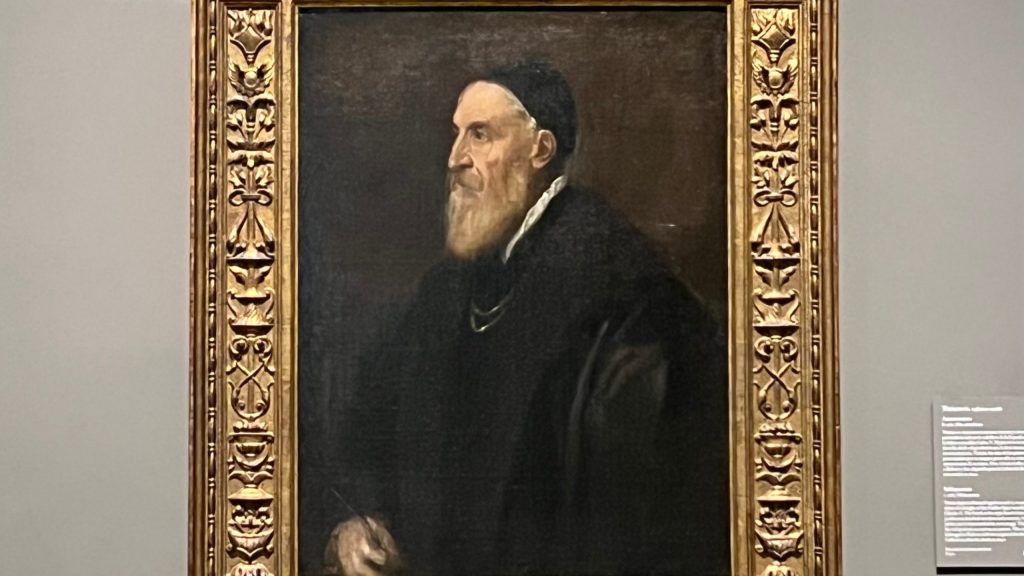
On August 27, 1576, Titian died in Venice, after a career that had made him one of the most admired artists in Europe. Born in Pieve di Cadore and trained in Venice’s extraordinary artistic environment, he worked for popes, princes, and some of the most powerful monarchs of the 16th century. His mastery of color and the evolution of his brushwork made him a major influence on generations of painters.
Among his most important patrons were Charles V, Mary of Hungary, and Philip II. This privileged relationship with the Habsburgs helps explain the exceptional presence of his works in the Prado Museum. But why did Titian become so famous? To mark the anniversary of his death, we explore his life and art through five essential facts about one of the greatest Venetian painters of the Renaissance.
In this article
1. Bellini, his master; Giorgione, his great influence
Before becoming one of the great names in European painting, Titian had to train in Venice’s extraordinary artistic scene. Born in Pieve di Cadore, probably sometime between the late 1480s and the beginning of the following decade, he arrived in the city at a very young age and came into contact with some of the leading Venetian painters of his time.
However, we should distinguish between two names that were fundamental during his youth. Giovanni Bellini was his master; Giorgione, his great influence. The former provided him with training within one of Venice’s most important pictorial traditions. The latter introduced him to some of the possibilities that this tradition was beginning to explore and that would prove essential to understanding the mature Titian.
Giovanni Bellini: the master
Giovanni Bellini was already one of the great painters of Venice when Titian began his training. His workshop occupied a central position in the city’s artistic life, and it was there that the young painter learned the technical and compositional foundations of his craft.
Bellini also belonged to a generation that had profoundly transformed Venetian painting. In contrast to a tradition in which drawing clearly defined forms, his paintings gave increasing importance to light, atmosphere, and chromatic relationships. Titian inherited this legacy and would eventually take it much further.
Giorgione: the great influence of his youth
The close artistic relationship between the two painters and Giorgione’s enormous influence on Titian’s early works are more than evident. They even worked together on the exterior decoration of the Fondaco dei Tedeschi in Venice in the early 16th century. Above all, this is where a word that will become fundamental to our story appears for the first time: color.
Color: the Venetian revolution of the 16th century
Giorgione was developing a way of painting in which color was no longer simply something used to fill forms previously defined by drawing. Tones, light, and shadow began to play a direct role in constructing figures, landscapes, and atmospheres. The young Titian was deeply influenced by this approach and would eventually turn color into one of the defining elements of his own painting.
We will not get too far ahead of ourselves, as we will return to color later in the article. For now, it is enough to emphasize something fundamental: Titian learned his craft from Giovanni Bellini, but found in Giorgione a decisive influence that helped him forge his own path. That path would ultimately transform European painting.
2. A revolution named “il colore”
We have already seen that color appeared very early in Titian’s artistic development, thanks in part to the influence of Giorgione. But what truly matters is what the painter subsequently did with that legacy. Throughout his long career, Titian turned color into one of his main tools for constructing forms, creating depth, representing light, and conveying the atmosphere of a scene.
This way of understanding painting was particularly characteristic of Venice. While the Florentine tradition placed extraordinary importance on drawing — disegno — Venetian painters developed an approach in which colorito played a fundamental role. It was not simply a matter of choosing brighter or more attractive colors: color itself participated in the construction of the image.
Disegno and colorito: two ways of understanding painting
The opposition between disegno and colorito became one of the great artistic debates of the Italian Renaissance. Broadly speaking, the former gave priority to drawing, contours, and the preliminary definition of figures; the latter placed greater emphasis on the application of color, tonal gradations, and the effects of light. The distinction, of course, was never absolute, but it helps us understand what made the Venetian school particularly innovative.
Titian became one of the greatest representatives of this tradition. In his paintings, forms do not always depend on a perfectly defined line separating them from their surroundings. The transition from light to shadow, the juxtaposition of different tones, and chromatic variations give volume to bodies and allow figures to become integrated into the space around them.
A brushwork that became increasingly free
This transformation becomes even more evident when we compare the young Titian with the artist of his final decades. Over the years, his brushwork became progressively looser and more visible. Surfaces no longer always displayed a uniform finish and instead began to be constructed through patches of color, glazes, and brushstrokes that could appear almost independent when viewed up close.
Yet when we step back, those brushstrokes come together before our eyes to create figures, fabrics, light, and space. This technical freedom was one of the aspects that most fascinated later generations of artists. Painters such as Velázquez, Rubens, and Rembrandt studied his work and found in Titian a way of painting that went far beyond the precision of the contour.
Color at the Prado Museum
The Prado Museum offers an exceptional opportunity to observe this evolution, as it houses one of the finest collections of Titian’s works in the world. Its paintings represent different stages of a career that spanned several decades, allowing us to see how the importance of color that Titian had first encountered in Giorgione’s Venice eventually developed into a completely personal artistic language.
For this reason, when we talk about color in Titian, we are not simply referring to an aesthetic characteristic. We are talking about a way of constructing a painting. The lesson that had begun with the great Venetian masters became, in Titian’s hands, one of his fundamental contributions to the history of art.
3. Became the painter of the Habsburgs
The venetian master’s prestige soon spread far beyond the borders of Venice. During the 16th century, his fame reached some of Europe’s leading courts, and he eventually established a particularly close relationship with a family that would shape much of his career: the Habsburgs. Among his most important patrons were Charles V, Mary of Hungary, and, later, Philip II.
This relationship was much more than a succession of commissions. The Habsburgs used portraiture as a powerful instrument of political representation and found in Titian an artist capable of creating an image of authority without sacrificing the individual personality of the sitter. At the same time, his connection with the dynasty led many of the Venetian painter’s works to enter the Spanish Royal Collections and, centuries later, the Prado Museum.
Charles V: an exceptional relationship between emperor and painter
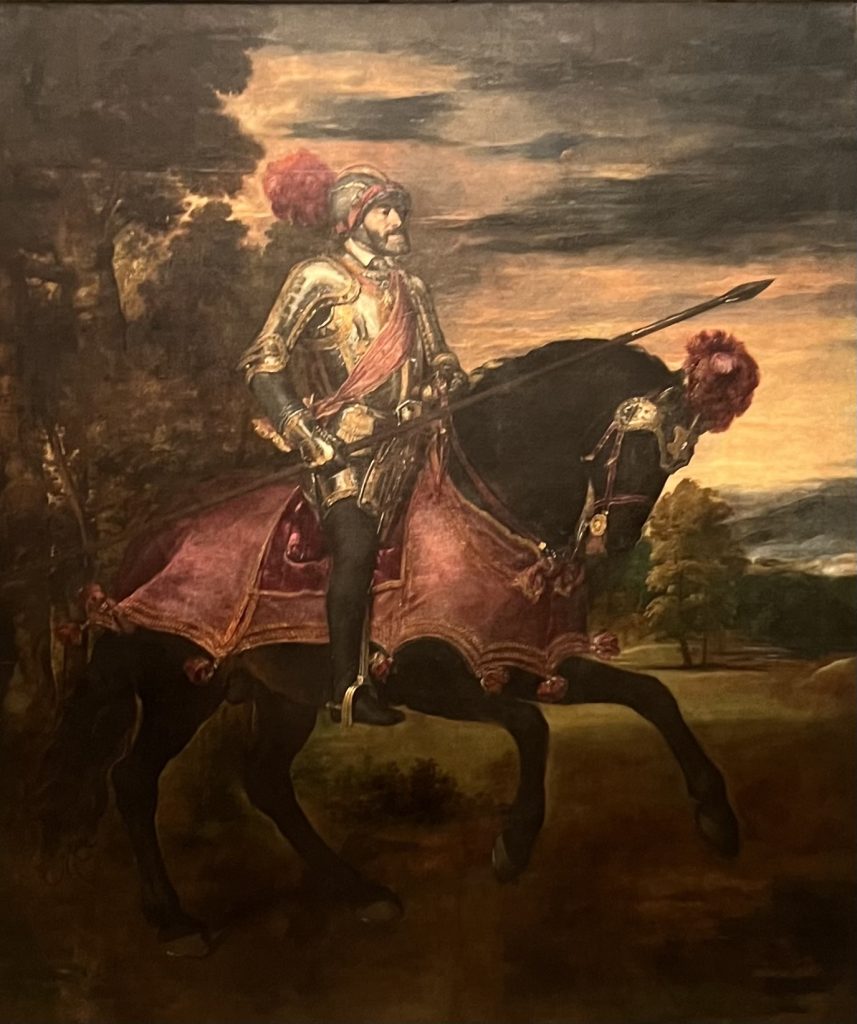
Titian met Charles V in Bologna in 1530, during the emperor’s journey to Italy to receive the imperial crown from Pope Clement VII. That encounter marked the beginning of a relationship that would last for years. Charles V repeatedly turned to the Venetian painter to shape his public image, and Titian eventually gained a privileged position among the artists associated with his court.
Their relationship produced some of the most important portraits of the Renaissance. Among them is Charles V at the Battle of Mühlberg, now in the Prado Museum. Titian depicts the emperor on horseback, wearing armor and advancing through a landscape shortly after his victory over the Schmalkaldic League in 1547. We are not simply looking at the portrait of a man: we are looking at a visual construction of imperial power.
Mary of Hungary: a great collector of Titian
But Charles V was not the only Habsburg who understood Titian’s importance. His sister Mary of Hungary, governor of the Netherlands, played a fundamental role as a collector and patron of the arts. For her palace at Binche, she commissioned an important cycle of works from the painter intended to celebrate the victories and power of the imperial family.
Mary also assembled an extraordinary collection that later passed to her nephew Philip II. Her role is essential to understanding how some of Titian’s works became linked to the collections of the Spanish monarchy. Charles V had found in the Venetian painter a magnificent creator of images of power; Mary of Hungary helped turn those images into part of the dynasty’s artistic heritage.
Philip II: Titian’s great patron during his mature years
Titian’s relationship with the Habsburgs continued with Philip II, who became one of the most important patrons of the painter’s mature career. Unlike the great imperial portraits produced for Charles V, a significant part of the commissions intended for the new monarch focused on religious and mythological subjects.
Their relationship was so close that Titian worked for Philip II from Venice for years, sending his paintings to the Spanish court. Among these works was one of the most extraordinary groups of his entire career: the so-called “Poesie”, a series of mythological paintings inspired primarily by Ovid’s Metamorphoses.
But we will return to them later. The “Poesie” deserve to be considered one of the five essential facts for understanding Titian in their own right, and they reveal just how far a relationship with the Habsburgs that had begun decades earlier with Charles V would eventually develop.
4. He transformed the portrait of power forever
Titian’s relationship with the Habsburgs leads us directly to another of his great contributions: his approach to the portrait of power. The Venetian painter did not invent court portraiture, but he took it to a new level. His sitters had to be recognizable as individuals while simultaneously conveying their political and social status.
To achieve this, Titian combined seemingly simple elements: posture, gaze, hands, clothing, and the objects surrounding the sitter. Nothing was entirely accidental. A column, a suit of armor, or a particular position of the body could help construct an image of authority without the need for an overtly propagandistic scene.
Charles V at Mühlberg: the image of the victorious emperor
The most spectacular example can once again be found at the Prado Museum. In Charles V at the Battle of Mühlberg, painted in 1548, Titian depicts the emperor after his victory over the Schmalkaldic League. Charles V appears in full armor on horseback, holding a long lance as he advances through the landscape.
However, Titian avoids depicting the battle itself. We see no defeated soldiers, corpses, or armies fighting one another. The entire force of the painting is concentrated on the solitary figure of the emperor. The horse, the armor, the lance, and Charles V’s posture create an image that combines individual portraiture with the exaltation of power.
Not every portrait of power needed a battle
Titian’s greatness as a portraitist becomes even clearer when we look at other images of Charles V. In Charles V with a Dog, also housed at the Prado Museum, the horse, armor, and landscape of Mühlberg disappear. The emperor is shown standing, accompanied only by a dog, yet his social status remains perfectly evident.
Titian could adapt his resources to the image he needed to create. On some occasions, he portrayed the ruler as a military victor; on others, as an aristocrat or sovereign. Portraiture thus ceased to be merely a reproduction of a person’s physical appearance and became a representation of their status, character, and authority.
A formula that would influence Velázquez
The importance of these portraits did not end with Titian’s death. Their presence in the Habsburg collections allowed later generations of Spanish painters to study them directly. Among them was Diego Velázquez, who found in the Venetian master a fundamental reference for developing his own court portraits.
The influence did not consist of copying a particular formula, but of understanding everything that could be expressed through portraiture. Titian had demonstrated that the image of a monarch could be solemn without appearing rigid and powerful without losing its human dimension. This way of representing power would become one of the great legacies he left to European painting.
5. “Le Poesie” turned mythology into painting
We have already mentioned the close relationship between Titian and Philip II, but one of its most fascinating chapters deserves a section of its own. During the 1550s, the painter began creating a series of large mythological compositions for the future king of Spain, which he himself called “Poesie.” The name was no coincidence: Titian conceived these works as the pictorial equivalent of poetry, images in which he could explore the nude, landscape, movement, color, and human passions with extraordinary freedom.
Their main literary source was Ovid’s Metamorphoses, one of the fundamental texts in the Renaissance rediscovery of classical mythology. Titian, however, did not simply illustrate the Roman poet’s stories. He selected moments of extraordinary dramatic intensity and transformed them through his own pictorial language.
Six paintings for Philip II
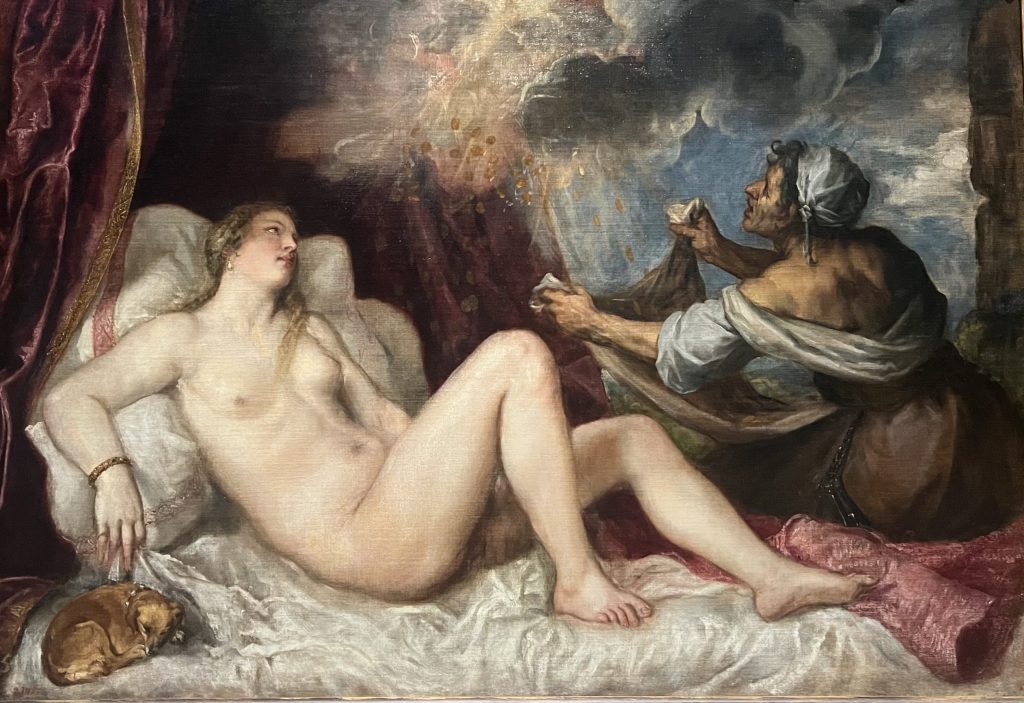
The series consisted of six major compositions: Danaë, Venus and Adonis, Perseus and Andromeda, Diana and Actaeon, Diana and Callisto, and The Rape of Europa. All were created for Philip II, although over the centuries they eventually became dispersed among different collections and museums.
The stories Titian chose allowed him to explore very different themes: desire, violence, transformation, punishment, love, and death. They also gave him the opportunity to represent the human body from different points of view. Titian himself explained to Philip II that some of these compositions were conceived to show figures from different perspectives, as though the paintings could enter into dialogue with one another.
Danaë and Venus and Adonis at the Prado
Two works closely associated with this project can be seen today at the Prado. In Danaë, Titian depicts the episode in which Jupiter reaches the young woman transformed into a shower of gold. Danaë’s nude body, the light, and the richness of the surfaces reveal the extent to which color could become a protagonist in the composition.
In Venus and Adonis, the painter chose an especially dramatic moment. Venus tries to prevent Adonis from leaving to hunt because she knows the danger that awaits him, while he pulls away from the goddess. Titian does not simply depict a mythological episode: he transforms the moment into a scene dominated by the tension between desire, movement, and tragedy.
Mythology, poetry, and pictorial freedom
The “Poesie” bring together many of the characteristics we have encountered throughout this article. We find the color that Titian learned and developed within the tradition of Venice, his increasingly free brushwork, and his privileged relationship with the Habsburgs. But we also encounter a painter capable of engaging with classical antiquity without merely reproducing it.
Titian transformed Ovid’s stories into deeply personal images and demonstrated that a painting could aspire to the same expressive freedom as a poem. That is why he called these works “Poesie.” And that is why, almost five centuries later, they remain one of the fundamental chapters of his career.
Bonus Track: Tiziano, Titian, Titien… why does his name change?
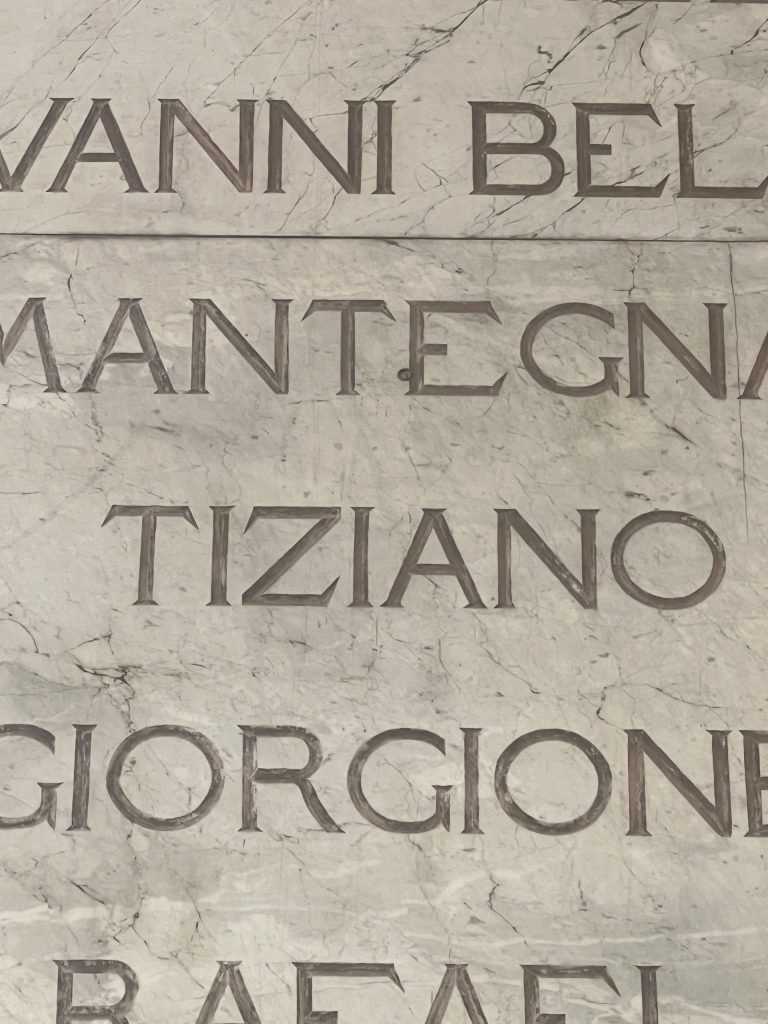
If you have read about Titian in different languages, you may have noticed something curious: his name changes. In Italian and Spanish, he is known as Tiziano, although the name is not pronounced in the same way in both languages. In English, he becomes Titian, while in French he is Titien. All of these names, of course, refer to the same man: Tiziano Vecellio.
The explanation is quite simple. For centuries, it was common to adapt the names of historical figures into different European languages, particularly when they were internationally renowned. We do the same with monarchs, popes, and other artists: Carlos V becomes Charles V in English and Charles Quint in French, while Rafael becomes Raphael in English and Raphaël in French.
Spanish and Italian: same spelling, different pronunciation
The most amusing case is probably the Spanish and Italian one. Tiziano is spelled exactly the same way in Italian and Spanish, but an Italian and a Spanish speaker would not pronounce his name in the same way. The main difference lies in the sound of the letter combination “zi”, which has a different pronunciation in Italian from the one a Spanish speaker would naturally use.
So, if you visit a museum in London and read Titian, come across Titien in a French text, or hear Tiziano during a guided tour in Madrid, there are not three different Venetian painters hiding behind those names. They all lead back to the same artist from Pieve di Cadore who became one of the fundamental figures in European painting.
Discover Titian at the Prado Museum 🎨
Would you like to discover Titian in front of his paintings? The Prado Museum houses one of the finest collections of works by the Venetian painter in the world, allowing us to explore his relationship with Charles V and Philip II, understand his revolution in the use of color, and see the enormous influence he had on later artists. With The Guides You Need, you can discover these stories accompanied by a professional guide and in a small group.
🎟️ Admission to the Prado Museum included in the price.
⚡ We purchase tickets in advance so you can “skip the line” (but we recommend reading our article on what this really means — click here!).
👥 Small groups of no more than 7 people.
🗣️ Tours available in English, Spanish, French, and Italian.
🎨 Professional guides specialized in art and history.
📍 Meeting point next to the Goya statue, opposite the Museum’s ticket offices.
❤️ No memorized scripts: we want you to ask questions, participate, and enjoy the museum.