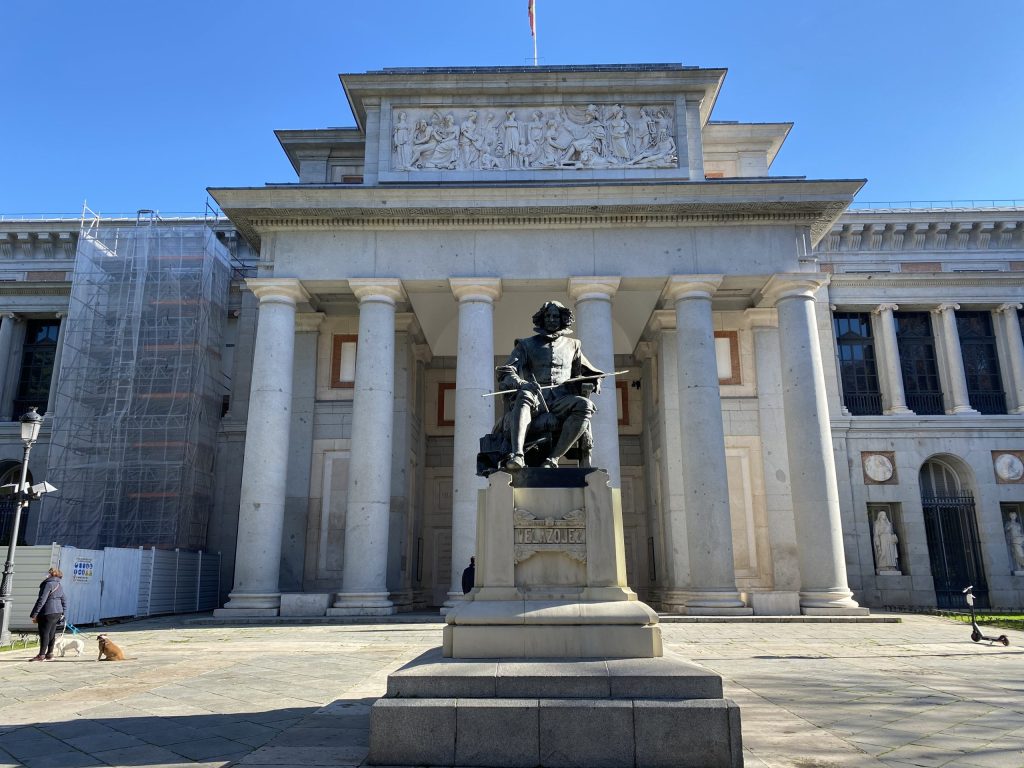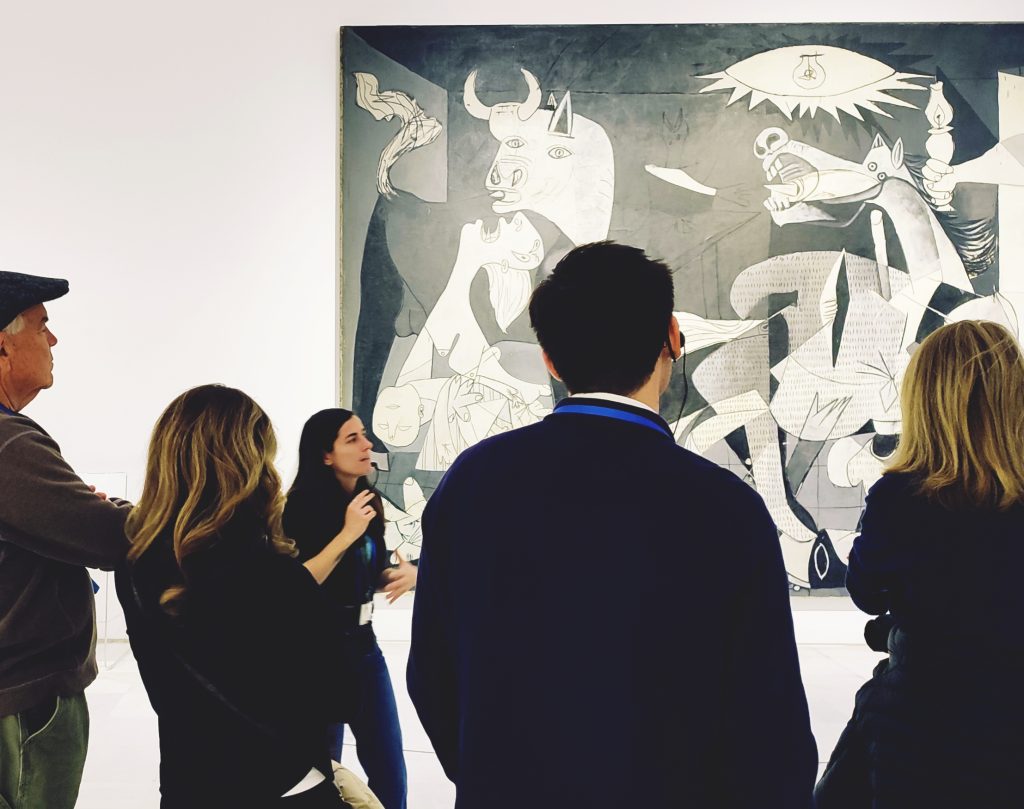
When people think about Madrid’s Landscape of Light, three names usually come to mind: the Prado, the Reina Sofía and the Thyssen Museum. It’s hardly surprising. Together, they house some of the finest art collections in the world and have turned this corner of Madrid into an essential destination for anyone interested in art and culture.
However, the Landscape of Light is much more than a group of museums. Declared a UNESCO World Heritage Site in 2021, this historic urban axis tells a large part of Spain’s story. Here you’ll find buildings that once represented the country’s financial power, institutions dedicated to protecting and studying the Spanish language, monuments closely linked to the monarchy, and remarkable examples of civil architecture that, unfortunately, many visitors simply walk past without noticing.
The surprising part is that several of these buildings stand just a few metres from Madrid’s most visited museums. Every day, thousands of people walk past their façades without stopping to wonder what they were built for, who designed them, or why they remain so important today. That’s a real shame, because discovering them is one of the best ways to understand how Madrid has evolved over the last five centuries.
In this article, we’d like to show you a different side of this remarkable UNESCO site. For a moment, we’ll leave the museum galleries behind and stop in front of five fascinating buildings that also form part of its history and will probably surprise you just as much as the masterpieces displayed inside the city’s great museums.
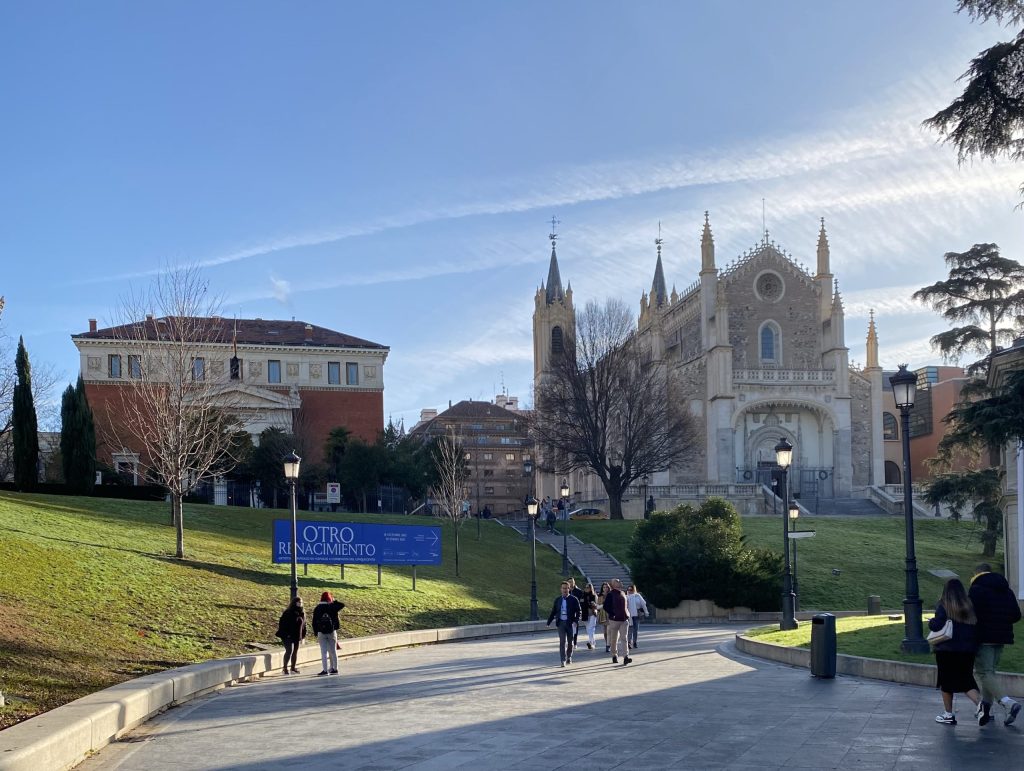
In this article
1. The Palacio de Comunicaciones: the Cathedral of Communications
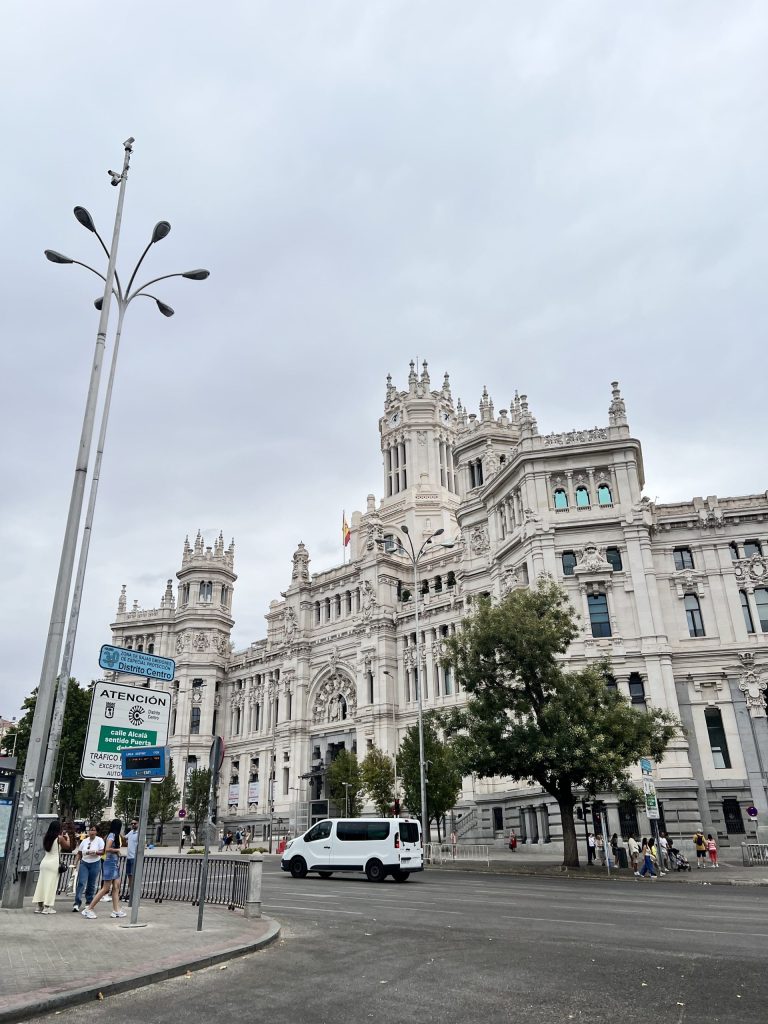
If we had to choose the most spectacular building in Madrid’s Landscape of Light, the Palacio de Comunicaciones would undoubtedly be one of the strongest candidates. Its dazzling white façade, elegant towers and extraordinary decorative detail lead many visitors to believe, at first glance, that they are looking at a royal palace—or even a cathedral. Curiously enough, it was never built for either purpose.
The building was designed at the beginning of the twentieth century as the headquarters of Spain’s Postal and Telegraph Service, at a time when communications were transforming the world. Letters, telegrams and parcels were travelling faster than ever before, and Spain needed a building capable of handling this enormous volume of correspondence. To achieve that goal, a competition was held and won by architects Antonio Palacios and Joaquín Otamendi, who went on to create one of the defining landmarks of modern Madrid.
When it was inaugurated in 1919, the building immediately became the subject of intense debate. Not everyone admired it. Some criticised its enormous cost, while others considered it far too monumental for what was, after all, a post office. Time, however, proved its critics wrong. Today, the Palacio de Comunicaciones is regarded as one of Madrid’s greatest architectural icons and one of Antonio Palacios’ greatest works.
Its architectural style is remarkably difficult to define. It combines Neo-Plateresque, Gothic Revival and Modernist influences with the monumental architecture that characterised the early twentieth century. That unique blend explains why it quickly earned a nickname that is still widely used today: the Cathedral of Communications.
Since 2007, the building has housed Madrid City Hall, while preserving much of its original appearance. It is also home to CentroCentro, a cultural venue dedicated to exhibitions and artistic events, as well as one of the city’s finest viewpoints. From the rooftop terrace, visitors can enjoy spectacular views over the Landscape of Light, El Retiro Park, Cibeles Fountain and much of Madrid’s historic centre.
There’s one more detail that often goes unnoticed. In many ways, the Palacio de Comunicaciones marks the northern gateway to the Landscape of Light. From here, it takes just a few minutes on foot to reach the Bank of Spain, the Casón del Buen Retiro, the Royal Spanish Academy and the Monastery of San Jerónimo el Real—five buildings that, together, have shaped Madrid’s political, cultural and artistic history for centuries.
2. The Bank of Spain: the Gold of the Landscape of Light
Few institutions spark as much curiosity as the Bank of Spain. It’s easy to see why. Standing beside Cibeles Fountain, it occupies one of Madrid’s most iconic locations and has become even more famous in recent years thanks to film and television. Its history, however, began long before anyone imagined daring heists or legendary vaults.
A Building for a Nation’s Economy
The Bank of Spain was founded in 1856, although the headquarters we see today came later. As the institution grew in importance, it needed a building worthy of its central role in the country’s economy. Few locations could have been more appropriate than the northern end of the Landscape of Light, where the Paseo del Prado, Paseo de Recoletos and Calle de Alcalá converge.
Construction began in 1884 under the supervision of architects Eduardo Adaro and Severiano Sainz de la Lastra. Seven years later, in 1891, the building was officially inaugurated by the young King Alfonso XIII, who was just five years old, accompanied by his mother, Queen Regent María Cristina of Habsburg-Lorraine, who served as Regent until her son came of age.
Over the following decades, the building was expanded to meet the needs of an increasingly complex institution, while preserving the monumental character of the original design. Its architecture conveys exactly what it was intended to represent: stability, strength and confidence. Unlike the exuberant Palacio de Comunicaciones nearby, the Bank of Spain embraces a more restrained style, characterised by imposing stone façades and elegant decoration that never feels excessive.
For decades, many of Spain’s most important economic decisions were made within these walls. This was where the Spanish peseta was issued, the nation’s gold reserves were safeguarded, and much of the country’s financial system was coordinated. Today, the Bank remains a key member of the European System of Central Banks and continues to play a fundamental role in Spain’s economy.
The Vault: A Legend Rooted in Reality
It’s impossible to talk about the Bank of Spain without someone mentioning its famous vault. Without question, it is one of the best-known stories associated with the Landscape of Light. According to the legend, the vault can be flooded with water from the nearby Cibeles Fountain to protect its contents in the event of an attempted robbery.
Although many details of the Bank’s security systems have never been officially confirmed, the legend is rooted in reality. Even so, reducing the Bank of Spain to its vault would mean overlooking more than a century of history. Its true importance lies in the role it has played as one of the Spanish state’s most important institutions.
Was Money Heist Filmed Here?
In short: No.
Although the Bank of Spain is the main setting for the final seasons of Money Heist (La Casa de Papel), neither the scenes set inside the Bank of Spain nor those inside the Royal Mint were filmed in the real buildings. As is often the case in film and television, the exterior belongs to one location, while the interiors are recreated on sound stages or in completely different buildings.
That may come as a slight disappointment to fans of the series, but it also demonstrates the remarkable power of fiction. Every year, thousands of visitors stop outside the Bank of Spain because of Money Heist, only to discover a building whose real history is even more fascinating than any fictional heist. Standing in front of its impressive façade is enough to understand why the Bank of Spain remains one of the most important institutional buildings in modern Madrid.
3. The Casón del Buen Retiro: the Last Surviving Witness of a Lost Palace
Of all the buildings that form part of Madrid’s Landscape of Light, the Casón del Buen Retiro is probably the one most visitors overlook. Most people walk past it on their way to the Prado Museum without giving it much thought. That’s a shame, because behind its elegant façade stands one of the last surviving reminders of what was once one of Europe’s most spectacular palaces.
Today, it’s hard to imagine, but during the seventeenth century this area was occupied by the Royal Palace of Buen Retiro, an enormous royal residence built during the reign of Philip IV at the initiative of the Count-Duke of Olivares. Unlike Madrid’s old Alcázar—located where the Royal Palace stands today—the Buen Retiro was never intended to serve as the official royal residence. Instead, it was conceived as a place for leisure, entertainment and a showcase for the power of the Spanish Monarchy. Today, the Casón is one of the very few architectural remains of that extraordinary palace still standing within the Landscape of Light.
The Great Palace of Buen Retiro
Talking about the Palace of Buen Retiro is like talking about a city within a city. The complex covered hundreds of thousands of square metres and included gardens, ponds, hermitages, courtyards, theatres, reception halls and dozens of auxiliary buildings. What we now know as El Retiro Park was once nothing more than the gardens of this vast royal residence. Just imagine how enormous the palace must have been if today’s park was only its garden. Unsurprisingly, El Retiro has become one of the defining landmarks of the Landscape of Light.
The palace was the setting for theatrical performances, diplomatic receptions, masked balls and even naumachiae—spectacular mock naval battles staged on the large pond that still survives in the park today. The aim was simple: to impress foreign ambassadors and demonstrate that the Spanish Monarchy remained one of Europe’s great powers.
Unfortunately, very little of this magnificent complex has survived. During the Peninsular War, Napoleon’s troops occupied the palace and used it for military purposes, causing extensive damage. After the conflict, much of the complex had deteriorated so badly that it was demolished during the nineteenth century.
That is precisely why the Casón is of such extraordinary historical importance. Together with the Hall of Realms (Salón de Reinos), it is one of only two surviving buildings from the former Palace of Buen Retiro. If you ever get the chance to study old plans or photographs of the archaeological excavations carried out in the area, you’ll begin to appreciate the true scale of a palace that has almost entirely disappeared from Madrid’s landscape.
From Ballroom to Research Centre
As you can probably imagine, the masterpieces of the Landscape of Light are not kept here—that is, after all, the Prado Museum’s role. Nor was the Casón originally intended to display works of art. Instead, it served as a magnificent ballroom and hosted some of the most important celebrations held by the court of Philip IV.
Inside, visitors can admire one of the great artistic treasures of both the Landscape of Light and the Spanish Baroque: the spectacular ceiling fresco painted by Luca Giordano, depicting the Allegory of the Golden Fleece. All you have to do is look up to understand why the Neapolitan master was considered one of the greatest painters of his age. The extraordinary sense of depth, the movement of the figures and the mastery of perspective transform the ceiling into a genuine masterpiece.
Today, the Casón forms part of the Prado Museum, housing its Centre for Studies as well as one of Europe’s most important libraries specialising in the history of art.
It may not be the most photographed building in the Landscape of Light, but it is undoubtedly one of the most significant for understanding what Madrid looked like during the reign of the Habsburgs. While thousands of visitors explore the Prado Museum or stroll through El Retiro every day, the Casón still reminds us that, long before Madrid became famous for its museums, this was the place where the Spanish Monarchy sought to build one of the most magnificent palaces in Europe.
4. The Royal Spanish Academy: Where Words Live
There is a building in Madrid’s Landscape of Light that thousands of people walk past every day without ever wondering what happens inside. It is one of those places overshadowed by its famous neighbours—in this case, the Prado Museum and the Monastery of San Jerónimo el Real. Yet it is one of Madrid’s most beautiful buildings and, without question, one of its most influential. We are, of course, talking about the Royal Spanish Academy.
Here, in the Landscape of Light, the Spanish language is studied, documented and its evolution carefully recorded. Today, Spanish is spoken by nearly 600 million people, making it one of the most widely spoken languages in the world. That is an enormous responsibility, yet most people summarise the Academy’s work with a phrase we’ve all heard at some point: “The RAE decides how we should speak.” The truth, however, is a little more nuanced.
Does the RAE Decide How Spanish Is Spoken?
The answer is simple: no. People do not come to the Landscape of Light to decide how Spanish should be spoken.
Although many people believe that the Royal Spanish Academy invents new words or decides which ones are correct and which are not, its role is quite different. The Academy observes how the language evolves, studies the way people actually use Spanish and, based on that evidence, produces essential reference works such as the Dictionary of the Spanish Language, the Official Orthography and the Grammar of the Spanish Language.
In other words, it is usually not the RAE that changes the language—it is the speakers themselves. When a word or expression has been widely used for many years and its usage is sufficiently documented, the Academy may incorporate it into its official publications. That is why Spanish continues to evolve while maintaining a common set of rules that allows people from Madrid to Buenos Aires, via Mexico City, Bogotá and Lima, to understand one another.
A Building with a Long History
The Royal Spanish Academy was founded in 1713 by Juan Manuel Fernández Pacheco, Marquis of Villena, following the example of other European institutions such as the Académie Française. At the time, however, its headquarters were not located in the Landscape of Light.
The building we see today was inaugurated in 1894 by Queen Regent María Cristina of Habsburg-Lorraine, just three years after she had presided over the inauguration of the Bank of Spain. Its location could hardly be more fitting: just a short walk from the Prado Museum, the Casón del Buen Retiro and the other landmarks that make the Landscape of Light one of Europe’s most remarkable cultural districts.
Its architecture reflects the monumental taste of the late nineteenth century without competing for attention with the surrounding buildings. In many ways, the Academy represents exactly what it was designed to express. Together with the Bank of Spain, it is one of the most restrained, elegant and perfectly balanced buildings in the Landscape of Light.
Spain’s Most Famous Seats
Perhaps the Academy’s most fascinating tradition concerns its seats. Unlike most institutions, its members do not occupy numbered chairs. Instead, each academic is assigned a letter of the alphabet, either uppercase or lowercase. When an academic dies, that letter becomes vacant until a new member is elected to occupy it.
Some of the greatest names in Spanish literature and culture have occupied these seats over the centuries. Benito Pérez Galdós, Ramón Menéndez Pidal, Camilo José Cela, Miguel Delibes and Carmen Iglesias are just a few of the scholars who have helped study, preserve and enrich the Spanish language. Every newly elected member must deliver an inaugural speech, a tradition that continues today and remains one of Spain’s most important cultural ceremonies.
The next time you walk past this building in the Landscape of Light, you may see it differently. Behind its walls, the history of a language shared by hundreds of millions of people is studied, documented and debated every day. Not bad for a building that so many visitors pass without even looking up.

5. The Monastery of San Jerónimo el Real: Five Centuries Watching Over the Landscape of Light
If the Bank of Spain represents economic power and the Royal Spanish Academy symbolises the strength of the Spanish language, the Monastery of San Jerónimo el Real reminds us of the historical origins of the Landscape of Light. In fact, it is the oldest of the five buildings featured in this article and one of the few places that allows us to travel back to Madrid in 1503. At that time, not only did the Landscape of Light not exist—there was virtually nothing here at all. To put that into perspective, the Puerta de Alcalá, now one of the defining landmarks of the Landscape of Light, would not be inaugurated until almost three centuries later.
The Monastery of the Catholic Monarchs
The monastery was founded by the Catholic Monarchs in 1503. In that time, there was nothing around it. Centuries would pass until the Landscape of Light added one of its very emblems: Alcala’s Gate!
Its church was built in the Late Gothic style, which can still be admired today in its elegant buttresses, tall windows and restrained façade. Unlike many of Madrid’s historic churches, San Jerónimo el Real has preserved much of its original character, making it one of the finest examples of Gothic architecture in the Spanish capital.
For centuries, the monastery was one of the Royal Family’s preferred places for attending religious ceremonies. It was also the setting for the last royal wedding held in this historic building of the Landscape of Light: the marriage of King Alfonso XIII—who has appeared several times throughout this article—to Victoria Eugenie of Battenberg. Better known as Ena, she became one of the best-known queens in modern Spanish history, inspiring songs and even a television series. Together, they remain one of the most famous royal couples associated with the Landscape of Light.
Where the Princes of Asturias Took Their Oath
There is another tradition that very few Landscape of Light’s visitors know about. Throughout much of the Early Modern period, the Princes of Asturias took their oath here as heirs to the Spanish Crown. That means this monastery witnessed some of the kingdom’s most significant political ceremonies, long before Madrid acquired many of the buildings we now associate with the institutions of the Spanish state.
Like many landmarks in the Landscape of Light, the monastery suffered extensive damage during the Peninsular War and later during the nineteenth-century confiscations of Church property. Much of the original monastic complex disappeared, although the church itself survived and was gradually restored over the years.
The Prado Extension: A Dialogue Across Five Centuries
Today, most visitors associate the monastery with its close relationship to the Prado Museum. When architect Rafael Moneo designed the museum’s extension, he chose to incorporate the monastery’s former cloister into the new building. The project transformed the Landscape of Light as we know it today.
That decision brought together two buildings separated by more than two centuries of history. On one side stands Juan de Villanueva’s neoclassical masterpiece; on the other, a monastery whose origins date back to the reign of the Catholic Monarchs. The result is widely regarded as one of the most elegant architectural interventions carried out in Madrid in recent decades.
Every day, countless visitors walk through the Cloister of San Jerónimo without realising that they are crossing one of the city’s most historically significant spaces. That is precisely what makes the Landscape of Light so special: its ability to bring together buildings from completely different periods while allowing each to retain its own identity.
The next time you pass the Monastery of San Jerónimo el Real, take a moment to imagine everything it has witnessed. It has seen the construction of the Palace of Buen Retiro, the arrival of the Bourbon dynasty, the Peninsular War, the birth of the Prado Museum and Madrid’s transformation into one of Europe’s great capitals. Few monuments can claim to have accompanied a city for more than five hundred years.
Discover the Landscape of Light with The Guides You Need
Exploring the Landscape of Light is about far more than visiting some of the world’s finest museums. It is about discovering how art, science, economics, architecture and Spanish history come together within just a few hundred metres. As you’ve seen throughout this article, many of its buildings hide fascinating stories that most visitors never get to hear.
At The Guides You Need, we help visitors uncover that hidden history while exploring the great museums of the Landscape of Light. We currently offer guided tours of the Prado Museum, the Reina Sofía Museum and the Thyssen-Bornemisza Museum, led by expert guides who have spent years sharing their passion and knowledge with travellers from around the world.
Here are a few things that make our tours different:
- 👥 Small groups: we keep our tours to a maximum of six guests, creating a relaxed, interactive and personal experience.
- 🎟️ Museum tickets included: we purchase your tickets in advance, so you don’t have to worry about a thing.
- 🎨 Experienced guides: our guides know the collections inside out and love bringing to life the stories behind every masterpiece and every building.
- 🌍 Tours in several languages: we offer tours in Spanish, English, Italian and French (French tours require a little more advance notice).
If you’d like to discover the Landscape of Light from a different perspective, we’d love to show you around. See you in Madrid!