If you’re wondering what to see at the Royal Palace, you’ve probably come across photographs of its grand rooms, impressive chandeliers and spectacular wall decorations. However, surrounded by so much splendour, it’s easy to overlook some of the objects that help us better understand the history of the building and the people who once lived there.
The Palace is much more than a collection of monumental rooms. Inside, you’ll find paintings, sculptures, musical instruments, clocks and symbols of the Spanish monarchy that are well worth stopping to look at. Some belonged to the kings who lived here, while others remain connected to the Spanish Crown and bring the story right up to the present day.
In this article
Frequently Asked Questions Before Visiting the Royal Palace
What is there to see at the Royal Palace?
A lot. During your visit, you’ll walk through some of the most important spaces in the building, including the Grand Staircase, the Throne Room, the Gasparini Room and the Gala Dining Room. You’ll also find paintings, sculptures, tapestries, furniture, musical instruments, clocks and countless objects connected to the history of the Spanish monarchy.
In this article, we’re going to focus on five particularly interesting objects or groups of objects: the Royal Crown, the sculptures in the Throne Room, the clocks from the Royal Collections, Antonio López’s portrait of the Royal Family and the extraordinary Stradivarius instruments kept at the Palace.
Is the Royal Palace worth visiting?
Yes. The exterior gives you an idea of the sheer size of the building, but much of what makes the Palace exceptional is inside. Its rooms preserve their decoration, works of art and countless objects that help us understand court life and the way royal power was represented throughout Spanish history.
And this isn’t a historic building that has completely lost its original purpose. The Palace is still used for receptions, ceremonies and other official events involving the Spanish monarchy. Visiting it therefore means stepping inside a historic building that still plays an institutional role today.
Is a guided tour of the Royal Palace worth it?
Yes, particularly because it’s very easy to be overwhelmed by the splendour of the rooms and miss the stories behind them. A guided tour helps you understand what each space was used for, who used it and what lies behind many of the paintings, sculptures, pieces of furniture and other objects you encounter along the way.
That’s one of the biggest differences between simply looking and actually understanding what you’re seeing. A clock, a sculpture or a crown may be beautiful in its own right, but knowing who commissioned it, what it was used for or what it represents can completely change the way you look at it. The five objects in this article are perfect examples of just how much history can be hidden in plain sight.
How long does it take to visit the Royal Palace?
It depends on how you visit. If you explore the Palace on your own, the amount of time you need will depend on how long you want to spend in each room and looking at the different objects on display. It’s worth taking your time: there’s much more to see than just the grandest rooms.
For tourist groups, guided tours cannot last longer than 90 minutes. These are the rules established by Patrimonio Nacional, the public institution responsible for managing and preserving the Palace. A good guided tour is therefore also about knowing what to focus on: 90 minutes is enough to explore the essential rooms and spend time on the objects and stories that really deserve an explanation.
Is the Royal Palace the official residence of the King of Spain?
Yes, but he doesn’t live there. The Royal Palace is the official residence of the King of Spain, although the Royal Family actually lives at the Zarzuela Palace. The building we’re visiting is mainly reserved for ceremonies, receptions and other official events.
As we explained in a previous article about the Royal Palace (click here!), Zarzuela is where the Royal Family has its usual residence. Don’t worry about them, though: the Palace is pretty nice.
Correct. The structure should be:
What to See at the Royal Palace: The 5 Objects That Will Drive You Mad!
1. The Royal Crown: a Crown No King Actually Wears
Among everything you can see at the Palace, few objects seem to represent the monarchy better than the Royal Crown. There is, however, something worth clarifying as soon as you see it: this is not a crown that Spanish kings place on their heads during a coronation.
In fact, Spain does not currently have a coronation ceremony comparable to the British one. The Crown displayed at the Palace has a primarily symbolic and ceremonial role. Together with the sceptre, it represents royal authority and appears at some of the most solemn events involving the Spanish monarchy.
An 18th-Century Crown
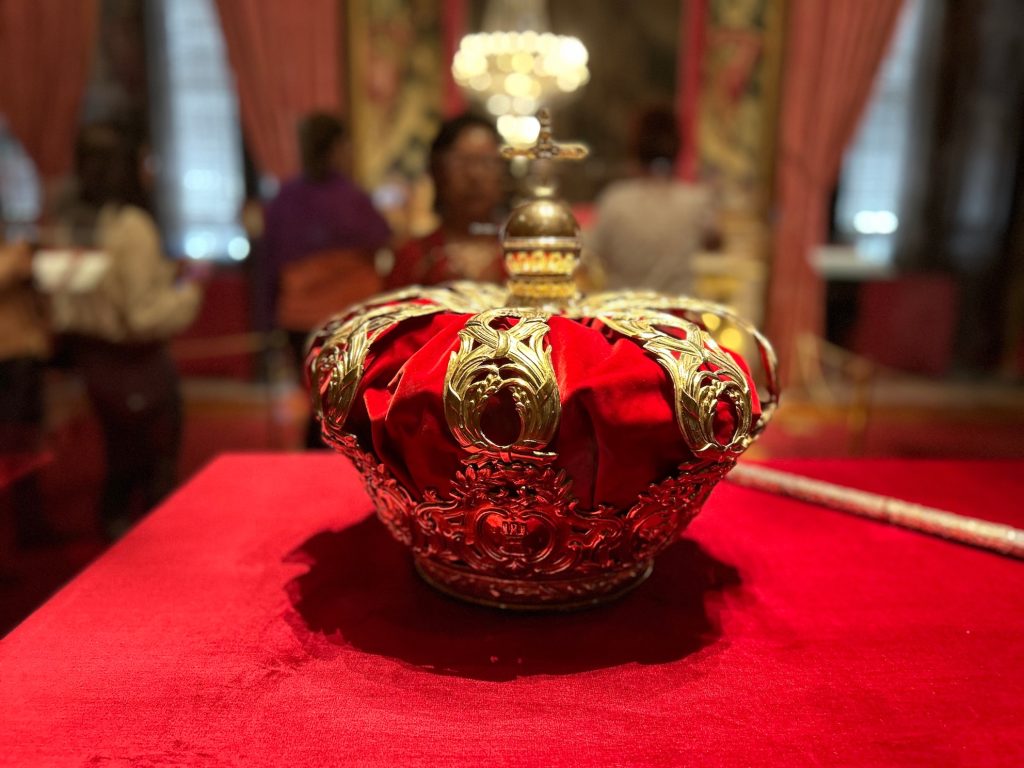
The Crown was made in 1775 by the silversmith Fernando Velasco, during the reign of Charles III. It is made of gilded silver and consists of a circlet decorated with eight floral ornaments, with arches rising above them and meeting beneath an orb topped by a cross.
Its appearance may come as a surprise if you’re expecting a crown covered in diamonds, rubies and other precious stones. Here, the craftsmanship of the silver and the shape of the object itself take centre stage. Its importance comes less from the value of its materials than from what it represents.
The Crown and the Sceptre
The Crown is displayed alongside the Royal Sceptre, a considerably older object. Dating from the 17th century, the sceptre is made from several materials, including rock crystal, gilded silver and enamel. Together, the two objects form what are known as the Spanish Crown Jewels.
Despite the name, don’t expect anything quite like the enormous collection of Crown Jewels in Britain. Spain’s case is rather different: the Crown and sceptre are the main historic objects that fulfil this symbolic role.
An Object That Still Has a Purpose
Perhaps the most interesting thing about the Crown is that we’re not simply looking at a historic object sitting in a display case. It still plays a role in some of the most important ceremonies of the Spanish monarchy, connecting an object made in the 18th century with the institution today.
For example, the Crown and sceptre were present at the proclamation of Felipe VI in 2014, displayed before the members of the Spanish Parliament. The King did not wear the Crown on his head; instead, it was placed there as a symbol of the institution he had just assumed.
That makes it a particularly interesting object to stop and look at during your visit. Made during the reign of Charles III, it has survived political upheavals, republics and restorations and, more than two centuries later, still performs a ceremonial function. Not bad for a crown that no king actually wears.
2. The Lions in the Throne Room: Velázquez Didn’t Just Buy Paintings
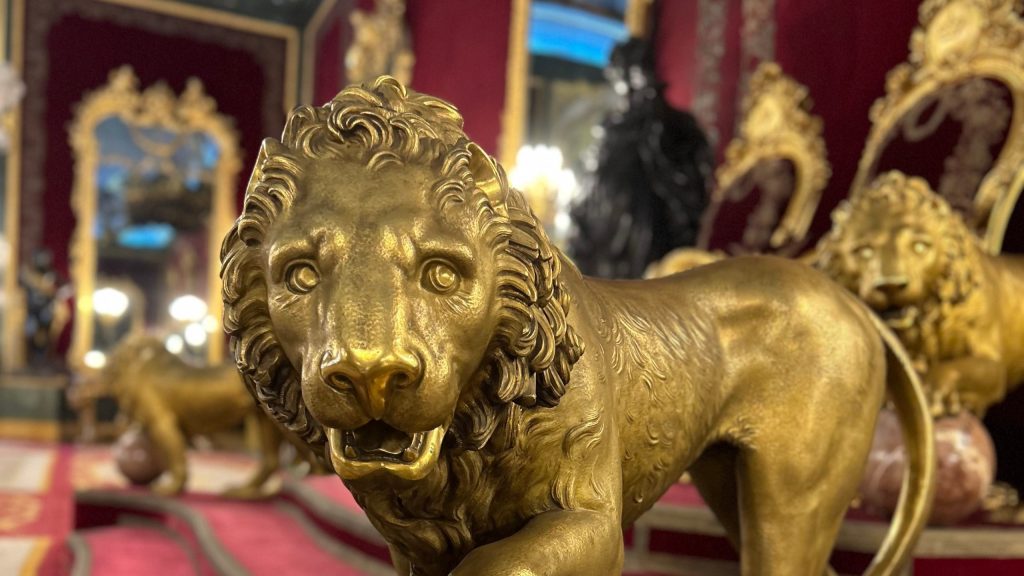
When you enter the Throne Room, there is plenty competing for your attention. You have the thrones, the red velvet covering the walls and, above your head, Tiepolo’s The Triumph of the Spanish Monarchy. But this time, we want you to look down. Around the thrones are several gilded bronze lions with a far more interesting story than you might expect.
To understand it, we need to leave the Palace for a moment and travel back to 17th-century Rome. And, curiously enough, our travelling companion is someone you probably already know very well: Diego Velázquez.
Velázquez Goes Shopping in Italy
In 1649, during his second journey to Italy, Velázquez did not travel simply as a painter. As we explained in this article (click here!), Velázquez was sent to Italy to acquire works of art and obtain sculptures and casts of some of the great masterpieces of Antiquity, which were intended to decorate Philip IV’s royal residences.
Not everything could simply be purchased and shipped to Madrid. An important part of the mission therefore involved obtaining moulds and producing copies of celebrated sculptures. Velázquez worked with artists and bronze founders in Rome, overseeing a project that would bring some of the most prestigious forms of classical sculpture to the Spanish court. Among the pieces connected with this project were the lions that we can now see in the Throne Room.
Lions Older Than the Palace
There is another detail that makes these sculptures particularly interesting: the lions were already in Madrid long before the present Palace existed. Their original destination was the old Habsburg Alcázar, the royal residence that once stood on this very site.
There, they were used in the Pieza Ochavada, one of the spaces created during the reign of Philip IV to display part of the Royal Collections. The Alcázar was destroyed by the devastating fire of Christmas Eve 1734, and the present Palace began to rise on the same site a few years later.
The lions survived the disappearance of the Alcázar and eventually found a place in the new building. So, when you stop in front of them, you are looking at objects that directly connect the Bourbon Palace we see today with the earlier Habsburg residence.
Why Are There Lions Next to the Throne?
Their current location could hardly be more appropriate. Since Antiquity, the lion has been associated with ideas such as strength, power and authority. Placing these animals around the space reserved for the monarch helped reinforce the message conveyed by the entire room.
Almost nothing in the Throne Room is there by accident. Charles III entrusted its decoration to Felice Gazzola, who conceived a setting designed to represent and glorify the Spanish monarchy. Sculptures created more than a century earlier could fit perfectly into this new visual programme.
So, when you enter the Throne Room, don’t look only at the thrones or Tiepolo’s enormous fresco. Take a moment to look down as well. Those lions take us back to Philip IV, Velázquez’s Italian journey and a royal palace that disappeared centuries ago. The building and the dynasty changed, but the lions are still there.
3. The Palace Clocks: When Telling Time Becomes an Art
Once you start paying attention to the clocks during your visit, you’ll probably notice that they seem to be everywhere. That is no coincidence. The Royal Collections contain an extraordinary collection of clocks assembled by Spanish monarchs over several centuries, with pieces dating from the late 16th to the early 20th century.
And don’t think of them simply as objects designed to tell the time. Some incorporate music, automata or complex astronomical mechanisms, while others are surrounded by sculptures and scenes inspired by Antiquity. Several pieces also contain mythological references to the passage of time, including Cronus, identified with the Roman Saturn and traditionally associated with time itself.
Charles IV, the Clockmaker King
The Spanish monarchy’s fascination with clocks began long before Charles IV, but it reached a particularly interesting point during his reign. The king had a special interest in mechanical arts and acquired numerous pieces for the royal residences, earning him a rather appropriate nickname: the Clockmaker King.
Some of Europe’s most prestigious clockmakers were represented at the Spanish court. Among them was Abraham-Louis Breguet, one of the greatest names in the history of watchmaking and the creator of a piece that deserves particular attention during your visit: the Atlas.
Atlas: a Clock with the Solar System Inside
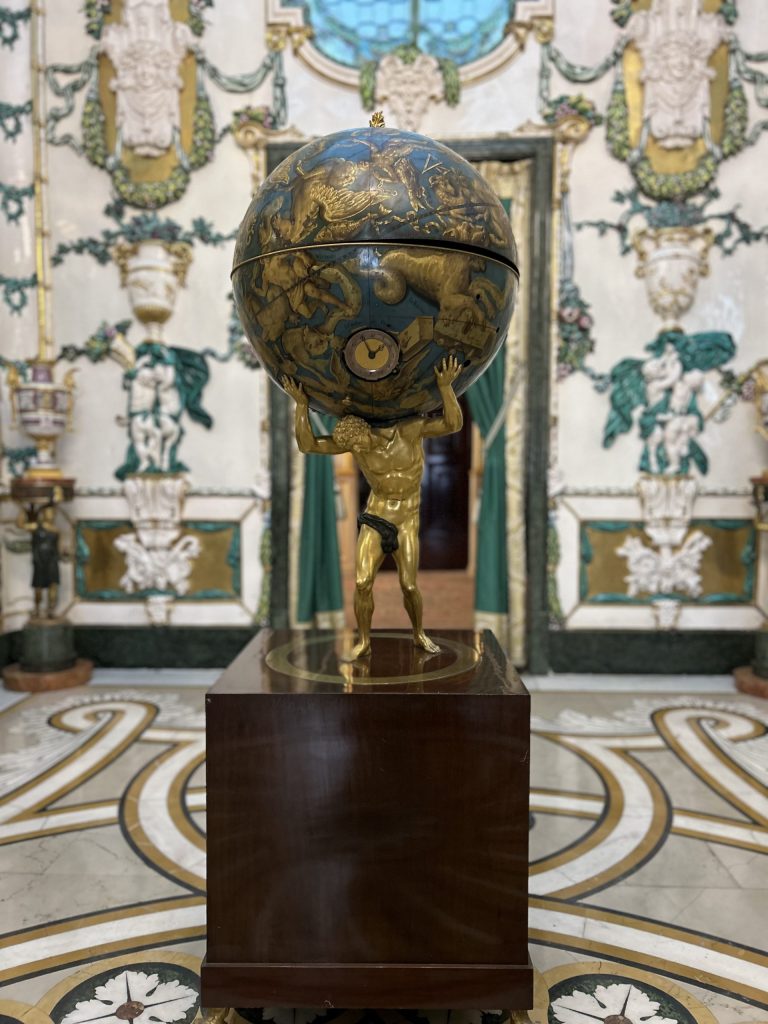
Take a look at the photograph accompanying this article. A man carries an enormous blue celestial globe covered with golden constellations on his shoulders. This is Atlas, the Titan from Greek mythology condemned to support the heavens, transformed here into the central figure of an extraordinary clock.
The piece was made by Abraham-Louis Breguet around 1800, and Patrimonio Nacional associates it with the collections of either Charles IV or Ferdinand VII. It stands approximately 160 centimetres tall and combines materials including bronze, wood and metal, but the most remarkable part is hidden inside the globe.
A Tiny Planetarium on Atlas’s Shoulders
The Atlas is much more than a clock. Inside is a mechanical planetarium representing the solar system as it was known at the time, including Mercury, Venus, Earth, Mars, Jupiter, Saturn and Uranus, as well as several of the satellites then known. Pluto, of course, would not be discovered for more than another century.
Its mechanism sets part of the planetarium in motion and was designed to create a visual representation of the planets’ orbits. The piece also incorporates references to the calendar and the Zodiac, turning the globe carried by Atlas into a miniature mechanical representation of the heavens and the passage of time.
Time Has a Face Too
Atlas is not the only mythological figure associated with the Palace’s clocks. One particularly appropriate figure is Cronus associated with Saturn and the relentless passage of time, who appears in the decoration of pieces in the Royal Collections. In the clock known as the Péndola de El Tiempo, for example, Cronus himself forms part of the composition.
The choice makes perfect sense: few mythological figures could be more appropriate for decorating an instrument specifically designed to measure time. These clocks therefore become much more than functional objects; they are also sculptures, allegories and demonstrations of the extraordinary technical skill achieved by European clockmakers.
That is why they are worth stopping for during your visit. In a building filled with frescoes, chandeliers, sculptures and spectacular rooms, a clock might seem like a minor detail, but pieces such as the Atlas prove otherwise. Sometimes all you need to do is look a little closer to find an entire solar system inside.
4. The Family of Juan Carlos I: the Painting That Took 20 Years to Finish
After crowns, 17th-century sculptures and mechanical clocks, we come to something completely different. In the Halberdiers’ Hall, you’ll find a huge painting by Antonio López depicting Juan Carlos I, Queen Sofía and their three children: Elena, Cristina and the then Prince Felipe, now King Felipe VI.
The painting measures an impressive three metres high and almost three and a half metres wide, so the five figures appear almost life-size. Its location is significant too: the Halberdiers’ Hall is the first room on the visitor route, allowing this contemporary image of the monarchy to introduce a journey that will take us back through several centuries of Spanish history.
Commissioned in 1993, Finished in 2014
Patrimonio Nacional commissioned the painting from Antonio López in late 1993. The artist began working on it the following year but did not add his final signature until 5 November 2014. Around twenty years had passed since the project began.
That may sound extraordinary, but it fits Antonio López’s way of working remarkably well. He is known for returning to his paintings repeatedly, making changes and allowing the creative process to continue until he considers the work truly finished. When he returned to the Palace in 2024 and saw the painting again, López himself recalled those twenty years as an experience that had marked his professional life.
A Royal Family Without Thrones or Crowns
It is interesting to compare this image with more traditional royal portraits. There is no throne, sceptre or elaborate display of royal power here. Antonio López places the five figures standing together in a bright, relatively undefined interior, almost forming a frieze in front of us.
Juan Carlos I occupies the centre of the composition. Infantas Elena and Cristina stand on one side, while Queen Sofía and the then Prince Felipe appear on the other. Felipe stands slightly in front of his mother, a position that Patrimonio Nacional interprets as a way of emphasising his status as heir to the Crown.
A Portrait That Already Belonged to Another Era
There is another curious twist to the story. By the time Antonio López finally completed the painting in 2014, the Royal Family he had begun portraying twenty years earlier already belonged, institutionally speaking, to another period: Juan Carlos I had abdicated and Felipe VI had become King of Spain.
The painting therefore became a historical image almost as soon as it was finished. It has been permanently displayed in the Halberdiers’ Hall since June 2015, connecting the centuries-old history of the building with a monarchy that continues into the present day.
Take a moment to look at it before continuing through the Palace. Surrounded by rooms created in the 18th century and reminders of monarchs from centuries ago, Antonio López’s painting makes an important point: the history of the Royal Palace did not end with Charles III, Charles IV or Ferdinand VII. It reaches almost to the present day.
5. The Stradivarius Instruments: a Unique Quartet
We have reached the last of our five objects and probably one of the most unexpected treasures in the Palace. The Royal Collections preserve an extraordinary group of instruments made by Antonio Stradivari, the famous Cremonese luthier whose instruments are now among the most highly prized in the world.
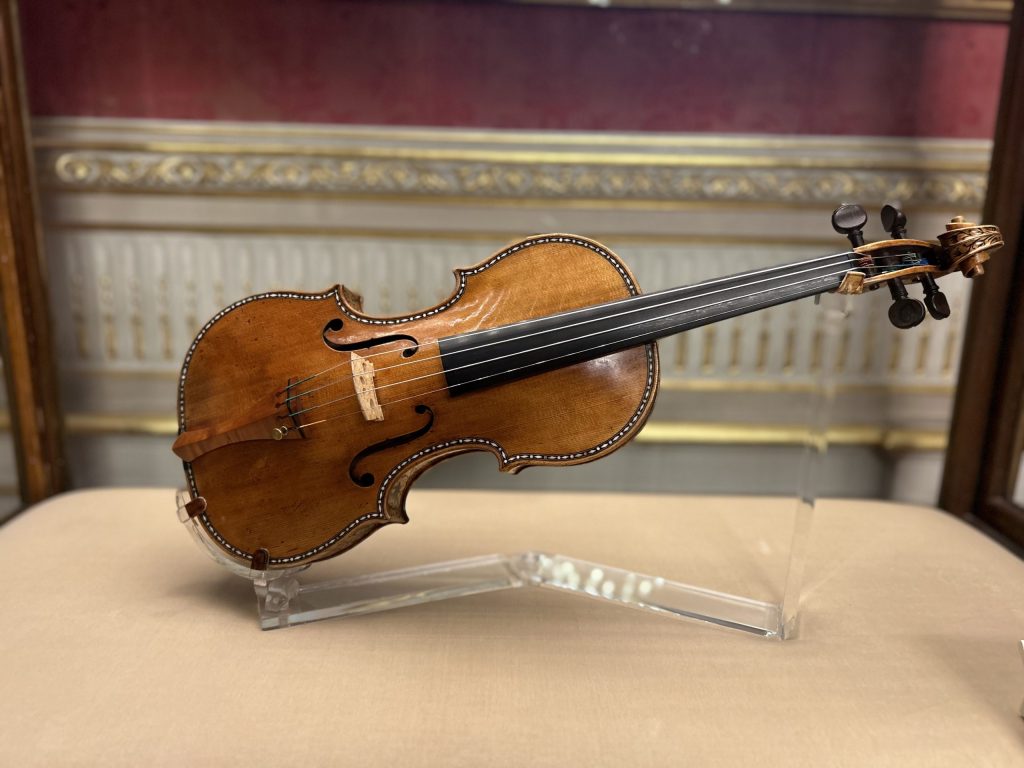
What makes the Spanish collection particularly remarkable is that four instruments designed as a group have remained together: two violins, a viola and a cello, known as the Palatine Quartet. Another Stradivarius cello is also preserved in the Royal Collections.
Stradivari Tried to Sell Them to a Spanish King
The story connecting these instruments with Spain begins in the early 18th century. In 1702, Philip V visited Cremona during his journey through Italy, and Stradivari tried to sell him a group of instruments he had made years earlier for an important royal court. The deal, however, did not go ahead.
Spain had to wait several more decades. In 1775, during the reign of Charles III, the Prince of Asturias —the future Charles IV— finally acquired the instruments from Paolo Stradivari, the luthier’s son. They therefore reached the Spanish court more than seventy years after that first encounter with Philip V.
These Are Not Just Any Stradivarius Instruments
Their importance does not simply come from the Stradivari name. The four instruments were conceived as a group and feature elaborate decoration, which explains why they are also known as the Decorated Stradivarius.
The decoration includes materials such as ivory and ebony, as well as ornamental motifs running across different parts of the instruments. Stradivari was not simply making exceptional instruments to produce music; he was creating objects worthy of a royal court.
A Viola That Disappeared for More Than a Century
The quartet’s history also includes a rather eventful separation. During the Peninsular War, the viola left Spain and became separated from the other instruments, breaking up a group that had been conceived to remain together.
The viola subsequently passed through different hands before finally returning to Spain in 1951. Its recovery reunited the quartet after more than a century apart and restored one of the most important pieces of the ensemble to the Royal Collections.
And They Can Still Be Played
Perhaps the most remarkable thing about these Stradivarius instruments is that they are not simply museum pieces. They have retained their musical function, and Patrimonio Nacional occasionally allows leading musicians to play them in concerts.
That changes the way we look at them. These instruments were made roughly three centuries ago, acquired by the Spanish Royal Family and preserved for generations, yet they can still do exactly what Stradivari created them to do: make music.
After the Crown, the lions that take us back to Velázquez, the extraordinary clocks and Antonio López’s royal portrait, we end with four instruments that have survived together —with a rather long interruption— for centuries. Not bad for a few objects that could easily be overlooked in a Palace where there is simply too much to see.
Want to Visit the Royal Palace? Come with The guides you need!
After crowns, lions, clocks, paintings and Stradivarius instruments, one thing should be clear: there is much more to the Palace than meets the eye. A guided tour is precisely about knowing where to stop, what to look at and why the objects in front of us are worth our attention.
At The Guides You Need, we explore the Palace in small groups and make the most of the 90 minutes available to discover its essential rooms, but also the stories and details that are easy to miss when visiting on your own.
👥 Groups of no more than 8 people.
🎓 Professional guides. Our tours are designed to help you understand and enjoy the Palace, not to recite a memorised script.
🎟️ Royal Palace admission included. We purchase your tickets in advance.
⏱️ 90-minute guided tour, the maximum duration permitted by Patrimonio Nacional for tourist groups.
📍 Meet us by the statue of Philip IV in Plaza de Oriente, right in front of the Palace.
🇪🇸🇬🇧🇮🇹 Tours available in Spanish, English and Italian.
👑 Want to discover the stories hidden inside its spectacular rooms? Book your guided tour of the Royal Palace with The Guides You Need here.