During the Renaissance, artists debated not only how to represent the world, but also what the true essence of painting was. The debate over colour vs. drawing confronted two different ways of conceiving the painter’s work: one placed greater importance on line, form and the intellectual construction of the work; the other championed the possibilities of colour, light and the very substance of paint.
The discussion found two particularly important settings in sixteenth-century Italy. While Florence made disegno one of the foundations of its artistic tradition, Venice developed an extraordinary culture of colore. Michelangelo and Titian provide particularly clear examples of these differences, although reducing the confrontation to two artists or two cities would be too simplistic. At stake was the very definition of what it meant to paint.
And the debate survived the Renaissance. Rubens and Poussin, Ingres and Delacroix would once again represent different approaches to drawing and colour. In the late nineteenth and early twentieth centuries, Impressionists, Post-Impressionists and Expressionists pushed the possibilities of colour much further, while artists such as Egon Schiele demonstrated that line, too, could be radically transformed.
But before tracing this history, we need to address a fundamental question: are painting and drawing really the same thing?
In this article
Are Painting and Drawing the Same Thing?
Although we use both terms somewhat freely, painting and drawing are not exactly the same thing. The difference may seem obvious when we think of a pencil and a paintbrush, but it goes much deeper. Drawing and painting involve different ways of constructing an image and, precisely for this reason, artists debated for centuries which of the two should occupy the dominant position.
What Does Drawing Mean?
Drawing is primarily based on line, form, proportions and spatial organisation. Through drawing, an artist can study the anatomy of a figure, establish its contours, decide its position or prepare the composition of a work before beginning to paint it.
However, reducing drawing to the act of tracing lines would be insufficient, especially when discussing the Renaissance. The Italian term disegno also referred to the ability to conceive and plan a work. Drawing allowed an idea to be transferred from the artist’s mind onto paper and its structure to be developed progressively. This gave it an intellectual dimension that is fundamental to understanding the prestige it acquired in places such as Florence.
Michelangelo is one of the most extraordinary examples. His knowledge of anatomy, proportion and movement allowed him to construct bodies of enormous complexity. His preparatory drawings reveal the extent to which a figure could be studied and resolved before appearing in the finished work.
What Does Painting Mean?
Painting introduces a different element: pigment. To paint means applying coloured material to a surface and working with its possibilities. The artist must relate colours to one another, construct light and shadow, create transparencies, modify tones and even decide how much material to leave on the surface.
Colour, therefore, does not have to be limited to filling in a previously drawn form. It can participate directly in constructing it. A transition between an illuminated area and one in shadow can create volume without the need for a precise contour, while different areas of colour can establish depth, separate planes or direct our gaze.
This distinction is essential to understanding the debate over colour vs. drawing. The question was not simply whether it was better to use beautiful colours or produce accomplished drawings. What was being debated was something much deeper: where did the essence of painting lie?
In the sixteenth century, two of Italy’s great artistic centres offered different answers. Florence made disegno one of the pillars of its artistic culture; Venice explored the possibilities of colore as few cities had done before. From this difference emerged one of the great debates in the history of art.
Disegno vs. Colore: The Great Italian Renaissance Debate
During the sixteenth century, Florence and Venice represented two different ways of understanding painting. The Florentine tradition placed enormous importance on disegno, while Venetian artists developed a style of painting in which colore acquired an extraordinary prominence. This opposition lies at the origin of the debate over colour vs. drawing, although we should avoid oversimplifying it: Venetian artists also drew, and Florentine artists obviously mastered colour as well.
The difference lay primarily in the hierarchy. Should a painting begin with a structure conceived and defined through drawing? Or could it be constructed mainly through relationships between colours, light and shadow? Behind these questions were two different artistic traditions, but also two different ways of understanding the painter’s work.
Florence and Rome: Michelangelo and the Primacy of Disegno
In Florence, disegno acquired enormous prestige because it connected manual execution with the artist’s intellectual abilities. Before painting a figure, the artist could study it through numerous drawings: its anatomy, movement, proportions and position within the composition could all be established before transferring it to the finished work.
Michelangelo brought this approach to one of its highest points. His figures are constructed through an extraordinary knowledge of the human body. Muscles, joints and twisting poses create bodies that seem to possess volume even when represented on a flat surface. It is no coincidence that Michelangelo was also a sculptor: his painting shares with sculpture a powerful interest in the three-dimensional construction of the figure.
Drawing was therefore much more than a preparatory stage. It allowed the artist to think through the work, correct it and resolve its problems before beginning its final execution. From this perspective, mastering disegno meant mastering one of the very foundations of artistic creation.
Venice: Titian and Constructing Form through Colour
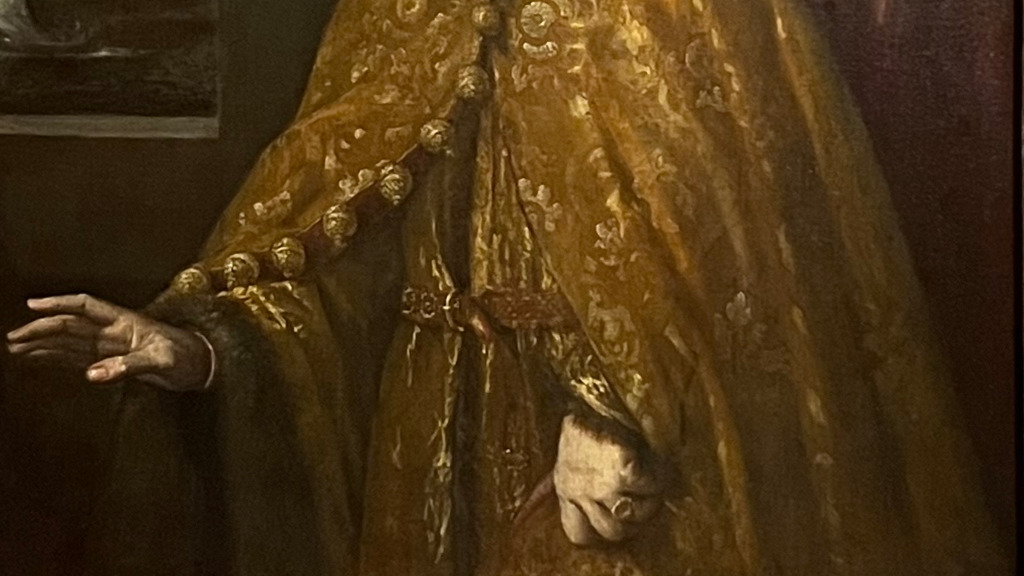
The Venetian tradition developed other possibilities. The refinement of oil painting techniques made it possible to work with glazes, transparencies, superimposed layers and extraordinarily rich chromatic transitions. Instead of always depending on clearly defined contours, forms could emerge through the relationship between colour, light and the materiality of paint.
Titian is one of the finest examples of this approach to painting. Particularly in his mature work, his brushwork became increasingly free and the boundaries between figures could lose definition. Viewed up close, the surface of some of his works appears to be constructed from patches of colour and brushstrokes that do not always correspond to perfectly defined forms. Seen from a certain distance, these chromatic relationships acquire coherence and construct bodies, fabrics, atmospheres and spaces.
This marks an important difference from understanding colour as something added afterwards to a drawing. In Titian, colour itself can construct form. Variations in tone and luminosity can model a face or a body without relying exclusively on a line that establishes its boundaries beforehand.
The Anecdote about El Greco, Pacheco and Michelangelo
A well-known anecdote involving El Greco and Francisco Pacheco, Velázquez’s teacher and future father-in-law, helps us understand how deeply these differences could influence the judgement of an artist. As Ulquízar recounts in Renacimiento, published by UNED, Pacheco recorded a surprising opinion expressed by El Greco about Michelangelo: despite acknowledging his extraordinary abilities, he considered that Michelangelo did not know how to paint.
The statement becomes far less surprising once we distinguish between painting and drawing. El Greco had worked in Venice and was directly familiar with a tradition shaped by artists such as Titian and Tintoretto. From a conception of painting that placed such importance on the handling of pigment and colour, it was possible to admire Michelangelo’s extraordinary ability as a draughtsman while simultaneously questioning his way of painting.
The anecdote does not prove that one tradition was superior to the other. On the contrary, it perfectly summarises the problem: an artist could be regarded as an extraordinary master of disegno while still being criticised for his treatment of colore. The debate was no longer simply a technical question; it had become a discussion about which qualities made a painter great.
Rubens vs. Poussin: The Debate Continues in France
The confrontation between disegno and colore did not disappear with the Italian Renaissance. During the seventeenth century, the question resurfaced with particular intensity in France, although the main points of reference were now Nicolas Poussin and Peter Paul Rubens. Once again, the discussion went far beyond personal preferences: it concerned which elements should organise a painting and which possessed greater intellectual value.
Poussin and Rubens never personally engaged in a dispute comparable to the one that would later develop among their followers. Rather, their works and their different approaches to painting became models for two opposing positions. The debate over colour vs. drawing had entered a new phase.
Poussin and the Defence of Drawing
Nicolas Poussin spent much of his career in Rome and found some of his principal sources of inspiration in classical antiquity and the Renaissance. In his compositions, the position of each figure, the relationships between the characters and the overall organisation of the scene follow a carefully planned structure.
Drawing made it possible to establish precisely this order. For those who defended this tradition, its superiority also had an intellectual explanation: through drawing, the artist could conceive a composition before executing it. Line defined forms and allowed space to be organised rationally, while colour remained subordinate to a previously established structure.
The defence of Poussin was therefore also a defence of a particular idea of painting: a discipline in which thought, composition and control should prevail over purely sensory effect.
Rubens and the Power of Colour
Rubens offered a very different model. His training was profoundly shaped by Italy and, in particular, by his knowledge of the Venetian tradition. The influence of Titian is fundamental to understanding his use of colour, paint and the expressive possibilities of oil painting.
In his paintings, colour contributes directly to creating volume, movement and depth. Flesh tones shift through pinks, reds, whites and areas of shadow; fabrics reflect light in different ways, and brushstrokes help create the sensation of bodies in motion. The viewer’s visual experience therefore acquires enormous importance.
This tradition can be studied exceptionally well at the Museo del Prado, which houses one of the largest collections of works by Rubens in the world. Moreover, the relationship between Titian and Rubens is particularly visible in Madrid: the Flemish painter studied and copied works by the Venetian master that belonged to the Spanish royal collections.
Poussinistes and Rubénistes: What Should Dominate Painting?
In the late seventeenth century, the differences between the two models developed into a genuine controversy within the French Academy. The so-called Poussinistes defended the primacy of drawing, while the Rubénistes championed the importance of colour. What had begun during the Italian Renaissance as a difference between Italian artistic traditions now acquired a much more explicit theoretical formulation.
Supporters of drawing could argue that it depended on knowledge and reason: representing a body correctly required an understanding of its proportions and structure. Colour, by contrast, appealed more immediately to the senses. Yet this was precisely where the Rubénistes found one of their arguments: painting should also address the eye, and colour was one of its most distinctive resources.
The debate therefore raised a question that would reappear time and again throughout the history of art: reason versus perception, structure versus sensation, line versus colour. And it was still far from being resolved. In the nineteenth century, Ingres and Delacroix would once again embody the two positions with extraordinary intensity.
Ingres vs. Delacroix: Drawing and Colour in the Nineteenth Century
The debate over colour vs. drawing also survived the French Academy of the seventeenth century. Almost two hundred years after the discussions surrounding Michelangelo and Titian, two great French painters once again represented very different ways of understanding painting: Jean-Auguste-Dominique Ingres and Eugène Delacroix.
The opposition between them revived questions we have already encountered. On one side were line, contour and the precise construction of forms; on the other, colour, brushwork and the effects produced by the relationships between different tones. The context, however, had changed. We are now in the nineteenth century, when the rigid hierarchies of academic painting were beginning to be challenged.
Ingres and the Primacy of Line
Ingres was one of the great defenders of drawing within the French academic tradition. An admirer of Raphael, he constructed his figures through extremely precise contours and placed enormous importance on the accuracy of line. Even when he deliberately altered anatomical proportions, as he did in some of his female figures, these distortions remained subject to the control of drawing.
His painting seems to aspire to a surface on which the artist’s physical intervention is barely visible. Brushstrokes are concealed, while contours clearly distinguish one form from another. Colour is naturally present, but it is integrated into a structure dominated by line.
Ingres thus represented the continuation of a tradition that could be traced back to Renaissance disegno. The artist had to master form and construct the composition intellectually. Painting should not depend exclusively on the immediate impact produced upon the senses.
Delacroix and the Power of Colour
Delacroix approached painting very differently. Colour acquired an essential role in his work, constructing atmosphere, generating movement and establishing relationships between the different parts of a composition. He also gave greater visibility to his brushwork, moving away from the carefully finished surface that characterised much of the academic tradition.
One of his great influences was Rubens. Delacroix admired his ability to organise complex compositions through movement and colour, thereby continuing a tradition that could be traced even further back to the Venetian painting of Titian.
The opposition between Ingres and Delacroix demonstrates just how alive a discussion that had begun several centuries earlier still remained. During the nineteenth century, however, a decisive transformation began to take place. The question was no longer simply which should predominate, drawing or colour. Some artists began to challenge the very idea that colour had to reproduce faithfully what we see.
From that point onwards, the old debate began to change completely. With Impressionism, Post-Impressionism and later Expressionism, colour began to acquire an autonomy that would transform the history of painting.
Contemporary Art Liberates Colour
Throughout much of the history we have explored, the debate over colour vs. drawing had confronted two different ways of constructing a painting. However, in the late nineteenth century, a transformation began to take place that would eventually alter the terms of this longstanding discussion. Colour progressively acquired an autonomy that moved it away from its traditional function of representing the visible appearance of things.
The process did not happen suddenly. Impressionism investigated the relationships between colour, light and perception; some Post-Impressionist artists took colour beyond the direct observation of nature; and, in the early twentieth century, Expressionism openly explored its expressive possibilities. The old Renaissance colore was thus entering completely new territory.
Impressionism: Colour, Light and Perception
The Impressionists profoundly transformed the representation of light. Artists such as Monet, Renoir and Pissarro observed that the colour of things could not be understood as a completely stable quality: it changed depending on lighting, atmosphere, the time of day and the colours surrounding it.
Shadows could be constructed with blues, violets or greens, while small brushstrokes of different colours placed alongside one another produced effects that were completed in the viewer’s eye. Contours could also lose definition as light and atmosphere altered our perception of the boundaries of objects.
Visible brushwork also acquired new importance. In contrast to the carefully finished surfaces of much academic painting, pigment could remain recognisable on the canvas. Colour did not merely represent light: it began to participate actively in constructing our perception of reality.
Post-Impressionism: Colour No Longer Imitates Reality
Post-Impressionism was not a homogeneous movement, but rather a term encompassing artists with very different interests. Nevertheless, some of its leading figures took a fundamental step in the evolution of colour: it was no longer essential for colour to correspond exactly to the appearance of nature.
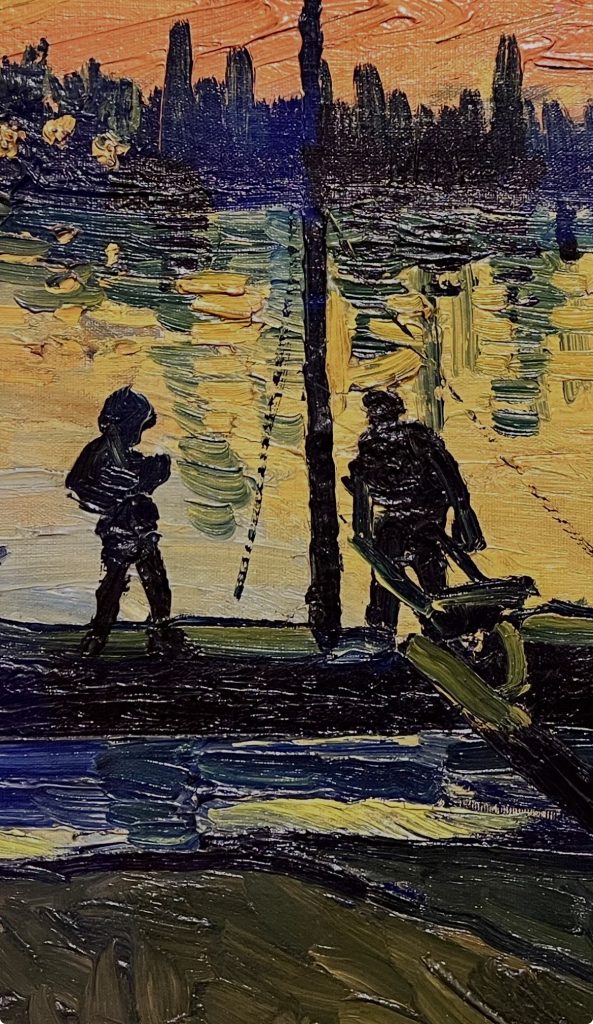
Vincent van Gogh used chromatic contrasts and intensities to increase the power of his images, while Paul Gauguin employed broad areas of colour and combinations that could deliberately depart from naturalistic observation. The artist acquired much greater freedom to decide which colours a composition required.
A sky no longer had to correspond to the blue observed at a particular moment; a face, a tree or a field could acquire tones determined by the needs of the work itself. Colour was beginning to free itself from the obligation to describe the visible world faithfully. This transformation can be followed particularly well at the Museo Thyssen-Bornemisza, whose collections allow us to trace the development from Impressionism and Post-Impressionism to some of the major artistic transformations of the early twentieth century.
Expressionism: Colour as a Means of Expression
In the early twentieth century, the Expressionists pushed this freedom even further. Colour could openly depart from the natural appearance of things and be used to intensify a sensation, create tension or deliberately alter our perception of a figure or landscape.
Faces in unexpected tones, intensified skies and violent chromatic contrasts made it clear that artists no longer had to reproduce the colours they saw before them. They could modify them according to what they intended to construct or express through painting.
The change from the Renaissance was enormous. Venetian colore had demonstrated that pigment could construct forms, light and atmosphere without depending entirely on drawing. Centuries later, contemporary art went one step further: colour could acquire autonomy from visible reality itself.
But this does not mean that colour had definitively won the old dispute. While Impressionists, Post-Impressionists and Expressionists were transforming its possibilities, line was also following its own path. The work of Egon Schiele allows us to see how.
Egon Schiele: The Evolution of Drawing in Contemporary Art
The progressive liberation of colour did not mean the disappearance of drawing. On the contrary, in the late nineteenth and early twentieth centuries, line also began to be used in ways that moved increasingly away from academic models. If colour could become independent from naturalistic representation, drawing could cease to pursue correctness, proportion and traditional beauty.
The work of Egon Schiele is particularly interesting for understanding this transformation. His figures demonstrate that line was still capable of constructing an image with enormous intensity, but it no longer necessarily served the same function it had performed within the Renaissance tradition of disegno.
Egon Schiele: Line as the Protagonist
Schiele was an extraordinary draughtsman. In many of his portraits and self-portraits, contour becomes so important that an irregular, seemingly fragile line is enough to define an arm, a face or the entire position of a body. The space surrounding his figures can remain almost completely empty, focusing our attention on their anatomy and the tension of their gestures.
But his bodies are very different from the anatomical constructions we encountered in Michelangelo. Schiele elongates limbs, exaggerates joints and adopts uncomfortable poses. This distortion does not necessarily result from an inability to represent the body correctly, but from an artistic decision. Knowing how to draw also means knowing when to depart from established rules.
This difference is fundamental. For centuries, academic drawing had used knowledge of anatomy and proportion as one of the foundations for convincingly representing the human figure. Schiele could use that knowledge to alter it deliberately, constructing tense, angular and deeply personal bodies.
From Academic Drawing to Expressive Line
Line thus acquired an autonomy comparable, though not identical, to that being achieved by colour. It was no longer solely responsible for accurately describing the boundaries of a figure. It could break, vary in intensity, exaggerate a form or distort a body in order to contribute to the expressiveness of the image.
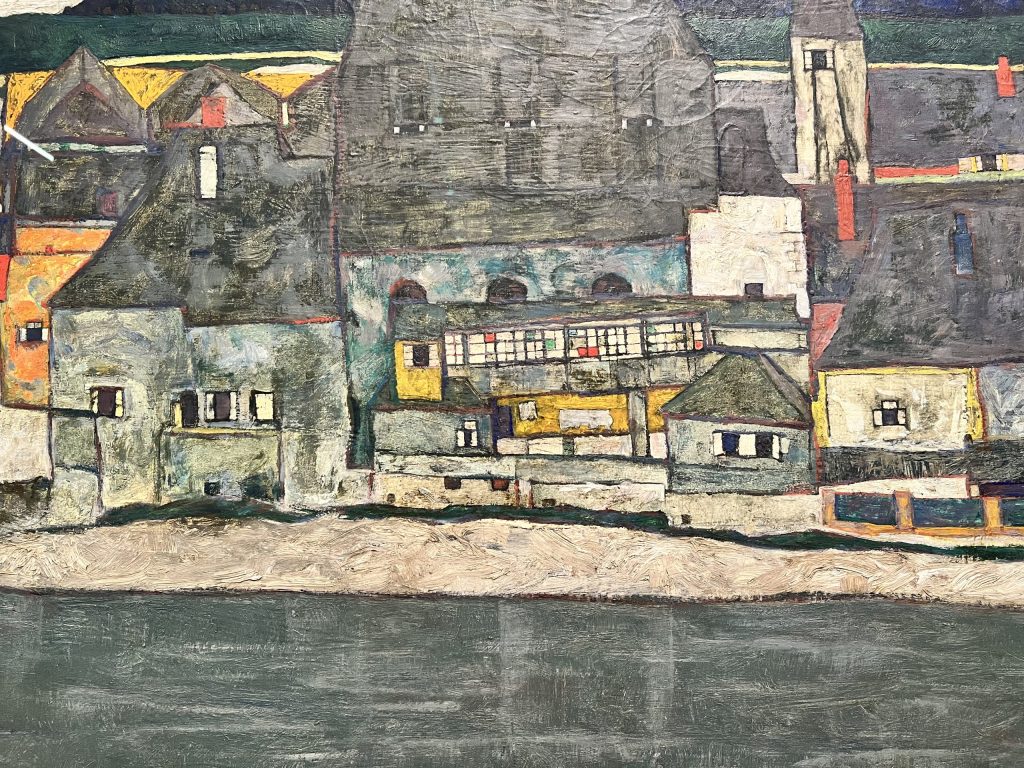
Colour did not disappear from Schiele’s work either. It often appears selectively, leaving large areas of the support uncovered and coexisting with the prominence of contour. This combination demonstrates precisely how much the old debate over colour vs. drawing had changed. Both could now be used freely, without either having to be systematically subordinated to the other.
By the early twentieth century, therefore, the discussion that had opposed Florentine disegno and Venetian colore could no longer be framed in exactly the same terms. Both line and colour had vastly expanded their possibilities. One final question remained: after four centuries of debate, had either of them won?
Colour vs. Drawing: Who Ultimately Won the Debate?
After several centuries of discussion, it is difficult to declare a winner. The debate over colour vs. drawing arose from the need to establish a hierarchy: to determine whether painting should be based primarily on the construction of form through line or on the possibilities of pigment and chromatic relationships. The subsequent evolution of art gradually made such a hierarchy less necessary.
Colour achieved enormous autonomy. From the Impressionists’ investigations into light to the chromatic intensity of Post-Impressionism and Expressionism, it was no longer required to reproduce faithfully the visible appearance of things. Drawing, however, followed a parallel path. Artists such as Egon Schiele demonstrated that line did not have to conform to the proportions, anatomy or ideals of beauty established by the academic tradition.
Perhaps, then, the most interesting consequence of the old confrontation between Titian and the Venetian tradition and Michelangelo and Florentine disegno was not the victory of either model, but the demonstration of how far both could go. Colour could construct, transform and even depart from reality; line could organise a composition, define a figure or deliberately distort it.
Four centuries later, the question had changed. It was no longer a matter of deciding whether a painting should be constructed through drawing or through colour. Contemporary artists could use both with a freedom that would have been difficult to imagine when the discussion began in sixteenth-century Italy. The debate did not end with a winner: it ended by expanding the possibilities of painting.
From Debate to Masterpieces: Experience Painting with The Guides You Need
The debate between drawing and colour becomes much easier to understand when we leave theory behind and stand in front of the artworks themselves. In Madrid, you can follow much of this history through the collections of the Museo del Prado, Museo Thyssen-Bornemisza and Museo Reina Sofía. At The Guides You Need, we want to help you understand not only what you are looking at, but also why each artist made particular choices when painting.
🎟️ Museum admission is included in the price of our tours.
⚡ We purchase tickets in advance to make access easier and avoid queues at the ticket office.
👥 We work with small groups, so you can take your time looking at the artworks and discuss them with your guide.
🎨 Our guides are professionals specialising in art and history, adapting their explanations to each group rather than simply repeating a memorised script.
🏛️ Visit the Museo del Prado, Museo Thyssen-Bornemisza or Museo Reina Sofía with us and see how centuries of debate about line, colour and the very nature of painting remain present in the works we encounter today.