Madrid’s Retiro Park is home to two buildings that seem to belong to entirely different worlds. One is dominated by brick and ceramics; the other by a delicate structure of iron and glass. They are Velázquez Palace and the Crystal Palace, two buildings constructed just four years apart and designed by the same architect: Ricardo Velázquez Bosco.
However, the history of the Palaces of Retiro Park does not begin with either of them. To understand why they were built, we need to go back to the former Royal Site of Buen Retiro and follow its transformation from gardens reserved for the royal court into the great public park of 19th-century Madrid. It was precisely during this period that Retiro Park began to be used as a setting for major exhibitions.
Those exhibitions gave rise to the two buildings at the heart of this article. Velázquez Palace was built for an exhibition devoted to mining and related industries, while the Crystal Palace appeared just a few years later for the General Exhibition of the Philippine Islands. Understanding their origins allows us to appreciate not only their architecture, but also a period in which Madrid itself was undergoing profound change.
In this article
What Is the History of the Palaces of Retiro Park?
The history of the palaces we find in Retiro Park today begins more than two centuries before they were built. During the reign of Philip IV, in the 1630s, a new Royal Site was created to the east of Madrid around the Monastery of Los Jerónimos. The Buen Retiro Palace was built there, surrounded by extensive gardens designed for leisure, celebrations and courtly entertainment.
The complex grew rapidly and eventually included gardens, ponds, hermitages, squares and numerous buildings. It was not simply intended to provide the king with an alternative residence to the Royal Alcázar of Madrid: Buen Retiro was also a grand courtly setting in which architecture, painting, theatre and gardens helped project the image of Philip IV’s monarchy.
Buen Retiro Palace: The Palace That Is No Longer There
It is difficult to imagine its scale today because most of the Buen Retiro Palace has disappeared. Unlike some of Europe’s great royal residences, it was not originally conceived as a single monumental and perfectly symmetrical building. Construction progressed extremely quickly, and the complex expanded through the addition of different wings, courtyards and rooms.
The exterior was dominated by relatively modest materials, particularly brick, combined with stone and slate roofs. Its architecture may have appeared restrained, but the interiors presented a very different picture. The rooms were decorated with major cycles of paintings, and the palace housed works by some of the leading artists of the 17th century.
One of its most important spaces was the Hall of Realms, conceived as a grand ceremonial room and decorated with paintings intended to glorify the monarchy. Among the works displayed there were Velázquez’s The Surrender of Breda and Zurbarán’s series of the Labours of Hercules. Many of these paintings would later become part of the collection of the Prado Museum.
The Casón del Buen Retiro was also part of the complex and originated as the palace’s former Ballroom. These two buildings — the Hall of Realms and the Casón — are the principal architectural remains that allow us to appreciate today the scale of a palace that once occupied a considerable area between the present-day Prado Museum and Retiro Park.
From Royal Residence to Public Park
The decline of the complex accelerated during the Peninsular War. Retiro’s elevated position gave the area military importance during the French occupation, and the former Royal Site suffered severe damage. After the war, many of the palace buildings were left in a condition that eventually led to their gradual demolition.
The gardens followed a different path. They survived the disappearance of much of the palace and gradually adapted to a city that was expanding around them. Following the Revolution of 1868 and Isabella II’s departure from Spain, Retiro passed into municipal ownership and was permanently opened to the public. A space originally conceived for the leisure of the royal court was thus transformed into one of Madrid’s great parks.
Retiro Park as a Setting for the Great 19th-Century Exhibitions
This transformation coincided with the rise of major exhibitions across Europe. During the second half of the 19th century, cities such as London and Paris organised enormous events showcasing industrial and scientific advances, commercial products, works of art and resources from different territories.
Madrid found in the former Retiro an ideal setting in which to participate in this exhibition culture. The extensive gardens provided enough space to construct buildings specifically designed for these events and, for the first time, the park’s new palaces would not be reserved for the king and his court, but conceived to receive exhibition visitors.
The two buildings at the heart of our article emerged from this new Retiro. In 1883, Velázquez Palace opened its doors, built for an exhibition devoted primarily to mining and related industries. Just four years later, another exhibition led Ricardo Velázquez Bosco to design the Crystal Palace.
History had therefore taken a curious turn. The great royal palace of the 17th century had almost entirely disappeared, but its former gardens began to fill with an entirely new kind of architecture. The palaces we now associate with Retiro Park were not built to house monarchs: they were built to exhibit.
Velázquez Palace: Retiro Park’s First Exhibition Palace
In 1883, visitors to Retiro Park encountered a completely new building in its gardens. It had been constructed to host the National Exhibition of Mining, Metallurgical Arts, Ceramics, Glassmaking and Mineral Waters, an event intended to showcase Spain’s mineral wealth and advances in the various industries connected with its extraction and transformation.
The building had to meet needs very different from those that had given rise to the old Buen Retiro. It was neither a residence nor a space reserved for the royal court, but a large venue designed to accommodate objects, products and visitors. Late 19th-century Madrid needed an architecture suited to the new culture of exhibitions.
Who Was Ricardo Velázquez Bosco?
The project was entrusted to Ricardo Velázquez Bosco, an architect born in Burgos in 1843 who would go on to create some of his most recognisable works in Madrid. His surname also explains a common misunderstanding: Velázquez Palace is not dedicated to the painter Diego Velázquez. Its name comes from the architect who designed it.
Velázquez Bosco would return to work in Retiro Park just four years later, when he was commissioned to design the Crystal Palace. The fact that the two projects were created so close together makes their comparison particularly interesting, as it shows how the same architect could adopt very different solutions depending on the building he was asked to design.
The Architecture of Velázquez Palace
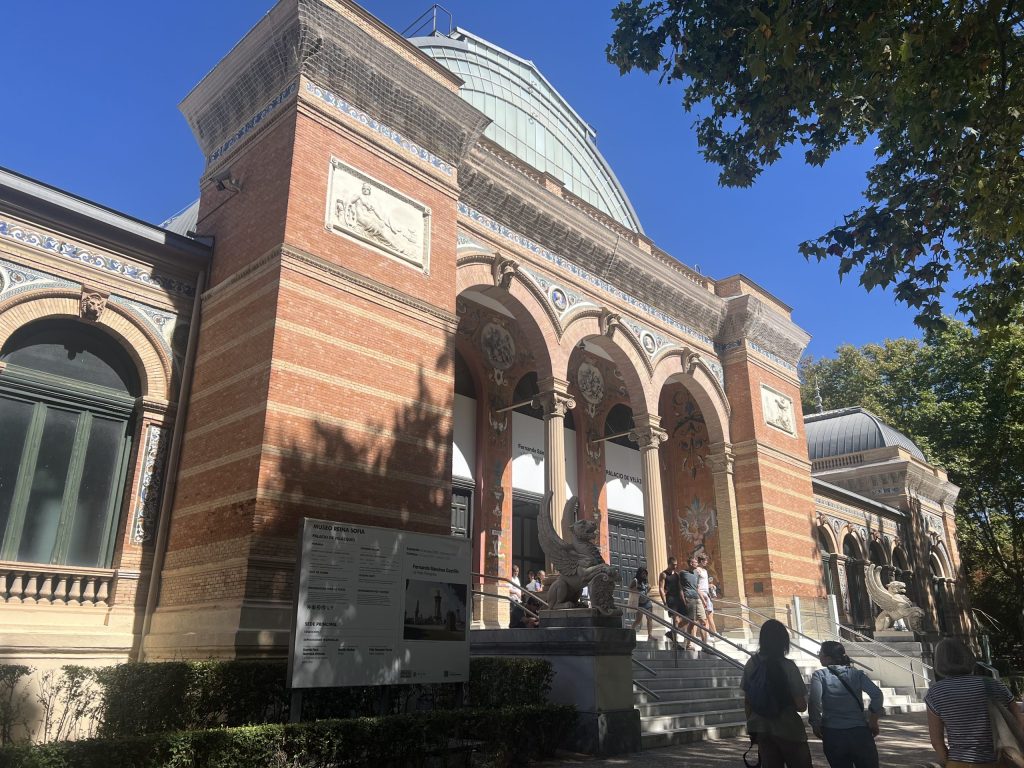
The palace has a rectangular plan and an exterior dominated by brick and ceramics, combined with stone, iron and glass. In contrast to the transparency that would later characterise the Crystal Palace, this building has a more solid and monumental appearance.
Iron made it possible to create large interior spaces suitable for exhibitions, while glazed surfaces allowed natural light to enter. The architecture therefore responded to practical requirements without sacrificing carefully designed exterior decoration.
Daniel Zuloaga played an important role in the building’s ceramic decoration. His work introduces colour and ornamental motifs across the brick façades and constitutes one of the palace’s most distinctive features. Architecture, industry and the decorative arts thus came together in a building conceived specifically for a major exhibition.
La Perla Peregrina: The Current Exhibition at Velázquez Palace
Velázquez Palace remains dedicated to exhibitions and currently serves as one of the Reina Sofía Museum’s venues in Retiro Park. Its galleries are now hosting La Perla Peregrina, an exhibition by Fernando Sánchez Castillo (Madrid, 1970). According to the Reina Sofía Museum’s presentation of the exhibition, the artist’s work examines the images, monuments and symbols through which power constructs and preserves its authority.
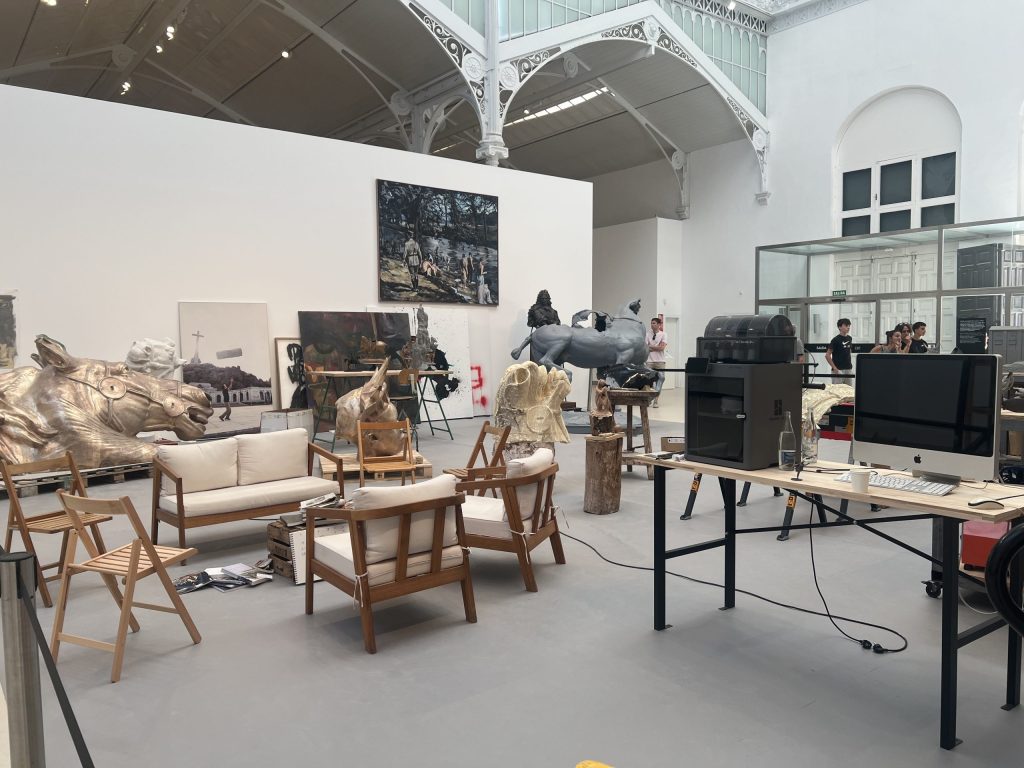
One statement by Sánchez Castillo neatly summarises this starting point: “art is a force that makes the narratives of the State tremble.” From there, the artist modifies objects associated with power and disrupts what we expect from them. The exhibition includes, for example, riot-control vehicles involved in a dance and monumental sculptures stripped of the solemnity we normally associate with such images.
The title leads us to a much older object. The Peregrina Pearl was discovered in Panama in the 16th century and later reached the court of Philip II. For centuries, the jewel remained closely associated with the Spanish monarchy and appears in court portraits of the Habsburgs. It later left Spain with Joseph Bonaparte and began a history of changing ownership that would eventually take it, centuries later, into the hands of one of Hollywood’s most famous couples.
In 1969, Richard Burton bought a pearl believed to be La Peregrina as a gift for Elizabeth Taylor. Following the actress’s death, it was auctioned again in 2011. Sánchez Castillo uses the extraordinary biography of this object to raise questions about value, ownership, memory and the relationship between images and power.
Almost a century and a half later, Velázquez Palace thus continues to fulfil the function for which it was originally built. It no longer displays minerals or industrial products, but it remains a place where objects are presented to the public in order to tell a story. What has changed radically is the kind of questions those exhibitions invite us to ask.
The Crystal Palace: Iron, Glass and Nature
Just four years after completing Velázquez Palace, Ricardo Velázquez Bosco received a new commission in Retiro Park. In 1887, Madrid was preparing to host the General Exhibition of the Philippine Islands and needed a building capable of housing some of the plants and species brought from the archipelago. The result was a work radically different from his previous palace.
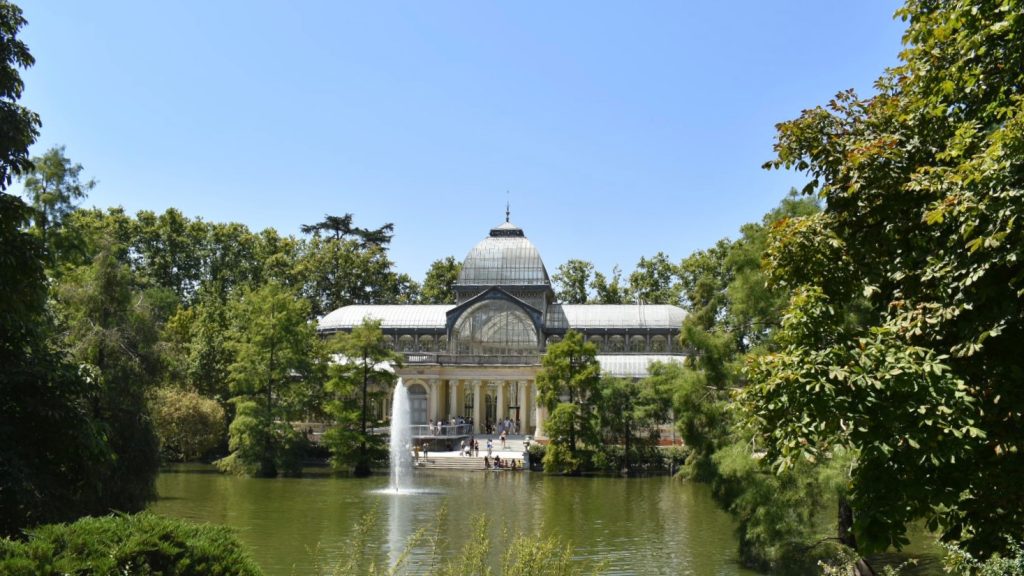
This time, the architect gave prominence to iron and glass. In contrast to the solid brick walls of Velázquez Palace, the new building appeared almost transparent. Its location beside an artificial pond further strengthened the relationship between architecture and nature that still defines its image today.
The General Exhibition of the Philippine Islands of 1887
When the exhibition was held, the Philippines was still part of the Spanish Empire. The event was intended to introduce audiences in mainland Spain to the archipelago’s natural resources, products, crafts and different aspects of life there. The Crystal Palace served primarily as a large greenhouse for the plant species brought to Madrid.
But the exhibition was not limited to plants and objects. People from the Philippines also travelled to Madrid and were presented to the public as part of this representation of the colonial territory. This aspect is essential to understanding the event from a contemporary perspective.
The building can be admired as an extraordinary example of iron architecture without overlooking the historical circumstances in which it was created. The exhibition formed part of a broader European culture that turned colonised territories, their resources and even their inhabitants into objects of display. The Crystal Palace is therefore both an architectural monument and a testimony to Madrid and the Spanish Empire at the end of the 19th century.
A Palace Inspired by London’s Crystal Palace
The idea of constructing large buildings from iron and glass did not originate in Madrid. One of the most famous precedents had appeared several decades earlier in London: the Crystal Palace, designed by Joseph Paxton for the Great Exhibition of 1851.
These new construction techniques made it possible to cover large areas with relatively lightweight structures while filling the interiors with natural light. They were particularly suitable for railway stations, markets, greenhouses and large exhibition halls, some of the architectural types that were transforming 19th-century cities.
Velázquez Bosco adapted this architectural language to the landscape of Retiro Park. The building is organised around a central space crowned by a large dome, from which several glazed sections extend. The iron structure supports an enclosure dominated almost entirely by glass, while ceramic elements provide decorative details and touches of colour.
The pond in front of the palace completes the composition. Trees, water and sky are reflected in the glass, continually changing the building’s appearance. In this way, what began as a practical solution for housing vegetation ultimately became one of Madrid’s most distinctive examples of the integration of architecture and landscape.
Why Is the Crystal Palace Closed?
The interior is currently closed to visitors. The Crystal Palace is undergoing a comprehensive restoration whose origins date back to 2023, when falling pieces of iron led the Reina Sofía Museum to close the building and assess its state of conservation.
According to El País in August 2026, the project has an emergency budget of €7.5 million and involves an extremely complex intervention. The work includes replacing more than 5,000 glass panes, as well as restoring the metal structure, windows, portico, flooring and the upper section of the dome. A vast scaffolding system reaching 25 metres in height has been installed to carry out the work.
One of the problems being addressed concerns the glass itself. Javier Contreras, the architect directing the restoration, told El País that the panes installed during an earlier intervention had created “an airtight space that did not allow the building to breathe.” Their rigidity also made them vulnerable to breaking as a result of movements in the structure or hail.
The restoration is returning to square, overlapping panes designed to withstand these conditions more effectively while improving ventilation. New ventilation windows are also being installed, and the building’s various metal elements are being restored.
If the current schedule is maintained, the work will be completed in July 2027. The Crystal Palace will then be able to resume its role as a Reina Sofía Museum venue dedicated to contemporary art.
This role has one particular characteristic: the building itself influences the works displayed inside it. Francisco Holguín, Head of Architecture and Sustainable Development at the museum, told El País that the palace “serves as a backdrop and as a tool for action for the artist.” This characteristic creates an unexpected connection with its origins: since 1887, the contents of the Crystal Palace have never been entirely separable from the space that contains them.
What Are the Differences Between Velázquez Palace and the Crystal Palace?
Only four years separate the opening of the two buildings, and it takes just a few minutes to walk from one to the other. Yet comparing them reveals two very different approaches to architecture. Velázquez Palace conveys solidity and monumentality, while the Crystal Palace seeks lightness, transparency and a much closer relationship with the surrounding landscape.
The comparison becomes even more interesting because Ricardo Velázquez Bosco was responsible for both projects. Their differences therefore do not result from a change of architect, but from his ability to adapt materials and construction solutions to the requirements of each commission.
From Brick to Glass
At Velázquez Palace, brick defines much of the exterior appearance. Stone and ceramic decoration reinforce its monumental character, while iron and glass also serve a practical purpose in the organisation and illumination of its large interior spaces.
At the Crystal Palace, this relationship changes radically. Iron is no longer partially concealed but becomes a defining element of the structure, allowing vast expanses of glass to replace much of the traditional masonry. The result is a building in which light, reflections and views of the surroundings become part of the architecture itself.
This difference can also be seen in the way each building relates to its surroundings. Velázquez Palace appears as a clearly defined structure within the park. The Crystal Palace, by contrast, seems to extend towards the pond and surrounding trees through its transparent and reflective surfaces.
One Architect, Two Exhibitions and Two Solutions
The differences between the two buildings also reflect what they were designed to house. The first required large halls for an exhibition devoted to mining and various industries; the second was intended, among other purposes, to serve as a large greenhouse for plant species brought from the Philippines.
Velázquez Bosco did not simply repeat a formula that had already proved successful. In just four years, he moved from a building visually dominated by brick and ceramics to another whose identity depends on iron, glass and light. Both belong to the same culture of major exhibitions, but each responds specifically to the event for which it was created.
This is where much of the interest of the Palaces of Retiro Park lies. Rather than two versions of the same idea, they represent two distinct architectural responses to the transformations Madrid was undergoing at the end of the 19th century.
What Is the Connection Between the Palaces of Retiro Park and the Reina Sofía Museum?
Although they were built more than a century before the creation of the Reina Sofía Museum, both Velázquez Palace and the Crystal Palace are now part of its exhibition spaces. The museum therefore extends beyond its main building near Atocha station, using these two historic buildings in Retiro Park for part of its exhibition programme.
This relationship has allowed the former exhibition palaces to retain a function very close to the one for which they were originally conceived. Their galleries continue to receive visitors and works of art, although the industrial and colonial exhibitions of the 19th century have given way to contemporary art.
Two Different Spaces for Contemporary Art
The architectural characteristics of each palace also influence the way art is exhibited. Velázquez Palace offers large interior galleries capable of accommodating substantial exhibitions. Its architecture establishes clear boundaries between the works on display and the park surrounding the building.
The Crystal Palace creates a very different situation. The transparency of its walls allows the pond, trees, light and weather conditions to become visually incorporated into the exhibition space. As a result, many of the installations presented there have had to engage directly with both the building and the landscape of Retiro Park.
Their incorporation into the Reina Sofía has opened a new chapter in the history of two palaces that have been associated with exhibitions from the very beginning. The works, artists and ideas about what it means to exhibit may have changed, but one fundamental idea remains: both buildings continue to be places designed for the public to enter, observe and engage with whatever occupies their spaces.
Where Are the Palaces of Retiro Park?
The two buildings are located in the eastern half of Retiro Park, very close to one another. Velázquez Palace stands beside Paseo de Venezuela, while the Crystal Palace is just a few minutes further on, surrounded by trees and overlooking its distinctive pond.
The short distance between them makes it easy to visit both during the same walk. Their location also places them close to other important landmarks in the park, including the Great Pond, the Monument to Alfonso XII and the Fountain of the Fallen Angel. Exploring this area reveals that Retiro is not simply a green space, but also a place where different periods of Madrid’s history overlap.
How Do You Get to the Palaces?
If you enter the park from the area around the Prado Museum, one of the easiest options is to use the Felipe IV Gate, located opposite the Casón del Buen Retiro. From there, you can cross the Parterre and continue into the park until you reach the area where the two palaces stand.
You can also enter from the eastern side of Retiro Park, particularly through the entrances near Avenida de Menéndez Pelayo. In either case, once inside the park, the proximity of the two buildings makes it very easy to include them as part of a longer walk.
Bear in mind that the experience is currently different at each building. Velázquez Palace remains active as an exhibition venue, while the Crystal Palace is closed for restoration work. The latter can still be viewed from the outside, although the scaffolding temporarily alters its familiar appearance beside the pond.
Visit the Prado Museum and Retiro Park with The Guides You Need
Retiro Park and the Prado Museum are just a few minutes’ walk from one another, and together they offer a journey through two fundamental chapters in Madrid’s history. With The Guides You Need, you can combine a guided tour of the Prado with a walk through Retiro Park, moving from masterpieces of European painting to gardens that were closely connected to the Spanish monarchy for centuries.
During the walk through the park, you will learn how it evolved from the former Royal Site of Buen Retiro into one of the capital’s great public spaces. The route also takes you past some of its most representative landmarks, revealing the history behind its monuments, gardens and buildings, including the two palaces explored in this article.
🖼️ Guided tour of the Prado Museum with a professional guide.
🎟️ Admission to the Prado Museum included in the price.
⚡ We purchase tickets in advance to make access to the museum easier, although all visitors must still pass through the security check.
🌳 Continue your experience with a tour of Retiro Park and its history.
🏛️ Explore some of its most important monuments and historic sites, including the Palaces of Retiro Park.
If you want to understand Madrid as more than a succession of monuments, combining the Prado and Retiro Park offers a fascinating way to see how the royal court, art and the city itself transformed this area over several centuries.