Few artistic revolutions changed the history of painting as profoundly as Impressionism. In the late 19th century, a group of French artists began to break with many of the academic conventions that had dominated European art for generations. Instead of focusing on grand historical and mythological subjects, the Impressionists turned their attention to everyday life, landscapes, movement and, above all, the changing effects of light.
This new approach gave rise to one of the most influential movements in the history of art. Gardens, railway stations, cafés, dancers, promenades, rivers and seemingly ordinary scenes became worthy subjects for painting, but they were represented in a way that puzzled many contemporary viewers. Brushstrokes became more visible, outlines less defined, and capturing the impression of a fleeting moment became more important than reproducing every detail with absolute precision.
If there is one museum in Madrid where this transformation can be explored particularly well, it is the Thyssen Museum. While the Prado Museum allows us to follow much of the history of European painting from the Renaissance to Francisco de Goya, and the Reina Sofía Museum takes us into the world of contemporary art, the Thyssen occupies a privileged position between the two. Its collection reveals some of the major transformations that took painting from the 19th century towards the avant-garde movements of the 20th, with Impressionism playing a fundamental role in that journey.
In this article
The Impressionists at the Thyssen Museum
Three artists at the Thyssen Museum show particularly well just how diverse Impressionism could be: Claude Monet, Pierre-Auguste Renoir and Edgar Degas. Monet made light and its transformations one of his great obsessions; Renoir focused much of his attention on the human figure and scenes of everyday life; while Degas explored movement, unusual compositions and the world of dance like few other artists of his generation.
In this article, we will focus on Monet, Renoir and Degas. We will discover who they were, what they contributed to the movement and, above all, what we can learn by standing in front of their works at the Thyssen Museum. Reading about Impressionism is one thing; looking closely at a painting and discovering why these artists changed the way we see the world is quite another.
What Is Impressionism?
Impressionism was an artistic movement that emerged in France during the second half of the 19th century and developed particularly during the 1870s and 1880s. It broke with many of the conventions of academic painting and sought to capture the immediate perception of reality: light, colour, atmosphere and the impression created by a particular moment.
Many of these artists used rapid, visible brushstrokes, placed less importance on perfectly defined outlines and paid extraordinary attention to the effects of light on objects. They also expanded the range of subjects considered worthy of painting: streets, cafés, gardens, railway stations, leisure scenes and simple walks could all become the focus of a work of art.
The Context: The Importance of the Paris Salon
To understand just how significant this break was, we need to look at how the French art world operated. For much of the 19th century, the Paris Salon was the great showcase for any painter hoping to develop a professional career. Being accepted meant exhibiting in front of critics, collectors and potential buyers; being rejected could leave a work practically invisible.
The future Impressionists had a complicated relationship with this system. Some exhibited at the Salon at different points in their careers, while others saw some of their works rejected. The decisive change came when a group of artists chose to organise their own exhibitions and present their paintings directly to the public, outside the official circuit.
Louis Leroy: A Bad Review Was Never So Positive
The first of these independent exhibitions took place in Paris in 1874. Among the works on display was Claude Monet’s Impression, Sunrise, a view of the port of Le Havre in which boats, water and sky seem to be constructed through rapid brushstrokes and patches of colour. The painting was far removed from the polished finish that some critics expected from a work presented at an exhibition.
One of those critics was Louis Leroy. Writing in Le Charivari, he published a satirical review of the exhibition and used the title of Monet’s painting to mock the artists, calling them “Impressionists”. What was intended as ridicule ultimately had a very different result: the term was gradually adopted and eventually gave its name to one of the most famous movements in the history of art.
The Firsts, Never the the Last
And it would not be the last time something similar happened. Decades later, the word “Cubism” also became associated with a new artistic movement following critical comments about paintings whose forms appeared to have been reduced to “cubes”. Giving mocking names to avant-garde artists could apparently be a risky business: some of those labels ended up in art history textbooks.
But that is another story. At some point, we will have to dedicate an article to Cubism and explain how another critical comment about a new way of painting ended up helping to name one of the fundamental movements of the 20th century.
What Were They Trying to Achieve?
These artists wanted to represent what the eye perceives at a particular moment. Rather than necessarily creating a meticulously detailed and perfectly finished image, many tried to capture phenomena that could disappear within minutes: a reflection on water, a shadow, sunlight filtering through the leaves of a tree or changes in colour as the day progressed.
Light therefore became one of the great concerns of Impressionism. Objects do not always appear to have exactly the same colour because our perception of them changes depending on the lighting, the time of day and atmospheric conditions. Monet took this concern particularly far, although we can also find it in Renoir and, in very different ways, in other members of the group.
Modern Life Could Be Painted Too
Their interest in the world around them was equally important. Traditional genres did not disappear, but apparently ordinary situations became worthy subjects in their own right. The new leisure spaces of Paris, cafés, theatres, gardens, horse races, promenades and railway stations all reflected a society undergoing rapid change. Modern life itself could become a subject for art.
This does not mean that our today’s painters and their contemporaries all painted in the same way. The three artists at the centre of our journey through the Thyssen Museum demonstrate this perfectly. They shared exhibitions, concerns and a desire for renewal, but developed very different solutions. Impressionism was a shared movement, not a recipe that every artist followed in exactly the same way.
Painting Outdoors
One of the images most closely associated with the Impressionists is that of a painter standing with an easel in front of a landscape. Painting outdoors, also known by the French expression en plein air, allowed artists to observe changes in light directly and transfer colours, reflections and shadows onto the canvas before the atmospheric conditions changed again.
Monet represents this approach particularly well. Direct observation of nature allowed him to study how the same place could produce completely different images depending on the time of day or the weather. However, we should not treat this as a universal rule: Degas, for example, preferred working in the studio and distanced himself considerably from the familiar image of an Impressionist painting directly in front of nature.
The Importance of the Paint Tube
All of this became much easier thanks to an innovation that might seem insignificant: the paint tube. Patented in 1841 by the American painter John Goffe Rand, the metal tube made prepared paint much easier to preserve and transport than previous systems. For artists who wanted to work outside the studio, this was an enormous advantage.
Paint tubes allowed them to carry different colours directly to the place where they wanted to work and preserve them for longer. They were not, of course, the cause of Impressionism, but they greatly facilitated one of the practices associated with the movement. Sometimes an artistic revolution depends on great ideas; at other times, it also needs something as apparently simple as being able to put your paints in a box and take them out into the countryside.
Claude Monet: The Painter Who Made Light the Protagonist
To talk about Impressionism is inevitably to talk about Claude Monet. Born in Paris in 1840, although he spent much of his youth in Le Havre, good old Claude showed a talent for drawing from an early age. One of the most important encounters in his artistic development was with Eugène Boudin, a painter who encouraged him to work outdoors and observe the changing effects of nature directly.
This way of painting eventually became one of the defining features of his career. As we have already seen, Monet was not the only artist in the group to work en plein air, but perhaps no other took the investigation of light, time of day and atmospheric conditions on the same landscape quite so far.
The Obsession with Light
What fascinated this artist was the fact that whatever stood before him never really remained the same. A river could take on different colours within minutes; a façade could be transformed depending on the position of the sun; a foggy morning could make the outlines of a landscape almost disappear. The painter therefore faced a problem: how could he represent something that was changing while he was painting it?
The artist’s answer was to make that transformation one of the central subjects of his work. Rather than simply representing a building, a bridge or a field, he tried to paint the effects that light produced on them. This is why his brushstrokes, colours and forms could change considerably even when the subject itself remained exactly the same.
His Series
This search explains one of the best-known features of Monet’s work: his series. He repeatedly painted the same subject under different conditions to study how it changed before his eyes. Haystacks, poplars and, most famously, Rouen Cathedral allowed him to take this experiment to extraordinary lengths.
In the Rouen Cathedral series, for example, the building remains essentially the same, but each painting looks different. The façade changes with the sunlight, fog and time of day, sometimes even appearing to lose part of its solidity. The architecture provides the subject; what the painter is really investigating is something much more difficult to capture: light.
Monet at the Thyssen Museum
You do not need to travel to France to see these ideas at work. The Thyssen Museum has several works by Monet that allow us to explore different moments in his career and understand why he occupies such an important place in Impressionism.
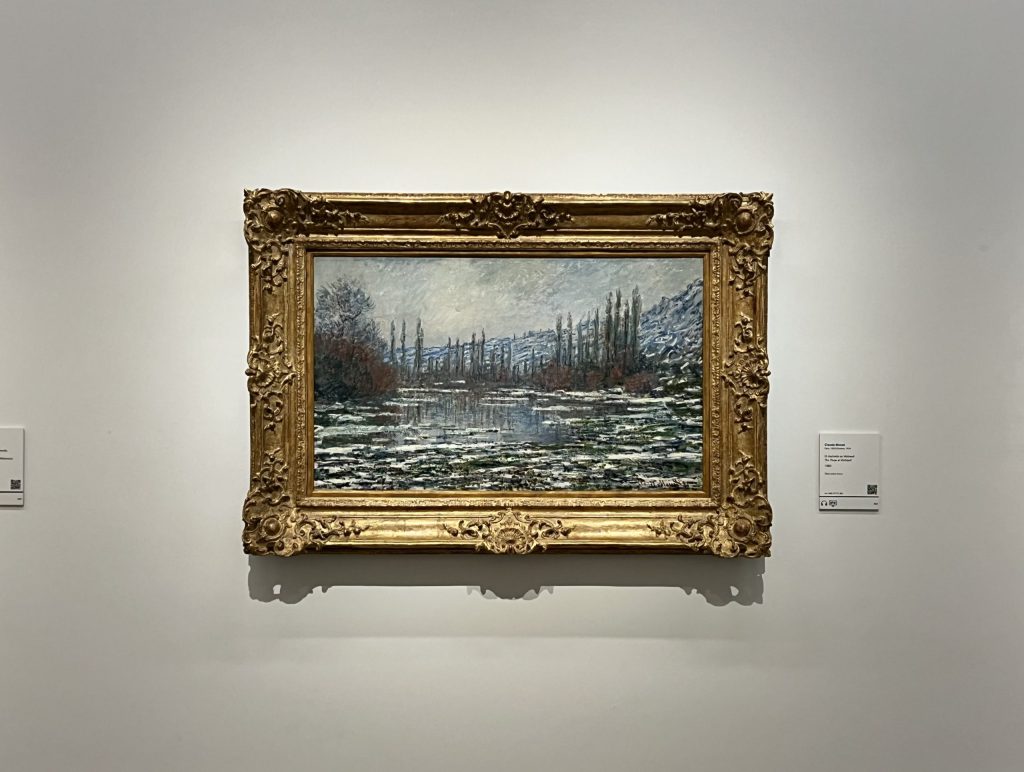
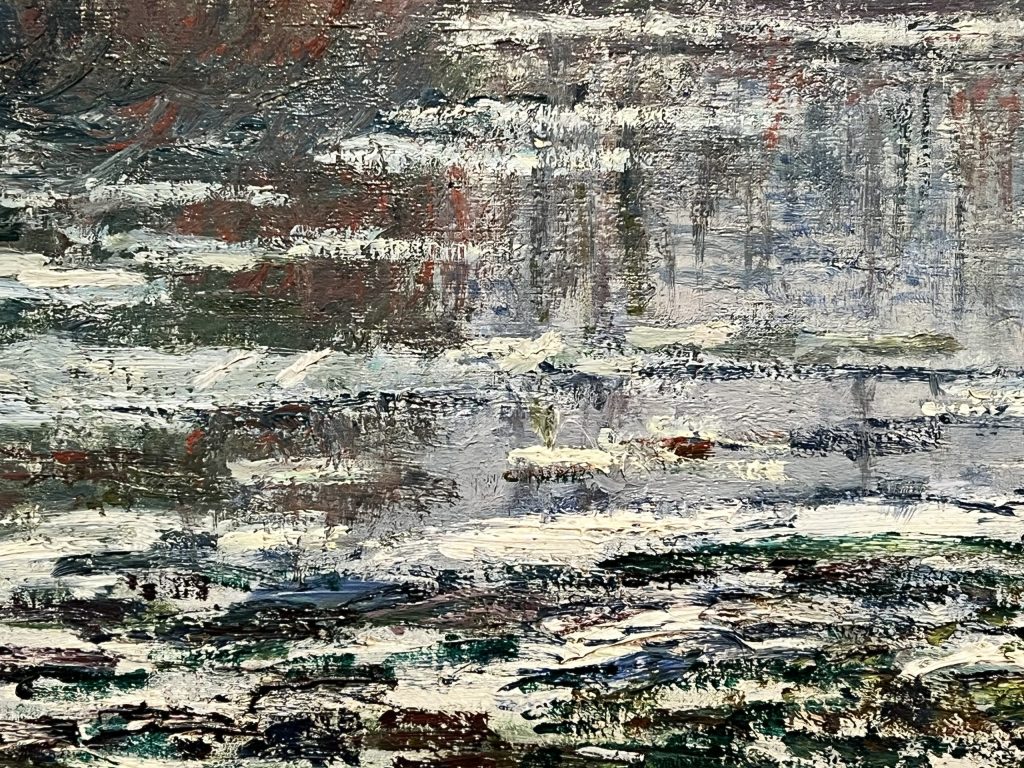
One of the most interesting works for putting everything we have just discussed into practice is The Thaw at Vétheuil, painted in 1880. The painter was living at the time in this village on the banks of the Seine, where the river and its surroundings provided him with numerous subjects for his paintings.
The Thaw at Vétheuil: A Landscape in Transformation
The winter of 1879–1880 was particularly severe, and the Seine froze. When temperatures began to rise, the ice broke apart and large blocks started moving along the river. Monet had therefore found a subject almost perfectly suited to his interests: he was not simply looking at a landscape, but at a landscape that was literally changing before his eyes.
In The Thaw at Vétheuil, water, ice, sky and reflections seem to merge into a single atmosphere. Outlines become less important, and it can be difficult to determine exactly where one surface ends and another begins. Rather than describing every block of ice in minute detail, the artist uses colour and brushwork to convey the sensation of standing beside the Seine at that particular moment.
What Should You Look for in This Painting?
Pay particular attention to the water. The reflections do not behave like a simple mirror: the brushstrokes fragment the surface, and our perception changes depending on how far we stand from the painting. Up close, we see paint; a few steps back, we begin to see water, ice, depth and atmosphere.
It is also worth thinking about time. The moment Monet represents is destined to disappear: the ice will continue to melt, the river will change and the light will be different a few hours later. This desire to capture something temporary takes us directly back to one of the central concerns of Impressionism.
An exercise by your mates from The guides you need: Want to Understand the Impressionists Better? Try This!
From Titian onwards, there are many paintings that are worth looking at first from a certain distance. With the Impressionists, this little exercise is particularly useful. When standing in front of The Thaw at Vétheuil, resist the temptation to walk straight up to the canvas and first look at it from a few steps away.
Then move closer. You will see that what appeared from a distance to be water, ice or a reflection begins to break down into brushstrokes and patches of colour. Step back again and your eye will reconstruct the landscape. Part of the experience of looking at Monet lies precisely in discovering how something we know is paint can visually become light, water and atmosphere.
Renoir: The Painter of the “Everyday Stuff”
While Monet made landscapes and changing light one of his great obsessions, Pierre-Auguste Renoir turned much of his attention towards people. His paintings are full of gardens, gatherings, dances, terraces, walks and everyday scenes in which the figures seem to be part of a moment that continues beyond the edges of the canvas.
He was born in Limoges in 1841 and moved with his family to Paris while still a child. During his artistic training, he met Monet, Alfred Sisley and Frédéric Bazille, three fundamental names in the birth of the new movement. Together, they shared experiences, painted outdoors and took part in the desire to transform painting that would eventually bring the Impressionists together.
A Modern Life Painter
One of the major differences between Renoir and Monet lies in where they directed their attention. Renoir also painted landscapes and shared the movement’s interest in the effects of light, but the human figure occupies a fundamental place in his work. Rather than turning to historical, mythological or religious figures, he found subjects to paint among the people of his own time.
This is why scenes of leisure and apparently simple moments appear so frequently in his work. His figures talk, walk, dance or enjoy a garden. This attention to contemporary life connects Renoir directly with Impressionism: the modern world did not need to be transformed into a grand historical scene to be worthy of painting.
The Human Figure in the Light
However, it is not enough simply to say that Renoir painted people. One of the most interesting things to observe is how he painted them. When his figures appear outdoors, the light does not illuminate them uniformly. Instead, it filters through trees and vegetation, creating reflections and constantly altering the colours of their clothes, skin and surroundings.
Figure and landscape can therefore become integrated through the same brushstrokes and effects of light. This characteristic is particularly useful when looking at Renoir in the Museum, because it can be clearly seen in one of the works we are about to examine.
Renoir at the Thyssen
The Museum allows us to see how Renoir shared many of the concerns of Impressionism without abandoning his particular interest in the human figure. Instead of separating a perfectly defined protagonist from a landscape that merely serves as a background, we find a painting in which figure, vegetation, colour and light seem to form part of the same visual experience.
The work that allows us to see this particularly clearly is Woman with a Parasol in a Garden. We are not witnessing a major event, nor do we need to know a complicated story to understand what is happening. A woman stands in a garden holding a parasol. From such a simple situation, the artist creates a painting that is remarkably useful for understanding his way of looking at the world.
Woman with a Parasol in a Garden
The first thing that stands out is how completely the protagonist belongs to the space around her. Our artist does not construct a perfectly outlined figure and then place her against a landscape. The vegetation, the dress, the flowers and the rest of the garden are built up with brushstrokes that make the different elements seem to interact constantly with one another.
This does not mean that the figure loses importance. On the contrary, she remains the focus of our attention, but Renoir makes her part of the same effects of colour and light that we see throughout the garden. The result is very different from a traditional portrait painted indoors: here, the protagonist exists within a specific atmosphere.
Light Through the Trees
Pay particular attention to the way the lighting works. Light filters through the vegetation and creates variations in colour that help break down the separation between the woman and the garden. Renoir does not need to define every leaf, every flower or every fold in the dress for us to understand what we are seeing. Our eyes end up completing much of that information.
Here we find one of the fundamental characteristics good old Pierre-Auguste shared with other artists in the movement. Light is not simply what allows us to see objects: it can become part of the subject of the painting itself. The garden is also interesting because it allows Renoir to explore what happens when light changes colours and makes surfaces appear to vibrate.
How to Look at Woman with a Parasol in a Garden
When you look at the painting up close, some details become difficult to distinguish. Areas that we immediately identify from a certain distance as vegetation, flowers or parts of the dress can turn into brushstrokes and patches of colour as we move closer. The image that seemed so obvious begins to break apart before our eyes.
Now take a few steps back. The brushstrokes begin to come together again, and what we had just been looking at as paint becomes a garden once more. It is very similar to the exercise we suggested in front of Monet: the distance from which we look at the work changes our perception of it and helps us understand more clearly how Impressionist painting works.
What Makes Renoir Different from Monet?
Precisely because we have just looked at his mate, we can make a direct comparison. Both artists shared an interest in painting outdoors, colour and the changing effects of light, but their priorities were not exactly the same. In The Thaw at Vétheuil, Monet makes us concentrate on a landscape undergoing constant transformation; water, ice and atmosphere almost completely dominate our attention.
In Woman with a Parasol in a Garden, Renoir introduces the human figure into that same artistic problem. Light remains fundamental, but now we see it acting on a person and the space around her. Looking at both works in the Museum allows us to understand something worth remembering throughout the visit: the Impressionists shared many of the same questions, but they did not always give the same answers.
Edgar Degas: The Artist Who Painted Movement
Edgar Degas occupies a rather unusual position within Impressionism. Born in Paris in 1834, he belonged to the same generation as the artists who led this revolution in painting and played an active role in their exhibitions. However, some of the characteristics we immediately associate with the movement do not fit particularly well with the way Degas worked.
While Monet made painting outdoors a fundamental part of his artistic research, Degas preferred to work in the studio. Nor did he reject the traditional importance of drawing. Quite the opposite: he was an extraordinary draughtsman and constructed many of his compositions through careful study of the figure. Despite these differences, he became one of the key figures in the development of the movement.
Was He Really One of the movement?
The short answer is yes, although Degas himself probably would not have been particularly enthusiastic about the question. He participated in seven of the eight exhibitions organised by the group between 1874 and 1886, but rejected the label and preferred terms such as “Realist” or “Independent”. His relationship with the other artists demonstrates once again that Impressionism was never a school governed by a set of rules that everyone had to follow.
Degas shared something far more important with them: an interest in representing the contemporary world in a new way. His settings were not primarily the landscapes that fascinated Monet, but theatres, rehearsal rooms, cafés, racecourses and other spaces of modern life. Within them, he found one of the subjects that would interest him throughout his career: the human body.
Ingres: Degas’ Love of Drawing
One of Degas’ great artistic references was Jean-Auguste-Dominique Ingres, a painter whose approach was very different from the new art emerging in the second half of the 19th century. Degas’ admiration for him helps explain the importance he always gave to line, drawing and the construction of the figure, even when his compositions appear to capture a spontaneous moment.
This becomes particularly interesting after looking at Monet and Renoir. Artists could share exhibitions and many of the same concerns without necessarily using the same techniques. Degas demonstrates that innovation in painting could also emerge from a solid classical training.
His Obsession with Movement
Dancers, horses, musicians, laundresses and women getting ready appear again and again in Degas’ work. What interested him was not simply who these people were, but what they were doing with their bodies. One dancer stretches her leg, another rests after a rehearsal, while a horse is about to begin a race. Movement may already be taking place before our eyes or may be just about to begin.
Ballet became one of his great laboratories. Good old Edgar visited the Paris Opera and observed not only performances but also rehearsals and moments that normally remained hidden from the audience. This allowed him to study much less formal poses: dancers stretching, waiting, correcting a position or resting after physical exertion.
Photography Changed the Way We Look
To understand Degas’ compositions, we also need to think about a relatively new technology in the 19th century: photography. The camera showed that an image did not always need to present its main subject perfectly centred. A captured moment could leave a figure cut off by the edge, pushed towards one side or caught in an apparently unusual pose.
Degas explored similar possibilities in his paintings and drawings. His compositions can give us the impression that we are seeing only one part of a much larger scene, as though life continued beyond the edges of the canvas. That apparent casualness, however, does not mean improvisation: many of these compositions were extremely carefully constructed.
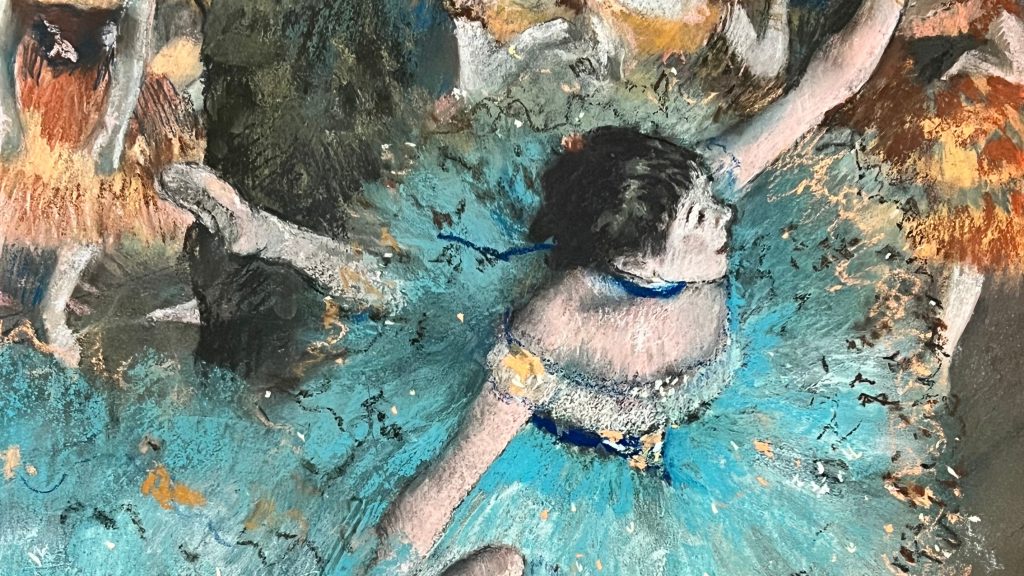
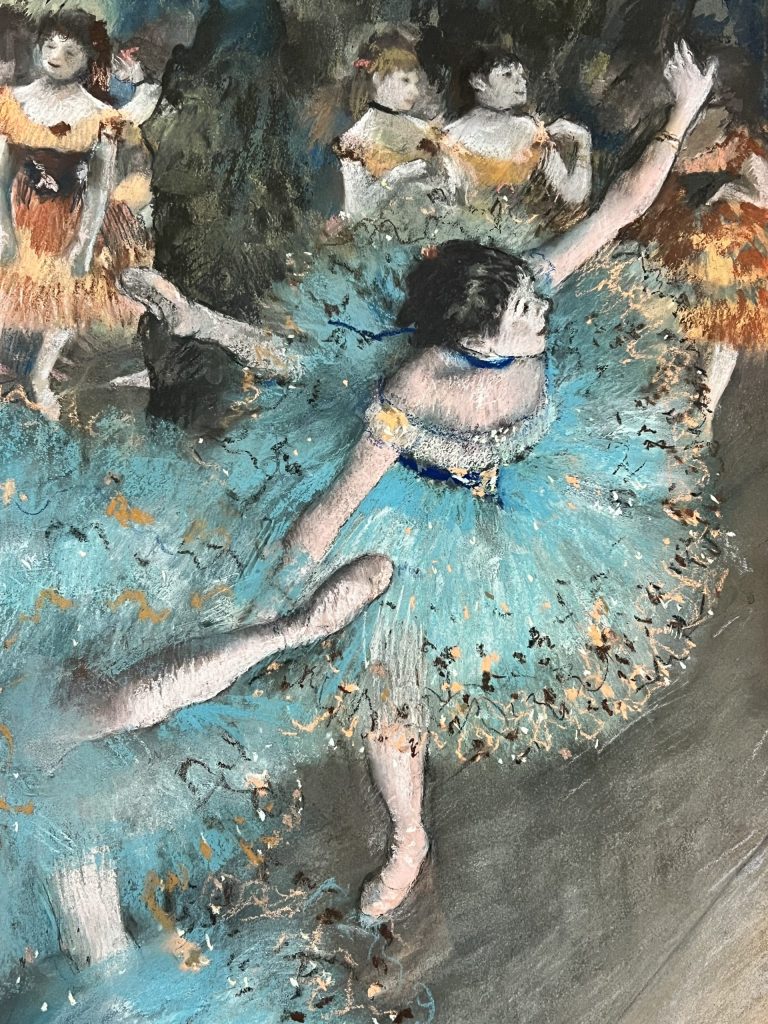
His work at the Thyssen: “Swaying dancer”
His works at the Museum allow us to recognise several of these concerns. After the changing landscape we saw with Monet and the integration of figure, garden and light in Renoir, Degas shifts our attention towards the body, the position of the figures and, above all, the way the artist chooses to show us a scene.
When standing in front of a Degas, it is therefore worth looking beyond the person being represented. Ask yourself where you seem to be observing the scene from. Is the figure in the centre? Can you see the whole body? Does the person seem to be posing for you, or do you feel as though you have arrived while something else was already happening? With Degas, the position of the viewer becomes part of the experience.
Movement Does Not Require a Running Figure
The artist did not need to represent spectacular action to convey movement. A slight change in posture, a leaning figure or a body resting its weight on one leg could be enough. Precisely because he studied drawing and anatomy so carefully, he could suggest what a figure had just done or what movement they might make next.
This creates an interesting contrast with academic painting. Many of his figures do not adopt poses designed to appear solemn or particularly beautiful. They may look tired, distracted or simply be performing an everyday gesture. The body ceases to be merely something we contemplate and becomes something that acts.
A Curiosity from The Guides You Need
Earlier, we explained how photography changed the way people looked at images and how this artist explored some of the possibilities offered by these new kinds of composition. Our boss likes to take this idea one step further. In his view, of the Impressionists featured in this article, Degas is the one who pushes the way an image is constructed furthest forward. His argument has less to do with brushwork or colour than with something that feels completely familiar to us today: the position from which we choose to look.
It is an observation that often comes up during our guided tours of the Thyssen. When we reach Degas, it is worth forgetting for a few seconds about what he is depicting and asking how he has chosen to show it to us. His figures are pushed away from the centre, some bodies are cut off by the edges of the canvas, and the viewer can find themselves looking from viewpoints far removed from a perfectly balanced, frontal composition.
Degas’ “Cinematic” Framing
Our boss explains it using a deliberately anachronistic comparison: there is something “cinematic” about Degas. Obviously, Degas could not have been imitating a cinematic language that did not yet exist as we understand it today. The relationship works the other way around: photography had already begun to transform the way images were constructed, and we, accustomed to more than a century of cinema, recognise some of Degas’ experiments as surprisingly familiar.
Elevated viewpoints, figures partially outside the frame, protagonists pushed away from the centre and scenes that seem to have begun before we arrived create a strikingly modern effect. Perhaps that is why the painter can feel so immediate when we look at his work today at the Thyssen: he experimented radically not only with what he painted, but also with the position from which we see it.
Manet: Why Is He Not on Our List?
Édouard Manet is frequently associated with the artists discussed in this article and had an enormous influence on several of them. There is, however, an important difference: he never participated in their independent exhibitions. Manet preferred to continue submitting his work to the Paris Salon, the same institution whose importance we discussed earlier.
Although he played a fundamental role in the changes taking place in French painting, it is therefore more accurate to see him as a precursor and close companion of the group rather than one of its members. That is why we have chosen to focus primarily on Monet, Renoir and Degas.
So, What About Horsewoman, Full-Face?
Things become slightly more complicated when we look at Horsewoman, Full-Face at the Thyssen Museum. Its brushwork, treatment of the figure and departure from a polished academic finish make the boundaries between artistic labels seem considerably less clear.
And perhaps that is the most interesting conclusion. Art history needs categories to explain how painting developed, but artists rarely worked with those categories in mind. Manet chose not to participate in the independent exhibitions, but that did not stop him from helping to open the path that Monet, Renoir, Degas and others would later explore.
Want to Discover These Artists with Us?
In a nutshell, this is what our tours are all about:
👤 Small groups of no more than 7 people.
🎟️ Admission included. You do not need to buy your museum ticket separately.
🙅🏻♂️ Free cancellation and changes up to 24 hours before the tour.
🏛️ Professional guides who bring the paintings to life and give you the historical and artistic context you need to understand what you are looking at.
🇪🇸🇬🇧 Tours are available in Spanish and English and, if you contact us in advance, we can also arrange them in Italian or French. 🇮🇹🇫🇷
You have read about the paintings. Now come and see them for yourself.