At the beginning of the 20th century, some artists began to wonder why a painting should represent the world from a single point of view. If we can observe an object from different angles, move around it, and retain different perspectives in our memory, why should painting be limited to reproducing only what we see at a particular moment?
Cubism emerged from questions like these and profoundly transformed the history of art. Objects began to fragment, traditional perspective lost its authority, and pictorial space no longer behaved like a window opening onto a perfectly ordered reality. The aim was no longer simply to copy what stood before the artist’s eyes, but to construct a new way of representing it.
Picasso, Juan Gris, and María Blanchard will guide us through this transformation from three very different perspectives. Through their works, we will explore how this new approach to painting emerged, its main characteristics, and why its consequences extended far beyond the artists directly involved in it.
In this article, we will therefore take a journey through one of the great artistic revolutions of the 20th century. We will begin with the simplest question of all: what exactly does this movement mean?
In this article
What Is Cubism in Simple Terms?
Cubism is a way of representing reality that breaks with the idea that a painting should show what we see from a single point of view. Instead of trying to faithfully reproduce the appearance of an object, artists break it down into different forms and show several of its aspects within the same image.
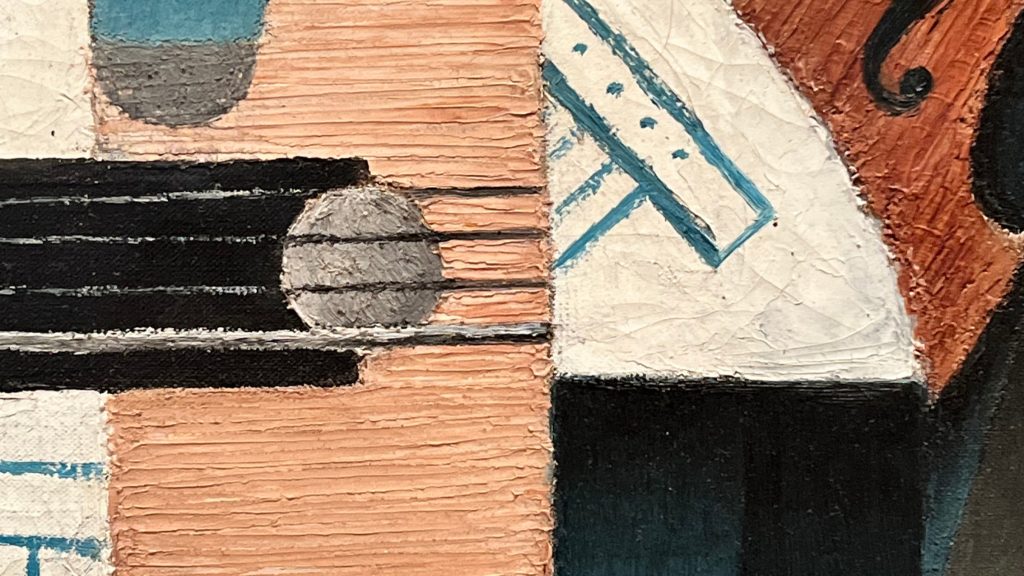
Think, for example, of a guitar placed on a table. If we remain still in front of it, we see one particular side of the instrument. But we can walk around it, observe its profile, move closer to its body, or look at it from above. Our experience of that guitar is made up of all these perspectives, not just one.
Painters associated with this new approach began to bring something similar onto the canvas. A face could appear simultaneously from the front and in profile; a table could tilt in a way that would be impossible according to traditional rules of perspective; and objects could become so fragmented that they were difficult to recognize.
A Break with Centuries of Perspective
The importance of this transformation becomes clearer when we consider the tradition it challenged. Since the Renaissance, perspective had made it possible to create the illusion of a coherent three-dimensional space on a flat surface. A painting could function almost like a window: the viewer looked from a fixed position into a world organized through depth, proportion, and distance.
At the beginning of the 20th century, some artists stopped considering this the only valid way to represent the world. It was not that they had forgotten how to draw correctly. Picasso, Braque, and other artists understood the conventions they were challenging. The break was deliberate.
Nor was the aim simply to turn every object into geometric shapes. Fragmentation offered a way to investigate how we mentally construct what we see. A painting could bring together different perspectives and moments on the same surface, even if the result no longer corresponded to the way a camera captures reality.
Representing What We Know, Not Only What We See
Here we find one of the most interesting ideas behind this artistic revolution. When we look at an object, our relationship with it does not depend solely on the image reaching our eyes at a particular moment. We know that it continues behind the part we can see, we remember what it looks like from other angles, and we can move around it to obtain new information.
Painting could incorporate this more complex experience. For this reason, distortion should not necessarily be understood as an arbitrary departure from reality. In a sense, these artists were attempting to provide more information about an object than a single point of view could offer.
This transformation opened up enormous possibilities for subsequent generations. To understand how it began, however, we need to answer another of the most common questions: who invented Cubism?
Who Invented Cubism?
There was no single inventor of Cubism. Although Pablo Picasso played a fundamental role in its emergence, the new movement developed primarily through the intense artistic exchange he maintained with Georges Braque in Paris during the years before the First World War. For a time, the two worked so closely that some of their paintings from those years can be difficult to distinguish at first glance.
One of their most important predecessors was Paul Cézanne. His way of constructing landscapes, figures, and objects through volumes had an enormous influence on young artists at the beginning of the 20th century. Picasso’s interest in other artistic traditions, including Iberian sculpture and certain forms of African art, was also important.
Picasso, Braque, and a Shared Revolution
Les Demoiselles d’Avignon, painted by Picasso in 1907, is often considered a decisive work in this process. Its figures radically break with the traditional representation of the human body and space. However, we have not yet reached the artistic language that the two painters would soon develop together.
Braque was deeply impressed by the painting, although his initial reaction was hardly enthusiastic. Over the following years, the two artists began exchanging ideas and investigating similar problems. Between 1909 and 1914, their collaboration became particularly close: they visited each other’s studios, followed one another’s progress, and pursued their experiments along parallel paths.
It is therefore misleading to present this transformation as the sudden discovery of a single genius. Picasso was essential, but Braque also played an active role in the creation and development of this new pictorial language.
Where Does the Word “Cubism” Come From?
Interestingly, the name was not chosen by the artists themselves. In 1908, Henri Matisse was part of the jury that rejected one of Braque’s paintings for the Salon d’Automne and described its forms in terms of small cubes. Shortly afterwards, the critic Louis Vauxcelles used a similar expression when writing about the painter’s works.
The term eventually became established as the name for an artistic revolution that was far more complex than simply reducing objects to geometric forms. What began almost as a critical description ended up naming one of the most influential movements of the 20th century.
A Curiosity: the Name “Impressionism” Was Born in a Similar Way
As we explained in our article on the subject, the term Impressionism emerged in a rather similar way. In 1874, the critic Louis Leroy used the title of Claude Monet’s Impression, Sunrise to mock the works exhibited by those painters. What had begun as ridicule eventually became the name by which we know the movement.
In both cases, then, a word initially applied from outside the group and with a critical intention became inseparable from some of the most important artists in the history of art.
Picasso and Braque were the main driving forces behind the new movement in its early years, but other artists soon began exploring the possibilities opened up by this break with tradition. Among them were two essential figures in our journey: Juan Gris and María Blanchard.
What Are the Two Types of Cubism?
Although the development of this artistic movement was complex and cannot be divided into completely separate stages, it is traditionally divided into two main types: Analytical and Synthetic Cubism. The distinction between them helps us understand how an investigation that began by fragmenting objects eventually incorporated materials taken directly from everyday life.
Analytical Cubism: Breaking Down to Understand
The first of these stages developed mainly between 1909 and 1912. Picasso and Braque pushed their experiments to the point where objects began to break down into numerous planes and geometric forms.
A face, a guitar, or a bottle could be viewed from different angles within the same composition. Traditional depth was reduced, while figures seemed to merge with the space around them. In some paintings, it can even be difficult to recognize immediately what we are looking at.
Color became less prominent during these years. Browns, greys, ochres, and muted tones allowed attention to focus on the structure of the image without an intense palette distracting the viewer. The fundamental question seemed to be how an object could be analyzed and reconstructed on a flat surface.
Analytical Cubism: Breaking Down to Understand
The first of these stages developed mainly between 1909 and 1912. Picasso and Braque pushed their experiments to the point where objects began to break down into numerous planes and geometric forms.
A face, a guitar, or a bottle could be viewed from different angles within the same composition. Traditional depth was reduced, while figures seemed to merge with the space around them. In some paintings, it can even be difficult to recognize immediately what we are looking at.
Color became less prominent during these years. Browns, greys, ochres, and muted tones allowed attention to focus on the structure of the image without an intense palette distracting the viewer. The fundamental question seemed to be how an object could be analyzed and reconstructed on a flat surface.
Synthetic Cubism: Reconstructing the Image
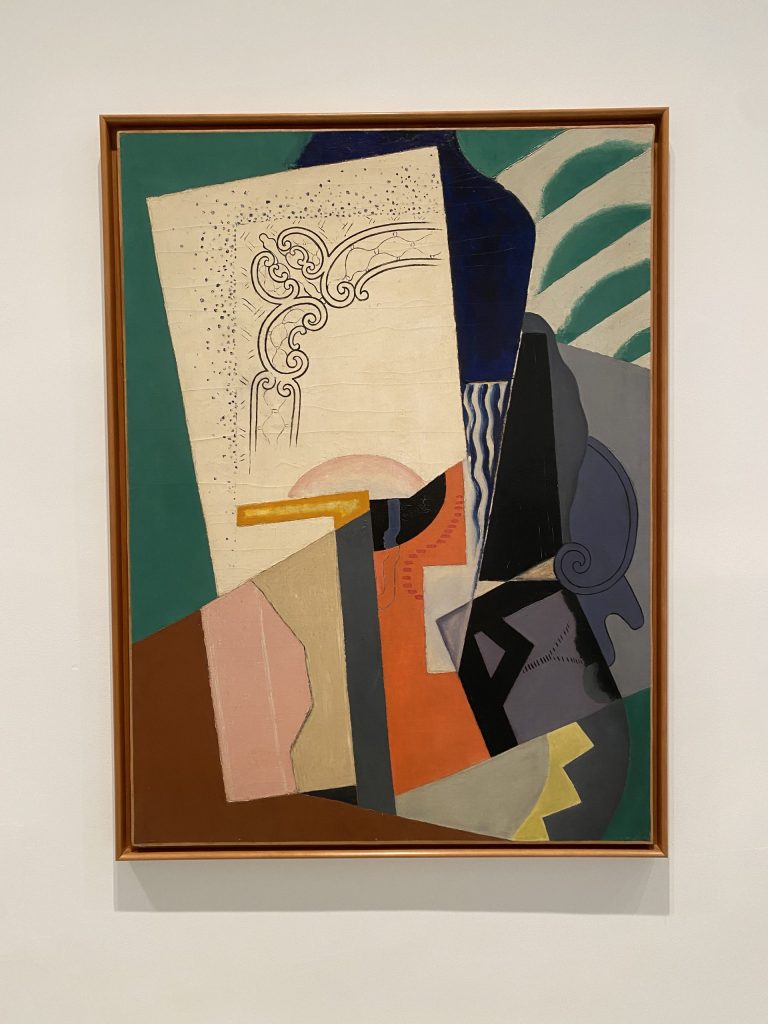
From around 1912, a different direction began to develop. Rather than fragmenting objects further and further, compositions moved towards broader and more recognizable forms. Color regained importance, and new materials appeared that would profoundly change the history of art.
One of the major innovations was collage. Newspaper, labels, pieces of wallpaper, or letters could be incorporated into a composition. Suddenly, an element taken from the real world physically entered an artwork that, at the same time, continued to represent other objects.
The difference may seem paradoxical. The analytical phase breaks down what we see in order to examine it from multiple perspectives; the synthetic phase reconstructs it using simpler forms and different elements. Both, however, challenge the idea that a painting should simply imitate the appearance of the world.
Two Stages, but Not Two Absolute Rules
These categories are useful for understanding the movement’s development, but they should not be treated as rigid boundaries. Artists experimented continuously, and characteristics associated with one stage could coexist with those of the other.
Moreover, when other painters adopted this new artistic language, they did so according to their own interests. Juan Gris, for example, developed compositions of remarkable structural clarity, while María Blanchard found a personal voice that cannot simply be explained as a repetition of Picasso and Braque’s experiments. This diversity will allow us to see that this pictorial revolution was far richer than a succession of established formulas.
Picasso, Juan Gris, and María Blanchard: Three Spanish Artists Who Transformed Painting
So far, we have discussed ruptures, multiple perspectives, and new ways of constructing an image. But these ideas become much easier to understand when we leave theory behind and look at how individual artists used them. Picasso, Juan Gris, and María Blanchard shared the artistic environment of early 20th-century Paris, although each developed a distinctive pictorial language.
Pablo Picasso: The Beginning of the Break
Talking about Pablo Picasso inevitably takes us back to the early years of this artistic revolution. As we have seen, he did not work alone: his collaboration with Georges Braque was fundamental. However, his constant willingness to question the solutions he found helps explain why he occupies such a central place in this story.
Les Demoiselles d’Avignon, painted in 1907, represents one of the great turning points. The bodies appear angular, space loses its traditional depth, and the faces move radically away from the conventions of Western painting. The work caused bewilderment even among people close to the artist. It was not yet a Cubist painting in the strict sense, but many of the questions that would lead towards this new language were already present.
Taking an Object Apart to Reconstruct It
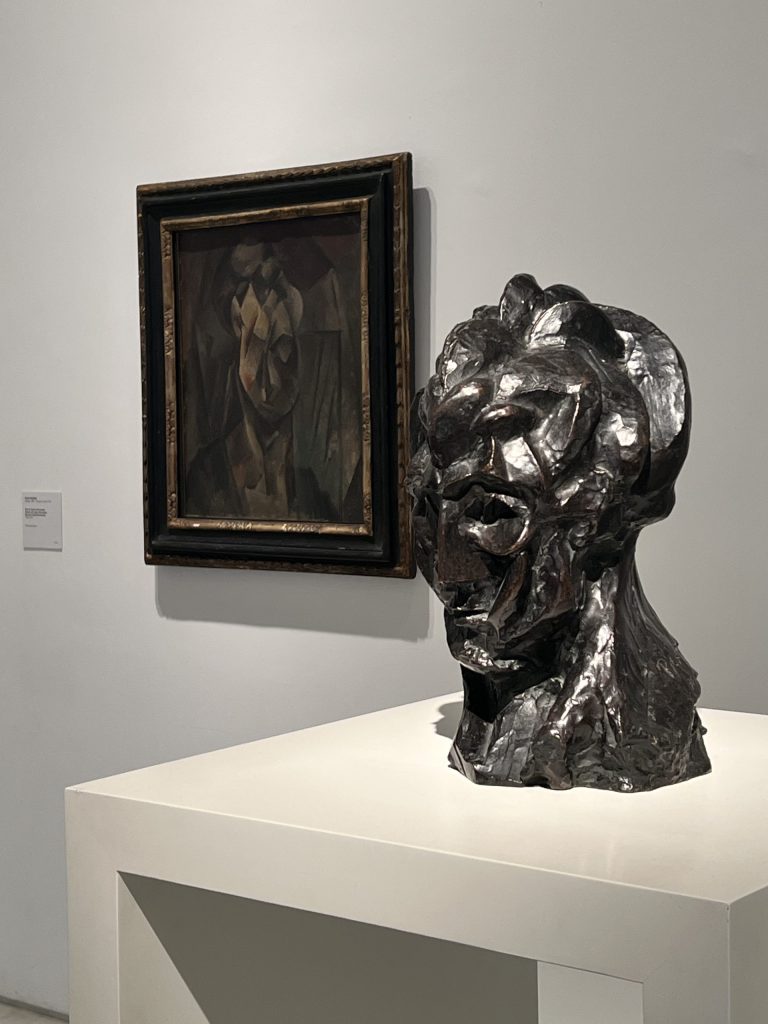
During the following years, the research developed alongside Braque went much further. A guitar, a bottle, or a face could be broken down into planes that seemed to show different parts simultaneously. Perspective no longer organized the painting from a single position.
What is particularly interesting is that the Málaga-born painter did not abandon reality. He continued to work with people, musical instruments, tables, and everyday objects. What changed was the way he represented them. Instead of accepting that the eye had to remain still in front of a scene, an image could bring together different visual experiences on the same surface.
Nor did he remain indefinitely within this artistic language. His career went through numerous later periods and experiments. Reducing Picasso to Cubism would be as limiting as explaining the entire movement through him alone.
His importance lies, to a large extent, in helping to open a door that other artists would pass through in very different ways. One of them was Juan Gris, who took many of these investigations and developed them into paintings of remarkable clarity and order.
Juan Gris: Organizing Fragmentation
If Picasso was there at the beginning of the break, Juan Gris arrived somewhat later and developed this new artistic language with a very different personality. Born in Madrid in 1887 as José Victoriano González-Pérez, he moved to Paris in 1906. There, he became involved in avant-garde circles and met some of the artists who were transforming European painting.
His first works associated with this movement appeared when Picasso and Braque’s experiments were already well underway. This did not make the Madrid-born painter a mere follower. On the contrary, he used those possibilities to construct images characterized by particularly rigorous organization.
Painting Constructed with Precision
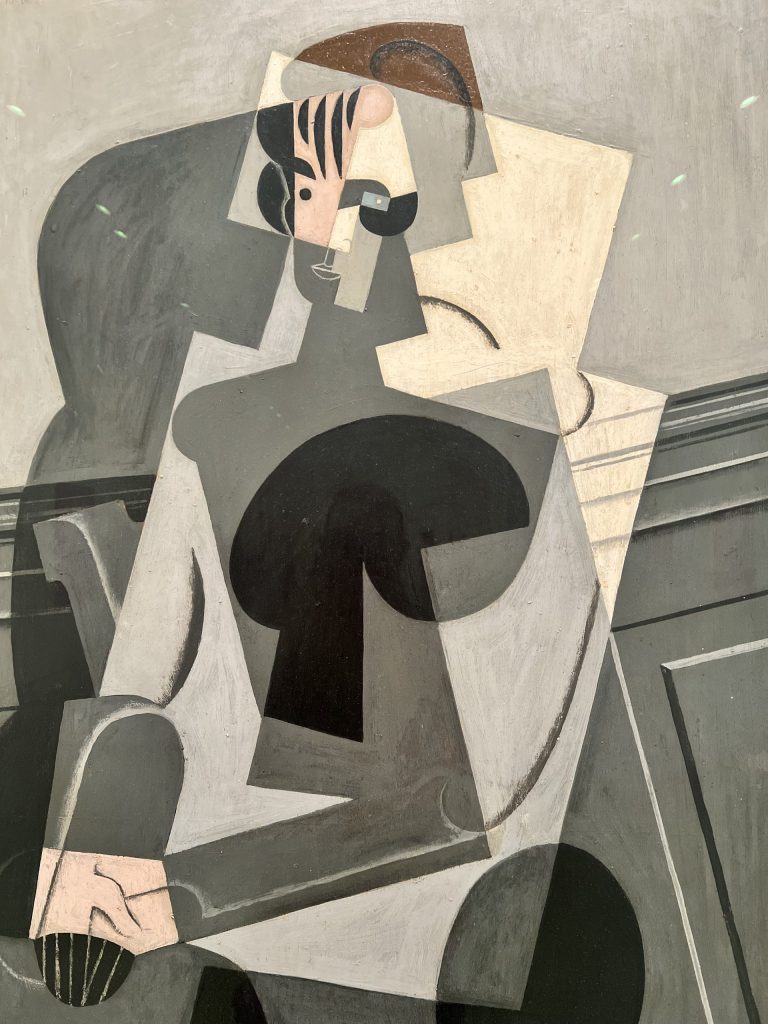
Many of his compositions feature elements that were common during those years: guitars, newspapers, bottles, glasses, or tables. However, the fragmentation is usually governed by a carefully calculated structure. Forms seem to fit together, while color gradually takes on greater importance.
This clarity is particularly evident in his still lifes. Objects may be divided and observed from different perspectives, but the composition retains a balance that allows the viewer to mentally reconstruct what lies before them. Geometry does not necessarily destroy the object: it can also serve to organize it.
Collage and papiers collés also formed part of his experiments. Letters, textures, and fragments that imitate or incorporate everyday materials complicate the relationship between what is painted and what belongs to the real world.
Gris thus demonstrates that the ideas developed during those early years could lead in highly personal directions. He did not simply repeat the pioneers’ solutions but created a body of work recognizable for its balance, structure, and way of organizing the image.
And he was not the only Spanish artist to find in avant-garde Paris a place to develop a distinctive voice. María Blanchard, his friend and fellow artist, also participated in these experiments, although for decades her name occupied a far less visible place in the history of the movement.
María Blanchard: A Distinctive Voice within Cubism
María Blanchard was born in Santander in 1881 and first arrived in Paris in 1909. The French capital brought her into contact with new artistic movements and, after settling there permanently in 1916, she developed a particularly close relationship with Juan Gris. Her involvement in these circles placed her at the heart of some of the most important transformations in European painting.
Her work also demonstrates why it is insufficient to tell this story solely through his male colleagues. The Cantabrian painter absorbed the experiments taking place around her but used them to construct a personal language, with a particular interest in color and a strong organization of forms.
Geometry, Color, and a Personal Vision
During the period most closely associated with this avant-garde, figures and objects appear fragmented and reconstructed through overlapping planes. However, her compositions are not simply geometric exercises. Color plays a significant role and helps organize a surface in which each element seems to be carefully related to the others.
Her friendship with Gris was important both personally and artistically. They shared interests and participated in an environment where ideas circulated constantly between studios, galleries, and exhibitions. Yet looking at their works side by side also reveals their differences: each used this new vocabulary to construct a distinctive pictorial identity.
Much More Than a Cubist Artist
At the beginning of the 1920s, her painting began to move towards a different kind of figuration. Domestic scenes, mothers, children, and other figures appeared more frequently, with an emotional presence that moved away from the experiments of the previous years. For this reason, reducing her entire career to a single label does not do justice to the richness of her work.
For decades, Blanchard received far less attention than many of the men of her generation. Her historical reassessment now allows us to give her the place she deserves and to better understand the diversity of this avant-garde.
Her presence alongside Picasso and Juan Gris completes our journey through three Spanish artists who started from common artistic problems but found very different answers. Fortunately, in Madrid we can see works by all three without having to experience them only through books or reproductions.
In Madrid’s Museums
Madrid offers an exceptional opportunity to complete this journey in front of the original works. The Reina Sofía Museum holds works by all three artists featured in our article and allows us to see how a shared artistic language could lead to very different results. Its collection includes important works by Juan Gris and María Blanchard, as well as an extensive representation of Picasso’s career.
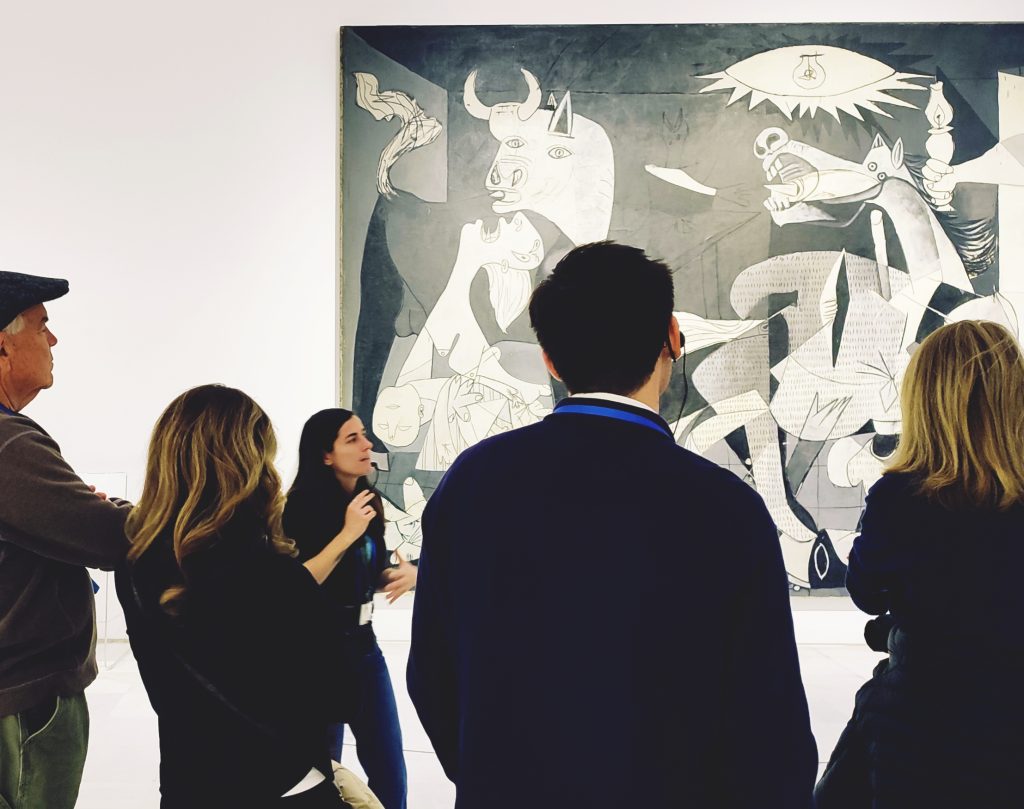
The museum is also home to Guernica, created many years after the early experiments we have discussed. Although it is not a Cubist work in the strict sense, it is difficult to understand certain aspects of its construction without considering the transformations that had previously shaped the Málaga-born artist’s painting.
The Thyssen-Bornemisza Museum allows us to take this story even further through its collection of 20th-century art. Visiting both museums therefore offers an opportunity to trace the consequences of that artistic break and observe how ideas that emerged in early 20th-century Paris ultimately transformed much of the art that followed.
🎨 Discover Cubism with The Guides You Need
👀 Seeing these works in person makes it much easier to understand what we have discussed. At The Guides You Need, we offer guided tours of the Reina Sofía Museum and the Thyssen-Bornemisza Museum, exploring their collections, the context in which their artists worked, and why they transformed the history of art.
🖼️ At the Reina Sofía Museum, we can follow the careers of these three great artists, while the Thyssen-Bornemisza Museum allows us to broaden the journey through the 20th-century avant-garde and explore its connections with other movements and artists.
🧑🏫 Our professional guides adapt their explanations to each group and approach every tour as a conversation in front of the artworks, without memorized scripts. If you want to go beyond dates and labels, a guided tour can help you understand why these paintings changed the way we see art.
👉 Explore our tours offered and choose the one that best suits your visit to Madrid.