Mythology at the Prado plays a far more important role than it might seem at first glance. Among portraits of kings, religious scenes and great historical episodes, we find gods falling in love with mortals, heroes confronting monsters, metamorphoses, abductions, punishments and passions that were first told many centuries before the museum even existed.
Their presence is no coincidence. For centuries, Spanish monarchs assembled some of the great mythological paintings of European art. Artists such as Titian, Rubens and Velázquez found in these stories an extraordinarily fertile territory for exploring desire, violence, beauty, jealousy and power.
But entering this universe immediately raises a few questions. Why are there so many myths in the Prado Museum? Which gods and stories can we find in its galleries? Why do we sometimes speak of Zeus and other times of Jupiter? And where do all these stories actually come from?
In this article, we will answer five essential questions for understanding mythology at the Prado. It will also be our starting point for exploring, little by little, the myths and characters hidden behind some of the museum’s greatest works.
In this article
Why Is There So Much Mythology in the Prado Museum?
The answer lies largely in the origins of its collections. The Prado Museum opened its doors in 1819, but many of the works it houses today had been collected over centuries by the Spanish monarchy. The Habsburgs, and later the Bourbons, commissioned and acquired numerous paintings inspired by classical mythology, some of them created by the most important artists in Europe.
These works did not serve the same purpose as religious painting. Mythological painting allowed artists to depict nudity, romantic passions, violence, desire and extraordinary transformations through stories inherited from Antiquity. It also provided a language rich in political and cultural meanings that an educated elite could recognise. Myths, therefore, decorated palaces, but they could also speak about power, virtue, love, war and fate.
From the Royal Collections to the Prado Museum
The Spanish Habsburgs had a particularly important relationship with this type of painting. Charles V and Philip II were closely associated with Titian, while Philip IV assembled an extraordinary collection and made Rubens and Velázquez two essential names for understanding the presence of mythology at the Prado.
Many of these paintings were originally displayed in royal residences such as the Alcázar of Madrid, the Buen Retiro Palace and the Torre de la Parada. They were not created with a modern museum in mind: they formed part of decorative programmes, private collections and spaces associated with the royal court. Over time, many of them entered the Prado’s collections, moving from royal palaces into galleries open to the public.
So, when we walk through the Prado Museum today, we are not simply looking at a collection of paintings about gods and heroes. We are also seeing the result of several centuries of collecting, commissions and the personal tastes of the Spanish monarchy. This history helps explain why Madrid is now home to some of the great masterpieces of mythological painting in European art.
Was Mythological Painting Considered a Second-Rate Genre?
Although some of these works are now among the most celebrated paintings in the Prado Museum, artistic genres were not regarded in the same way as they are today. For much of the Early Modern period, there was a clear hierarchy of subjects, with history painting at the top. This category encompassed major religious, historical, literary and allegorical subjects.
In fact, mythological painting could itself belong to this prestigious category, since it drew on stories from Antiquity and required artists to demonstrate their knowledge of literature, anatomy, composition and the representation of human passions. However, within royal collections, scenes from classical mythology did not always have the same function or status as major religious or dynastic compositions.
This also helps explain where many of these works were displayed. Myths could occupy more private spaces or areas associated with leisure at court, where nudity, eroticism and certain amorous stories found a place that would have been more difficult in other contexts. Their subject matter could be considered less solemn, but this did not make them minor works: monarchs entrusted these subjects to some of the most prestigious painters of their time.
This apparent contradiction is important for understanding mythology at the Prado: subjects that could occupy a secondary position compared with certain religious or political images were painted by first-rate artists and, centuries later, became some of the museum’s masterpieces.
Which Are the Main Mythological Gods We Can See at the Prado?
One of the difficulties when approaching mythology at the Prado is recognising its protagonists. Painters could depict gods with an entirely human appearance, but they usually included attributes, animals or objects that helped identify them. A thunderbolt, a trident or a bow could provide viewers with the clue they needed to understand who stood before them.
Among the gods with the strongest presence are Jupiter, ruler of Olympus and protagonist of countless love affairs; Venus, goddess of love and beauty; Mars, associated with war; Diana, goddess of the hunt; Apollo, associated, among other things, with music and the arts; and Bacchus, god of wine. They are joined by Mercury, Minerva, Neptune, Saturn and many other figures from classical mythology.
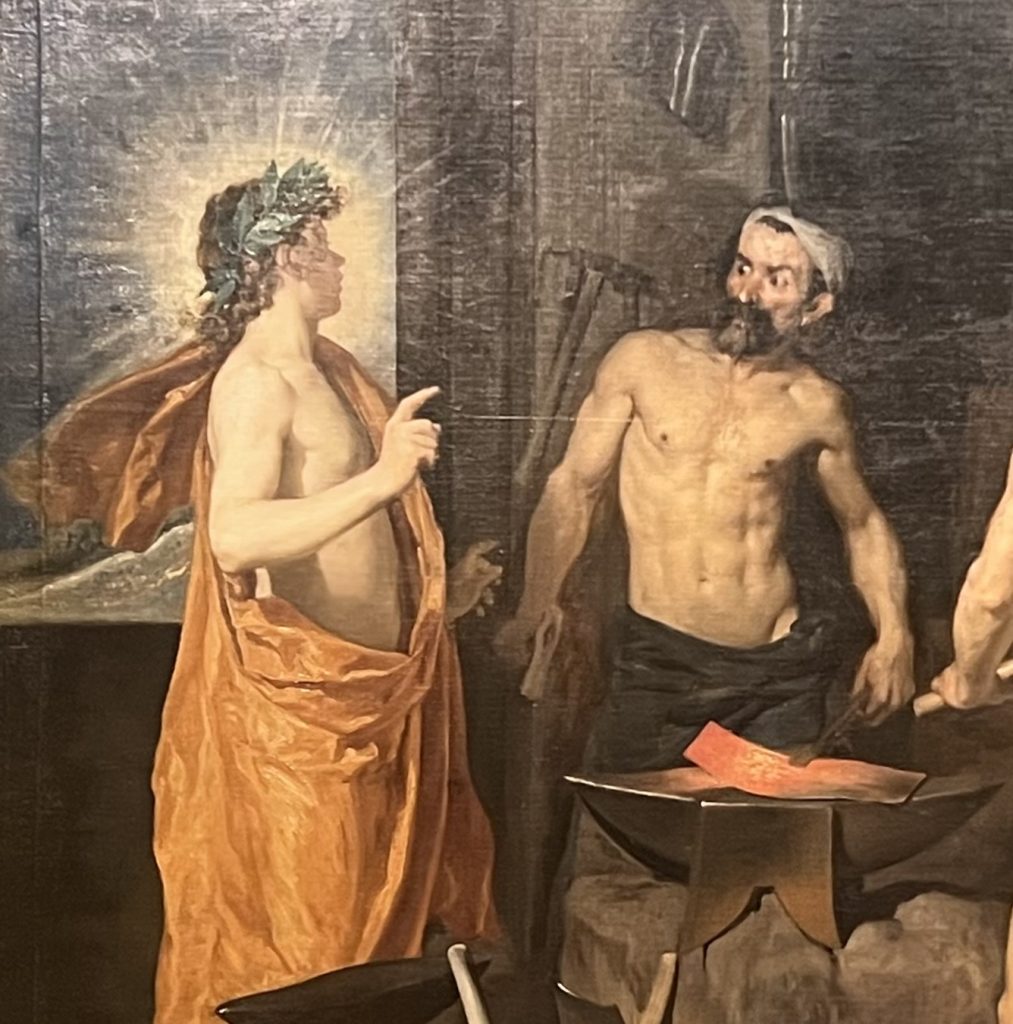
The Prado also allows us to see that these characters do not have a single appearance. Velázquez could transform Mars into a tired, contemplative man, while Rubens filled his mythological compositions with bodies in motion. The identity of the god remains, but each artist can reinterpret the character and use myths for very different purposes.
How Can We Recognise a God in a Painting?
Iconography is our best tool for recognising gods in a painting. The term refers to the set of attributes, gestures, objects and animals that allow us to identify a mythological character. Jupiter may appear with an eagle or a thunderbolt; Neptune with his trident; Mercury with the caduceus and winged footwear; Diana with her bow and the moon; and Bacchus with vine leaves, grapes or vessels associated with wine. Venus is more complex because her representations vary greatly, although she may appear accompanied by Cupid.
These visual codes were particularly useful because they allowed viewers to identify a character immediately, without the need to depict an entire narrative episode. For an audience familiar with classical culture, certain attributes functioned almost like a name written beside the figure.
Learning to recognise them also changes the way we explore the Prado Museum. A nude figure, an animal or an apparently secondary object may provide the very clue we need to reconstruct the story the painter is telling. Mythological painting therefore functions as a visual language: the better we understand its codes, the easier it becomes to read it.
What Are the Most Important Myths Represented in the Prado Museum?
Choosing just a few is difficult because mythology at the Prado encompasses everything from the great gods to heroes, monsters, love stories, punishments and metamorphoses. However, certain stories appear repeatedly or inspired fundamental works in the collection.
One of the great protagonists is Hercules, whose figure was particularly closely associated with the Spanish monarchy. Zurbarán depicted several of his labours for the Hall of Realms in the Buen Retiro Palace, turning the hero of classical mythology into a figure that could also be associated with strength and the legitimacy of royal power.
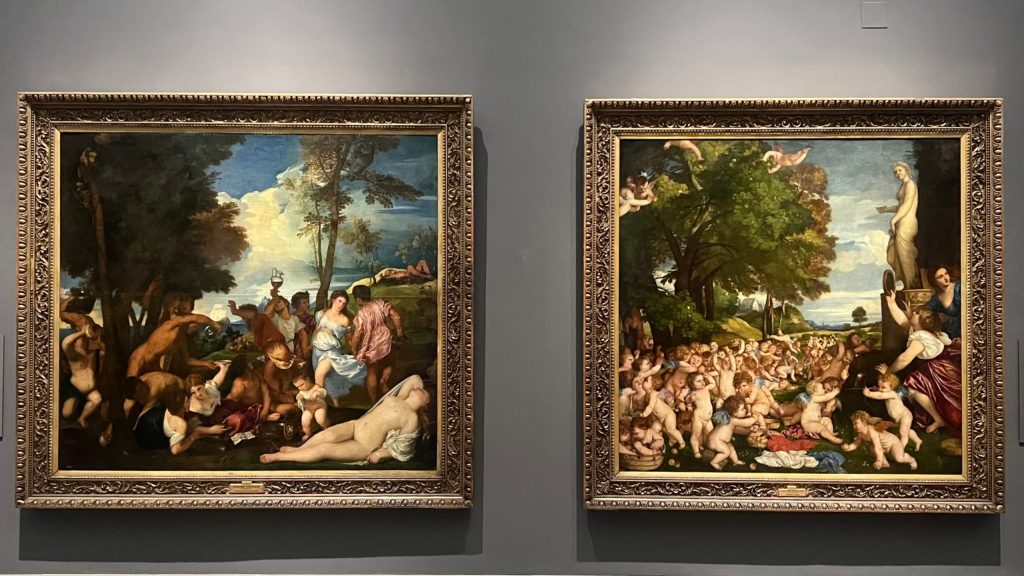
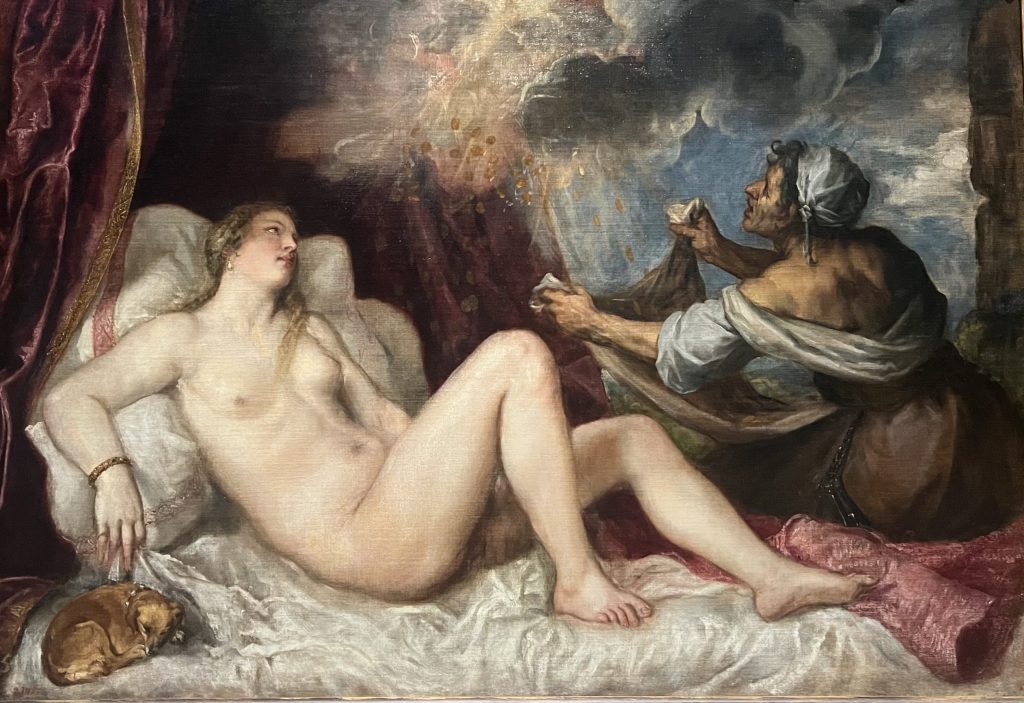
The world of Titian’s celebrated Poesie is very different. Stories such as Danaë, Venus and Adonis and the Rape of Europa allowed the painter to explore some of the great amorous and tragic narratives of Antiquity. Although not all the paintings from that series are now held by the Prado, their history is essential for understanding the Habsburgs’ fascination with myths.
Rubens also occupies a privileged place. The Judgement of Paris, Perseus and Andromeda and The Three Graces show how mythological painting could be used to represent beauty, desire and movement. Alongside these scenes, we find much more disturbing interpretations, such as Goya’s Saturn Devouring His Son, in which an ancient story acquires an entirely different kind of violence.
There is, therefore, no single way to represent a myth. The same story could be transformed according to the period, the setting for which the painting was commissioned and, above all, the artist who interpreted it. This ability to change without losing their identity goes a long way towards explaining the extraordinary survival of these stories.
Why Are the Names Sometimes Greek and Sometimes Latin?
Zeus or Jupiter, Aphrodite or Venus, Ares or Mars, Heracles or Hercules. Anyone beginning to explore mythological painting may get the impression that these are different characters when, in many cases, we are dealing with gods and heroes who came to be identified with one another in the Greek and Roman traditions.
Rome absorbed and reinterpreted much of the Greek religious and narrative tradition, establishing correspondences between its own deities and Greek gods. However, we should not think that their names were simply changed. The characteristics, cults and meanings associated with some of these figures also evolved as they became integrated into Roman culture.
Moreover, much of later European culture encountered these stories through Latin authors and commonly used Roman names. This is why, in art history, it is entirely normal to speak of Jupiter, Venus, Mars or Diana, even though many of their stories originated in the Greek tradition.
Throughout this series, we will mainly use the names traditionally employed for the works and characters in art history and by the Prado Museum. This is why we may sometimes speak of Hercules while also encountering references to Heracles: knowing both names will make it much easier to navigate the vast world of classical mythology.
Which Painters Represented Mythology at the Prado?
The extraordinary richness of mythology at the Prado does not depend solely on the number of stories represented. Over several centuries, some of Europe’s greatest painters turned to classical mythology, finding in it a fertile ground for experimenting with the nude, movement, colour and the representation of human emotions.
Among them, Titian stands out. His relationship with Charles V and, especially, Philip II helps explain the importance of Venetian mythological painting within the Spanish royal collections. For Philip II, he created his celebrated Poesie, a series inspired mainly by stories from Ovid in which the painter transformed ancient myths into scenes dominated by desire, sensuality and tragedy.
Rubens and Velázquez: Two Ways of Returning to the Myths
A century later, Peter Paul Rubens returned to many of these stories. His knowledge of Titian was fundamental, but his paintings introduced a different energy: powerful bodies, diagonals, movement and compositions in which the action seems capable of continuing beyond the canvas. Works such as The Judgement of Paris show how mythological painting could be reinterpreted again and again.
Velázquez followed a very different path. In The Drunkards, also known as The Triumph of Bacchus, the god appears surrounded by men who seem to have stepped straight out of seventeenth-century Spain. Something similar happens in his Mars, far removed from the triumphant image we might expect of the god of war. Velázquez brings mythological characters closer to everyday life and constantly plays with the distance between ancient stories and the reality of his own time.
From Titian’s Gods to Goya’s Monsters
The tradition did not end with the Baroque. Centuries later, Goya turned to one of the most terrifying stories in classical mythology for Saturn Devouring His Son. The result, however, has little in common with Titian’s sensuality or Rubens’s exuberance. The myth becomes a dark, brutal image that resists any single interpretation.
This is precisely one of the keys to understanding myths: every period can return to them and find different meanings. Titian, Rubens, Velázquez and Goya worked with stories that had circulated for centuries, but none of them painted them in the same way. Exploring these works in the Prado Museum allows us to see how an ancient story can survive for generations without ever ceasing to transform.
Where Do the Mythological Stories in the Prado’s Paintings Come From?
The painters represented in mythology at the Prado worked with stories that had been circulating for many centuries. Some originated in oral tradition, but we know a large part of them thanks to the authors of Antiquity who wrote them down, allowing them to be transmitted, reinterpreted and later rediscovered by European culture.
Among the fundamental sources are Homer, author of the Iliad and the Odyssey, and Hesiod, whose Theogony recounts the origins of the gods and the successive generations of deities. They were joined by numerous later authors who expanded, modified or provided new versions of the same myths.
We should not, therefore, imagine classical mythology as a closed book containing a single version of every story. These narratives could vary considerably depending on the author, period or place. This variety also passed into the visual arts: when a painter chose to represent a particular episode, they could draw on a specific tradition and select precisely the moment that best suited their composition.
Ovid and Metamorphoses: A Fundamental Book for Painters
Few authors had as much influence on European mythological painting as the Roman poet Ovid. Written at the beginning of the first century AD, his poem Metamorphoses brings together hundreds of stories connected by a recurring idea: transformation.
Its pages contain divine love affairs, pursuits, punishments and characters transformed into animals, plants, stones or constellations. Stories such as Apollo and Daphne, Diana and Actaeon, Perseus and Andromeda or the Rape of Europa provided artists with an extraordinary repertoire of scenes that could be transformed into images.
Ovid’s importance is particularly evident in Titian. To create his celebrated Poesie for Philip II, the Venetian painter drew primarily on episodes from Metamorphoses. However, he did not simply transfer a written text onto canvas: he selected moments, altered details and used the literary tradition as a starting point for creating his own images.
From Ancient Text to Painting
This relationship between literature and painting is essential for understanding the Prado Museum. Artists were not simply illustrators of classical texts. A story might have been written many centuries earlier, but each painter decided which moment to represent, which characters to include and which elements to transform.
This is why knowing the sources can change the way we look at these works. Identifying the episode represented is only the first step. Comparing what the text tells us with what the artist chose to paint allows us to discover what they preserved, what they omitted and what they invented.
Much of the richness of mythology at the Prado lies precisely here: stories transmitted for more than two thousand years remain alive because each generation has found a different way to tell them.
Would You Like to Explore Mythology at the Prado With Us?
Knowing the stories of Saturn, Venus, Bacchus or Hercules completely changes the way we look at their paintings. At The Guides You Need, we explore the Prado Museum in small groups, using its masterpieces to understand not only who these characters are, but also the stories, symbols and artistic choices behind them.
🎟️ Admission to the Prado Museum is included in the price.
⚡ We purchase tickets in advance to make access to the museum easier, although all visitors must still pass through the security check.
👥 Small groups of no more than 7 people.
🎨 Professional guides specialising in art and history, helping you understand the works beyond dates, names and memorised facts.
🌍 Tours available in English, Spanish, French and Italian.
🏛️ A different way to experience the Prado Museum, understanding the stories that turn its paintings into much more than images.