Maruja Mallo was one of the most distinctive figures of the Spanish avant-garde in the 20th century. Connected to the Generation of ’27 and to the group of women now known as Las Sinsombrero, she took part in a period of extraordinary artistic and cultural renewal. However, her painting developed a language of its own that underwent profound transformations in just a few years.
Two works at the Reina Sofía offer an exceptional opportunity to see this evolution. La verbena, painted in 1927, introduces us to a popular, festive world crowded with people, objects and colours. Only three years later, Antro de fósiles presents an almost opposite universe: dark, mineral and desolate, constructed from bones, remains and decaying matter.
How could such a radical change have taken place in such a short time? Through these two paintings, we will explore one of the most intense periods in Maruja Mallo’s career, from the festive Madrid of the late 1920s to her engagement with Surrealism and the series Cloacas y campanarios.
In this article
Who Was Maruja Mallo?
Before stopping to look at La verbena and Antro de fósiles, it is worth getting to know the woman who painted them. Maruja Mallo was born in Viveiro, Galicia, in 1902, although her artistic training and the beginning of her career were deeply connected to Madrid. Her family moved to the capital in 1922, and that same year she enrolled at the Royal Academy of Fine Arts of San Fernando.
There she met Salvador Dalí, but her world soon extended far beyond the Academy. During the 1920s, she came into contact with some of the leading figures of the Generation of ’27, including Federico García Lorca, Rafael Alberti and Luis Buñuel. Mallo thus became part of a generation that was simultaneously transforming Spanish literature, cinema and the visual arts.
Maruja Mallo and Las Sinsombrero
She was also closely associated with the women of the Generation of ’27 who would later become known as Las Sinsombrero (hatless women). Among them were figures such as Concha Méndez, María Zambrano, Rosa Chacel and Margarita Manso. The term, coined many decades later, is now used to recover the work of female artists and intellectuals whose importance was long overshadowed by that of their male contemporaries.
The name derives from an episode involving Mallo, Margarita Manso, Salvador Dalí and Federico García Lorca. As Mallo later recalled, the four decided to remove their hats while crossing Puerta del Sol. This apparently simple gesture provoked insults and a hostile reaction from some passers-by. In 1920s Madrid, rejecting an item of clothing associated with social conventions could itself become a small act of provocation.
An Artist in 1920s Madrid
This environment is essential for understanding La verbena. Mallo did not observe Madrid’s modernity from a distance: she actively participated in it. Popular festivities, the streets, sport, cinema and new forms of leisure provided material for a style of painting that combined tradition and modernity without drawing a clear boundary between the two.
In 1928, a decisive moment arrived. José Ortega y Gasset organised Maruja Mallo’s first solo exhibition in the rooms of the Revista de Occidente. The works on display confirmed the emergence of an artist whose visual language was difficult to fit into traditional categories. By then, she had already painted La verbena. The bright, crowded world of that painting, however, was about to undergo a profound transformation.
La verbena (1927): Maruja Mallo’s Popular Madrid
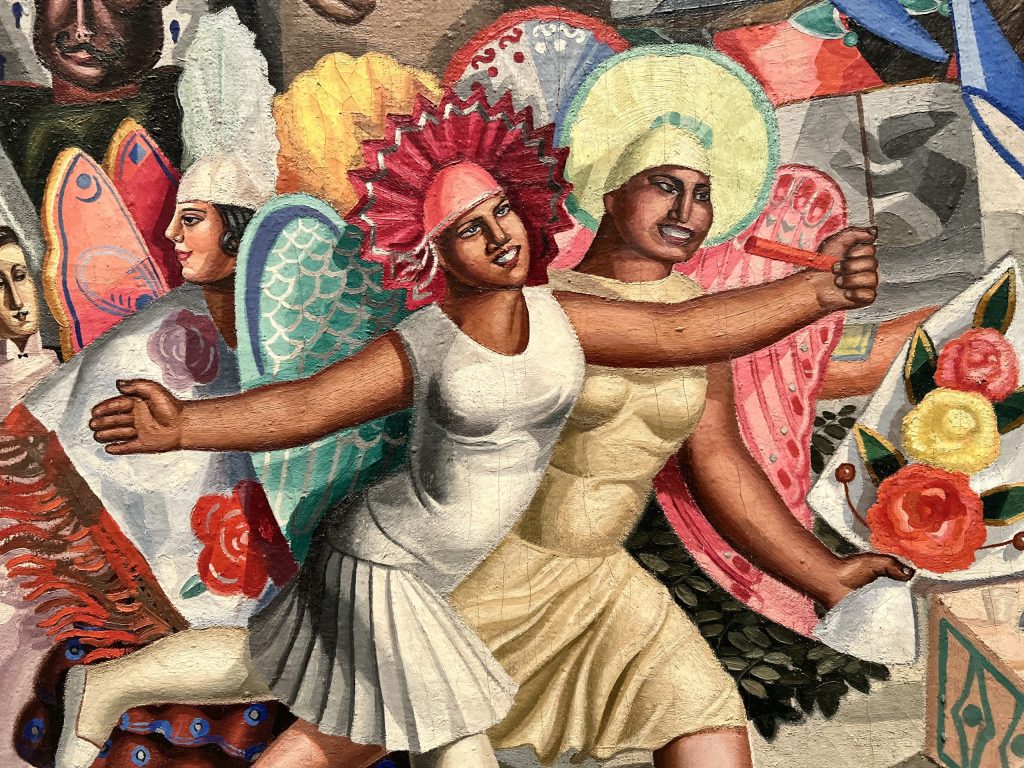
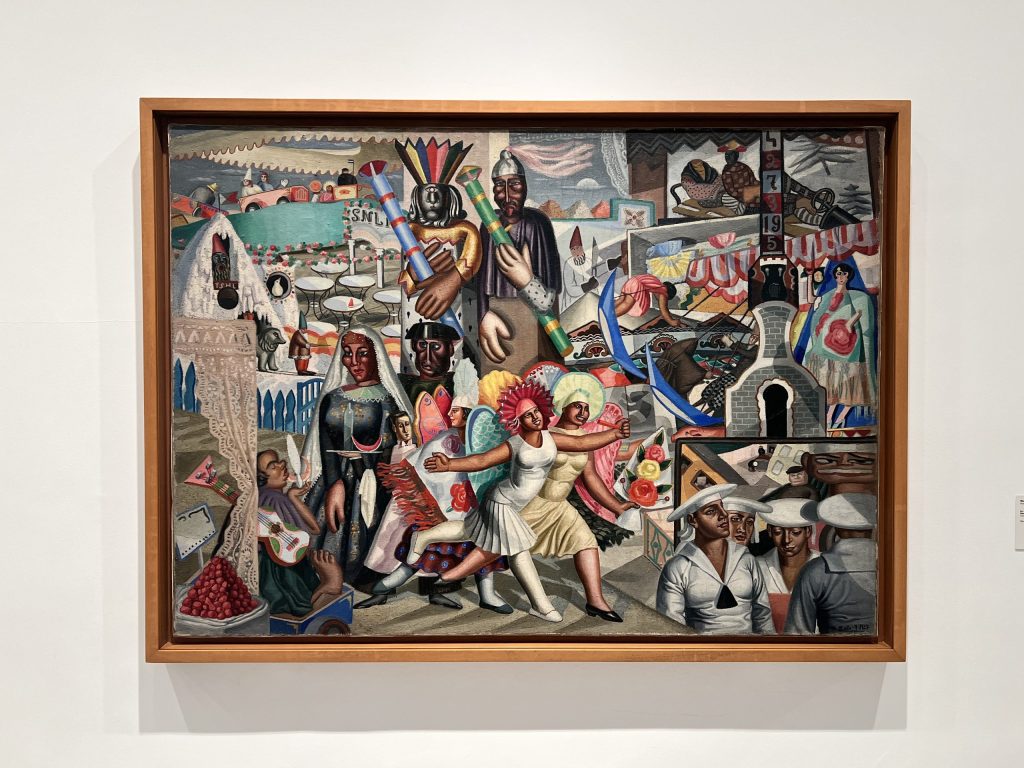
In 1927, Maruja Mallo painted one of the most recognisable works of her early career. La verbena transforms a popular Madrid celebration into an overflowing scene in which it is difficult to find a single place for the eye to rest. Human figures, fairground attractions, food, objects and decorative elements accumulate within a deliberately crowded composition.
The choice of subject was no coincidence. Verbenas were an important part of Madrid’s popular culture, bringing together people from very different social backgrounds in the same space. For a generation of artists interested in breaking down the distinction between so-called high culture and popular forms of expression, these celebrations offered an extraordinary field for experimentation.
A Composition Where Everything Seems to Move
One of the first sensations produced by La verbena is its lack of stillness. The painting is constructed through diagonals, curves and figures that seem to overlap one another. There is no single protagonist: the eye constantly moves across the canvas, searching for smaller scenes within the larger one.
Mallo uses this accumulation to represent something more complex than a celebration. Modern Madrid appears alongside traditional elements, fairground stalls and caricatured figures. Popular culture is not presented as a picturesque custom preserved unchanged from the past, but as a living reality that coexists with the transformation of the city.
Humour, Exaggeration and Criticism
But La verbena is not simply an innocent celebration. Among the crowd we find distorted figures, exaggerated faces and deliberately absurd situations. Humour allows the artist to observe social conventions from a certain distance and transform the festivities into a setting where the rules of everyday life appear to be temporarily suspended.
This aspect is particularly important for understanding the painting. At a verbena, tradition and modernity, solemnity and absurdity, celebration and satire can exist simultaneously. Mallo brings these contrasts together in a pictorial space where social hierarchies seem to disappear for a few hours.
Colour Before Darkness
The festive character of the painting is reinforced by an intense palette. Reds, yellows, greens and blues compete for our attention and contribute to the sensation of movement. Colour does more than describe objects: it establishes the visual rhythm of a composition that seems incapable of remaining still.
This is precisely why seeing Antro de fósiles afterwards is so surprising. Only three years separate the two paintings, yet the world of the verbenas has almost completely disappeared. The crowds, humour and intense colours give way to dark earth, skeletons and organic remains. To understand this transformation, we need to follow Mallo away from the festivities and into one of the most radical periods of her painting.
From Colour to Cloacas y campanarios: A Radical Change
Only three years separate La verbena from Antro de fósiles, yet the transformation in Maruja Mallo’s painting is enormous. By the end of the 1920s, the festive and colourful universe of her earlier works had begun to disappear. The artist turned her attention towards degraded landscapes, waste, skeletons, organic matter and abandoned objects.
This change coincided with her growing engagement with Surrealism and a period of experimentation that would lead to the series Cloacas y campanarios. In contrast to the bustle of the verbenas, Mallo became interested in what was normally excluded from artistic representation: the discarded, the eroded and what remains after destruction.
The Vallecas School and a Different Landscape
Her relationship with Alberto Sánchez and Benjamín Palencia, both associated with the so-called Vallecas School, played an important role in this process. Their excursions through the outskirts of Madrid revealed an image of the capital very different from the one depicted in La verbena. Instead of crowded streets and popular celebrations, we find wastelands, arid ground, stones and a natural world subjected to processes of erosion and decay.
These peripheral landscapes also offered the possibility of finding beauty in materials that the artistic tradition would hardly have considered worthy of attention. Bones, ashes, earth, fossils and waste could become protagonists. It was not simply a question of painting a different landscape, but of changing what could be considered artistic material.
Cloacas y campanarios
These explorations gave rise to Cloacas y campanarios, one of the fundamental series of her career. The title itself contains a significant opposition: sewers belong underground, associated with waste and everything the city seeks to conceal; bell towers, by contrast, rise above the landscape and are associated with an architecture deeply rooted in tradition.
Her painting consequently abandoned much of its earlier chromatic intensity. Browns, blacks, greys and earthy tones construct spaces inhabited by bones, skeletons and organic forms. The crowded life of 1927 has given way to its remains.
This change does not, however, represent a complete break with the artist who had painted the verbenas. In both cases, there is a determination to look towards spaces traditionally excluded from academic art. First came popular festivities and entertainment; later, wastelands and discarded materials. What changes radically is the way she represents them, and it is within this context that Antro de fósiles, the second work that interests us at the Reina Sofía, appeared in 1930.
Antro de fósiles (1930): The Other Side of La verbena
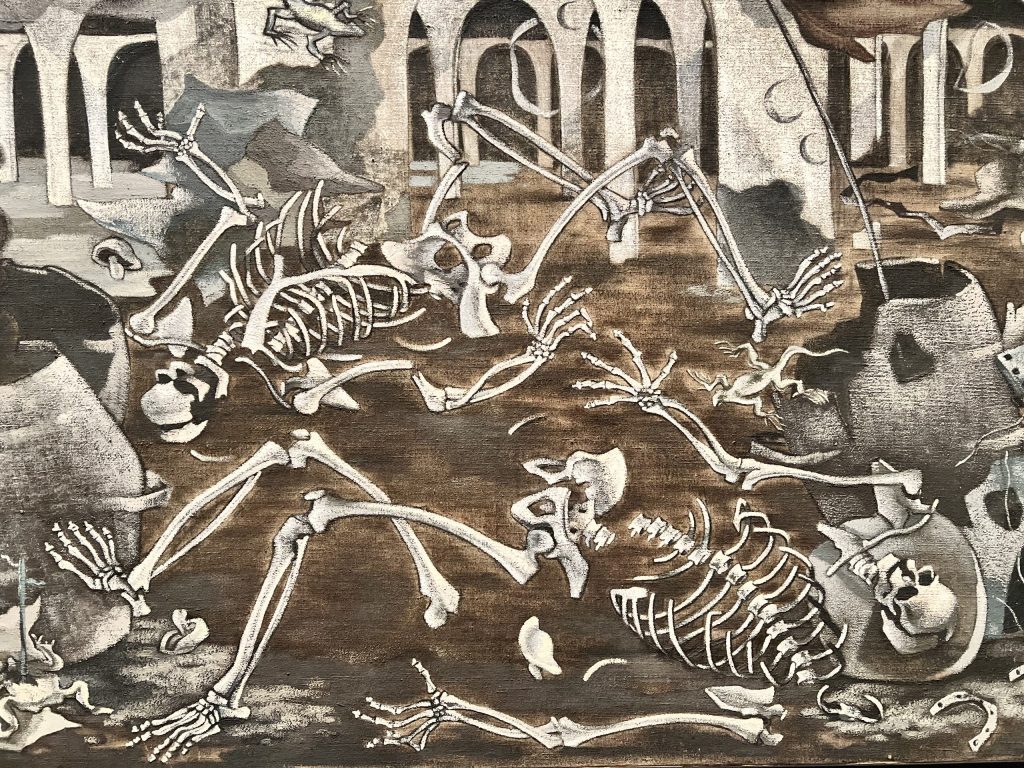
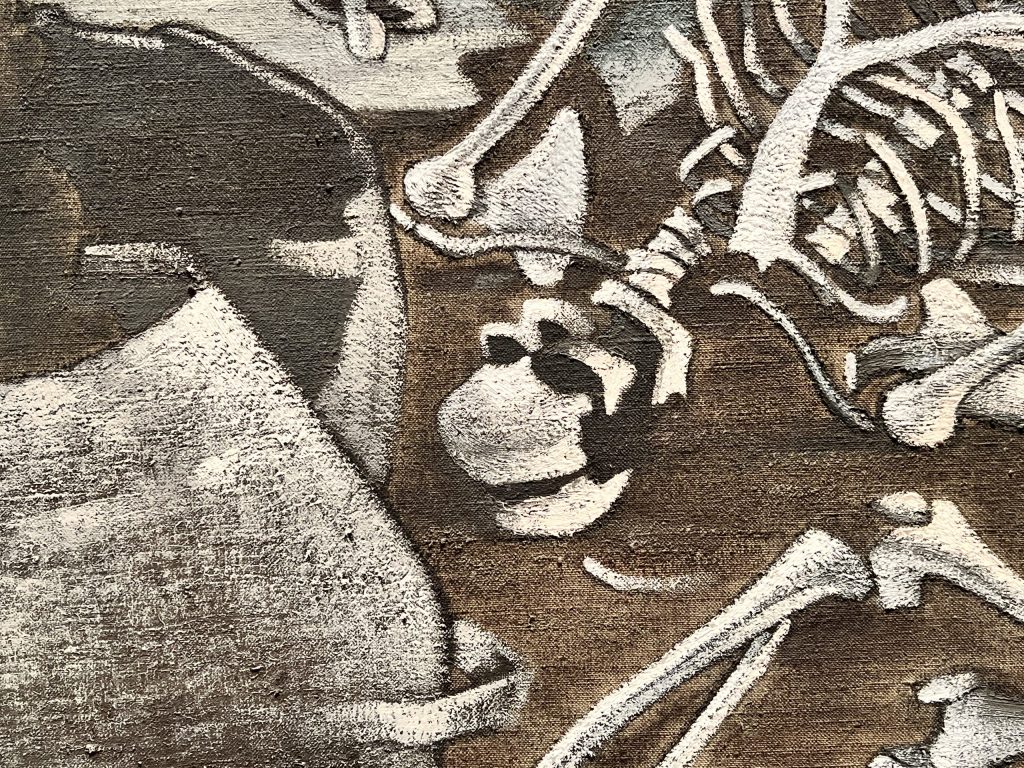
In Antro de fósiles, Maruja Mallo places us before a completely different scene from that of 1927. There are no longer crowds, attractions or caricatured figures. The space is occupied by skeletal structures and fossilised forms that seem to emerge from dark earth, while a limited range of browns, greys and blacks replaces the intense colours of La verbena. The transformation is even more striking when we remember that only three years separate the two paintings.
The work belongs to the universe of Cloacas y campanarios, where things that would normally be discarded take centre stage. Remains no longer appear as secondary elements within a landscape; they constitute the landscape itself. Mallo directs our attention towards matter after life and towards processes of erosion and decay, while avoiding a conventional narrative scene that explains what has happened.
Bones, Fossils and Matter
The title provides a first clue. A fossil is both a remnant and a trace: something that belonged to a vanished organism but whose form has remained imprinted in matter. This tension between disappearance and permanence runs throughout a painting in which it is difficult to establish a precise boundary between bone, stone and earth.
The absence of human figures reinforces this sensation. In contrast to the concentration of characters in La verbena, here human presence can only be sensed indirectly through a world of remains. The landscape seems to have been frozen after some process of destruction, and this ambiguity allows the objects to remain recognisable without forming a completely realistic scene.
A Painting Close to Surrealism
Mallo’s engagement with Surrealism did not simply consist of adopting strange imagery or depicting dreams. Her painting began to establish unexpected associations between objects and materials, turning everyday or discarded elements into the protagonists of unsettling spaces. In Antro de fósiles, the familiar thus loses part of its usual meaning.
This transformation also connects her work with the experiments of other European avant-garde artists interested in found objects, waste and natural forms. However, the dry landscape surrounding Madrid and her experiences associated with the Vallecas School gave these investigations a context of their own. The result is not an imitation of French Surrealism, but an interpretation connected to the territory Mallo was exploring.
From Celebration to Remains
Looking at La verbena and Antro de fósiles together reveals the scale of the transformation. In the first painting, accumulation comes from a society that seems to produce images without pause: people, stalls, objects, food and entertainment fill almost every available space. In the second, there is also accumulation, but what gathers before us are the remains of things that were once alive.
There is therefore continuity beneath the apparent rupture. Maruja Mallo remains interested in what she finds on the margins of academic culture, even though her gaze has shifted from popular celebration to abandoned materials. This ability to transform her visual language radically without losing her interest in the peripheral is one of the reasons these two works provide such a compelling introduction to her career at the Reina Sofía.
After Antro de fósiles: The Evolution of Maruja Mallo
The darkness of Cloacas y campanarios did not become a final destination either. During the 1930s, Maruja Mallo’s painting underwent another transformation, increasingly revealing an interest in geometric order, proportions and the structures found in nature. While Antro de fósiles focused on the remains of organisms and matter subjected to erosion, her later works gradually presented nature as something organised through rhythms and mathematical relationships.
This evolution is important because it prevents us from interpreting La verbena and Antro de fósiles as two opposite poles that summarise her entire career. They represent two remarkably different moments, but both belong to a career defined precisely by experimentation. Later series such as Naturalezas vivas present shells, flowers and other marine elements transformed into carefully ordered constructions, while works associated with Shells and Compass further develop this interest in natural forms and their underlying structures.
The Spanish Civil War and Exile
The Spanish Civil War violently interrupted this process. When the conflict began in 1936, Mallo was in Galicia and later managed to reach Portugal with the help of Gabriela Mistral. From there, she travelled to Buenos Aires in 1937, beginning a long period of exile that would keep her away from Spain for decades.
Argentina became one of the main settings of her career. There she continued to paint, gave lectures, published texts and remained connected to Latin American cultural circles. Exile therefore did not bring her artistic production to an end, although it did contribute to separating her from the narrative of the Spanish avant-garde that would develop during Franco’s dictatorship.
The Return to Spain
Mallo returned permanently to Spain in 1965. The country she returned to was very different from the Madrid where she had begun her career, and many members of the generation with whom she had shared those years had died, remained in exile or followed very different paths. Her name no longer occupied the position it had held within the cultural circles of the 1920s and 1930s.
Recognition gradually returned over the following decades. Today, her presence in public collections and the renewed attention given to artists associated with Las Sinsombrero have helped restore her place within the history of the Spanish avant-garde. The two paintings we have explored show precisely why her work is so difficult to reduce to a single label: between the celebration of 1927 and the landscape of remains of 1930 lies an extraordinary artistic transformation.
Explore Maruja Mallo at the Reina Sofía with The Guides You Need
La verbena and Antro de fósiles take on a different dimension when viewed as part of the Reina Sofía collection. There, we can connect them with other artists of the Spanish avant-garde and understand the context in which a generation profoundly transformed art during the first decades of the 20th century. At The Guides You Need, we believe a guided tour should help you make precisely these connections rather than simply accumulate names, dates and artistic movements.
🎟️ Admission to the Reina Sofía is included in the price.
⚡ We purchase tickets in advance to make your access to the museum easier.
👥 Small groups of no more than 6 people.
🗣️ Tours in English and Spanish, with French and Italian available on request.
🎨 Professional guides who place the artworks within their historical and artistic context.
If you want to understand how Maruja Mallo could move from the festive world of La verbena to the darkness of Antro de fósiles in just three years, join us at the Reina Sofía and explore some of the essential works of the Spanish avant-garde.