On 1 October 1541, a painter who would become one of the most distinctive figures in art history was born in Candia, present-day Heraklion. His name was Doménikos Theotokópoulos, although centuries later few people would need to pronounce it to know who we are talking about: the world would come to know him simply as El Greco.
His life was also a journey between cultures. Born in Crete and initially trained in the tradition of Byzantine icons, he left the island to experience Italian painting first-hand. Venice and Rome transformed his understanding of colour, composition and the human figure. Then came Spain and, finally, Toledo: the city where he would develop much of his career and forge his unmistakable language of elongated bodies, otherworldly light and scenes charged with spiritual intensity.
But the story of El Greco is not simply the story of an extraordinary style. It is also that of an ambitious, cultivated artist who was deeply conscious of the intellectual value of his profession; a foreign painter who sought opportunities in some of the great cities of his time, aspired to work for Philip II, and ultimately found in Toledo something far more enduring than royal favour.
Today, on the anniversary of his birth, we trace his biography from Crete to Toledo to understand how Doménikos Theotokópoulos became El Greco and why, more than four centuries after his death, his paintings remain so difficult to mistake for those of any other artist.
In this article
1. Crete: before El Greco, there was Doménikos Theotokópoulos
When Doménikos Theotokópoulos was born in Candia in 1541, Crete was not part of the Greek world as we understand it today. The island was under the rule of the Republic of Venice, which had controlled it for centuries. This situation made Crete a remarkable meeting point between East and West, where the Byzantine artistic tradition coexisted with influences from the Italian Renaissance.
It was in this environment that the future painter began his training. Before encountering the work of Titian, Tintoretto or Michelangelo, Doménikos learned his craft within the late Byzantine tradition of icon painting. We should not imagine, therefore, a young apprentice leaving Crete to begin studying painting in Italy. By the time he embarked on that journey, he was already a professional: in 1563 he was documented as a master painter, and three years later he requested an appraisal of an icon of the Passion that he intended to sell by lottery.
Very few works from this early period have survived, but they are essential for understanding his origins. Among them is the Dormition of the Virgin, dated to around 1565–1566 and preserved in Ermoupoli, on the Greek island of Syros. The work still displays a visual language closely connected to icon painting, although the artist was already familiar with some of the conventions of the Italian Renaissance, which circulated in Crete through engravings and other sources.
This combination helps us understand something important about his artistic development. Doménikos never simply replaced one style with another. His painting accumulated experiences: first Crete, then Venice and Rome and, finally, Toledo. Even after mastering Western perspective, anatomy and oil painting, elements of his earliest artistic education continued to shape the way he conceived images.
In 1567, he left Crete for Venice. He was around twenty-five years old, with a craft already mastered and a career already under way. What he would encounter on the other side of the Mediterranean would profoundly transform his painting.
2. Venice: learning to paint with colour
Arriving in Venice around 1567 meant entering one of Europe’s great artistic centres. For a painter trained in Crete, moreover, the city was not entirely unfamiliar: the island belonged to the Republic of Venice, and commercial and cultural connections between the two territories were constant. Yet seeing the paintings of the city’s great masters first-hand must have offered Doménikos an experience very different from anything he could have gained through prints and imported works.
The Venetian tradition gave colour an extraordinary prominence. In contrast to the Florentine and Roman emphasis on drawing, painters such as Titian, Tintoretto and Veronese constructed forms through colour, light and an increasingly free handling of the brush. Doménikos gradually absorbed this language and began to work fully within the Western tradition of oil painting.
The influence of Titian was particularly important. The master had pushed the expressive possibilities of colour and brushwork to a level that would influence entire generations of European artists. We do not know for certain whether Doménikos worked directly in his workshop, as was long claimed, but his familiarity with Titian’s painting is evident in the Cretan artist’s development. Tintoretto, with his dramatic perspectives, elongated figures and compositions filled with movement, also offered solutions that would later find a clear echo in his work.
A good example of this transformation is Christ Healing the Blind, a subject the painter explored several times during his Italian years. These compositions already feature spaces constructed through perspective, classical architecture, groups of figures receding into depth and an interest in movement that would have been foreign to his earliest Cretan icons.
But Venice did not erase Crete. This is precisely one of the keys to understanding his development. Doménikos learned the tools of Western Renaissance painting without completely abandoning a visual education based on religious images conceived to transcend everyday reality. The combination was still far from reaching its definitive form, but some of the tensions that would later characterise his painting had already begun to emerge.
Around 1570, he decided to continue his journey to Rome. If Venice had taught him the possibilities of colour, there he would have to confront another tradition: that of Raphael and, above all, the enormous shadow of Michelangelo.
3. Rome: El Greco versus Michelangelo
In 1570, Doménikos Theotokópoulos arrived in Rome, a city very different from Venice. While there he had discovered a type of painting built around colour and light, Rome was dominated by a tradition that placed enormous importance on drawing, anatomy and the monumentality of the human figure. And above all the artists of the recent past loomed one name: Michelangelo, who had died only six years earlier.
Doménikos quickly managed to enter some of the city’s cultural circles. He was welcomed into the Palazzo Farnese, where he came into contact with the circle of Cardinal Alessandro Farnese and intellectuals such as the librarian Fulvio Orsini. In 1572, he also joined the Accademia di San Luca, the professional association of Roman painters. The former Cretan icon master was now attempting to establish himself in one of Europe’s most competitive artistic markets.
Rome allowed him to study the works of Michelangelo and Raphael first-hand, but his response to them was not that of an obedient disciple. El Greco admired Michelangelo’s extraordinary abilities as a draughtsman and sculptor, although he was far more critical of his painting. Decades later, the painter and writer Giulio Mancini would even record a famous story according to which Doménikos had claimed that, if The Last Judgement in the Sistine Chapel were destroyed, he could replace it with a work just as large and more appropriate. The anecdote was written down years later and should therefore be treated with caution, but it contributed to the image of an artist remarkably confident in his own ideas.
Beyond such stories, his Italian paintings show that Rome left a profound mark on him. His figures became more monumental, the human body acquired greater prominence and his compositions grew increasingly complex. Yet Doménikos continued to defend something he had learned in Venice: colour could be just as important as drawing. This combination of different traditions would eventually prove fundamental to the development of his personal artistic language.
Even so, Rome did not provide the great opportunity he was looking for. Competition was fierce, and Doménikos remained a foreign painter trying to make a name for himself among numerous Italian artists. Around 1576–1577, he decided to leave Italy and pursue his career in a territory where artistic projects of enormous scale were under way.
His next destination would be Spain. El Escorial was being built, and Philip II needed painters to decorate the great project of his reign. For an ambitious artist still searching for a major patron, the Spanish court may have seemed exactly the opportunity he had been waiting for.
4. Spain: the opportunity of Philip II
Around 1577, Doménikos Theotokópoulos arrived in Spain. We do not know exactly why he decided to leave Italy, but the timing was particularly attractive for a painter seeking major commissions. Philip II was deeply involved in the construction and decoration of the monastery of El Escorial, one of the most ambitious artistic projects in sixteenth-century Europe, and needed artists capable of working for the monarchy.
However, Doménikos’s first major stage in Spain was not the royal court, but Toledo. There, almost immediately after his arrival, he secured two important commissions. For the convent of Santo Domingo el Antiguo, he produced a major group of paintings that included The Trinity, while Toledo Cathedral commissioned The Disrobing of Christ. Within only a few years, the painter who had recently arrived from Italy was already working for two of the city’s most important religious institutions.
The opportunity to approach Philip II eventually came. The king commissioned The Martyrdom of Saint Maurice and the Theban Legion, intended for one of the altars of the basilica at El Escorial. For Doménikos, this was an exceptional opportunity: gaining the king’s approval could open the door to further commissions from the Spanish court.
The outcome, however, was not what he had hoped for. The painting was completed around 1582, but Philip II decided not to place it in the location for which it had been intended. This has often been interpreted as evidence that the king simply ‘did not understand’ El Greco’s painting, although the reality is more interesting. The problem appears to have been related to the way the artist organised the narrative. Rather than making the martyrdom the immediate visual focus of the scene, he placed Saint Maurice’s conversation with his companions in the foreground, while the execution itself was pushed into the background.
In an image intended for an altar, the clarity of the religious message was of fundamental importance. Philip II could appreciate a painting while still considering that it did not adequately fulfil the function for which it had been commissioned. In fact, the king paid for the work and kept it at El Escorial, but commissioned another version of the subject from the Italian painter Romulo Cincinnato to occupy the altar.
That episode had important consequences. Doménikos would not develop the stable career in the service of the monarchy that he may have imagined when he arrived in Spain. Yet what might appear to have been a failure ultimately redirected his career towards somewhere else.
While the doors of the royal court were closing, Toledo was already offering him clients, commissions and a place where he could build a career of his own. The city that had initially been a stop in his search for opportunities would become his home for the rest of his life.
5. Toledo: the place where Doménikos became El Greco
If Crete gave him his earliest training and Italy transformed his painting, Toledo was the city where Doménikos Theotokópoulos definitively built his career. He arrived in 1577 and remained closely connected to the city until his death in 1614. After realising that the court of Philip II would not provide the position he had hoped for, he found something perhaps even more important in the former Castilian capital: a clientele capable of supporting an independent workshop for decades. The Church in Toledo became his main patron, although he also worked for private clients and institutions throughout the city.
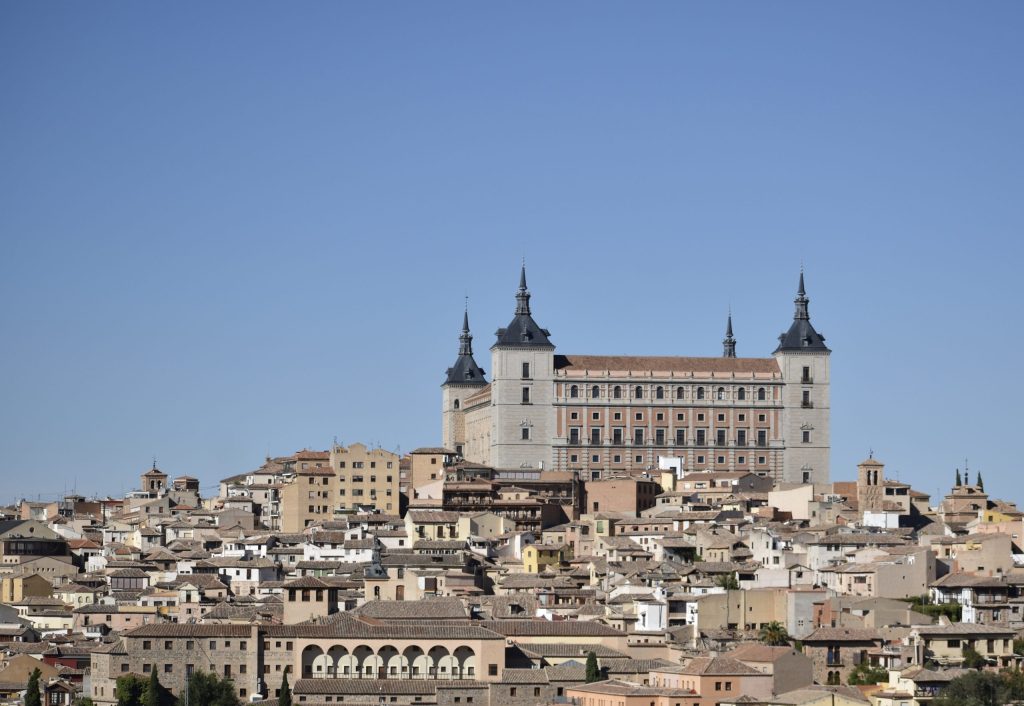
Toledo was also particularly attractive to a cultivated artist. It remained one of the principal religious centres of the Spanish Monarchy and maintained a vibrant intellectual life. Doménikos associated with figures such as Antonio de Covarrubias, a humanist and jurist whom he portrayed and with whom he maintained a friendship. A Greek-language edition of the works of Xenophon, which had belonged to Covarrubias and later became part of the painter’s library, still provides a small but fascinating testimony to that intellectual circle.
It was also in Toledo that his family life developed. In 1578, his only known son, Jorge Manuel Theotokópoulos, was born from his relationship with Jerónima de las Cuevas. Jorge Manuel would eventually follow in his father’s footsteps as a painter and architect and became involved in the family workshop, particularly during the final years of Doménikos’s life.
From 1585, the artist rented several rooms in houses belonging to the Marquis of Villena, located in Toledo’s Jewish Quarter. It is worth clarifying here one of the most persistent misconceptions surrounding his biography: today’s El Greco Museum is not exactly the house in which the painter lived. At the beginning of the twentieth century, the Marquis of Vega-Inclán acquired buildings close to the actual site of the Villena houses and created a reconstruction of what a Toledan home of the painter’s period might have looked like.
During these years, Doménikos gradually ceased to be a foreign artist searching for an opportunity and became a recognisable figure in Toledan society. His workshop received increasingly important commissions, while his painting fully developed the characteristics we now associate with his name: elongated figures, spaces that are difficult to measure, intense contrasts of light and a use of colour that no longer needed to reproduce the visible world faithfully.
The relationship between the painter and the city would become so profound that it is difficult to think of one without immediately recalling the other. Yet this identification was also constructed retrospectively. During the nineteenth and twentieth centuries, an image emerged of El Greco as the quintessential interpreter of supposed ‘Spanish mysticism’ and the Castilian spirit. This historical interpretation became enormously influential, but it can obscure a far more interesting reality: the man who made Toledo his home had been born in Crete, trained between two artistic traditions and spent approximately a decade in Italy before ever setting foot in Spain.
And it was precisely in Toledo, in 1586, that he received the commission for the work that would become one of the most celebrated images of his entire career: The Burial of the Count of Orgaz.
6. The Burial of the Count of Orgaz: a masterpiece is born
In 1586, when Doménikos received the commission to paint The Burial of the Count of Orgaz for the Church of Santo Tomé in Toledo, he had been living in Spain for almost a decade. He was no longer the recent arrival trying to establish himself between Toledo and the court of Philip II. He had clients, an active workshop and an increasingly recognisable artistic language. The new commission gave him the opportunity to bring all of this together in a monumental painting.
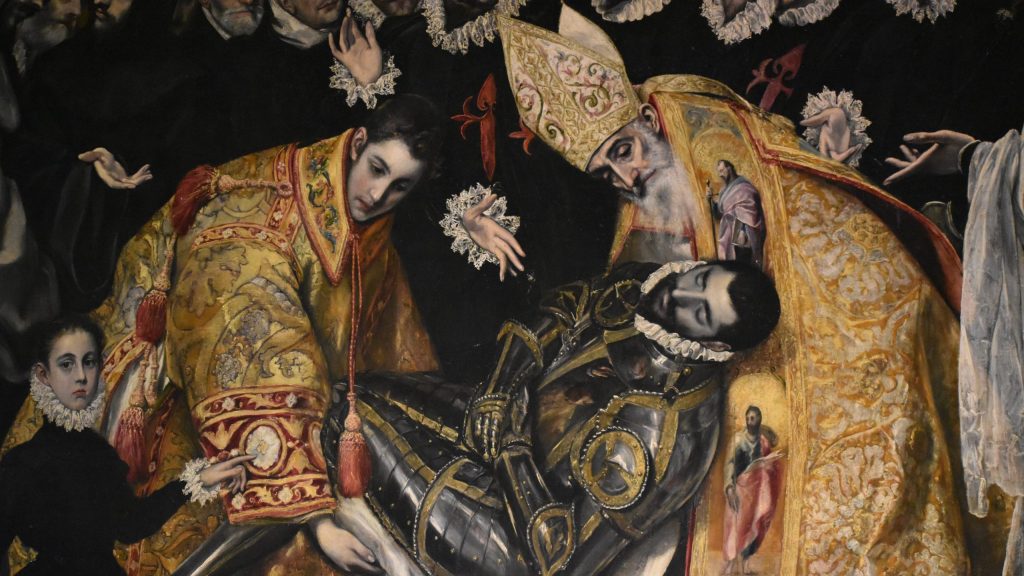
The work commemorated an event that, according to tradition, had taken place more than two centuries earlier. Gonzalo Ruiz de Toledo, Lord of Orgaz and a benefactor of Santo Tomé, had died in 1323. According to legend, during his burial, Saint Stephen and Saint Augustine miraculously descended from heaven to place his body in the tomb, in recognition of his pious life and his donations to the Church.
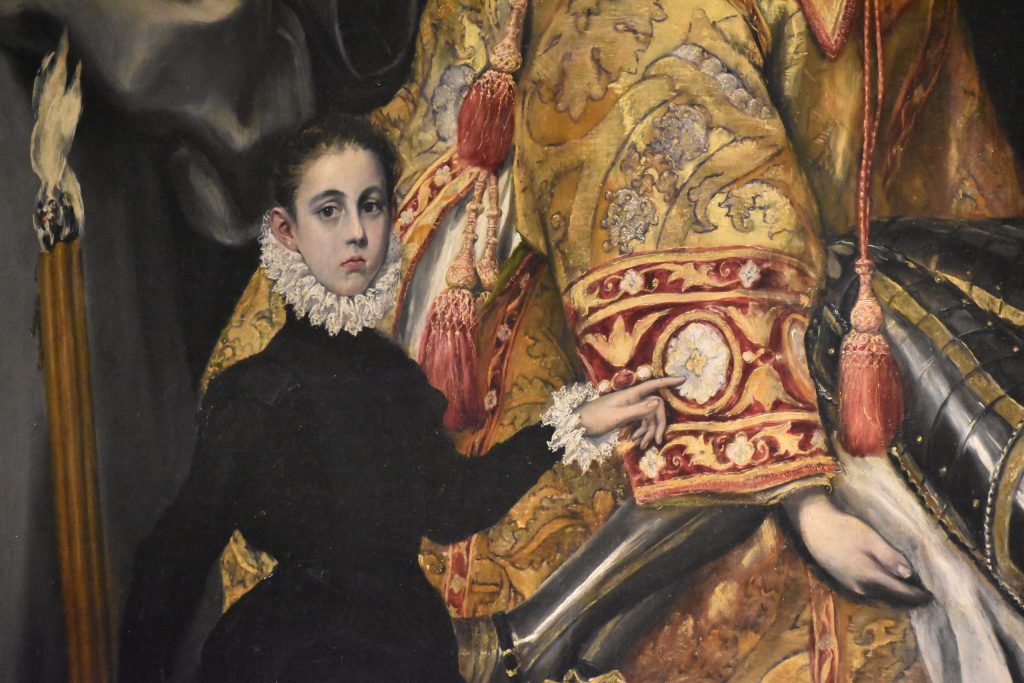
Doménikos transformed this medieval story into a strikingly contemporary scene. In the lower half, the miracle takes place before a group of men dressed according to sixteenth-century fashion. We are not simply looking at figures from a distant past: among them are members of Toledan society whom the painter knew. He even included his own son, Jorge Manuel, who looks towards the viewer and points to the event. On the handkerchief emerging from his pocket, a date can be read: 1578, the year of his birth.
Above this earthly world, an entirely different realm opens up. The solid and recognisable figures below give way to a heaven in which bodies become elongated, space loses its stability, and clouds, light and colour construct a reality that no longer attempts to behave like our own. The soul of the Lord of Orgaz, represented as a small figure, rises towards Christ through this celestial space.
The two halves allow us to understand much of the painter’s journey within a single image. The richness of the colour reflects his Venetian experience; the monumentality of the figures reveals the lessons he learned in Italy; while the separation between the material world and a spiritual reality that does not need to obey the same visual rules reminds us that Doménikos’s training had begun much earlier, before the icons of Crete.
But The Burial of the Count of Orgaz also demonstrates just how completely the painter had found his place in Toledo. The city appears not merely as a setting, but through its inhabitants, institutions, beliefs and social networks. The foreigner who had arrived from the eastern Mediterranean was now capable of portraying Toledan society itself witnessing one of its miracles.
Completed around 1588, the painting remained in Santo Tomé, where it can still be seen today. Doménikos was only in his forties and still had more than two decades of work ahead of him. Yet many of the characteristics that would define our image of El Greco were already fully developed.
Among them, one is particularly striking: those bodies that seem to stretch upwards until they acquire almost impossible proportions. Why did El Greco paint such elongated figures?
7. Why did El Greco paint such elongated figures?
Few characteristics make a painting by El Greco as instantly recognisable as his elongated figures. Small heads, slender hands and bodies that seem to stretch vertically appear again and again in his works, particularly during his mature period. For a long time, an astonishingly simple explanation was proposed for this peculiarity: the painter saw the world in a distorted way.
In the early twentieth century, the hypothesis that Doménikos suffered from astigmatism became popular, suggesting that this condition caused him to perceive figures as more elongated than they actually were. The theory is appealing, but it presents an obvious problem: a visual impairment alone would not explain why these distortions appear deliberately and vary according to the needs of each composition. Moreover, if an artist saw both the model and the canvas through the same visual distortion, it would not necessarily be transferred to the finished work.
The explanation, therefore, should be sought in painting rather than ophthalmology. In Italy, Doménikos had encountered Mannerism, an artistic tendency that had begun to move away from the balance and ideal proportions characteristic of much Renaissance art. Artists such as Parmigianino, Pontormo and Tintoretto had demonstrated that the human body could be deliberately stylised, twisted or elongated to heighten the elegance, movement or expressive intensity of an image.
The painter pushed these possibilities much further during his years in Toledo. His figures did not need to reproduce the anatomy of a real body exactly because many of them belonged to scenes that sought to represent precisely what lies beyond the everyday world. Saints, apostles and celestial figures stretch upwards, while spaces lose their depth and light appears without an identifiable natural source.
Nor did this elongation remain constant throughout his career. If we compare his early Italian paintings with works from his final decades, we can see how this transformation became progressively more intense. In paintings such as The Opening of the Fifth Seal, produced towards the end of his life, the bodies have acquired extraordinary proportions, while colour, movement and anatomy seem to respond above all to the expressive needs of the scene.
It is therefore more interesting to understand these distortions as an artistic decision. El Greco knew the conventions of representing the human body that he had studied during his years in Italy and, precisely because he knew them, he could alter them. He did not paint this way because he was incapable of depicting a proportionate body, but because he had reached a point where natural proportion was no longer always what he needed to construct an image.
That freedom also helps explain why, centuries later, some modern artists saw something surprisingly familiar in his painting. What had appeared strange or incorrect to certain viewers in other periods would eventually become one of the fundamental reasons behind his rediscovery.
8. A painter who wanted to be treated as an artist, not a craftsman
Doménikos Theotokópoulos not only had very clear ideas about what a painting should be. He also had strong views about what it meant to be a painter. During the Renaissance, Italy had witnessed a profound transformation in the social status of artists: figures such as Leonardo, Raphael, Titian and Michelangelo had helped establish painting as an intellectual activity rather than simply a manual craft. After approximately a decade in Italy, Doménikos made this idea his own.
This had very practical consequences during his life in Toledo. Artistic contracts of the period established the characteristics of a work, and appraisers could subsequently be called upon to determine its value. The painter had several financial disagreements with his clients because he defended valuations of his work considerably higher than those they were prepared to accept. Some of these disputes even ended up in court.
One of the earliest examples involved The Disrobing of Christ. After completing the painting for Toledo Cathedral, the difference between the valuations proposed by the two sides led to a prolonged disagreement over how much he should be paid. Something similar would happen years later with The Burial of the Count of Orgaz. Financial disputes thus accompanied some of the commissions that we now consider fundamental to his career.
Reducing these disputes to a simple question of money, however, would prevent us from understanding an important aspect of his artistic personality. For Doménikos, debating the price of a painting also meant debating the value of the knowledge required to create it. Drawing, composing, studying nature, mastering colour and constructing an image were activities that demanded intellectual ability. The painter did not want his work to be valued solely according to the cost of its materials or the hours required to produce it.
His library allows us to understand this side of him even better. At the time of his death, he owned books in Greek, Italian and Spanish, including works related to art, architecture, literature and classical thought. Copies of Giorgio Vasari’s Lives and Vitruvius’s treatise on architecture containing numerous annotations by the painter himself have also survived. In their margins, he challenged the ideas of other authors and recorded his own opinions on painting and architecture.
This image is quite different from the Romantic stereotype of an isolated artist who painted solely under the influence of an almost mystical inspiration. El Greco was also a professional who ran a workshop, negotiated contracts, disputed prices, read artistic theory and reflected on his profession.
This conception of painting would become particularly important during his final decades. Doménikos no longer needed to pursue recognition at court: from Toledo, he had built a workshop capable of undertaking major commissions and had developed an increasingly free and personal way of painting.
9. El Greco’s final years
At the beginning of the seventeenth century, Doménikos Theotokópoulos had been living in Toledo for more than twenty years. By then, he was an established painter, ran his own workshop and was capable of undertaking projects that went far beyond the production of a single painting. Major religious commissions required him to design complete altarpieces, coordinate paintings, sculptures and architectural elements, and work with numerous collaborators. During this final period, his son Jorge Manuel played an increasingly important role alongside him.
One of the most important projects was undertaken for the Hospital de la Caridad in Illescas, beginning in 1603. Doménikos designed the altarpiece and produced paintings including The Annunciation, The Nativity and The Virgin of Charity. The commission demonstrates the extent to which his activity encompassed different disciplines: he did not necessarily conceive of paintings as isolated objects, but as parts of larger ensembles in which architecture, sculpture and image were intended to interact.
During these years, he also developed some of his most characteristic series: the Apostolados, sets depicting Christ and his apostles individually. Settings and narrative elements almost completely disappear from these works. The figures emerge from dark backgrounds, while their faces, hands and colour concentrate all the intensity of the image. The result shows just how far the simplification of his artistic language had progressed during his mature years.
Toledo continued to occupy an extraordinary place in his work. In View and Plan of Toledo, produced during his final years, the city appears alongside a young man holding an urban plan. But Doménikos was not attempting to produce a photographic reproduction — long before photography existed, of course — of the landscape. He even altered the position of certain buildings to construct the image he needed. Once again, the real city was subordinated to the painter’s artistic decisions.
His artistic freedom is even more evident in some of his final works. In The Opening of the Fifth Seal, the figures seem almost to dematerialise through disproportionate bodies, visible brushstrokes and intense colours. Seen centuries later, the painting can appear strikingly modern, but it was the result of a process that had begun much earlier: from the icons of Crete to the experimentation of his final years in Toledo.
Doménikos continued working almost until the end of his life. In 1614, he fell ill while working on a commission for the Hospital de Tavera. He died in Toledo on 7 April, aged 72, and was initially buried in the convent of Santo Domingo el Antiguo, the same place for which he had produced some of his first major works after arriving in Spain.
His death brought to an end a career spanning more than half a century and an extraordinary journey across the Mediterranean: Crete, Venice, Rome and Toledo. Yet the story of El Greco was far from over. His reputation would change dramatically over the centuries that followed. Some of the very characteristics that would eventually make him one of the most admired painters in art history were precisely those that, for a long time, made his work appear strange, excessive or even incorrect.
10. From an extravagant painter to a master of modernity
The death of Doménikos Theotokópoulos in 1614 did not mean that his name immediately disappeared. His workshop continued for a time under the direction of Jorge Manuel, while his paintings remained in churches, convents and collections. Artistic tastes, however, were changing. Alongside the naturalism and new forms of the Baroque, those elongated figures, unreal colours and unstable spaces became increasingly difficult to understand.
During the eighteenth century, his critical reputation was particularly poor. Antonio Palomino, although acknowledging his extraordinary skill, considered that in his final period he had pushed his style towards extravagance. Later, Antonio Ponz used even harsher terms to describe some of his works. The freedom we admire today could then be interpreted as a departure from the rules that a good painter was expected to respect.
The change began during the nineteenth century. Romanticism found new reasons to take an interest in an artist who was so difficult to classify, while his association with Toledo helped to construct an almost legendary image of the painter. Travellers, writers and artists began to look again at works that had been regarded as strange for generations. Gradually, what had once been considered a flaw became precisely one of his greatest attractions.
The process acquired a new dimension around 1900. In 1902, the Museo del Prado organised the first monographic exhibition devoted to El Greco, a fundamental event in his modern rediscovery. Shortly afterwards, in 1908, Manuel Bartolomé Cossío published an extensive monograph on the artist. The former Cretan painter was beginning to occupy a central place in the construction of a new history of Spanish painting.
But something even more interesting happened: new generations of artists did not simply admire him as an Old Master. They saw in his distortions, his chromatic freedom and his ability to alter reality tools that could be used to construct a new kind of art. His paintings began to engage with concerns that now belonged to the twentieth century.
Pablo Picasso was one of the most important examples. During his youth, he studied the Cretan painter’s work and found in it solutions that could challenge the conventions of academic representation. The connection is particularly suggestive when considering Les Demoiselles d’Avignon and The Opening of the Fifth Seal: this does not mean that one work was simply a copy of the other, but rather that Picasso could find in a painter who had died almost three centuries earlier a radically free way of transforming the human body. That search would eventually become part of the path towards Cubism, one of the great artistic ruptures of the twentieth century.
There is a certain irony in this story. For generations, El Greco had been criticised precisely for what modern artists would later admire: distorting, simplifying, exaggerating and placing the needs of painting above the exact reproduction of reality. What had once seemed like a mistake eventually came to be understood as freedom.
Perhaps that is why his biography is so difficult to confine within a single label. He was an icon painter born in Crete, an artist trained in Venice and Rome, a foreigner who sought the favour of Philip II and a master who ultimately built his career in Toledo. But he was also a sixteenth-century painter whose work found some of its most enthusiastic interlocutors three hundred years later.
Doménikos Theotokópoulos was born on 1 October 1541. More than four centuries later, we still call him by the nickname that permanently recalled where he came from: El Greco.
Discover El Greco with TGYN 🎨
El Greco’s story crossed half the Mediterranean before finally finding its home. He was born in Crete, learned from Venetian painting, sought new opportunities in Rome and arrived in Spain with his sights set on some of the great artistic projects of Philip II’s reign. But it was Toledo that ultimately became his home.
Exploring Toledo still allows us to follow the traces of that story today. Its churches, streets and buildings form part of the same urban landscape in which Doménikos Theotokópoulos lived, worked and ran his workshop for decades. And in Santo Tomé, The Burial of the Count of Orgaz remains in the place for which it was created, offering an extraordinary opportunity to understand not only his painting, but also his relationship with the Toledan society that welcomed him.
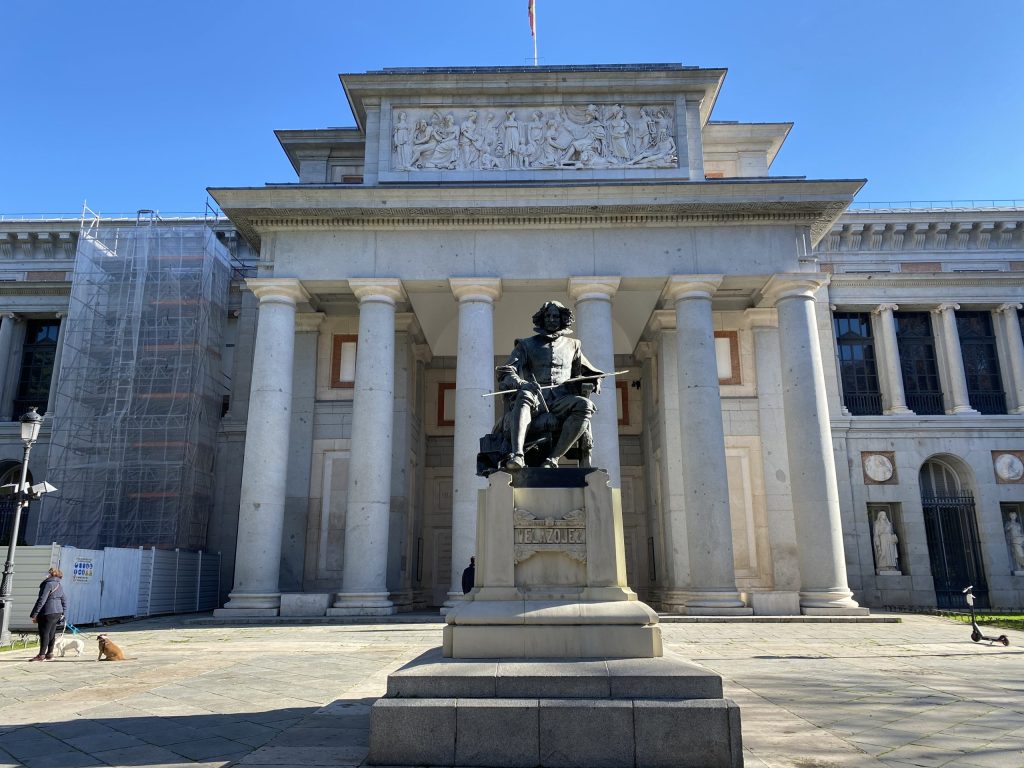
But the journey can also continue in Madrid. The Museo del Prado houses an extraordinary collection of his paintings, ranging from works connected to his early years in Spain to portraits and religious compositions that reveal the evolution of his artistic language.
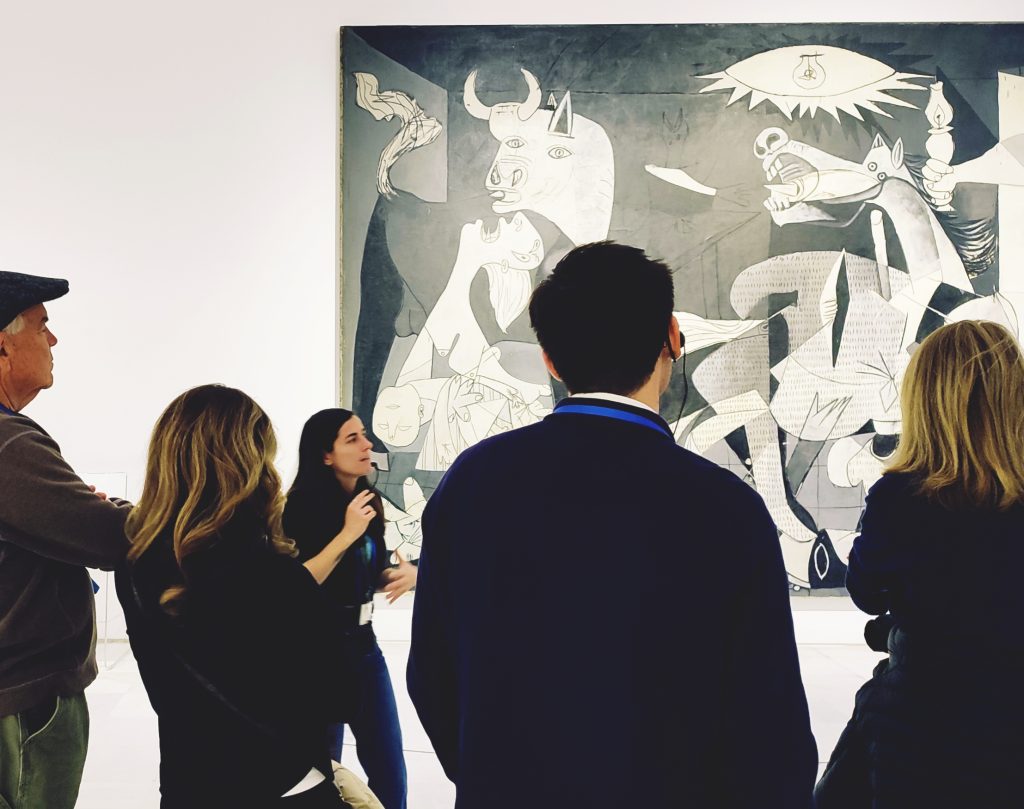
At TGYN, we believe that understanding a work of art also means understanding the stories, decisions and people behind it. That is why our guided tours of Toledo and the Museo del Prado offer the opportunity to explore El Greco within the historical and artistic context that shaped his remarkable career.
🖼️ Crete, Venice, Rome, Toledo and Madrid. More than four centuries later, El Greco’s journey continues.