Synthetic Cubism emerged around 1912 as a new stage in an artistic transformation that had begun only a few years earlier. Picasso and Braque had pushed the fragmentation of forms to remarkable extremes during Analytical Cubism, but that process raised new questions: was it necessary to fragment objects so extensively in order to break with traditional representation? Could an image be constructed using fewer elements?
The answer changed the rules of the game once again. Forms became simpler and more recognisable, colour regained prominence, and materials taken from everyday life began to physically enter artworks through collage. The experiments of Picasso and Braque were joined by artists such as Juan Gris and María Blanchard, who developed this new language through their own distinctive approaches.
This new phase did not, therefore, mean abandoning the principles of Cubism, but rather exploring the possibilities opened up by its first revolution. Through three key ideas and six specific works, we will see how these artists reconstructed objects, brought reality into the picture and restored colour to a fundamental role.
In this article
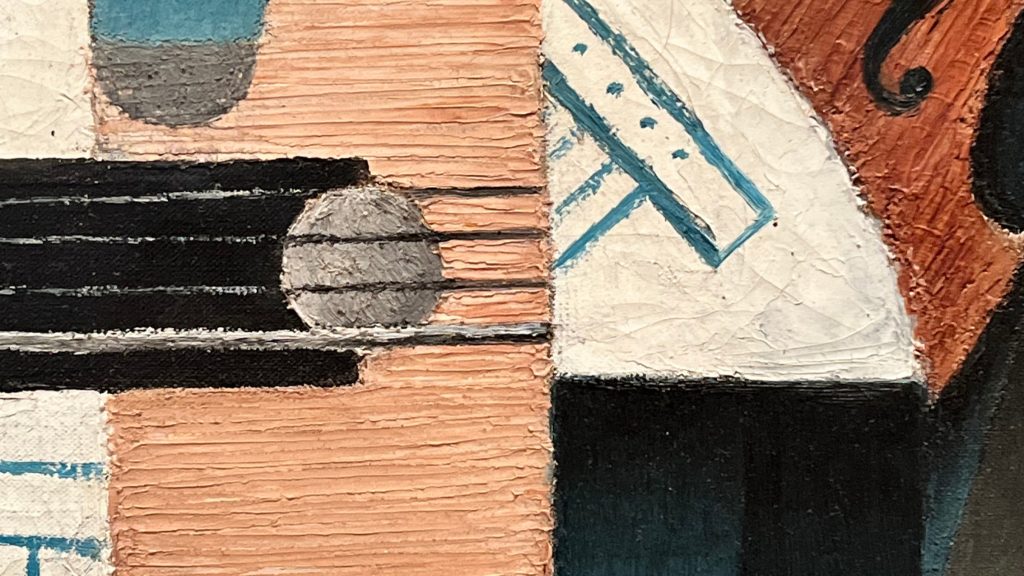
1. Simplifying to Reconstruct Reality
After several years of pushing the fragmentation of forms further and further, Cubist artists began to move in the opposite direction. Analytical Cubism had broken objects down into numerous planes and multiplied the points of view from which they could be observed. Around 1912, another possibility began to emerge: reconstructing those objects through broader, simpler and more recognisable forms.
This transformation helps us understand the term “synthetic” itself. Whereas artists had previously analysed an object visually in order to break it down, they could now select some of its essential features and use them to construct a new image. A curve could suggest a guitar; a few lines, a table; a circle, the rim of a glass. Painting continued to reject naturalistic representation, but fragmentation no longer needed to make its subjects almost unrecognisable.
Juan Gris: Guitar on a Table
A good example can be found in Guitar on a Table, created by Juan Gris in 1913 and now held at the Reina Sofía Museum. The guitar, one of the recurring objects in the Cubist vocabulary, is not reproduced as we would see it before our eyes. Gris selects some of its characteristic elements and integrates them into a structure dominated by lines, curves and geometric surfaces.
What is particularly interesting is that the object remains recognisable. We do not need to find a perfectly drawn guitar to understand that it is there: certain visual signs are enough for us to reconstruct it mentally. The work thus makes the viewer part of the process. Gris provides the essential pieces, and our gaze completes the connections between them.
María Blanchard: Woman with a Guitar
In Woman with a Guitar, from 1917, María Blanchard approaches a similar problem through the human figure. Woman and instrument are articulated through large geometric planes that overlap and relate to one another, yet both subjects remain identifiable. Geometrisation has not disappeared; what has changed is the way it is used.
The example is particularly interesting because it shows that this process of reconstruction was not limited to still lifes. The human body could also be reduced to a selection of forms capable of suggesting a figure without returning to the modelling, volume or perspective of traditional painting. Blanchard thus preserves much of the Cubist rupture while making the image more legible.
The works of Gris and Blanchard reveal two possibilities within the same approach. It was no longer simply a matter of taking reality as a starting point and breaking it down, but of constructing an image using the elements necessary for the viewer to recognise it. Synthesis did not undo the previous revolution: it proposed another way of continuing it.
2. Collage: When Reality Enters the Picture
The second major transformation affected even the materials from which an artwork could be constructed. Printed papers, newspapers, labels and fragments taken from everyday objects began to be incorporated directly into compositions. Collage thus introduced something entirely new: reality no longer had simply to be represented; it could also physically enter the picture.
The difference is fundamental. An artist could paint the letters of a newspaper, imitate the grain of wood or reproduce the label on a bottle. Now, a printed fragment could be pasted directly onto the surface and turned into part of the image. This created a constant interplay between what a material actually was and what it represented within the composition.
Juan Gris: The Bottle of Anís
The Bottle of Anís, created by Juan Gris in 1914 and now held at the Reina Sofía, is an excellent example. Gris combines oil, graphite and collage, incorporating different printed materials. Among them is the Anís del Mono label, which immediately identifies one of the objects represented.
The label performs two functions simultaneously. Before our eyes, it remains a real fragment of paper produced outside the artwork, but within the composition it becomes part of the bottle. Gris no longer needs to paint everything he wants to represent in detail: he can introduce one of its most recognisable signs and allow our gaze to reconstruct the rest.
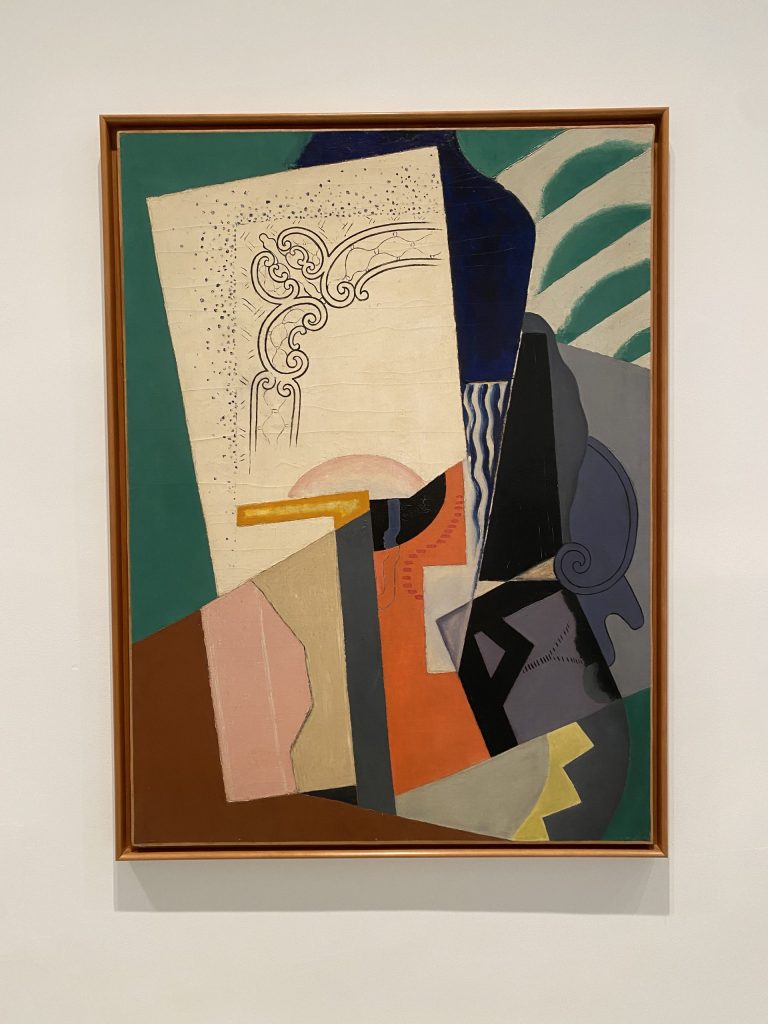
María Blanchard: Cubist Composition
María Blanchard also experimented with these possibilities. In Cubist Composition, created between 1916 and 1919 and also held at the Reina Sofía , she combines oil and collage on canvas. The incorporated materials do not appear as independent or merely decorative elements; instead, they participate in the construction of forms and the organisation of the pictorial surface.
The work shows how thoroughly this technique could be integrated into an artist’s individual language. Blanchard uses the added fragments alongside geometric planes and painted areas, making it difficult to establish an absolute boundary between what is represented and what materially belongs to the outside world. Collage ceases to be a surprising addition to the picture and becomes one of the means through which the picture itself is constructed.
This innovation had consequences that extended far beyond Synthetic Cubism. By incorporating everyday objects and materials, these artists questioned a distinction that had seemed self-evident for centuries: the difference between a thing and its representation. A picture could still depict a bottle, a table or any other object, but it could now also contain small fragments of the very reality it sought to represent.
3. The Return of Colour
The third key becomes clear when we compare these works with those produced only a few years earlier: colour regained prominence. During the analytical phase, Picasso and Braque had deliberately restricted their palettes to ochres, greys and browns. This austerity allowed them to focus attention on the fragmentation of objects and the structure of the numerous planes that made up the image.
The new way of constructing objects made a different relationship with colour possible. Surfaces were now broader and more clearly defined, allowing them to be distinguished through chromatic contrasts. A colour did not have to correspond to the actual appearance of an object either: it could organise the composition, separate planes or help us recognise a particular form.
María Blanchard: Woman with a Fan
In Woman with a Fan, painted by María Blanchard in 1916, colour actively participates in the construction of the figure. Blues, greens, ochres and other tones are distributed across the different planes that form the woman and the space around her. It is not simply a matter of adding colour to a pre-existing geometric structure: the chromatic differences themselves help to organise it.
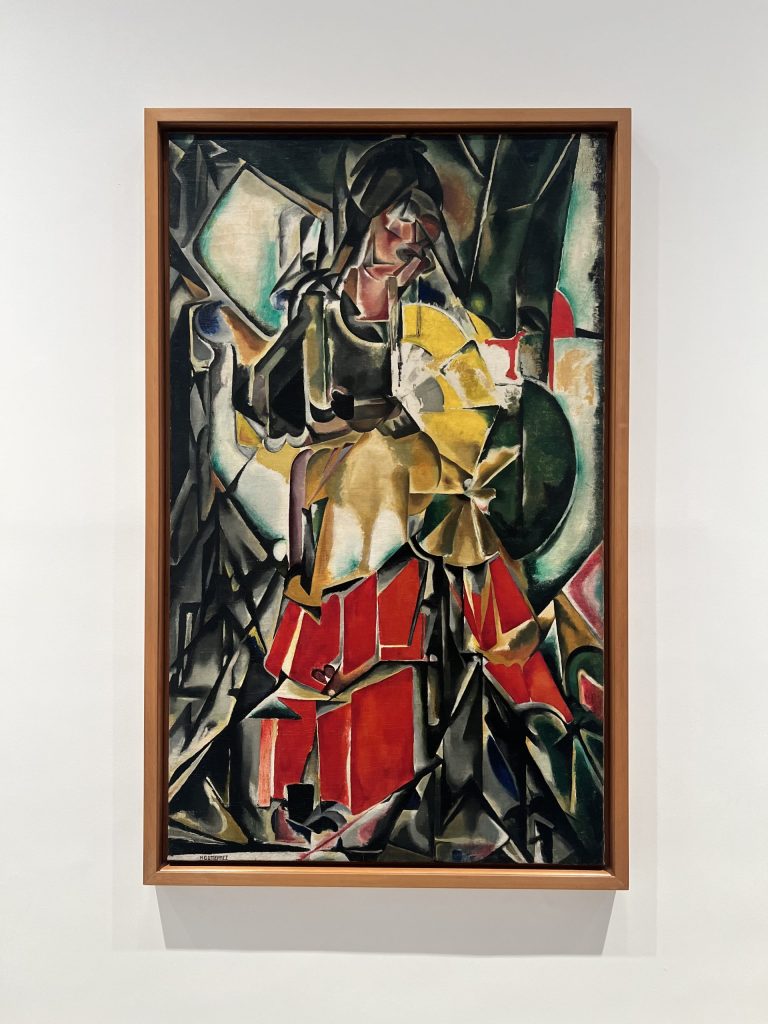
The result shows just how important a structural function colour could acquire. Different tones separate one surface from another and help our gaze reconstruct the figure from them. Blanchard retains Cubist geometrisation while combining it with a chromatic richness far removed from the austerity that characterised much of the previous phase.
Juan Gris: Woman with a Mandolin, after Corot
This relationship between form and colour was also fundamental to the painting of Juan Gris. In Woman with a Mandolin, after Corot, from 1916, Gris takes a composition by Jean-Baptiste-Camille Corot and subjects it to his own pictorial language. The figure, the instrument and the surrounding space are reorganised through broad geometric surfaces in which colour helps establish relationships between the different parts of the image.
This example is particularly interesting because Gris never abandoned colour in the same way Picasso and Braque had during their analytical years. In his work, geometric construction and chromatic relationships could develop together. Colour therefore ceased to be an attribute that had to correspond to the external appearance of things and became one of the tools used to construct them.
This return to colour did not mean going back to painting as it had existed before Cubism. Quite the opposite: once the obligation to imitate reality through naturalistic perspective, volume and colour had been broken, colour itself could become independent. It no longer necessarily had to tell us what things looked like, but could help the artist decide how they could exist within the picture.
What Is the Difference Between Synthetic and Analytical Cubism?
The fundamental difference between the two phases lies in the way the image is constructed. Analytical Cubism starts with the object and breaks it down: it fragments its forms, combines different points of view and restricts colour in order to focus on analysing its structure. The later phase largely reverses this process. It selects simpler forms and combines them until the object becomes recognisable again.
The change can be summarised through two verbs: to analyse and to synthesise. In the first phase, a guitar could be broken down into numerous small planes; in the second, just a few curves and surfaces could be enough to construct it. This shift was accompanied by the return of colour and the introduction of collage, which made it possible to incorporate real materials into compositions.
However, we should not understand them as two completely independent movements. Synthetic Cubism emerged from the problems and discoveries of the previous phase and maintained its rejection of traditional perspective and of the need to faithfully imitate the appearance of things. What changed were the solutions. After learning how to visually dismantle reality, these artists began to ask how they could build it again.
What Are the 3 Types of Cubism?
Although it is common to speak of three types of Cubism, this classification should be understood more as a way of explaining the movement’s evolution than as an entirely fixed division. A first stage, usually known as Cézannian Cubism or Proto-Cubism, is generally followed by the analytical and synthetic phases.
The first developed approximately between 1907 and 1909 and reveals the importance of Paul Cézanne in the early experiments of Picasso and Braque. Figures and landscapes began to be reduced to geometric structures, while traditional perspective gradually lost its unity. This marked the beginning of a transformation that had not yet reached the fragmentation characteristic of the following years.
From around 1909, the analytical phase developed, breaking objects down into numerous planes and presenting them from different points of view. Around 1912, the synthetic phase began, characterised by reconstruction through simpler forms, the return of colour and the introduction of collage.
These dates are approximate, and the three stages should not be imagined as perfectly separate compartments. The transformations were gradual, and different approaches coexisted at certain moments. Rather than three distinct movements, they allow us to observe how the same artistic problem changed rapidly in the space of just a few years.
What Are the 5 Main Characteristics of Cubism?
As we already discussed in our introductory article on Cubism, this movement profoundly transformed the way objects, figures and spaces were represented. Five of its main characteristics can be highlighted: the geometrisation of forms, the rejection of traditional perspective, the simultaneous representation of different points of view, the gradual move away from naturalistic imitation, and experimentation with new materials and techniques.
However, these characteristics did not remain unchanged. The importance of each one shifted as the movement evolved. Fragmentation and multiple perspectives became particularly complex during the analytical phase, while the simplification of forms, colour and collage later gained greater prominence.
For this reason, identifying five characteristics can help us recognise the movement’s general principles, but it cannot explain its entire evolution. In this article, we have seen precisely how some of those principles changed in just a few years, giving rise to a new way of constructing images without returning to traditional representation.
Explore Cubism in Madrid’s Museums
Understanding these changes on paper is one thing; standing in front of the works themselves is another. The Reina Sofía offers the opportunity to explore major figures such as Juan Gris, María Blanchard and Pablo Picasso, while the Thyssen-Bornemisza Museum also holds important examples that broaden our understanding of the movement and its international development.
At The Guides You Need, we offer guided tours of both museums in small groups. Our aim is not simply to identify artists and artworks, but to understand why these images broke with centuries of tradition and how their experiments transformed the history of art.
🎟️ Museum admission included in the price of the tour.
⚡ We purchase tickets in advance to make access to the museum easier.
👥 Small groups for a more personal experience.
🗣️ Tours available in several languages.
🎨 Professional guides specialising in art and history.
❤️ A tour designed to observe the artworks, ask questions and understand the ideas behind them.